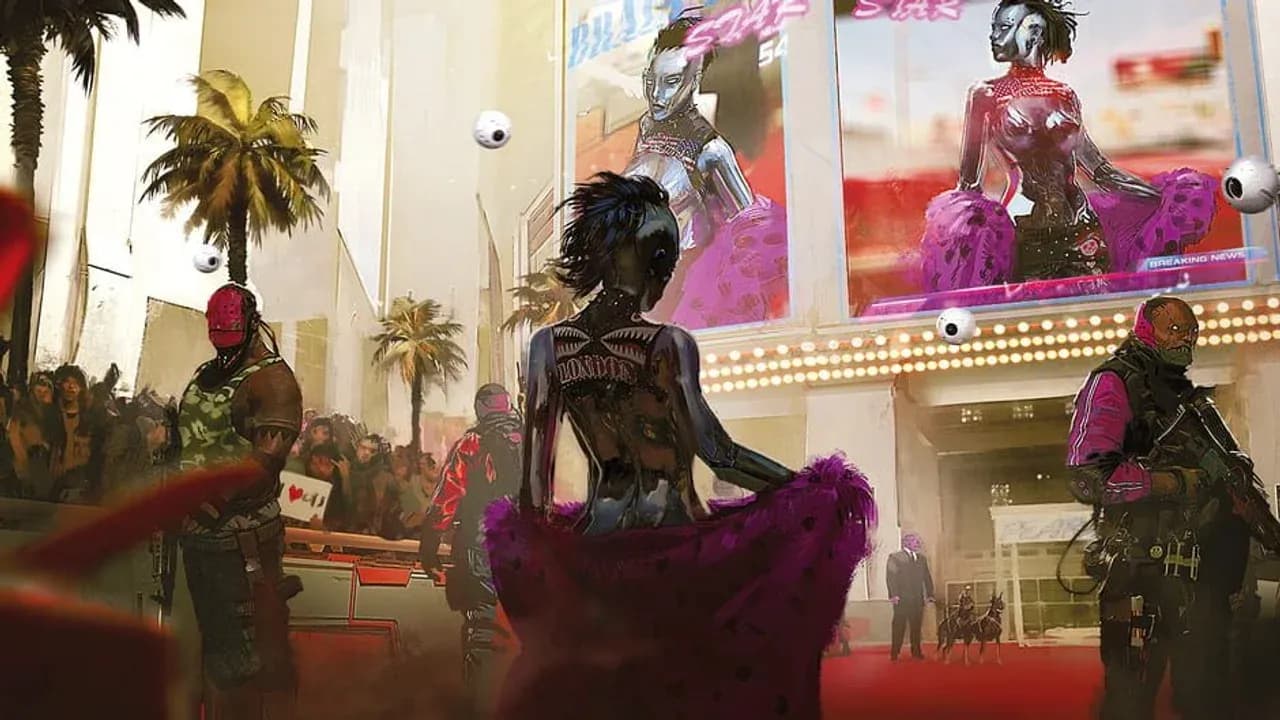
Santo Domingo makes the cost of abandonment visible. Arroyo keeps factories and power infrastructure running beside junkyards and unfinished construction, while Rancho Coronado houses the workers those sites depend on. 6th Street occupies the space between them: a gang that presents armed control as neighborhood protection.
Its flags, military clothing, and 1776-style patriotism are more than faction decoration. They are the gang’s argument for legitimacy. In Santo Domingo, the question is not whether 6th Street can enforce order; it is who gets to define order once corporations and the NCPD leave residents to manage the consequences.
Arroyo Makes Santo Domingo’s Labor Visible
Santo Domingo avoided serious damage in the Fourth Corporate War, then became a provisional camp for displaced residents. In 2077, corporations use the district as an industrial testing ground, building, abandoning, and replacing factories while the surrounding neighborhoods absorb the disruption.
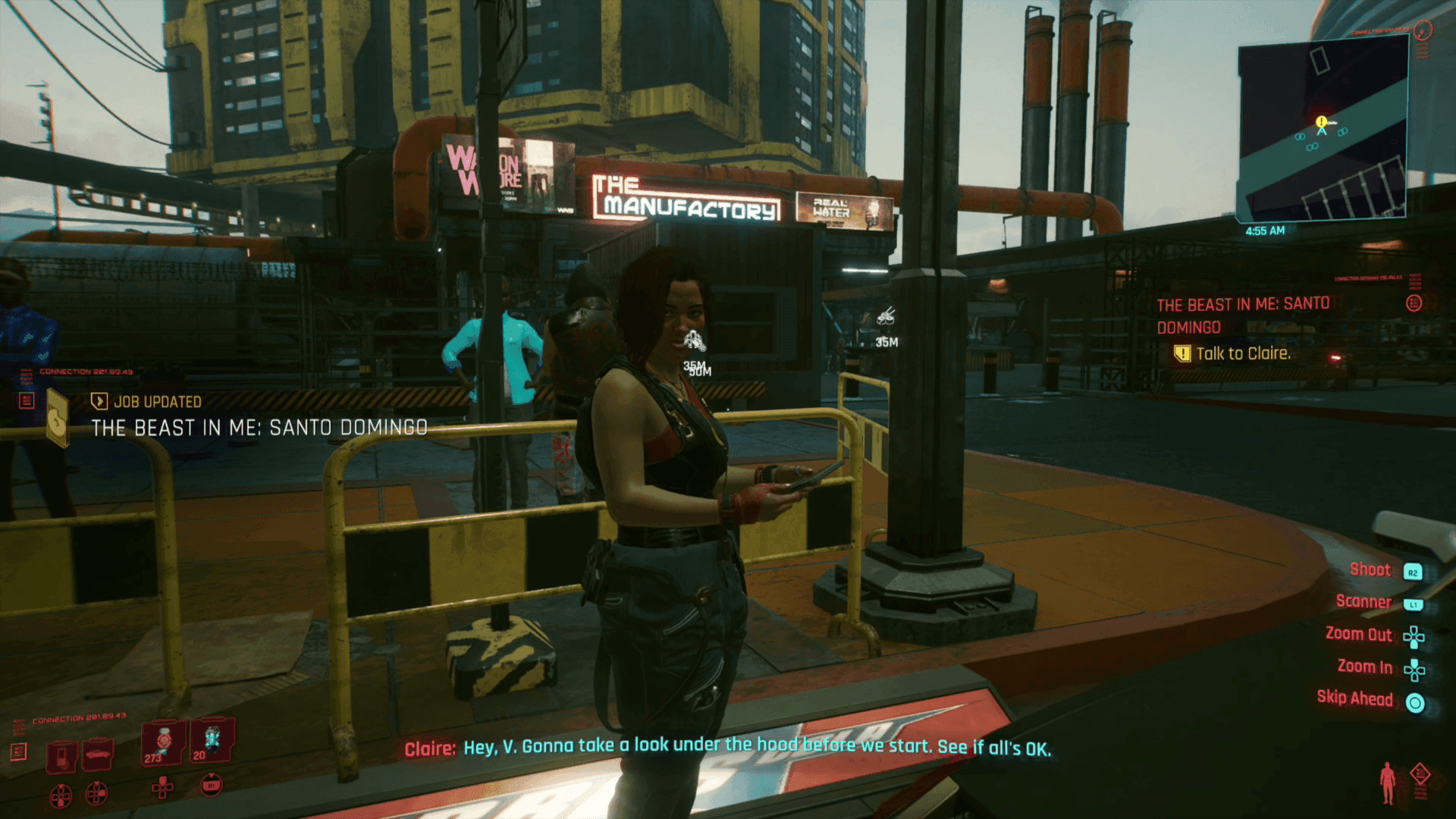
Arroyo’s factories and race route show Santo Domingo’s industrial side.
Arroyo is the material evidence. Its old power plants, junkyards, logistics sites, and active factories sit beside unfinished structures, so the skyline never looks settled. The operational corporate sites have their own security. The abandoned warehouses and heavy-equipment yards are the spaces 6th Street can claim.
Rancho Coronado is the district’s social answer to that industrial system. Its identical houses were designed as worker housing close to Arroyo’s factories, a self-contained version of the American dream built around a commute that never leaves Santo Domingo. Arroyo shows what the district produces; Rancho Coronado shows who is expected to keep producing it.
6th Street Turns Protection Into a Brand
6th Street’s origin story is simple: veterans and civilians wanted to protect neighborhoods the NCPD and corporations had left exposed. The gang is profiled at 2,300 members in 2077 and holds much of Santo Domingo, especially Arroyo. Its members still describe themselves as the force willing to enforce order, but the gang’s methods include extortion, smuggling, and self-appointed justice.
The visual language makes that claim portable. Military surplus, patriotic murals, stars and stripes, and arguments about individual rights turn a local security force into a national myth. Their 1776-themed identity presents Santo Domingo as a community that must defend itself; the weapons and territory show what that defense costs.
6th Street therefore wants more than money or status. It wants recognition as a legitimate authority. That ambition explains why the gang can look like a neighborhood association in one scene and a private army in the next: both images support the same claim to rule.
Stadium Love Turns the Brand Into a Party
Stadium Love puts that claim in a playable setting. After completing Playing for Time, you can find the side job at a party in Rancho Coronado. This is a neighborhood gathering in the housing district built for Santo Domingo’s workers, not a military checkpoint or a warehouse raid.
Keep your weapon holstered and the gang lets you enter its shooting competition. Drink before each round, use the revolver provided by the hosts, and move between four timed stations. The competing score is 43; hit 44 targets to win the iconic Divided We Stand assault rifle.
The threshold is useful because it makes the scene’s boundary concrete. 6th Street’s hospitality has rules, a weapon, and an enforcement mechanism. You are welcome as long as you perform the role of a guest. Treat the party as hostile, and the community image gives way to the violence that protects it.
Visit Arroyo for Industry, Rancho Coronado for Control
Start in Arroyo when you want to see the district’s economic reality: factories, power infrastructure, scrapyards, and construction gaps arranged around restricted corporate sites. The contrast between guarded production and gang-held leftovers explains why 6th Street has room to present itself as necessary.
Then move to Rancho Coronado for the social version of that claim. The repeated houses make the worker settlement feel planned, but Stadium Love shows who controls the plan. The party is open, the contest is voluntary, and the boundary is still enforced at gunpoint.
That sequence gives the district its shape. Arroyo shows the work; Rancho Coronado shows the authority built around it. The two subdistricts are where Santo Domingo’s 6th Street story stops being a faction description and becomes a neighborhood you can read.