Path of Exile 2 Combat: A Deliberate Reinvention of the ARPG
Path of Exile 2 begins with an argument: the action RPG does not need to become faster to become more satisfying. Where Path of Exile 1 often reduced combat to movement, cooldown management, and watching entire screens evaporate, Path of Exile 2 makes each attack feel like an action with physical consequences. Axes land with weight, spells carry a sharper sense of impact, and the accompanying sound effects give even basic abilities a tactile punch. The result is a slower combat rhythm that initially feels almost austere by ARPG standards—but it earns that restraint by making positioning and timing matter again.
The new animation system makes every strike feel more impactful in Path of Exile 2.
The new dodge roll is the foundation of this reinvention. It has no cooldown, so it is always available, but using it effectively still requires judgment: rolling through a visible attack cone is useful, while panic-rolling into another area-of-effect attack simply delays the inevitable. Enemy attacks are generally telegraphed clearly enough to create a readable exchange of threat and response, particularly in larger encounters where the player must watch for sweeping strikes, projectiles, and ground hazards rather than rely purely on damage output. This is a major improvement over Path of Exile 1’s most extreme screen-clearing moments, where defensive decision-making could disappear beneath speed and particle effects.
Path of Exile 2’s combat succeeds because it makes survival feel like something the player does, not merely something the build calculates.
That design also changes the emotional texture of ordinary fights. A Warrior does not simply charge into a pack and trade health for damage; the player must consider spacing, attack timing, and when to disengage. A Mercenary can switch between ammunition types to freeze enemies with ice shots before using fragmentation shots to detonate them, turning crowd control into a deliberate sequence rather than a single damage rotation. Once the underlying systems click, the game can still produce the extravagant power fantasy expected from the genre—rapid clears and elaborate ability combinations remain possible—but the path to that power feels more active than in Path of Exile 1. The power is satisfying precisely because the player has had to earn control of the battlefield first.
Movement is equally important, and Path of Exile 2’s support for both traditional click-to-move and WASD movement gives the combat system an unusual degree of flexibility. Click-to-move remains familiar for veterans, but WASD is transformative when paired with the Mercenary’s crossbow: aiming, strafing, and switching ammunition makes the class feel like a tactical top-down shooter rather than a conventional loot-driven spellcaster. The same control scheme also improves the Monk, whose hit-and-run style benefits from directly steering around enemies instead of relying on destination clicks. This is more than a controller preference or accessibility option; it changes how players read space, maintain distance, and commit to attacks.
The game also gives weapon specialization more agency than constant manual micromanagement would allow. Skills can automatically use the weapon associated with them, letting a character move between weapon-linked abilities without forcing the player to stop and perform a swap every time the situation changes. That distinction matters because it preserves tactical choice without turning combat into inventory administration: a player can build around distinct weapon identities while maintaining a coherent flow of attacks. Path of Exile 2 understands that meaningful decisions should happen during combat, not in the friction between two menu inputs.
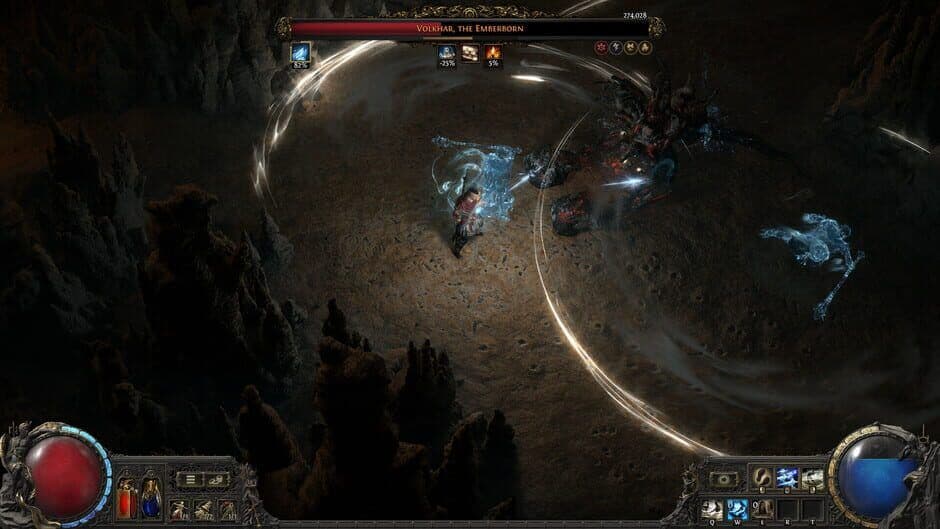
However, the system’s greatest weakness is also visible in its most ambitious encounters: combat readability. Player effects, boss attacks, and summoned mobs can overlap into a storm of color and motion, occasionally obscuring the character and hiding the very telegraphs the dodge-roll system depends on. The problem is especially damaging when a boss attack is technically signaled but visually buried beneath a spell effect or a crowd of enemies; a death in that moment feels less like a failure of timing than a failure of visual communication. This does not invalidate the deliberate combat design, but it exposes a seam between intention and execution.
Path of Exile 2 therefore succeeds at the difficult part of its combat overhaul: it makes the genre’s familiar power fantasy feel physical, deliberate, and earned without abandoning build-driven spectacle. Its dodge roll, flexible movement, and weapon-linked skills create a stronger foundation than Path of Exile 1’s most frantic combat ever had. The visual clutter needs sharper discipline, but the central reinvention is sound. This is a sequel that remembers an ARPG should not only make numbers go up—it should make every swing, spell, and escape feel like the player’s decision.
Path of Exile 2 Bosses and Difficulty: Rewarding Mastery or Unfair Friction?
Path of Exile 2’s bosses are where its slower combat philosophy proves it has teeth. The Early Access build contains roughly 50 major bosses—or more than 100 unique encounters if optional and side-bosses are counted—and the best of them feel less like loot piñatas than compact examinations of player knowledge. Each phase introduces new positioning demands, attack patterns, or hazards, forcing you to understand the encounter rather than simply overwhelm it with damage. This is the moment the game earns your trust: a victory feels authored by your decisions, not merely by a sufficiently inflated damage number.
Mastering boss mechanics is central to the Path of Exile 2 experience.
Tor Gul the Defiler, Zalmarath the Colossus, and Blackjaw demonstrate how effective that structure can be. Their fights reward studying the rhythm of attacks, identifying safe positioning, and recognizing when a phase change alters the rules of the arena. Telegraphed attacks give you a fair opportunity to respond, but “fair” does not mean forgiving; several boss abilities can kill a character outright if you stand in the wrong place or fail to react. The result sits closer to Soulslike trial-and-error than Diablo’s more accessible progression, yet Path of Exile 2 preserves the ARPG satisfaction of returning with a stronger build and seeing the same encounter collapse under better preparation.
Path of Exile 2’s finest bosses do not ask whether your character is powerful enough; they ask whether you have actually learned what the boss is doing.
That standard becomes much harder to defend when ordinary enemies interfere with the fight. Almost every monster type can push the player, regardless of size, and swarms can chain those impacts together as enemies shove both you and one another across the battlefield. A single misstep can therefore become a sudden death without the clean cause-and-effect of a missed boss telegraph: you are cornered, displaced, and unable to regain control while the pack closes in. The checkpoint system compounds the irritation because respawning often means clearing previously defeated enemies again, turning a failed attempt into a death loop rather than a useful lesson. Path of Exile 2 wants crowd control to make positioning matter, but universal knockback makes some encounters feel physically hostile in a way that skill alone cannot reliably solve.
Enemy modifiers create a similar distinction between demanding design and needless friction. Siphoning Mana is the clearest offender: it severely restricts spellcasting, and the affected enemy can move at the player’s pace, making disengagement difficult for a spellcaster whose entire defensive plan depends on maintaining distance and resources. That modifier does not merely ask the player to change tactics; it can invalidate the basic rhythm of a build while the enemy continues applying pressure. Elemental switches and area effects that reduce resistances are more successful because they encourage adaptation through gear, charms, or skill selection, whereas mana suppression often feels like a hard tax imposed on one archetype. The difference matters: one mechanic expands the build puzzle, while the other can make the player feel punished for choosing the wrong kind of character.
The broader difficulty curve is demanding by design and uneven in execution. Builds can make a boss dramatically easier, but poorly prepared characters face resistance checks, punishing area effects, and attacks capable of one-shotting them; health and mana each occupy a single flask slot, with charges replenished through enemies, waypoints, or town wells rather than unlimited emergency healing. That resource pressure makes every failed attempt more consequential, especially when a death sends you back through a hostile zone or forces another clearing run. For veterans, this creates a satisfying loop of diagnosing weaknesses, adjusting equipment, and trying again; for newcomers, it can resemble a tutorial written in red ink. Path of Exile 2’s difficulty is at its best when it teaches through a boss’s readable phases and at its worst when crowd displacement, restrictive modifiers, and visual chaos turn the same death into information the player could not reasonably act upon.
The balance is imperfect, but the ambition is unmistakable. Path of Exile 2 offers some of the strongest boss encounters in the modern ARPG because it makes mastery, positioning, and preparation matter alongside damage output. Its swarming enemies and punitive modifiers occasionally confuse hardship with obstruction, particularly for spellcasters and characters caught in chain-pushing mobs. Even so, the game’s demanding encounters give its progression real purpose: improving a build is not only about clearing faster, but about earning another chance to understand—and finally conquer—the fight that stopped you.
Path of Exile 2 Builds and Progression: Exceptional Freedom with a Steep On-Ramp
Path of Exile 2’s greatest strength is also its most intimidating promise: almost any class can become the foundation for a build the developers never explicitly prescribed. The Early Access roster already spans six sharply differentiated starting points—Warrior, Sorceress, Witch, Mercenary, Ranger, and Monk—and their identities are more than cosmetic labels. The Witch can build around permanent and timed skeleton variants, the Sorceress can layer elemental effects, and the Mercenary turns the isometric ARPG into a tactical crossbow shooter by switching between rapid-fire, spread, ice, and fragmentation ammunition. That range gives replaying Path of Exile 2 a genuine purpose: choosing another class changes the decisions you make moment to moment, not merely the color of your damage numbers.
Support gems modify how active skills behave.
The build system then tears down the boundaries those classes initially establish. Active Skill Gems provide the abilities, Support Gems alter their behavior, and the passive tree determines how far a character can lean into damage, defenses, resource management, or hybridization. Weapon specialization adds another layer, since skills can draw on the weapon associated with them, while the two available Ascendancies per class push characters toward distinct identities. The Dual Specialization Tree makes that experimentation even more practical by allowing players to prepare alternate weapon-and-passive configurations rather than committing permanently to one approach. A Sorceress can evolve from basic elemental spells into a chain of interactions involving Fire Wall, Frostbolt, Arc, Conductivity, and triggered effects such as Cast on Freeze; that is not theoretical freedom, but a system capable of producing entirely different playstyles from the same starting class.
Path of Exile 2 does not merely give you a large skill tree; it gives you enough overlapping systems to make “what if?” a viable way to play.
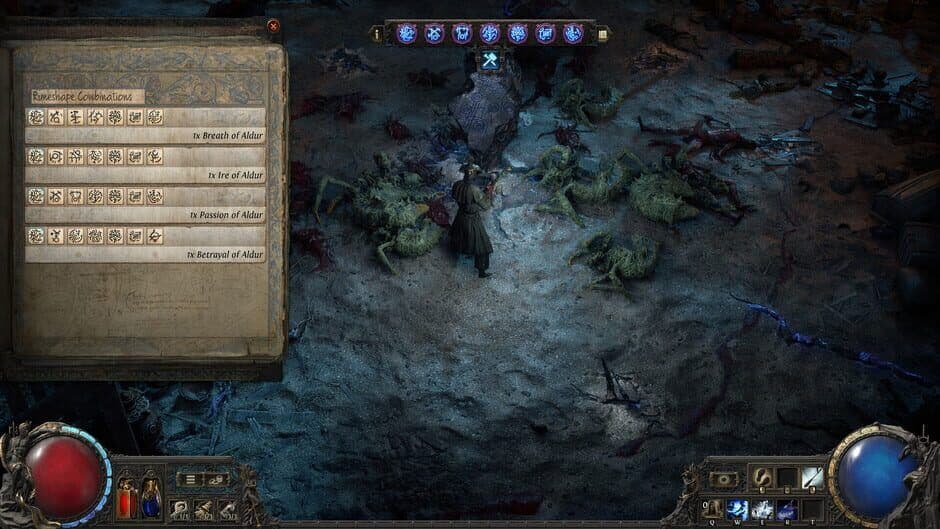
The redesign of Support Gems is the clearest improvement over Path of Exile 1’s early learning experience. In Path of Exile 2, Support Gems socket directly into individual Skill Gems instead of being tied to an item’s socket configuration, so changing an ability does not require reconstructing an entire piece of equipment. Early on, a player can attach a Support Gem to an attack or spell, see the intended modification, and test the result without first mastering the older item-socket model. Built-in recommendations offer further guidance, and voiceover explanations for new Skill Gems make the first stages unusually welcoming for a notoriously dense genre. Veterans may find those recommendations restrictive if followed blindly, but they can be disabled; the important achievement is that Path of Exile 2 turns experimentation into a low-risk activity before gradually revealing the deeper system underneath.
The scale remains enormous. Research on the Early Access tree describes roughly 1,500 skills, compared with about 1,325 in Path of Exile 1, while another breakdown places it at over 1,000 nodes distributed across six core attributes. Either figure communicates the same design philosophy: class choice determines where you begin, not where you must end. A Witch can path toward unconventional defenses or weapon synergies, while a Ranger or Mercenary can borrow tools from neighboring archetypes if the passive bonuses and equipment support the idea. That freedom is exceptional, but it also creates a steep on-ramp; a new player is not choosing between a handful of upgrades so much as navigating a continent of interacting assumptions. Path of Exile 2 is more approachable than its predecessor at the skill level, yet its full progression system still expects curiosity, patience, and—eventually—an external build guide.
The problem is that the game does not always provide enough information to make that curiosity productive. Support Gem descriptions can communicate the broad effect while leaving the important consequences unclear: how a modifier changes actual DPS, how it interacts with elemental damage, or what trade-off makes one option superior to another in a specific build. The issue becomes especially pronounced when a Support Gem improves one damage type while weakening another, or when a trigger-based setup depends on conditions the interface does not explain with sufficient granularity. Recommendations can point a newcomer toward a plausible combination, but they cannot replace the missing logic behind the choice. This is where the design’s intent falls short: Path of Exile 2 wants players to discover builds, yet it sometimes withholds the data needed to understand why a discovery works.
That tension defines the progression experience. Path of Exile 2 offers one of the most generous build-crafting sandboxes in the ARPG genre, with six distinct classes, direct Skill Gem customization, weapon-linked abilities, Ascendancies, Dual Specialization, and a passive tree large enough to support years of theorycrafting. But the freedom is not frictionless, and the game’s unclear explanations can turn an exciting experiment into a damage problem that the player cannot diagnose. For newcomers, the training wheels are better placed than they were in Path of Exile 1; for serious build-makers, the road still leads to spreadsheets, wikis, and community testing. The payoff is worth the climb—when the systems finally click, progression feels less like following a class template than engineering a character that belongs uniquely to you.
Path of Exile 2 Classes, Gear, and Crafting: Where Experimentation Meets RNG
Path of Exile 2’s classes only reach their full identity when gear turns a good idea into a functioning machine. The Witch’s skeletons, the Sorceress’s elemental layering, the Monk’s hit-and-run pressure, the Warrior’s durability, and the Mercenary’s ammunition toolkit are not cosmetic variations; they impose different priorities on weapons, defenses, resources, and support effects. A Witch wants enough Spirit to sustain minions and a sceptre such as the Rattling Sceptre to reinforce them, while a Warrior is far more concerned with surviving contact and capitalizing on heavy weapon damage. That distinction gives equipment real purpose, but it also means a weak drop can stall one class far more severely than another.
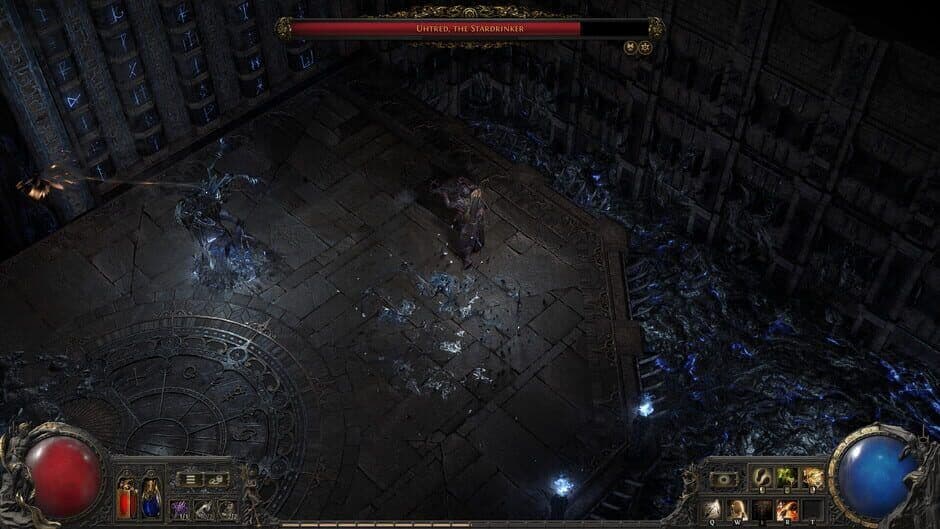
Minion mechanics and tactical gameplay.
The Mercenary provides the clearest example of Path of Exile 2 making gear and skills work together rather than merely stacking larger numbers. Ice shots can freeze a group, after which fragmentation ammunition detonates those targets for a burst of damage; the progression is satisfying because each upgrade improves a sequence of decisions, not just a damage percentage. Support Gems can deepen that relationship by rewarding ammunition swaps and giving the player different answers for packs and single targets. This is tactical progression in the best sense: the crossbow becomes more versatile as the character develops, and the player’s understanding of when to switch ammunition matters as much as the weapon’s raw statistics.
Charms add another useful layer to that preparation. They consume flask charges to provide automatic defenses against specific skills or elements, allowing a character to prepare for threats without dedicating every active input to defensive maintenance. A charm that answers an elemental hazard can be the difference between adapting to an area and being forced to abandon a build, particularly when enemy effects reduce resistances or change the terms of an encounter. Weapon-linked skills and Spirit management create a similar optimization problem: swapping weapons can support different abilities, but the available Spirit pool may determine whether a minion or aura setup is sustainable. Path of Exile 2 is strongest here because equipment asks practical questions—what can this weapon enable, what can this charm cover, and how much Spirit can this setup afford?—instead of reducing every upgrade to a higher item level.
The best gear decisions in Path of Exile 2 do not simply increase damage; they make a build’s intended playstyle possible.
The Witch exposes the less polished side of that equation. Minion builds can feel underpowered through roughly the middle of Act Two, with summoned creatures struggling to deliver convincing damage until greater Spirit investment, stronger skills, and better supporting equipment come together. That delay is especially conspicuous because the fantasy arrives immediately: the Witch can summon skeletal warriors, snipers, and bomb-throwers, but the battlefield does not always reward the player for investing in that identity early on. Once Spirit and minion-focused upgrades begin to accumulate, the build becomes far more persuasive, yet the opening stretch asks the player to endure a power curve that feels out of step with the class’s promise. For a game built around experimentation, an experiment that spends hours underperforming before its key resources mature is a real barrier.
The loot loop creates a more basic problem. Drops can be stingy, and there is no reliable class-specific filter ensuring that a Witch receives useful minion gear, a Monk finds suitable staves, or a Warrior sees a steady supply of relevant shields and weapons; too many rewards simply belong to another archetype. That would be tolerable if inventory management were generous, but Path of Exile 2’s unusually small inventory forces players to abandon items or return to town repeatedly to sell them, with only a specific Warrior skill offering an exception. The result is friction at precisely the point where an ARPG should feel most rewarding: a promising drop appears, the inventory is already full of marginal possibilities, and the player must interrupt the next run to make room. Loot is supposed to fuel experimentation; here, its low relevance and limited storage often turn it into administrative noise.
Crafting is more successful, though it never escapes the franchise’s dependence on chance. The streamlined currency system lets players augment magic items, upgrade them to rares with Exalted Orbs, reroll modifiers with Chaos Orbs, randomize numerical values using Divine Orbs, and risk unpredictable corruption with Vaal Orbs; Artificer’s Orbs add slots for Runes. Salvage and Reforge Benches provide more controlled routes, including combining three similar items into a new one, making the process easier to understand than Path of Exile 1’s famously opaque early economy. Yet the lack of a currency for rerolling modifiers on magic items and the continued reliance on random outcomes mean that “crafting” often describes choosing which gamble to take rather than designing the exact upgrade you need. A Vaal Orb can create something exceptional or brick the item entirely, and even ordinary improvements can consume scarce resources without producing a meaningful result.
That tension keeps Path of Exile 2’s equipment loop compelling without making it consistently satisfying. Class-specific identities are unusually strong, charms and weapon-linked skills create meaningful preparation, and the Mercenary’s ice-to-fragmentation progression demonstrates how rewarding a deliberately engineered loadout can be. But weak early minion scaling, irrelevant drops, cramped inventory space, and RNG-heavy crafting repeatedly interrupt the fantasy of building with intention. Gear gives the game’s freedom a material form, yet the loot system too often asks players to sort through chance before they can act on that freedom.
Path of Exile 2 Exploration: Striking Biomes Undercut by Procedural Repetition
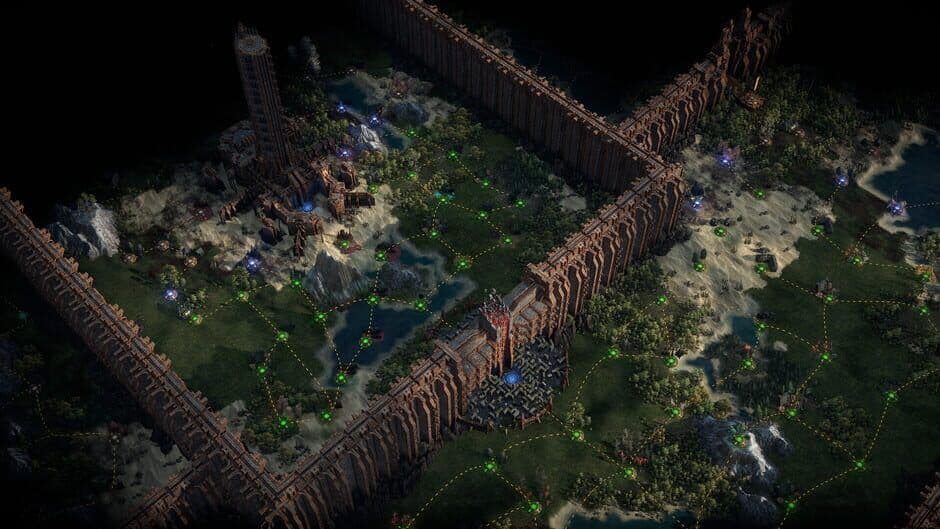
Path of Exile 2 understands that a beautiful map is not automatically an interesting place to explore. Its campaign moves from Ogham’s gothic forests to the Maraketh’s Vastiri Desert and finally Utzaal’s Vaal jungle ruins, and each transition changes more than the color palette: cultures, creature designs, architecture, and environmental mood all shift with it. The crimson sands and nomadic caravan of Act Two feel radically removed from Act One’s damp, European-gothic wilderness, while Act Three’s vivid jade-and-red ruins introduce a more vibrant, ancient menace. These regions succeed because they give progression a geographical identity; reaching a new act feels like entering a different civilization rather than walking into another collection of procedurally assembled combat rooms.
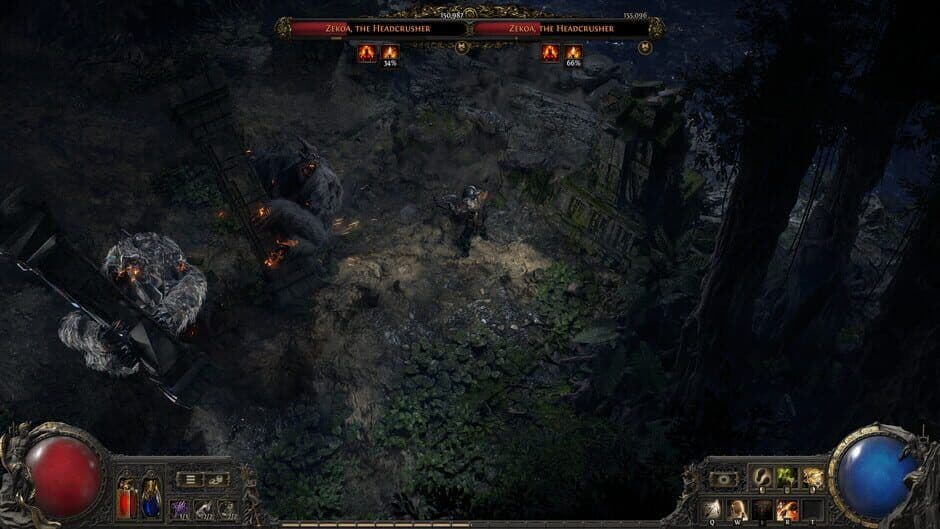
The intersection of visual spectacle and map design.
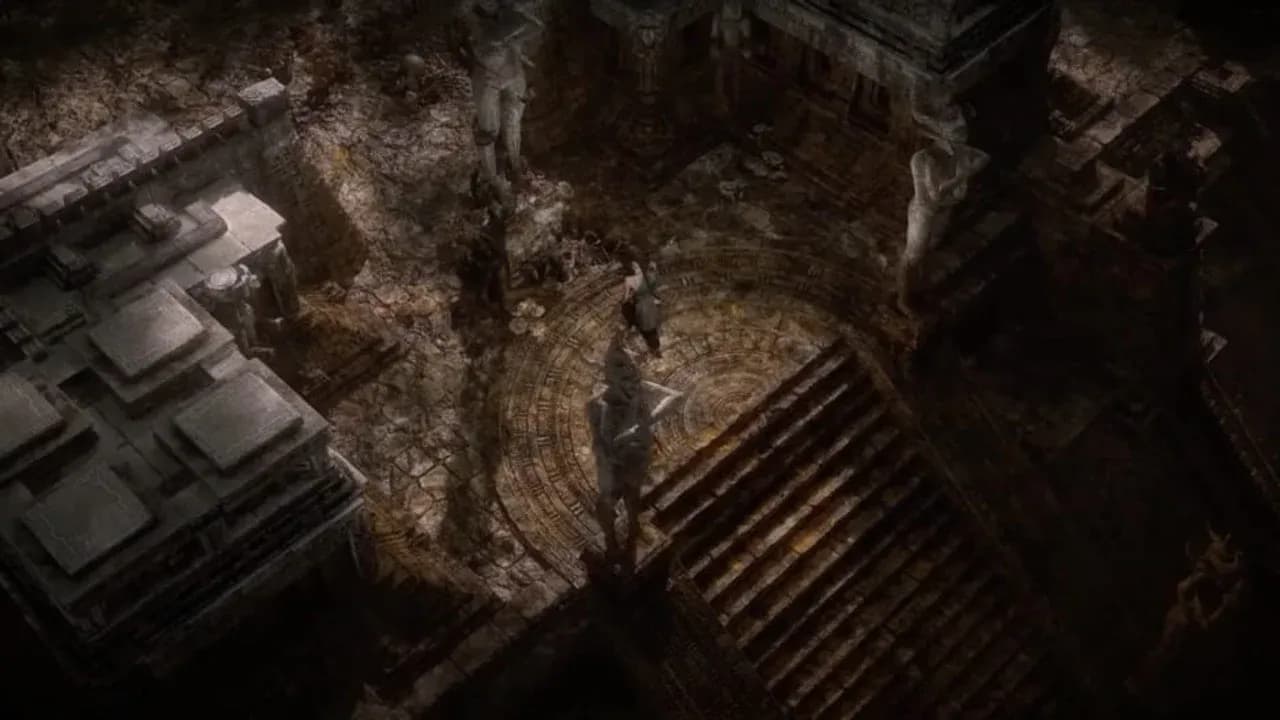
The strongest spaces also prove that the isometric perspective can support more than efficient monster slaughter. The Count’s Manor is built around staircases, interconnected halls, pits, and layered rooms, allowing the player to glimpse routes before reaching them and creating tension through elevation and restricted sightlines. That structure makes exploration feel spatially deliberate: a staircase is not merely decoration, because it connects combat arenas, hides approaches, and changes how the player reads the next room. Path of Exile 2 is at its best when a location uses its verticality to shape anticipation rather than simply presenting another flat arena. These moments are relatively uncommon, but they demonstrate a level-design intelligence that the game’s more generic zones often lack.
Path of Exile 2’s best maps make the camera feel like an advantage for exploration, not merely a convenient angle for watching enemies die.
The campaign also gives players credible reasons to leave the critical path. Points of interest and dungeon entrances shift between playthroughs, while optional bosses can grant permanent increases to health, Spirit, or resistances—rewards that alter the character rather than merely filling the inventory with another temporary upgrade. Side quests similarly vary between gear rewards and lasting progression, and checkpoints provide practical landmarks that refill health and mana flasks. This combination turns exploration into a calculated risk: detouring toward an optional encounter may cost time and resources, but the reward can strengthen every subsequent fight. Path of Exile 2 therefore avoids the common ARPG problem in which “exploration” means opening irrelevant chests after the meaningful content has already been completed.
However, procedural generation repeatedly undercuts that ambition. Generic forests, damp cave systems, and dungeon layouts can begin to resemble one another, especially when their points of interest are placed inside familiar room structures. The issue is not that the maps are random; randomness is useful when it changes the player’s decisions. The issue is that repeated visual language and similar spatial rhythms can make a newly generated zone feel like a rearranged version of somewhere already visited, weakening the sense of discovery that the distinctive biomes initially establish. After the shock of arriving in Utzaal or the Vastiri Desert fades, the connective tissue between set pieces often feels assembled rather than authored.
The reset system makes that repetition harder to ignore. Instances reset roughly 15 minutes after the player leaves, which can force a return journey through areas they had already cleared if they paused to manage inventory, pursue another objective, or simply stepped away. That turns Path of Exile 2’s expansive maps into a questionable bargain: their size suggests generous exploration, but their reset behavior can make revisiting them feel like administrative maintenance. Checkpoints soften the inconvenience by restoring flask charges and offering useful respawn locations, yet they do not eliminate the underlying problem when the route back to a destination is populated again with the same broad categories of enemies.
Checkpoint friction also affects the emotional value of failure. In the early access structure, respawning could require clearing previously defeated monsters again, so a death did not always provide a clean opportunity to study what went wrong; it could instead demand another round of routine encounters before the player reached the relevant threat. Large maps compounded the irritation when a remaining rare enemy had to be hunted down after the rest of the area was clear, creating tedious backtracking rather than meaningful navigation. Later Atlas improvements displayed rare monsters on the minimap from the start and reduced the punishment for dying in maps, which shows that Grinding Gear Games recognized the problem, but those fixes address tracking and recovery more than the campaign’s broader repetition. The friction is especially unfortunate because the game’s combat is deliberate and demanding: when the level structure makes failure expensive through chores, the player is less likely to feel challenged and more likely to feel delayed.
Path of Exile 2’s exploration is consequently a study in contrast. Its biomes are among the campaign’s strongest achievements, and spaces such as the Count’s Manor show how layered architecture, elevation, and optional routes can make an isometric ARPG feel genuinely navigable. Yet procedural repetition, timed instance resets, and checkpoint backtracking repeatedly flatten that ambition into re-clearing corridors. The game gives exploration worthwhile rewards and memorable destinations, but it does not always make the journey between them worth remembering.
Path of Exile 2 Story and Worldbuilding: Strong Atmosphere, Incomplete Payoff
Path of Exile 2 opens with a premise that understands dark fantasy is strongest when corruption feels personal before it becomes cosmic. Twenty years after the original game, the prisoner protagonist escapes execution just as Count Geonor of Ogham unleashes the Seed of Corruption, allowing the Beast and its spreading blight to drag Wraeclast back toward ruin. That opening gives the campaign an immediate dramatic engine: survival is not an abstract heroic duty but a desperate flight from a society already collapsing around you. The story earns attention because its central threat is tied to Geonor’s madness and Ogham’s decay, rather than introduced as another anonymous demon army. For a genre where narrative often exists to move players between combat zones, Path of Exile 2 begins with unusually firm dramatic footing.
The worldbuilding gains strength by making each act feel like a collision with a distinct civilization rather than another interchangeable fantasy region. Act One’s Ogham is rooted in European gothic imagery and primordial wilderness; Act Two follows the Maraketh across the Vastiri Desert, where the caravan and its nomadic culture provide a social center; Act Three enters the Vaal ruins of Utzaal, where ancient architecture and surviving stone creatures suggest a civilization whose history has become inseparable from its monstrosity. Those settings reinforce the campaign’s themes through their material details: the caravan’s carpets, pillows, and furnishings communicate a living culture, while Utzaal’s ruined temples and Vaal relics make the past feel dangerous rather than merely decorative. Path of Exile 2’s strongest worldbuilding comes from this connection between place and history—the environment is not just where the story happens, but evidence of what happened before the player arrived.
Path of Exile 2 makes Wraeclast feel less like a backdrop for slaughter than a civilization still living inside the consequences of its own history.
The presentation of its characters also gives the campaign more presence than the usual ARPG backdrop narrative. NPCs are fully voiced, visually distinctive, and given enough optional dialogue to establish factional tensions and personal motives beyond the next quest marker. Act One’s relatively linear structure helps here because the player spends more time with the people of Clearfell Settlement and follows a clear route through the crisis, while Act Two’s caravan creates a moving cast whose conversations make the Maraketh journey feel communal rather than solitary. Act Three expands the number of optional tasks and conversations, and its standout character benefits from that additional room to develop. These moments do not turn Path of Exile 2 into a character-first RPG, but they make the world’s survivors feel like participants in the catastrophe instead of quest dispensers waiting for the player to click through them.
The delivery becomes more exploratory as the campaign advances. Act One largely guides the player through a linear sequence of discoveries, Act Two introduces choices about which locations to investigate, and Act Three combines that structure with broader optional objectives and challenges. This progression works because the story’s form gradually reflects the player’s growing understanding of Wraeclast: first escape, then investigation, then a wider attempt to piece together the corruption’s origins. However, much of the actual narrative weight sits in environmental clues and optional dialogue rather than mandatory scenes. That approach rewards attentive players who stop to listen and inspect, but it also means a player focused on combat and progression can miss the connective tissue between the Seed, the Beast, the Vaal, and the cultures caught in the crisis.
Newcomers face a steeper contextual burden than the improved presentation initially suggests. References to Corruption, Kitava, the Vaal, and the Beast assume that players either remember Path of Exile’s history or are willing to reconstruct it from scattered conversations and lore fragments. The campaign explains its immediate conflict—the prisoner escapes, Geonor’s actions unleash a spreading evil, and the player must pursue its source—but it is less successful at clarifying how that conflict fits into the broader mythology of Wraeclast. Veterans will recognize the sequel’s continuity and appreciate the way it extends the original’s consequences; newcomers may instead feel that important nouns arrive fully formed, carrying significance the game expects them to supply. Path of Exile 2 is more approachable in its moment-to-moment storytelling than its predecessor, but its lore remains an inherited language rather than a fully translated one.
The larger problem is structural, and Early Access makes it impossible to ignore. The initial campaign’s three acts—roughly 25 hours before the Cruel progression in the reviewed build—end just as the central mystery begins to escalate, leaving the current arc feeling like a carefully staged setup rather than a complete narrative. The ending can transition into the game’s broader progression, but it does not provide the resolution that the opening premise promises; the prisoner escapes, the corruption spreads, the Vaal and the Beast deepen the mystery, and then the campaign stops before those threads fully converge. That incompleteness is understandable for an Early Access release with additional acts planned, yet it still affects the present-tense experience: players are asked to invest in characters and civilizations whose conflicts remain suspended. The atmosphere is strong enough to make that absence frustrating, which is both a compliment to the writing and a clear limitation of the current package.
Path of Exile 2 therefore tells an effective story in fragments. Its prisoner-escape opening, voiced cast, civilization-driven acts, and environmental clues give Wraeclast more narrative texture than the average loot-focused action RPG, while Act Two’s investigative choices and Act Three’s optional objectives show a campaign becoming more confident in how it delivers information. But the lore burden remains substantial for newcomers, and the incomplete Early Access arc denies the story a proper payoff just when its mythology starts to cohere. The recommendation is straightforward: Path of Exile 2 is worth following for its atmosphere and worldbuilding, but not yet for narrative closure. Its campaign has built a compelling foundation; the remaining acts must prove that foundation supports a finished story rather than an exceptionally polished prologue.
Path of Exile 2 Art Direction and Audio: Grotesque Beauty with Exceptional Production Values
Path of Exile 2’s visual identity is built on a rare contradiction: it is drenched in blood and body horror, yet its images remain remarkably legible. Ogham’s forests, ruined settlements, and corrupted interiors use oppressive darkness without collapsing into muddy brown, while sharp lighting separates enemies, architecture, and spell effects within the same frame. That clarity gives the game’s grim fantasy more force because the player can actually study the decay—the swollen flesh of undead creatures, the warped silhouettes of monsters, and the wet surfaces of ruined spaces—rather than merely register “dark fantasy” as a color grade. Path of Exile 2 looks more expensive than its predecessor not because it chases photorealism, but because every environment has a controlled material and lighting language.
The environmental detail is where that artistic ambition becomes tangible. The Maraketh caravan is filled with fabrics, carpets, pillows, and furnishings that make it feel inhabited rather than like a temporary menu hub, while the Vastiri Desert’s luminescent red sands give the entire region an alien, almost Dune-like identity without reducing it to imitation. Utzaal makes an even stronger impression through its vivid jade-and-red ruins, where jungle vegetation, ancient stonework, and Vaal architecture create a palette far removed from Act One’s European gothic forests. These details matter because they turn progression into visual discovery: moving between acts changes not only the enemies on screen, but the cultures, materials, and histories the player is walking through.
Path of Exile 2’s world is at its best when the grotesque is also specific: a ruin, a creature, or a piece of armor tells you where it came from before the dialogue does.
That specificity extends to the creatures. With roughly 400 monster types and dozens of bosses in the Early Access build, the game has enough visual range to give each region its own bestiary: emaciated undead and warped beasts in Ogham, hostile desert factions and River Hags in Vastiri, and intricate stone creatures among Utzaal’s Vaal ruins. The bosses benefit from the same discipline, presenting memorable silhouettes and animations rather than simply enlarging ordinary enemies; Zalmarath the Colossus, Tor Gul the Defiler, and Blackjaw each read as distinct threats before their mechanics are understood. This is more than decorative variety—visual identity helps players anticipate the kind of world they are entering, and it gives victories a stronger sense of place. Path of Exile 2’s monsters look designed around their civilizations and environments, not pulled from a universal catalogue of fantasy enemies.
Character models, armor, item designs, and spell effects complete the upgrade. Armor carries sharper silhouettes and more convincing surface detail, while weapons and equipment feel like objects with their own histories rather than interchangeable stat containers. Spells and boss attacks have satisfying animation weight, and the sound design reinforces that impact: attacks crack, strike, and detonate with enough force to make even routine encounters feel physical. This presentation supports the combat redesign discussed earlier without replacing it; a Warrior’s heavy swing feels consequential because animation, effects, and audio agree about the force of the action. The production values are especially impressive for an ARPG, a genre that often prioritizes quantity of enemies over the quality of the individual things being killed.
However, spectacle occasionally undermines the visual communication that makes these encounters work. During large fights, player abilities, boss effects, summoned mobs, and environmental hazards can overlap into a bright, noisy mass, making it difficult to distinguish a friendly spell from an attack that needs to be dodged. That is not a minor aesthetic complaint: Path of Exile 2’s deliberate combat depends on reading danger quickly, so an effect that obscures a telegraph can turn a carefully designed reaction test into a death the player could not reasonably parse. The game’s lighting and color separation usually establish a strong baseline, but the sheer volume of particles can overwhelm that discipline at the exact moment clarity matters most. Its art direction is therefore exceptional in stillness and controlled motion, even if the most spectacular battles occasionally need a stricter visual hierarchy.
Path of Exile 2 ultimately delivers one of the strongest presentation packages in the ARPG genre. Its grotesque creatures, richly differentiated civilizations, detailed materials, expressive animation, and forceful audio give Wraeclast a sense of physical reality that the original game rarely approached. The effects clutter is a genuine flaw because it compromises the readability of combat, but it also reveals the scale of the game’s ambition: Path of Exile 2 is not short on visual ideas, only occasionally short on restraint. The result is a world that is beautiful in the most unpleasant way—and a production whose every corpse, ruin, spell, and armor plate makes the journey through Wraeclast harder to forget.
Path of Exile 2 Endgame and Replayability: A Promising Atlas Still Under Construction
The campaign is only the tutorial for Path of Exile 2—and the Atlas is where Grinding Gear Games must prove its systems can sustain obsession rather than merely reward it. The answer, so far, is encouraging but incomplete: mapping offers exceptional agency and a near-limitless build for experimentation, yet its early layers were burdened by busywork, opaque mechanics, and punishments that confused inconvenience with mastery.
The Atlas Finds Its Shape
The Atlas of Worlds is a procedurally generated web of maps that escalates from tier 1 to tier 15, with Waystones determining which areas players enter and which modifiers those maps carry. Those modifiers can increase monster density, improve rewards, and raise the danger of a run, turning each map into a risk calculation rather than a fixed dungeon. Clearing maps also grants Atlas passive points for a separate progression tree, allowing players to specialize in activities such as Breach, Ritual, Expedition, Delirium, and Strongboxes. That structure works because the endgame is not simply “repeat the same map at a higher level”; it lets players decide what kind of repetition they actually want.
This is where Path of Exile 2’s long-term design becomes more convincing than the campaign’s linear progression. A player interested in crafting materials can shape the Atlas toward mechanics that produce them, while another can prioritize monster density, rare encounters, or higher-value loot. Waystone modifiers create a second layer of choice: increasing the danger of a map is worthwhile when the reward justifies the risk, but a fragile build can run safer content while accumulating currency and gear. The Atlas passive tree gives those decisions permanence, so the endgame gradually becomes a personalized route through Wraeclast rather than a generic treadmill.
The Atlas succeeds because it turns repetition into authorship: you are not merely running maps, you are deciding what kind of game your next hundred maps will be.
That agency is reinforced by the game’s seasonal structure. Leagues reset the economy and introduce temporary mechanics, giving veterans a reason to start new characters and test unfamiliar builds rather than simply continuing one perfected account forever. Rise of the Abyssal, for example, added fissures that spawned enemies and supplied splinters for pinnacle bosses, while Fate of the Vaal asked players to assemble a Vaal Temple by placing room cards that shaped its layout and rewards. Later additions such as Act 4’s islands and narrative interludes show that Grinding Gear Games is treating Early Access as an evolving platform, not a static campaign followed by an afterthought. The roadmap has meaningful ambition—but ambition alone does not make every new system understandable.
Progress, Then Busywork
The original endgame structure often made progression feel more laborious than strategic. Large maps could require extensive searching, especially when one rare monster remained hidden somewhere in the layout, and preparing “juiced” content involved running multiple low-reward maps to activate towers, clear them, load tablets, and finally reach the content worth farming. That preparation could mean running 10 to 15 maps before the Atlas entered a properly rewarding state. The design intent was to make high-value mapping feel earned; the practical result was that too much of the player’s time went into setup rather than mastery.
Death penalties made that friction harder to tolerate. Initially, dying inside a map could mean restarting the entire encounter and losing the progress and rewards attached to it, even though the map might have been enormous and the build’s failure could hinge on one obscured attack. Pinnacle bosses were similarly gated behind scarce materials and limited attempts, making experimentation expensive. Players who wanted to learn a boss mechanic had strong incentives to overpower the encounter instead, because a single failed attempt could erase the work required to reach it. That is the opposite of the game’s best boss design, where repeated attempts teach positioning and timing; the early Atlas often punished learning before learning could begin.
The Dawn of the Hunt 0.2 update made several corrections that materially improved the loop. Corrupted areas now function as meaningful Atlas destinations, with more enemies, better loot, and a culminating nexus encounter that grants Atlas passive points; this gives players a reason to explore the Atlas’s edges instead of grinding the nearest convenient map. Rare monsters appear on the minimap from the beginning, eliminating the tedious hunt for a single straggler. Map deaths became less destructive because players can respawn a limited number of times without losing all progress, while improved tower coverage reduces the number of disposable preparation maps needed to create a rewarding region. Pinnacle bosses can also be attempted multiple times, with the number of attempts decreasing at higher difficulties, which shifts the emphasis back toward learning mechanics rather than hoarding access.
These changes do not erase every structural problem, but they reveal a healthier design philosophy. A corrupted area with a miniboss and a clear reward is meaningful friction; searching an oversized map for one unseen rare monster is not. Choosing how aggressively to modify a Waystone is a strategic decision; running a string of low-value maps simply to unlock the opportunity to play better content is administration. Path of Exile 2’s endgame is improving precisely where it distinguishes decisions from chores, and that distinction will determine whether the Atlas remains compelling after the novelty fades.
A Roadmap Still Speaking in Riddles
The weakest part of the endgame is its onboarding. The Atlas itself is legible enough once players understand maps, Waystones, passive points, and modifiers, but league mechanics often introduce their own rules with minimal explanation. Fate of the Vaal is the clearest example: players place room cards to construct a temple, certain room arrangements upgrade others, Tier 3 rooms unlock powerful corruption crafting, and the structure eventually leads to Atziri, Queen of the Vaal. That is a fascinating system on paper, but the game does not adequately explain which rooms matter, how upgrades interact, or when corruption is worth the risk. External guides become less like optional optimization tools and more like basic instruction manuals.
The same problem appears in the broader Atlas ecosystem. Breach, Ritual, Expedition, Delirium, Strongboxes, towers, tablets, corrupted areas, pinnacle fragments, and Waystone crafting all compete for the player’s attention, but their relationships are not presented as a coherent learning path. A newcomer can understand how to enter a map while remaining unsure which currency to spend, which mechanics to pursue, or why one Atlas passive is more valuable than another. For experienced Path of Exile players, this opacity is part of the familiar treasure hunt; for everyone else, it makes the endgame feel like a collection of community-discovered procedures. Path of Exile 2 improves the campaign’s early explanations, yet its post-campaign systems still assume the player is willing to keep a wiki open.
The resulting replayability is substantial, but conditional. The Atlas offers enough map variety, specialization, seasonal resets, league mechanics, and pinnacle goals to support hundreds of hours for players who enjoy optimization and economic planning. It also gives build progression a clearer purpose than the campaign does: stronger gear and better passives are not merely numbers to accumulate, but tools for increasing map danger, targeting specific rewards, and surviving encounters designed to test a finished character. However, the current experience still asks players to tolerate unfinished explanations and occasional procedural overhead before reaching that payoff.
Path of Exile 2 has a promising endgame because its foundation is player-directed rather than purely repetitive. The Atlas passive tree, Waystones, map modifiers, seasonal mechanics, and pinnacle encounters create a compelling framework, while Dawn of the Hunt demonstrates that Grinding Gear Games is willing to remove busywork when the system gets in its own way. But the Atlas is still under construction: onboarding remains poor, early preparation was excessively laborious, and its most interesting league mechanics can be impenetrable without outside help. For dedicated ARPG players, that is enough to justify the grind today; for anyone seeking a clean, self-explanatory post-campaign loop, Path of Exile 2 has not finished making its case.
Performance and Interface in Path of Exile 2: Impressive Fidelity, Uneven Stability
Path of Exile 2 looks like a modern ARPG, but its technical performance still feels like an Early Access work in progress. The upgraded engine renders Wraeclast’s environments, armor, creatures, and spell effects at a level far beyond the original game, and one later PC assessment reported up to 144 FPS at 1440p on a mid-range GPU during normal mapping. That figure is an encouraging target, not a universal promise: visually dense boss arenas can still produce frame dips, and other reports describe stuttering, crashes, and inconsistent frame pacing on both PC and PlayStation 5. The result is a game whose fidelity is impressive enough to expose every technical weakness around it.
Fidelity Meets Instability
Path of Exile 2’s ordinary mapping performance can be excellent when the engine has room to breathe. The sharp lighting, detailed environments, and elaborate effects remain readable during standard encounters, while the later PC testing cited above suggests the game can scale impressively on capable hardware. However, particle-heavy boss arenas are where the presentation begins to strain: overlapping player abilities, enemy attacks, and summoned creatures can cause frame drops while also making threats harder to distinguish. That combination is particularly damaging in an action RPG built around reacting to danger, because a performance hitch and a buried telegraph can turn one mistake into a death that feels technical rather than tactical.
The platform gap matters. PC reports range from strong high-refresh performance during normal mapping to stuttering, excessive RAM usage, and the need to restart after extended sessions, while PlayStation 5 reports include frame drops and crashes. Console play is not inherently broken—the simplified controller interface communicates the core options clearly, and navigating skills, equipment, and basic menus is easy to understand—but the hardware appears to have less headroom when Path of Exile 2 fills the screen with effects. The game’s visual ambition is therefore both its achievement and its stress test: a quieter map can look spectacular and run smoothly, while a crowded arena reveals how much the engine is being asked to process.
Path of Exile 2’s technical ceiling is genuinely high, but its floor still moves depending on platform, encounter, and update.
The bug list is more serious than the usual Early Access roughness. One reported boss left its arena, returned to its starting position, became invulnerable, and continued summoning enemies until the instance reset; that does not create a difficult fight, it removes the fight altogether. Another report involved disconnections when self-casting Lightning Conduit, while unusually high RAM usage forced restarts during longer sessions. A large patch also caused equipped Skill and Support Gems to disappear, with Skill Gems easy enough to recover because of their drop rate but rarer Support Gems creating a much more consequential setback. These failures strike at the foundations of an ARPG—combat access, build continuity, and time investment—so they are far more disruptive than a harmless visual glitch such as fish continuing to swim after a waterway has been drained.
Interface Friction
The interface is cleaner than Path of Exile 1’s, but “cleaner” does not mean frictionless. The controller layout succeeds because it strips the game’s dense systems down to understandable actions: selecting abilities, navigating menus, and managing equipment are all reasonably clear without requiring a mouse. That accessibility is valuable for newcomers who might otherwise be intimidated by the passive tree and gem system. Yet switching between controller and keyboard-and-mouse requires logging out, turning what should be a flexible control option into a session-level commitment. A player who prefers a controller for combat but wants a mouse for inventory management cannot simply change schemes when the task changes; they must interrupt play and reconnect.
PC remains the stronger interface platform for players who manage large inventories or participate in trading. Console inventory navigation is less precise, which matters in a game that constantly asks players to compare modifiers, socketed gems, runes, and equipment types. Trading interfaces are also clunkier on console than on PC, where a mouse makes selecting items, inspecting listings, and organizing stash space more direct. None of this makes the console version unplayable, but it adds friction to the administrative side of Path of Exile 2—the very part of an ARPG that already involves frequent sorting, selling, and build maintenance.
Inventory space compounds that problem. The small inventory forces players to make repeated decisions about what to keep, drop, or carry back to town, and the interface does not fully transform that limitation into a satisfying form of prioritization. Instead, the player often stops a promising run to clear space for another weapon or armor piece, then repeats the process when a new build experiment begins. On PC, external loot filters can help reduce the flood of low-value items, but that solution depends on player setup rather than an especially strong in-game presentation. Path of Exile 2’s interface communicates individual systems well; it is less successful at managing the sheer volume of information those systems generate.
The Early Access Asterisk
The most important qualification is timing. The December 2024 launch build should not be treated as identical to later assessments, because Grinding Gear Games has already changed the game through patches and the 0.2 Dawn of the Hunt update. That update improved Atlas navigation by displaying rare monsters on the minimap, reduced the punishment for dying in maps through limited respawns, and made towers cover larger areas, but those are progression and endgame changes rather than proof that every performance or interface issue has been solved. Reports of stuttering, crashes, memory problems, and input friction therefore need to be read as evidence of an evolving technical state, not as a single fixed verdict that applies equally to every platform and version.
This distinction does not excuse the launch build’s instability; it clarifies the recommendation. Path of Exile 2 already delivers unusually high visual fidelity for an ARPG, and its controller UI demonstrates that complex systems can be made approachable without flattening them. But an invulnerable boss, a lost Support Gem, a crash during a build-defining spell, or a forced logout to change controls can erase the trust that the game’s otherwise excellent systems work as intended. On PC, the performance ceiling and mouse interface make it the preferred version for demanding players, while console users gain a clear controller experience at the cost of less precise inventory and trading tools.
Path of Exile 2 is technically impressive, but not yet technically dependable. Its engine can produce beautiful environments and high-refresh-rate mapping, while its interface is more welcoming than the franchise’s reputation suggests; meanwhile, inconsistent stability and Early Access bugs still make the experience vary too sharply from one setup to another. The foundation is strong enough to support the game’s long-term ambitions, but the final polish must ensure that the player’s next failure comes from a bad decision—not a crash, a missing gem, or a frame drop at the worst possible moment.
Path of Exile 2 Value and Comparisons: Who Should Invest in the Exile Grind?
Path of Exile 2 is an extraordinary long-term investment trapped inside an incomplete short-term product. The December 2024 Early Access build offers roughly 25 hours across three acts before repeating them on Cruel difficulty, yet its build systems and Atlas endgame are designed to consume hundreds—or potentially thousands—of hours. That gap defines the buying decision: Path of Exile 2 is not a finished story campaign with an optional loot treadmill attached, but the opening chapter of a much larger ARPG designed around experimentation, mastery, and seasonal reinvention.
An Early Access Package with a Long-Term Promise
The current scope is substantial but clearly unfinished. Early Access launched with six of 12 planned classes—Warrior, Sorceress, Witch, Mercenary, Ranger, and Monk—and three of six planned acts. Completing Acts 1–3 normally takes approximately 25 hours with optional content, bringing most characters to around level 45; Cruel progression then revisits those acts and pushes characters toward level 65, where endgame mapping begins. That structure gives committed players a meaningful progression ladder, but it also means the present campaign ends before the story reaches its promised conclusion. Path of Exile 2’s content is not thin, exactly—there are extensive builds, optional bosses, and an evolving Atlas—but anyone buying primarily for a complete narrative should treat the current version as a polished prologue.
The price complicates that proposition. Access initially required an approximately $29.99–$30 supporter pack, even though the campaign remained incomplete and only half of the planned classes and acts were available. That is a reasonable entry fee for players who intend to spend dozens of hours testing builds and exploring the endgame, but a harder sell for someone expecting a complete premium RPG. The Early Access purchase is best understood as paying to participate in development while receiving a substantial playable foundation, not as buying the finished Path of Exile 2 experience today. If an incomplete story arc or shifting systems are dealbreakers, waiting for the full release is the more sensible recommendation.
The eventual free-to-play model is considerably more persuasive. The campaign, endgame maps, seasonal leagues, and character-building systems are available without purchasing power, and the game’s replay value comes from its systems rather than from paywalled combat advantages. A player can create a Witch focused on minions, then return with a Mercenary built around ammunition switching, or rebuild a Sorceress around layered elemental triggers without paying to unlock a new gameplay tier. With leagues resetting the economy and encouraging fresh characters, Path of Exile 2 has the kind of structure that can support years of play—provided the player actually enjoys starting over and refining the same fundamental loop.
Fair Monetization, Expensive Attention
Grinding Gear Games’ monetization is unusually restrained for a free-to-play ARPG. Purchases focus on cosmetics and quality-of-life stash tabs, with no reported experience boosters, power-enhancing items, or pay-to-win loot boxes. Stash tabs become increasingly useful once players accumulate currencies, crafting materials, and gear across multiple characters, but they do not make a weak build strong or lock core endgame activities behind a payment. That distinction matters in a game where progression depends on understanding Support Gems, passive nodes, equipment modifiers, and Atlas specialization; Path of Exile 2 sells convenience and expression rather than combat power.
The real cost is cognitive. The game expects players to understand an enormous passive tree, interpret Support Gem interactions, learn crafting currencies, navigate Atlas mechanics, and often consult a community guide before their first serious endgame build. That is a fair exchange for players who enjoy theory-crafting, but an exhausting one for anyone who wants to play without a second monitor full of explanations. Path of Exile 2’s value is therefore unusually high in hours and unusually demanding in attention. It does not waste your money; it may consume every spare evening you have.
Path of Exile 2 is generous with content because it is demanding with your time.
The comparison with Diablo 4 clarifies the audience. Diablo 4 is more immediately accessible, more cinematic, and easier to understand within its first few hours; its progression communicates its priorities more directly. Path of Exile 2 offers deeper character customization, more intricate loot interactions, and far greater room for cross-class experimentation, but its passive tree and endgame systems require substantially more patience before their logic becomes visible. A Diablo 4 player can usually begin building toward a recognizable fantasy with limited research, whereas Path of Exile 2 can leave a new player wondering why a promising skill combination is underperforming until they investigate resource scaling, support interactions, resistances, and gear dependencies. Neither approach is inherently superior, but they serve very different appetites.
Compared with Path of Exile 1, the sequel is more welcoming without becoming simple. Directly socketing Support Gems into individual Skill Gems makes early experimentation clearer, built-in recommendations and voice explanations reduce the initial shock, and the heavier combat gives ordinary encounters more physical consequence. Yet the formidable complexity remains: the passive tree is still vast, crafting still relies heavily on chance, and the Atlas still assumes players are willing to learn systems the game does not fully explain. Path of Exile 2 is the better starting point for newcomers to the franchise, but it is not a casual ARPG. It lowers the first step; it does not flatten the mountain.
Who Should Buy Path of Exile 2?
The ideal player is easy to identify. Buy Path of Exile 2 if you enjoy turning a class into a personal engineering project, repeating campaigns with different builds, learning difficult bosses, chasing better gear, participating in a seasonal economy, and using community guides to understand systems the game leaves deliberately opaque. The payoff is the rare feeling that a character is genuinely yours: not just a Sorceress or Witch, but a specific arrangement of skills, passives, gear, charms, and triggers that changes how every encounter is approached. The tactile combat, remarkable art direction, memorable bosses, and fair monetization make that investment feel worthwhile once the systems click.
The poor fit is just as clear. Players seeking a short, straightforward, story-first ARPG will run into the incomplete campaign, lore gaps, repeated Cruel acts, and an endgame that demands homework before it becomes rewarding. The loot and inventory friction can make early progression feel stingy, procedural zones can repeat their visual and spatial rhythms, and visual clutter or technical instability can occasionally turn a carefully designed challenge into frustration. Path of Exile 2’s value is extraordinary only if the player wants the exile grind itself; the game cannot disguise that grind as something more accessible or less demanding than it is.
Path of Exile 2 earns a strong recommendation for the right audience, but not an unqualified one. Its combat has genuine weight, its bosses give progression purpose, its world is among the most striking in the genre, and its build freedom is almost unmatched. The Early Access campaign is incomplete, the interface and loot systems still impose needless friction, and the technical state can vary by platform and encounter. Buy it now if you want to help shape and explore a deep ARPG in progress; otherwise, waiting for the full campaign and further polish is not a failure of enthusiasm—it is the rational choice.
Pros
- Tactile combat with meaningful positioning, weapon specialization, and active defensive play.
- Distinctive bosses that reward learning patterns and adapting builds.
- Exceptional art direction, environmental variety, creature design, and sound.
- One of the deepest build systems in the ARPG genre.
- Fair free-to-play monetization focused on cosmetics and quality-of-life stash tabs.
- Hundreds of hours of potential replayability through builds, leagues, trading, and Atlas specialization.
Cons
- Early Access currently includes only three of six planned acts and six of 12 planned classes.
- The approximately 25-hour normal campaign ends before the story reaches a full resolution.
- Steep onboarding still pushes players toward wikis, guides, and community explanations.
- Stingy, inconsistent loot and cramped inventory create unnecessary administrative friction.
- Technical instability, visual clutter, and procedural repetition can interrupt otherwise excellent gameplay.
- The $30 Early Access entry point is difficult to justify for players who want a complete story-first RPG.
For dedicated ARPG players, Path of Exile 2 is worth buying—with the Early Access caveat plainly understood. It is not yet the definitive finished sequel its systems suggest, but it is already a remarkable foundation: generous in content, ambitious in design, and demanding in exactly the ways its target audience will appreciate.