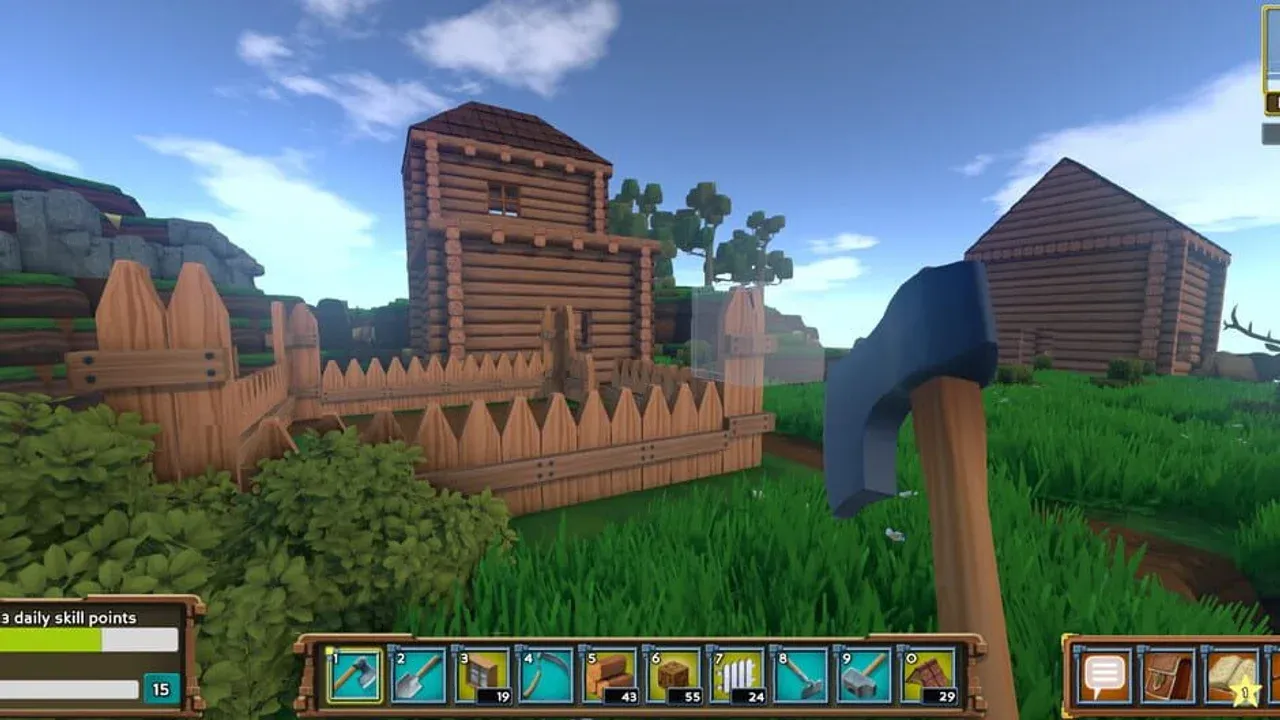
Eco’s Core Idea: A Survival Simulation Built Around Cooperation
Eco is not really a survival game with a cooperative mode attached; cooperation is the survival game. Strange Loop Games’ Eco, developed and published by the studio and released on February 6, 2018, gives players one shared objective: build a civilization capable of stopping a world-ending meteor. That premise immediately gives routine actions—gathering resources, constructing settlements, and advancing technology—a collective purpose that most survival sandboxes lack. You are not merely building a better house before nightfall; you are contributing to a deadline that threatens everyone.
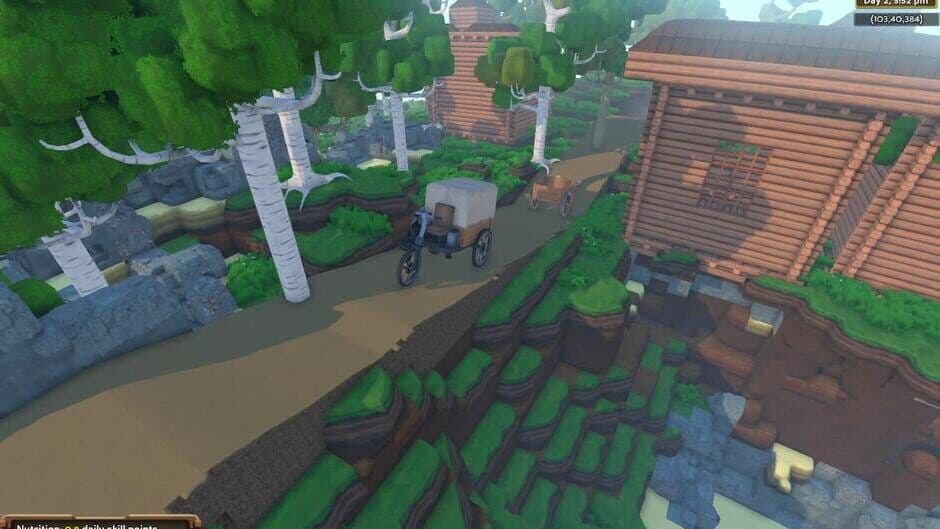
Cooperation is essential for progress in the world of Eco.
Eco’s most radical idea is that survival is not an individual test. It is a civilization-management problem, and every player is part of the solution—or part of the delay.
This design places Eco somewhere between a survival game, a social simulation, and a political strategy game. Its identity also includes bureaucracy and player governance: laws, taxes, rewards, towns, and cities are not decorative systems orbiting the main loop, but expressions of how a community decides to distribute responsibility and resources. That combination makes Eco unusually distinctive beside conventional survival games, where progression usually means improving one character’s equipment and expanding one player’s base. Here, the meteor turns civilization itself into the protagonist, while the players supply the conflict, compromise, and institutional structure.
The design intent is clear, but it creates a demanding social dependency. Eco assumes that players will keep communicating, specialize their efforts, and remain engaged long enough for a functioning society to form; when that happens, the meteor objective gives cooperation real stakes rather than reducing it to casual resource trading. When it does not, the central fantasy loses its foundation. A solo player, a newcomer joining a server at the wrong time, or someone entering a community organized around established friend groups may find that the supposedly shared civilization has no meaningful place for them. Eco’s appeal therefore depends less on whether its systems are interesting in isolation than on whether the surrounding players are available, welcoming, and willing to treat the settlement as a common project.
That is both the game’s greatest strength and its first warning. Eco offers a rare survival simulation in which a successful society matters more than a successful individual, but it cannot manufacture the cooperation its premise requires. The result is a remarkably original foundation—one capable of producing genuine communal purpose—paired with an unusually narrow audience that must want social commitment as much as it wants survival gameplay.
Eco Gameplay: A Deep Civilization-Building Loop With a Steep Entry Cost
Eco’s progression is most satisfying when it stops feeling like a crafting tree and starts behaving like an economy. A player gathering raw materials cannot simply brute-force the entire climb to civilization; the group must coordinate resource collection, specialization, construction, and technological advancement before the meteor deadline arrives. That interdependence gives every contribution weight: one player’s work supplies the materials, infrastructure, or expertise needed for someone else’s next step. In a conventional survival game, upgrading your tools mainly improves your personal efficiency. In Eco, progression is shared infrastructure, and that makes a completed building or technological advance feel like a communal achievement rather than another item checked off a private list.
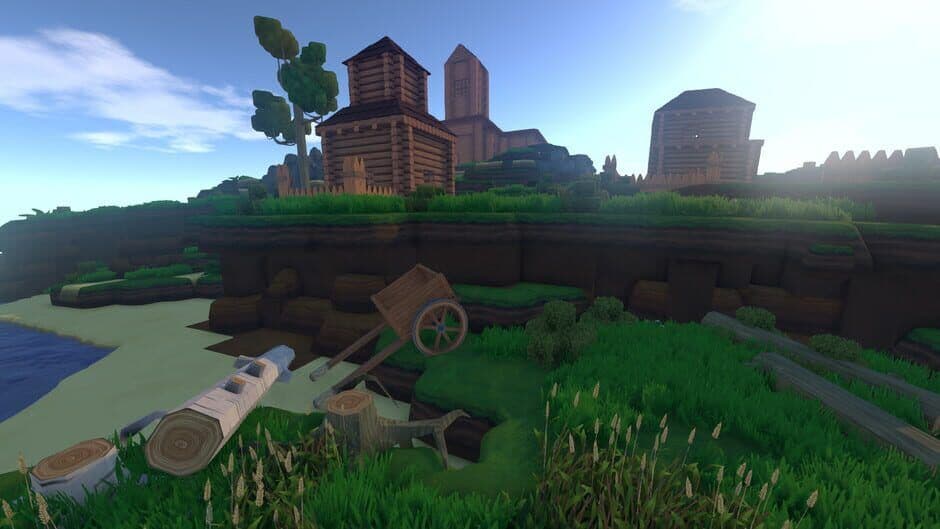
Managing the delicate balance of the Eco ecosystem.
Eco turns the survival-game question from “What can I craft next?” into “What does this society need next, and who is responsible for providing it?”
The survival-to-civilization transition is the game’s strongest mechanical idea because it transforms individual labor into a network of dependencies. Gathering is not valuable merely because it fills an inventory; it matters because those materials feed construction, specialization, and the broader technological climb. The result resembles a simulation of economic cooperation more than the self-sufficient loop found in simpler survival games, where one player can gather, build, and progress alone. That depth also explains why Eco can become so absorbing once a community finds its rhythm: production stops being busywork when players must rely on one another to move the settlement forward. The cost is that a stalled specialization or absent contributor can make personal progress feel blocked, turning the same interdependence that creates purpose into a source of friction.
Governance is not an optional role-playing layer pasted onto that economy. Laws, taxes, rewards, towns, cities, and homestead relationships directly shape how players participate in the settlement, making political decisions part of the practical progression system. A rule about debris, for example, can change how a seemingly harmless act such as cutting down trees is received, while taxes and payments determine how contributions are recognized or redistributed. This is where Eco distinguishes itself from most open-world survival games: the community is not merely cooperating around a shared base; it is establishing institutions that decide what responsible cooperation means. The system is powerful because it creates consequences beyond the workbench, but it also asks players to understand civic structures before they have learned the basic survival loop.
That onboarding is Eco’s biggest mechanical barrier. A new player can be confronted with pop-ups about debris policies, taxes, payments or rewards, a local town they do not recognize, and a homestead being adopted by a city—all before they understand why those systems matter. Each notification may represent a meaningful part of the simulation, but presented together they read less like guidance than an administrative ambush. The impact is substantial: instead of learning through a clear sequence of gathering, crafting, and building, newcomers must decode a server’s social and political machinery while trying not to violate rules they have only just encountered. Eco’s complexity is valuable for players who enjoy bureaucracy, optimization, and negotiation; for everyone else, this is where its ambition becomes needless resistance.
Solo play exposes the limits of the design even more sharply. Eco’s systems are built around interdependence, so a solitary player may still gather resources and construct a settlement, but they cannot easily recreate the specialization and communal decision-making that give those actions their larger purpose. The same economy that feels rich when several players divide responsibilities can feel isolating when one person is expected to supply every function. That does not make Eco a failed solo survival game—it makes it a narrowly targeted one. Players seeking a private base-building experience with uncomplicated progression will find the game’s bureaucracy and dependence exhausting, while those willing to treat the settlement as a living organization will find a depth that most survival games never attempt.
Eco’s gameplay loop is therefore both its greatest achievement and its clearest warning. It successfully turns resource gathering into civilization-building, and governance into a practical tool rather than a decorative feature, but it makes players pay for that ambition with a steep learning curve and limited solo viability. The game is not inaccessible because its systems lack logic; it is inaccessible because too many of those systems become relevant at once. For the right player, that administrative density is the point—and for everyone else, it is the reason Eco feels less like a survival sandbox than a second job with a meteor attached.
Eco’s Multiplayer World: Community Governance Versus Social Isolation
Eco’s multiplayer is where its ambitious civilization simulation either becomes unforgettable or quietly collapses into loneliness. A welcoming server can make a newcomer feel like a genuine resident rather than a visitor: your work contributes to a settlement, local decisions affect what you are allowed to do, and even cutting down trees can carry consequences under community rules. That sense of belonging gives Eco’s shared objective emotional weight, because responsibility is no longer abstract—you are accountable to the people living beside you. The problem is that the game cannot guarantee this social foundation, and without it, the most distinctive multiplayer design in Eco can feel arbitrary.
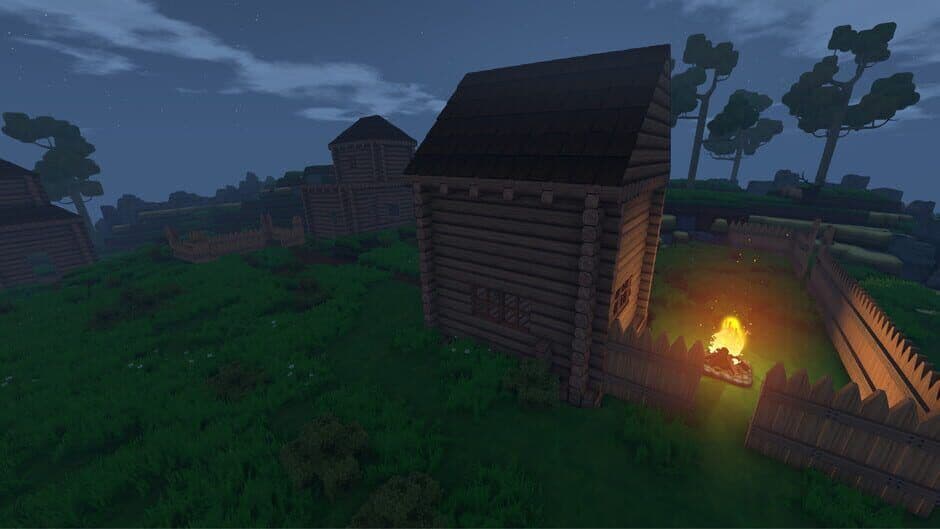
Town centers serve as the heart of Eco's social structure.
Eco’s communities can produce the rare multiplayer feeling of having a civic role—but joining the wrong server can make that role feel assigned, misunderstood, or unwanted.
The best servers turn cooperation into a genuine social structure. Players divide responsibilities, establish towns, recognize contributions through taxes or rewards, and create expectations about how the settlement should grow; a newcomer who is properly welcomed can see exactly how their gathering, construction, or specialization supports the larger project. This is more substantial than the casual teamwork found in many survival games, where players exchange materials and then retreat to private bases. In Eco, local rules and shared infrastructure make membership matter, because the player’s actions occur inside a community with consequences rather than beside one. This is the moment the game earns your trust: the server stops feeling like a lobby and starts feeling like a small, functioning society.
However, Eco’s social design is brutally dependent on timing and personality. Solo players and less-social players can find themselves working in near-isolation, particularly when a server’s active population is split across time zones or organized around pre-existing friend groups. A player may join expecting a shared civilization and instead discover that the established community already has its routines, conversations, and division of labor in place. That produces a particularly frustrating kind of loneliness: there may be other characters online, but no clear way to become part of what they are doing. Friends substantially improve the experience because they supply trust and continuity from the start; with strangers, Eco’s interdependence can feel less like cooperation and more like waiting for permission to participate.
The server browser makes that problem harder to solve. Eco primarily relies on browsing available servers, with no broader group-finding or matchmaking support beyond that system, so the game offers little help in finding a community whose schedule, expectations, or social style suits you. Joining is therefore not the beginning of a guided multiplayer experience; it is a gamble on a particular server culture. Many servers impose extensive rules, and a newcomer can unintentionally create resentment before understanding them—for example, cutting down trees and immediately encountering policies concerning debris, taxes, rewards, an unfamiliar local town, or a homestead adopted by a city. These systems may be coherent from the community’s perspective, but to a new arrival they turn an ordinary survival action into a possible social offense. Eco’s complexity is meaningful once you understand the settlement, yet its weak path into that settlement makes the first impression needlessly hostile.
That barrier explains why Eco can feel dramatically different with friends than with strangers. A friend group can explain local expectations, distribute work without formal negotiation, and treat mistakes as part of building the civilization; an unfamiliar server may instead make every decision feel like trespassing in someone else’s project. The contrast is not cosmetic. Because Eco’s progression depends on shared responsibilities, a player who lacks social access is also denied much of the game’s mechanical purpose, even if the server technically contains other people. The result is a multiplayer experience with extraordinary upside and very little safety net: Eco creates memorable community only when players arrive with, or successfully find, a community willing to include them.
Yet the persistence of a dedicated player base over several years matters. Eco has retained committed communities despite its dated presentation, complicated onboarding, and reliance on a server browser, which suggests that its governance systems produce durable engagement for players who enjoy social organization. Once a server develops its own rules, institutions, and shared history, participation can become self-reinforcing: people return not merely to collect resources, but to maintain the society they helped shape. That longevity separates Eco from a disposable co-op survival session, even if it also confirms how specialized the game is. Its multiplayer world is not broadly welcoming by default; it is a demanding social simulation that rewards players who actively want the obligations of membership.
Eco’s server structure therefore succeeds as a model of community governance but fails as an onboarding system for the socially uncommitted. Friends and welcoming servers reveal a remarkable game about responsibility, belonging, and collective progress, while time-zone gaps, entrenched groups, and opaque local rules expose how quickly that promise can become isolation. Eco’s dedicated communities prove that the design has lasting power—but they also show that the game’s audience must build the bridge for newcomers themselves.
Exploration and Environmental Systems in Eco: Consequences Matter More Than Discovery
Eco’s world is not built to reward sightseeing; it is built to make every act of extraction politically consequential. In Eco, cutting down a tree can trigger concerns about debris, taxes, rewards, or local rules, turning a basic survival action into a decision about how the settlement manages its land. That is a sharper idea than the usual open-world promise of discovering another scenic valley or abandoned ruin, because the environment matters primarily as a shared resource. The question is not simply what lies beyond the horizon, but who owns that space, who depends on it, and what your intervention costs everyone else.
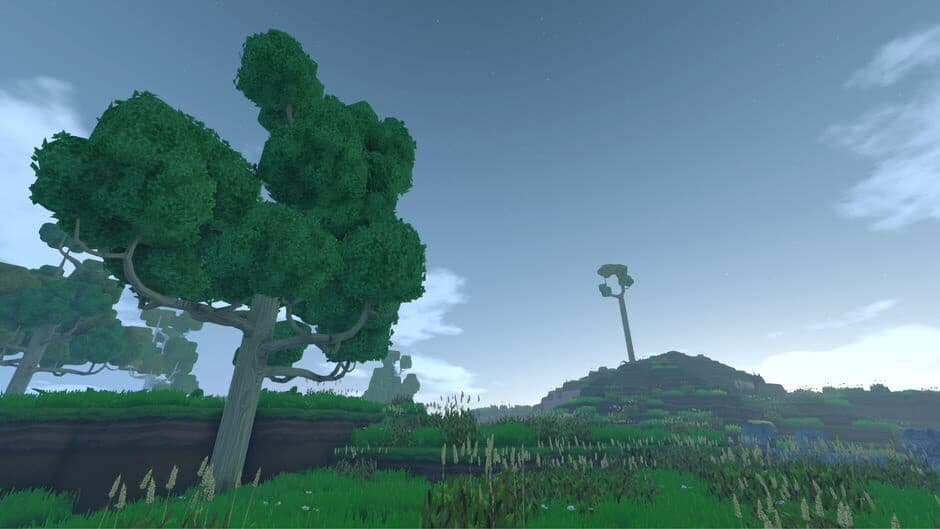
The environment reacts dynamically to player actions and industrial growth.
Eco’s most meaningful discoveries are not hidden landmarks. They are the consequences of realizing that your private shortcut has become a public problem.
This environmental responsibility gives the game’s world scale a practical purpose. The approaching meteor means settlement building and resource management are not isolated projects around one player’s base; they contribute to a civilization trying to survive a shared catastrophe. A forest cleared for materials, a town expanded into new territory, or resources directed toward one specialization can affect the community’s ability to advance toward that objective. Eco therefore makes environmental management part of world-scale collaboration: the landscape supplies the materials needed for progress, but careless use can create conflict over debris, payments, and local policy. The design works because it connects ordinary labor to consequences beyond the immediate workbench, even if its environmental pressure is expressed more through community systems than through a richly authored wilderness.
Exploration itself is consequently less rewarding as adventure than as orientation. Finding resources matters because those resources feed the settlement’s economic and technological needs, while locating towns and cities reveals the political structure that governs access and responsibility. Yet Eco rarely frames discovery as a dramatic personal revelation; the value of a new area depends on how it fits into the community’s plans. That makes exploration organically meaningful for players who enjoy surveying a shared world and identifying where their labor belongs, but comparatively thin for anyone expecting the secrets, landmarks, or self-contained rewards of a conventional open-world game. The game’s geography is infrastructure first and scenery second.
Where this breaks down is the lack of clear local context. A newcomer may discover that their homestead has been adopted by a city or that they belong to a local town without understanding the territorial and political systems behind those assignments. Combined with notifications about debris policies, taxes, and rewards, the result makes the world feel governed before it feels legible: the player is already implicated in civic decisions before they know which community they have joined or what obligations come with that membership. This is more than a tutorial problem. It weakens exploration by making arrival feel administrative rather than curious, because entering a new part of Eco can mean encountering rules and affiliations that the game has not adequately explained.
Eco’s environmental systems are therefore stronger as a simulation of responsibility than as a system of discovery. The meteor gives land use consequences beyond any single base, and resource gathering becomes genuinely communal when cutting a tree can intersect with policy and taxation. But the game’s weak explanation of towns, cities, and homesteads makes that consequence difficult to interpret, especially for players who have not already learned the server’s political language. Exploration supports Eco’s civilization fantasy when players understand the society they are exploring; before that, it mainly serves as the front door to a maze of administration. That is a distinctive achievement, but also a reminder that Eco is interested in making players citizens—not adventurers.
Eco’s Narrative Framework: A Strong Premise With Limited Character-Driven Storytelling
Eco’s meteor is less a plot twist than a deadline imposed on an entire society. That distinction matters: the threat gives otherwise disconnected players a concrete reason to cooperate, turning gathering, construction, and technological advancement into responses to a shared crisis rather than isolated survival chores. When a community must decide which resources, industries, or infrastructure deserve attention before the catastrophe arrives, the meteor supplies stakes that ordinary crafting systems cannot create. Eco’s narrative succeeds because its central emergency makes cooperation meaningful; players are not simply building a settlement, but trying to make civilization itself survive.
In Eco, the civilization is the protagonist—and its best scenes are written by the people arguing over how to save it.
The game’s most memorable stories therefore emerge from player action rather than authored plot. Economic dependencies create immediate drama: one player’s raw materials may be necessary for another’s specialization, while a communal project can expose disagreements over labor, priorities, or resource distribution. Laws, taxes, rewards, towns, cities, and homestead relationships turn those disagreements into lasting consequences, allowing a dispute over how the settlement should operate to become part of its history. A rule concerning debris can transform tree-cutting from an unremarkable survival task into a political flashpoint, while payments or rewards can determine whether a contribution feels recognized or exploited. This is storytelling through institutions, and Eco is unusually effective when its systems force players to negotiate the values of the society they are building.
However, that emergent strength also defines the limits of Eco’s narrative framework. The game’s storytelling is centered on systems and community behavior, not on authored characters, dialogue, voice acting, or a conventional narrative campaign with personal arcs to carry the player forward. The meteor provides a clear premise, but it does not automatically provide individual emotional stakes; those must come from the people sharing the server and the consequences of their decisions. A player who enjoys watching a town develop laws, economies, and rival priorities will find plenty to interpret, while someone expecting memorable companions or scripted dramatic turns will find the experience comparatively sparse. Eco asks players to remember the argument over a tax or the collapse of a communal plan—not a character’s monologue—and that is a deliberate trade rather than an accidental omission.
This makes Eco’s narrative unusually dependent on participation. A lively, cooperative server can turn the meteor into a pressure cooker for political stories, with every economic dependency and communal project reinforcing the sense that the settlement has a shared past and an uncertain future. On a quiet or socially disconnected server, the same framework loses much of its dramatic force because there are fewer competing priorities and fewer relationships for its systems to shape. Eco’s premise is strong enough to motivate civilization-building, but its narrative payoff belongs to the community that forms around it. The result is not a story you passively consume; it is a civic drama you help create, provided the server gives you people worth building with.
Eco’s Visual Design and Audio: A Specialized Simulation Undercut by Dated Presentation
Eco’s visual problem is not that it refuses to chase photorealism; it is that its rough presentation often looks accidental rather than purposeful. Eco has a specialized simulation underneath, but its dated visuals weaken the first impression beside newer survival and city-building games, where even utilitarian worlds usually establish a clearer visual identity. The criticism is especially difficult to dismiss because the game’s central systems—civilization, environmental management, economics, and governance—already demand patience from the player. When the presentation also feels old-fashioned, Eco makes its audience work harder before its strongest ideas have a chance to land.
The character creator and models are the clearest failure. Characters have been described as hideous and “wild-eyed,” and that judgment points to more than low visual fidelity: the designs lack the appealing stylization that could have made simplicity feel deliberate. Attractive graphics are not essential to a game built around taxes, specialization, and civic planning, but unappealing character design is not the same as functional minimalism. A player spending hours inside a shared settlement is repeatedly represented by these avatars, so poorly designed faces make the social simulation less inviting at precisely the point where Eco needs players to feel attached to their community. This is where the seams show: the game asks players to invest in the identity of a civilization while giving that civilization an unusually unwelcoming human face.
Eco does not need cutting-edge graphics. It needs an art direction strong enough to make its world feel intentional—and its character models rarely clear that lower bar.
The interface is more defensible because it prioritizes information over atmosphere, but even that strength comes with qualifications. Pop-ups about debris policies, taxes, rewards, local towns, and homestead adoption demonstrate that Eco can communicate the existence of its economic and territorial systems; the problem is that it often communicates them all at once, before the player understands their hierarchy or consequences. In other words, the presentation is informative without being consistently readable. That distinction matters in a game where a simple act such as cutting down a tree can carry civic implications: the interface surfaces the rule, but the visual design does little to make the larger structure feel intuitive. Eco’s functional clarity is therefore real but limited—useful for players already learning the simulation, intimidating for newcomers still trying to understand what they are looking at.
Audio does not substantially repair that weak presentation. The available evidence does not establish a distinctive soundtrack, memorable voice acting, or a soundscape that gives Eco a strong identity, so this review cannot credit the game with an audio signature it has not demonstrated. That absence is less damaging than the character art because Eco’s drama is supposed to come from player decisions, server politics, and the pressure of the meteor rather than cinematic performance. Still, the result is an audiovisual package that rarely creates excitement on its own: the systems may generate a tense dispute over resources or policy, but the presentation largely leaves players to supply the atmosphere. Prospective buyers should also verify the platform listing before purchase: one source describes Eco as PC-exclusive with mouse-and-keyboard support, while Steam data lists Windows, Mac, and Linux. That discrepancy does not change the visual critique, but it is precisely the kind of basic product information that should be settled rather than assumed.
Eco’s graphics and audio are not disastrous because they are modest; they are disappointing because the art direction does too little to turn modesty into character. The interface supports the game’s dense civic simulation well enough to expose its rules, yet the dated world, awkward models, and unremarkable audio make the experience feel less mature than its underlying systems. Eco remains visually serviceable for players who treat presentation as secondary, but its specialized simulation deserved a clearer, more welcoming shell.
Eco’s Technical State and Early Access Legacy: Improved Systems, Unclear Progress
Eight years in Early Access is no longer a footnote; it is a promise. Eco has had enough time for its systems to become unusually ambitious, but returning players may still struggle to see a proportionate improvement in the game’s visible polish or onboarding.
The development progress is real, but it is easier to feel inside the simulation than to recognize from the outside. Eco’s interconnected economies, laws, taxes, rewards, towns, cities, and environmental policies form a more sophisticated machine than a basic survival sandbox, and those systems give returning players more mechanical depth to discover. Yet the first moments can still be dominated by pop-ups about debris policies, payments, unfamiliar towns, and homestead adoption, creating the impression that the game has accumulated complexity faster than it has clarified it. Someone who steps away for years and returns may reasonably ask what has changed, because the underlying machinery has advanced without producing an equally obvious transformation in presentation or player guidance.
Eco has spent long enough in Early Access to feel like a mature simulation underneath—and an unfinished project everywhere the player has to learn how that simulation works.
That distinction defines Eco’s current technical state. The game’s systemic foundation feels deliberate: resource gathering feeds specialization, specialization supports communal construction, and governance gives those activities consequences beyond the inventory. But systemic depth is not the same as finish, and Eco’s dated presentation and administrative onboarding—already substantial barriers for new players—make its maturity difficult to read. The result is not evidence of a specific performance failure: the supplied research gives no frame-rate measurements, crash rates, load times, or documented bugs, so claims about stability must remain cautious. What can be judged is the player-facing polish, and there the seams are clear: Eco frequently explains that a rule or institution exists before it explains why the player should care.
The reception snapshot shows why this unevenness has not killed the game’s appeal. Steam data lists Eco at $29.99, with approximately 13,964 reviews and an 81/100 player score, including 11,274 positive and 2,690 negative reviews. That Very Positive response confirms that the game’s dedicated audience values its unusual blend of survival, economics, and civic management, but it does not erase the reasons some players bounce off: an eight-year Early Access legacy, complicated servers, limited solo viability, and presentation that feels older than the ideas underneath. For returning players, the question is not whether Eco has evolved—it has—but whether that evolution is visible enough to justify renewed confidence.
Eco’s long development has produced a remarkable simulation, yet not a consistently polished product. The game’s strongest improvements are embedded in its institutions and interdependent systems, while its weakest areas remain the basic acts of understanding and entering the world. That makes Eco worth revisiting for players who want deeper civilization management, but prospective buyers should treat the Early Access label as a meaningful warning: this is a game with mature ambitions and an unclear sense of completion, not a finished survival experience whose rough edges have been fully resolved.
Final Eco Verdict: Who Should Buy This Community Simulation?
Eco is not a survival game for everyone—and that is precisely why it remains worth discussing. Its combination of resource gathering, economics, political simulation, and collective governance is so unusual that comparing it with ordinary survival sandboxes misses the point; Eco is a community simulation disguised as a survival game, and its narrow appeal is inseparable from its originality.
The closest comparisons are EVE Online and heavily modified Minecraft communities built around player administration, not straightforward survival games. Like EVE, Eco can turn a simple task into a spreadsheet-like social problem: resources require specialization, specialization creates dependencies, and laws, taxes, rewards, towns, and cities determine how those dependencies are managed. Like a governance-focused Minecraft server, its most memorable moments come from players deciding how their shared world should function rather than merely building impressive structures. The difference is that Eco gives those decisions a common deadline—the meteor—so political arguments are connected to a civilization-wide objective instead of existing as optional role-play.
Eco is the rare game where a tax policy can matter as much as a new tool, because both determine whether the civilization reaches its goal.
That originality is also Eco’s commercial weakness. Players seeking an immediately approachable modern survival game will find little comfort in server rules, dense onboarding, dated visuals, and the requirement to participate socially. A newcomer can cut down a tree and be confronted with debris policies, taxes, rewards, an unfamiliar local town, and a city adopting their homestead before understanding the basic logic of the server. Solo players face the opposite problem: the systems remain intricate, but the communal specialization and political negotiation that make them meaningful are largely absent. Eco does not merely ask for time; it asks for civic attention, patience, and a willingness to work with people who may already have established routines.
At the listed $29.99 price, Eco’s value depends almost entirely on whether that proposition sounds appealing. You are not buying a visually polished solo campaign or a neatly packaged sequence of survival challenges; you are buying access to a long-running server simulation whose value grows when players coordinate, establish institutions, and create shared history. A welcoming group of friends can justify the price quickly because the meteor objective, interdependent economy, and governance systems generate stories that conventional crafting games cannot. For a buyer planning to browse random servers alone, the same price is harder to defend: the server browser offers no matchmaking or group-finding safety net, and a poor community can make most of Eco’s depth inaccessible.
Eco also has durable replay value, but it is the replay value of a social system rather than a conventional campaign. Different servers can produce different laws, economic priorities, civic structures, and political disputes, and the dedicated communities that have remained with the game demonstrate that these emergent situations can sustain long-term engagement. However, the available evidence does not establish a fixed campaign length, a broad formal endgame, or a range of structured scenarios that guarantee fresh content. Eco’s replayability therefore depends on restarting with a new community or watching a familiar community evolve—not on a large menu of authored endgame activities. That is potentially endless for players who enjoy institutions and negotiation, but limited for anyone who expects a traditional progression arc to keep reinventing itself.
The recommendation is straightforward. Buy Eco if you enjoy economic planning, bureaucracy, political systems, and the satisfaction of contributing to a civilization with friends or strangers; its meteor deadline and shared infrastructure make cooperation feel necessary rather than decorative. Approach it cautiously if you are socially reserved, intend to play alone, or dislike learning server-specific rules before you understand the wider game. Conventional survival players looking for an easy base-building loop should look elsewhere, because Eco’s greatest strength—making every player part of an interdependent society—is exactly what makes its barriers so severe.
Pros
- Cooperative civilization building: The meteor gives players a meaningful shared goal, while specialization, resource chains, construction, and technological advancement make individual contributions matter to the whole settlement.
- Niche originality: Eco combines survival, economics, political simulation, and player governance in a way that few games attempt, with laws, taxes, rewards, towns, and cities shaping practical play.
- Emergent community stories: Different servers can develop their own policies, conflicts, economies, and civic identities, giving long-term players reasons to return beyond simple resource collection.
- Strong value for the right audience: At $29.99, the game can support a long-running collaborative server experience rather than a short, disposable co-op session.
Cons
- Severe accessibility barriers: Dense notifications, extensive server rules, and unfamiliar systems can overwhelm newcomers before they understand how to participate.
- Limited solo appeal: A solitary player cannot easily reproduce the specialization, negotiation, and shared responsibility that power Eco’s best moments.
- Unreliable multiplayer access: The server browser leaves players to find a suitable community themselves, while time-zone gaps and established friend groups can produce genuine social isolation.
- Dated presentation: Awkward character models and old-fashioned visuals make Eco feel less inviting than its sophisticated simulation deserves.
- Unclear Early Access value: After eight years in Early Access, the mechanical depth is evident, but the visible polish and onboarding do not communicate a proportionate sense of completion.
Eco is a specialized recommendation, not a universal one. For players who want to help govern a living settlement, argue over resource policy, and watch a civilization emerge from collective labor, it remains one of the most distinctive simulation games available. For everyone else, the bureaucracy, social dependence, dated presentation, and uncertain finish make the $29.99 asking price difficult to justify. Buy Eco for the community, not the graphics—and only if building that community sounds like the game.