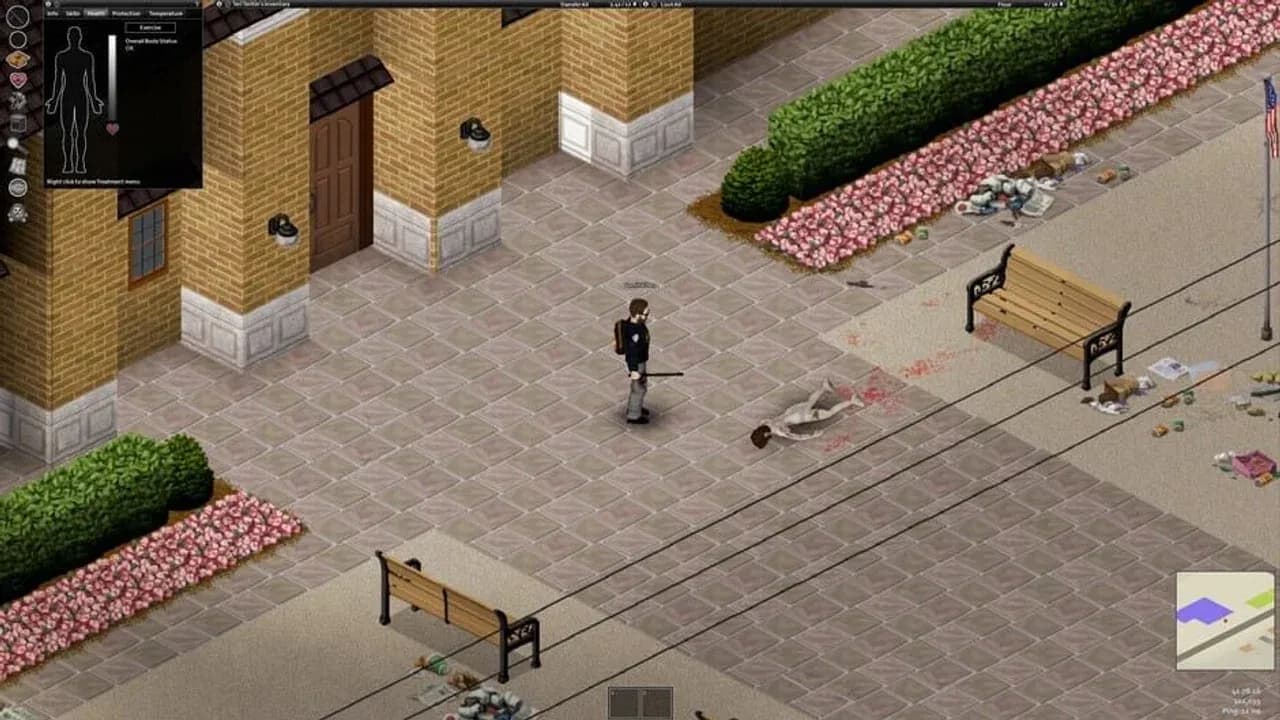
Indoor campfire safety in Build 42.20 is not a simple property of the word “campfire.” The standard campfire and the new masonry fire pit are different objects, and the strongest available evidence does not justify treating every concrete, stone, or metal floor as safe. What you can do is rank the evidence: wood and carpet are unsafe when fire spread is enabled, dirt, sand, and gravel are the strongest reported firebreaks, and the remaining hard-floor cases need a fresh test in your own save.
That distinction matters because Build 42.20’s official notes mention campfire interaction and fuel-check fixes, but do not publish a floor-by-floor fire-spread matrix. This guide separates reported-safe, reported-unsafe, and unresolved cases, then isolates FireSpread, NoFire, and MaximumFireFuelHours before giving you a disposable-room test you can run without gambling your real base.
Build 42.20 Changes the Question: Campfire or Masonry Fire Pit?
Build 42.20 is the correct version boundary for this test. The stable release arrived on July 29, 2026, and its notes mention improved campfire controller interactions and a fix for checking campfire fuel. They do not announce a change to indoor fire spread, floor flammability, or masonry fire-pit safety (Features Overview: Build 42.20, 42.20 stable patch notes).
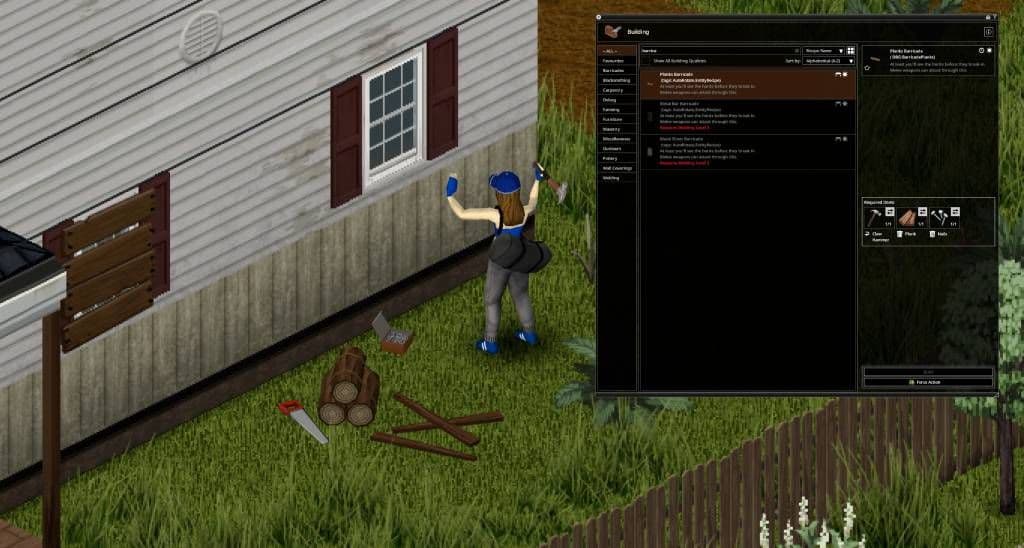
Build 42 building interface and player-built structure; supports the version and construction context, not fire behavior.
Official Build 42.20 material provides no floor-by-floor safety matrix. Build 42 expanded masonry, building, crafting, and sandbox systems, but the Indie Stone’s earlier fire-rewrite posts describe iterative or planned behavior rather than a final specification for how every current floor reacts. Observations from Build 42.19 or earlier are useful, but you should treat them as version-qualified reports to recheck in a 42.20 save.
The object matters just as much as the version. A standard campfire placed on an indoor floor is one test: the surrounding tiles and nearby furnishings may determine whether structural fire spreads. A masonry fire pit is a separate Build 42 object, and player reports describe it behaving more like a contained indoor fire source. In one detailed admin test, a masonry fire pit burned for repeated five-day runs beside carpet and other flammable items without reported spread. That result is encouraging, but it does not answer what happens when you place a standard campfire on the same carpet.
Use the same separation when comparing this guide with existing coverage. General heat-source advice and generator guidance answer broader questions about cooking, heating, fuel, and exhaust; they do not establish whether a standard campfire can safely occupy a particular indoor tile. Identify the object you are placing before importing any advice, and label community observations as reported behavior rather than official guarantees.
The practical question is therefore not “Are indoor campfires safe?” It is “Which fire object am I testing, in which Build 42.20 environment, and what evidence supports that exact combination?” Once the standard campfire is isolated from the masonry fire pit, the next step is to examine the floor materials themselves.
Wood and Carpet Are Unsafe; Dirt, Sand, and Gravel Are the Strongest Reported Firebreak
With FireSpread enabled, treat a standard campfire on a wooden or carpeted indoor floor as reported-unsafe. Community reports identify the surrounding floor and nearby flammable tiles as the danger, so a fire that looks contained on its starting tile can still put the room at risk. The same caution applies to furniture and other flammable clutter within the surrounding area.
The strongest reported-safe setup—meaning community-reported firebreak behavior, not verified Build 42.20 safety—is a standard campfire centered on a broad patch of dirt, sand, or gravel. These substrates are repeatedly reported as practical firebreaks in Build 42 discussions, but no official material table confirms that they prevent spread in every situation. Treat this as the best-supported starting point, not a permanent guarantee.
For a practical comparison, do not place the campfire directly on a wooden or carpeted floor. Instead, replace the surrounding area with sand, dirt, or gravel and center the fire in the patch. One current report describes a 3×3 sand area as a minimum convention, with 5×5 offering more caution. Those dimensions are community testing recommendations, not an engine-certified safety radius.
Decision matrix
| Object | Condition | FireSpread |
Evidence status | Recommended action |
|---|---|---|---|---|
| Standard campfire | Wood, carpet, or nearby flammables | true |
Reported-unsafe | Avoid; clear flammable clutter before testing |
| Standard campfire | 3×3 or larger dirt, sand, or gravel patch | true |
Reported-safe* | Use only as a disposable-room starting point and repeat the test |
| Standard campfire | Concrete or stone | true |
Unconfirmed | Fresh test required before main-base use |
| Standard campfire | Metal floor | true |
Unresolved | Do not make a safety claim without a fresh controlled test |
| Standard campfire | Any floor used as a control | false |
Spread-control result | Does not certify the campfire tile as safe |
| Masonry fire pit | Carpet or other flammable items nearby | Not stated in report | Reported-safe* | Strongest reported indoor option; verify in your own save |
*“Reported-safe” means community-reported firebreak or indoor behavior, not verified Build 42.20 safety.
The useful distinction is therefore simple: wood, carpet, and nearby flammable tiles belong in the reported-unsafe column; dirt, sand, and gravel belong in the strongest reported-firebreak column. If you must test a standard campfire indoors, remove it from wood and carpet first, clear nearby flammables, and begin with the largest practical firebreak you can build. The result still needs to be rechecked in your own Build 42.20 save, because the evidence does not establish a universal coverage size.
Concrete, stone, and metal remain separate cases: the available evidence does not promote them to safe indoor campfire floors. They need their own tests rather than being inferred from this firebreak result.
Concrete, Stone, and Metal Still Need a Fresh Test
Hard floors are where a useful observation can become bad advice. One recent test placed a standard campfire on concrete inside a stone-walled building and observed no spread for three to six hours. That is valuable evidence, but the tester explicitly treated it as inconclusive rather than proof that concrete is permanently safe (campfire test discussion).
The same result does not certify stone. The test describes the building’s stone walls and concrete floor, not a controlled comparison of every stone or concrete tile. It also does not establish what happens after a longer burn, under different world settings, or in another Build 42.20 save. Record concrete and stone as unconfirmed, not reported-safe.
Metal is even less settled. The available discussions provide no sufficiently current, controlled metal-floor result, so you should record metal as unresolved rather than calling it safe or unsafe. A short period without visible spread is not enough to promote any of these materials into a universal safety class.
Official Build 42.20 material does not fill that gap: the feature overview, stable patch notes, and sandbox documentation publish no floor-by-floor campfire matrix. Reports about masonry fire pits also cannot be transferred to standard campfires, because they are separate objects with different observed behavior. Until a fresh 42.20 test reproduces the result under your own settings, treat concrete, stone, and metal as unsuitable for a main-base safety decision.
The next variable to isolate is the active sandbox and server configuration.
FireSpread, NoFire, and MaximumFireFuelHours Do Different Jobs
The settings answer different questions, so record them before comparing any indoor campfire result. FireSpread is the Boolean sandbox option that controls whether fires spread; the official SandboxOptions documentation confirms the field, and the Build 42.19 configuration reference lists true as the documented default. Verify your own save because preset values may differ.
Use the same disposable-room condition as a control:
- With
FireSpread=true, test the campfire’s actual spread risk across the chosen floor and nearby tiles. - With
FireSpread=false, test whether fire moves from tile to tile. A result without spread does not prove that the campfire tile itself is safe to stand on or that other fire risks disappear.
NoFire is separate. The official server-options documentation exposes both NoFire and SafehouseAllowFire, while the Build 42.19 settings reference reports that NoFire=true still permits campfires. Treat NoFire as a broader server fire restriction with a reported campfire exception—not as an alternative way to disable campfire spread. Record SafehouseAllowFire as well, especially when testing inside a protected multiplayer safehouse.
MaximumFireFuelHours controls how long a campfire or similar fire container can hold fuel. The SandboxVars reference identifies it as an integer, and the Build 42.19 configuration reference documents a 1–168 range with 8 as the default. A separate Build 42.19 fuel-setting report lists 8-hour caps for Apocalypse, Rising, and Extinction and a 12-hour cap for Outbreak, but those preset values should be checked against your current world rather than assumed.
That creates an important comparison: an 8-hour test and a reported 12-hour Outbreak test differ in how long the fire can remain active, not in the flammability of the floor. More fuel can expose a spread problem for longer, but neither a shorter burn limit nor a longer one makes an unsafe floor safe. Likewise, NoFire=true is not proof that an indoor campfire is harmless.
Before trusting a result, write down FireSpread, NoFire, SafehouseAllowFire, and MaximumFireFuelHours, then hold every other variable constant. With those controls isolated, you can run the repeatable disposable-room test without risking the established base.
Run a Disposable-Room Test Before You Trust an Indoor Fire
The settings only make a comparison meaningful; they do not make your main base a test site. Build a disposable room away from your stored supplies, clear furniture and other unrelated flammables, and test one fire object on one floor material at a time. In Build 42, campfire construction uses the Building menu, and you should prepare fuel, tinder, and an ignition source separately. Fatigue can prevent construction or lighting, so start each run with a rested survivor (Build 42 campfire discussion).
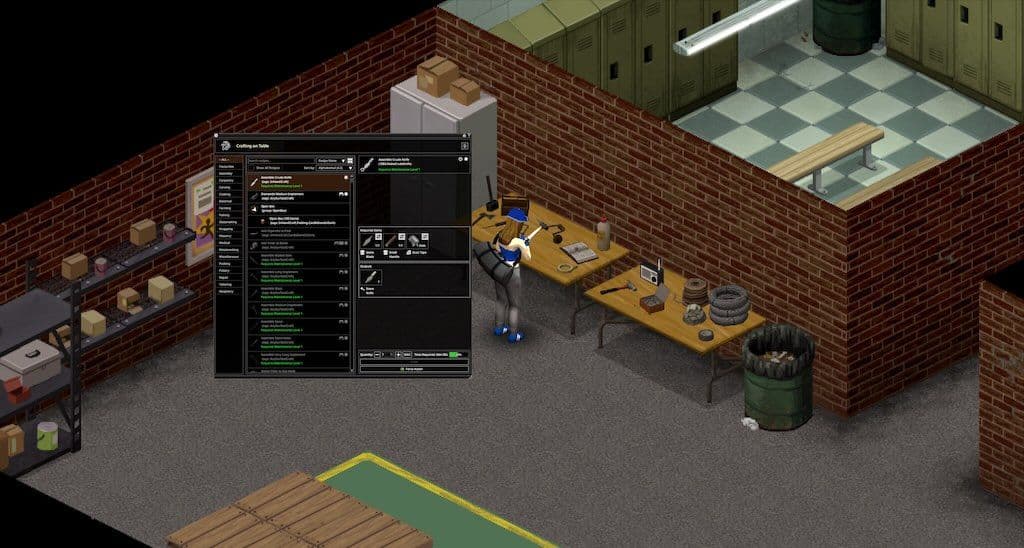
Build 42 crafting workspace inside a constructed room; supports preparation and disposable-room context, not a fire-safety result.
Use the same procedure for every condition:
- Place either a standard campfire or a masonry fire pit; do not treat the two objects as interchangeable.
- Use the same fuel load and record
FireSpread,NoFire,SafehouseAllowFire, andMaximumFireFuelHours. - Test one floor material at a time, with the surrounding area cleared of avoidable flammable clutter.
- Let the fire run through the relevant fuel duration for that save. Repeat each condition, and use a longer fuel window where your settings allow it.
- Label the result as reported-safe, reported-unsafe, or unresolved rather than turning one short run into a permanent safety rule.
The masonry fire pit currently has the strongest reported indoor result. In repeated player-admin tests, it burned for five-day runs beside carpet and other flammable items without reported structural spread (masonry fire-pit test). That is useful evidence, but it is still a player report that predates stable 42.20, applies only to the tested masonry object, and does not certify a standard campfire.
If you need to test a standard campfire indoors, begin with the broadest practical dirt, sand, or gravel firebreak, keep FireSpread=true, and remove nearby flammable clutter. Repeat the test before committing the setup to a real base. A short period without visible spread—especially on a hard floor—remains an observation, not permanent certification.
Boundary note: Preventing tile-to-tile spread does not automatically establish that the fire is safe to stand on, that players or zombies cannot ignite, or that the object cannot be walked through. A Workshop mod describes these as separate concerns, but its description is not proof of vanilla behavior. No reviewed source establishes that an indoor standard campfire is harmless to breathe, so do not transfer the wiki’s generator-exhaust warning into a definitive campfire smoke or carbon-monoxide claim.
The practical choice is therefore conservative: prefer a masonry fire pit when an indoor fire is necessary. Otherwise, a dirt, sand, or gravel patch is only the strongest community-reported firebreak starting point—not a verified safe floor—so test and repeat it in a disposable room with nearby flammable clutter removed before committing the standard campfire to a real base. Keep every other floor provisional until a fresh test in your own save supports it.