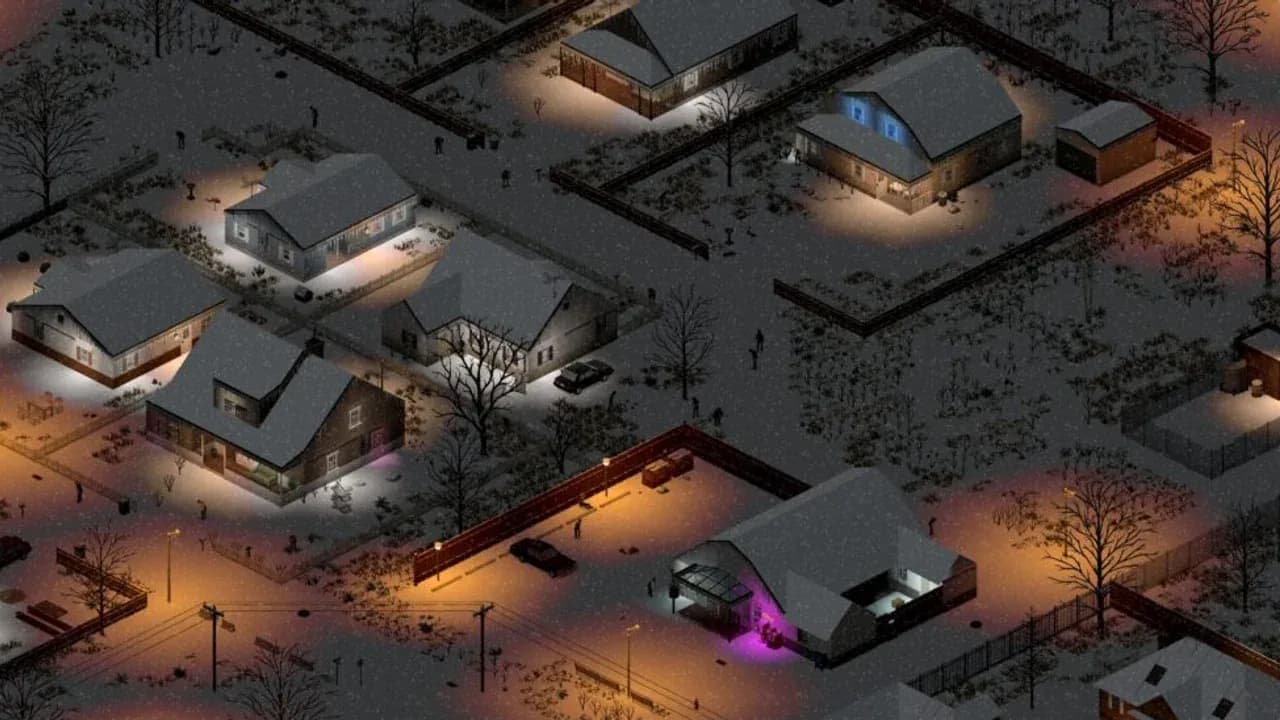
Project Zomboid opens with an obituary. Before the world loads, three lines appear — These are the end-times. There was no hope of survival. This is how you died. — and the verb is in the past tense, so the ending has already been decided and you are only being asked to fill in the middle. It is easy to read that as a marketing shrug about difficulty. It isn't. It is a specification, and The Indie Stone has honored it for nearly thirteen years by cutting everything from the game that disagreed — starting with the only story the studio ever wrote.
You Are Not Playing to Win, You Are Producing a Document
There is no state the game describes as winning. Steam's own page asks the same question the loading screen answers — not whether you will die but how — and promises only that your survivors will "delay their inevitable death day by day."
So what you produce instead of a victory is a record: a particular survivor, with particular traits, who made a particular sequence of choices in Knox Country and stopped at a particular moment. The score is not how far you got. The score is what happened.
The game is funny about it, which is the tell that this is a considered position rather than edgelord marketing. The status icon you get for dying reads "High chance of becoming rat food." The one for dying while infected reads "Sudden desire to eat people." Those are jokes written for two icons you see once per character, told at the survivor's funeral by the same authorial voice that opened by telling you they were already gone.
The Studio Deleted the Only Story It Ever Wrote
Project Zomboid used to have authored narrative, and it was good. 'Til Death Us Do Part was a story mode that doubled as the tutorial: you played Bob "Baldspot" Smith, holed up in a house with his wife Kate, whose leg had been broken by looters. You ripped sheets into bandages for her, found painkillers in the medicine cabinet, barricaded the ground floor with planks from the shed. Kate talked to you the whole time — when Bob promises to make the place a fortress, she answers, "Third fortress this week." Then a man named Bobby Collins walked in with a shotgun, decided Kate's broken leg was a bite, and started counting down from three. Fight him in the open and he kills you. Your only chance was to hide and ambush him with a hammer.
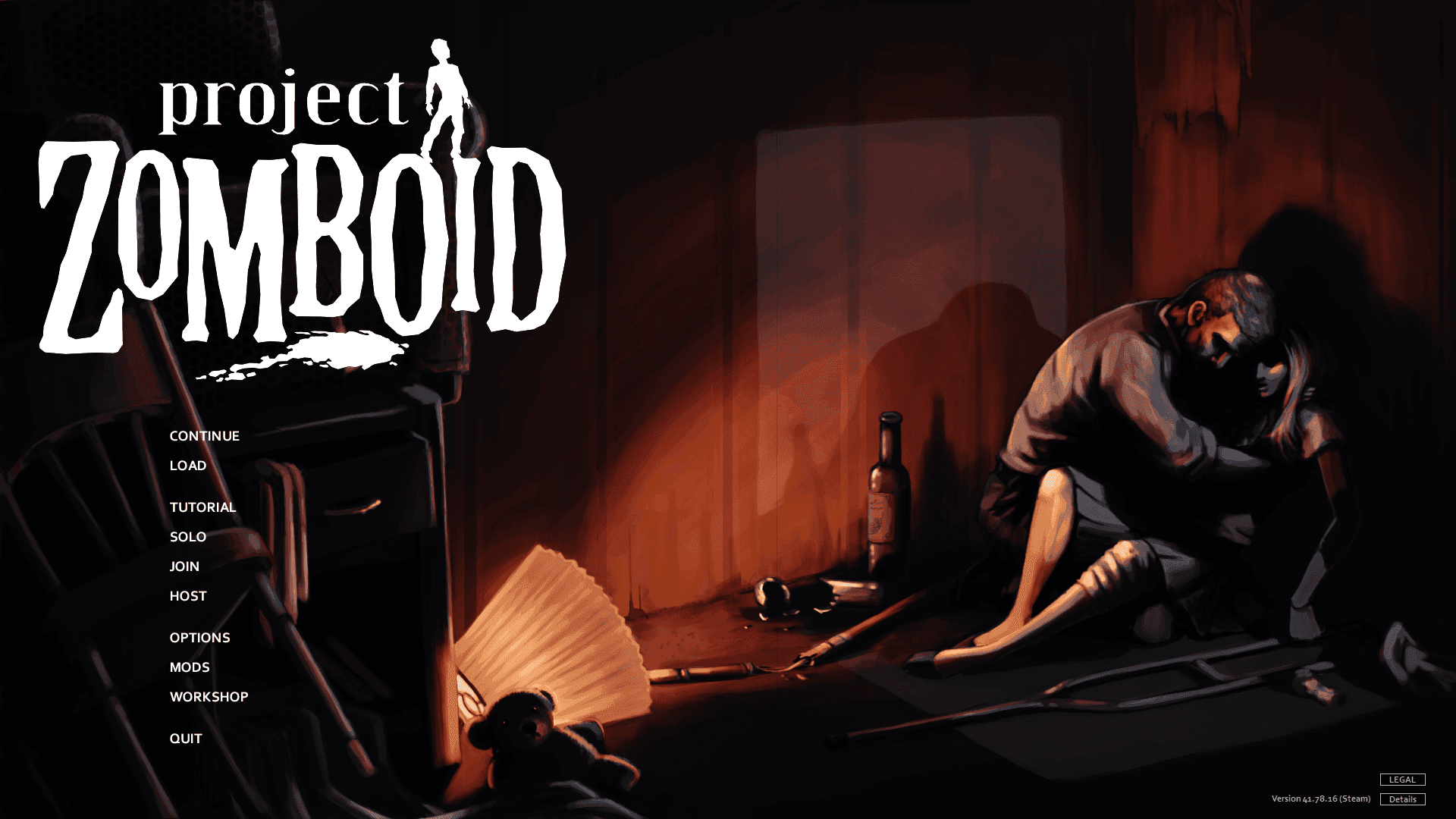
The Build 41 title screen kept 'Til Death Us Do Part on the wallpaper for a decade after the story itself was cut.
There was also a second, quieter ending built into the tutorial. The closet next to Kate's bed contains a pillow, and using the pillow on Kate smothers her and ends the tutorial early. That is the skip button. The studio's escape hatch out of its own authored content was killing the person it had just spent ten minutes teaching you to care for.
All of it was cut in 2013, with version RC 2.9, along with the NPC survivors it depended on, because those NPCs were too buggy to ship. What replaced it, in Build 41, is a tutorial narrated by Spiffo — the raccoon mascot of an in-fiction fast food chain — who cheerfully describes the training map as the lonely place where you are about to die, and who threatens the player with "termination" for opening a window and not climbing through it. The authored content that survived the cut is the authored content that agrees with the motto.
Your Corpse Becomes Terrain
Permadeath undersells what actually happens here, because the character dies and the save does not. The world you were living in keeps existing, and you can walk straight back into it as somebody else.

Your predecessor is still there. If you died infected you do not leave a body at all — the game's documentation is blunt about it, the uncontrollable player will rise from the ground and aimlessly wander the world — and everything they were carrying is still on them. To get your kit back you find your former self somewhere in the neighborhood, recognize the outfit, and put them down.
That is the only narrative device the game has and it beats a cutscene, because a cutscene tells you what a death meant while this makes the death into level design. The previous character becomes a hazard with a name you chose and a shirt you picked, wearing the backpack you spent weeks filling. The record is not a stat screen. The record is walking around.
The honest cost is the skills. Carpentry, mechanics, aiming, fitness — the survivor's actual accumulated competence — die with the survivor, and that is the real basis of the complaint that permadeath wastes your time. But look at what the game gives you to answer it: skill books, which multiply experience gain so heavily that a replacement rebuilds a trade far faster than the first survivor ever did — because you already know which house had the carpentry manual. The competence is character-bound. The knowledge is yours. That is the trade the loading screen was describing all along — the person is temporary and the county is not.
The Simulation Schedules Your Ending, Then Makes You Watch
Project Zomboid almost never kills you by surprise. It kills you on a timetable it shows you in advance, and that is what makes the deaths worth documenting.

Take the bite. The Knox Infection is invariably fatal, and it runs as flu-like symptoms for up to three days before you die and reanimate within the hour. A bad second at a window therefore buys you days of certain knowledge. You keep playing. You go back out, because there is no longer any reason not to, and the last stretch of a character's life gets spent with full information and nothing left to lose — the exact situation dramatists spend whole acts engineering.
Take panic, which is a character arc expressed as a decay rate. It climbs 3% for every zombie your survivor actually sees on screen and another 0.5% per in-game minute they stay in view, narrowing your vision cone and cutting your critical chance for as long as it lasts. But recovery gets faster every day you stay alive, up to a cap at 150 days survived: on day one, shedding a full panic meter takes about 56 seconds, and at the cap it takes two seconds. Nobody wrote a scene where your survivor stops flinching. The number just moves, for as long as they last.
Take noise, which is a debt the world always collects — and the clearest illustration of it sits inside the deleted tutorial. Leave the oven on while you go upstairs to hear the radio, and the smoke alarm brings forty zombies within two seconds and ten more the second after. Even in the studio's one piece of hand-written drama, the best scene was a systems scene: an appliance, a sound radius, and a mistake you can trace.
Build 42 Makes the Best Case Yet for Staying Alive
Build 42 landed on the stable branch on 29 July 2026 as version 42.20, nineteen months after it opened as an unstable beta on 17 December 2024, and its pitch is self-sufficiency — blacksmithing, pottery, brewing, animal husbandry, a crafting tree deep enough that you can stop scavenging and start producing. Knox Country grew to match. By the art department's own count the map's surface area has doubled since Build 41, with 1,400 new unique buildings, 20,000 new tiles and 400 procedural basements. It is now a place worth staying in.
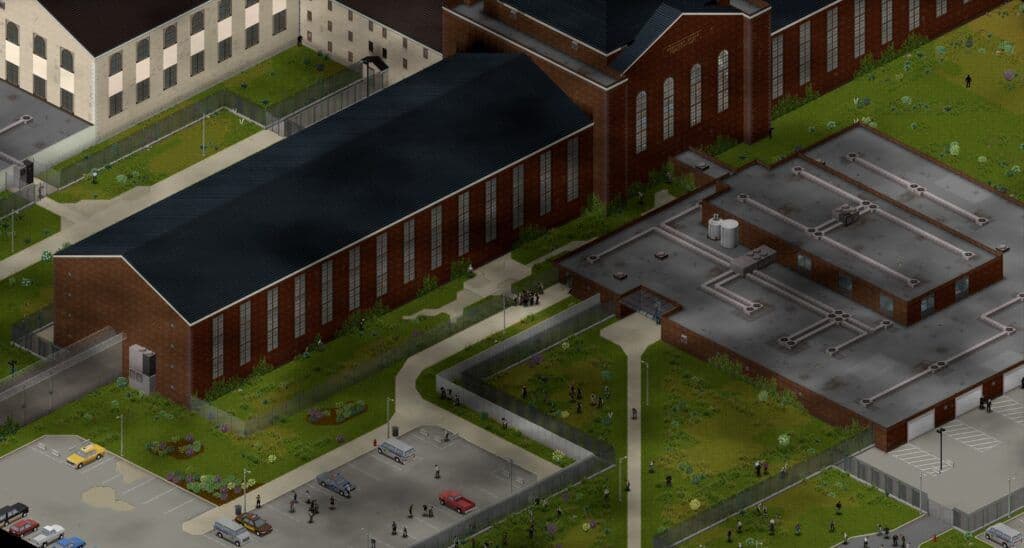
Build 42 rebuilt whole towns, including Rosewood's prison. The one thing it did not add was other people.
You could read that as the studio contradicting itself, and the reading is worth taking seriously: a game whose thesis is that you are already dead has just shipped its most convincing argument for permanence. Sandbox mode has always let you dial zombie population, infection lethality and loot rarity until the motto is simply untrue, but that is a settings menu — an opt-out. Build 42 is the first time the default game has handed you a plausible future.
It doesn't break the motto. It raises the price. Nothing about a forge or a goat pen changes the tense of the sentence on the loading screen; what they change is how much a survivor has to lose when the sentence comes due, and a death in a base you built from ore is a better document than a death in a house you found. The risk is not to the design. The risk is to the player, who now has a homestead to protect and every incentive to start playing like someone who intends to live — which is precisely the frame of mind the game was built to punish.
There is one absence that undercuts all of it, and it is thirteen years old. Build 42 ships without human NPCs; those are Build 43. Bob and Kate have been promised back since the day they were cut and teased in the studio's own footage since 2019, and they remain the one thing The Indie Stone has never managed to reinstate. As of this release they are not even on the title screen anymore, which Build 42 replaces with new menu art. The game has finally built a world worth surviving in and still has nobody in it to survive with.
So the sentence is still the whole design, and the only way to feel it is to stop insulating yourself from it. One character, one save, no restoring last night's backup because the bite was unfair. The bite is always unfair. That is what the past tense was warning you about, and Build 42 has only made it more expensive to ignore.