Factorio’s Core Loop: Turning Industrial Problems Into Compelling Puzzles
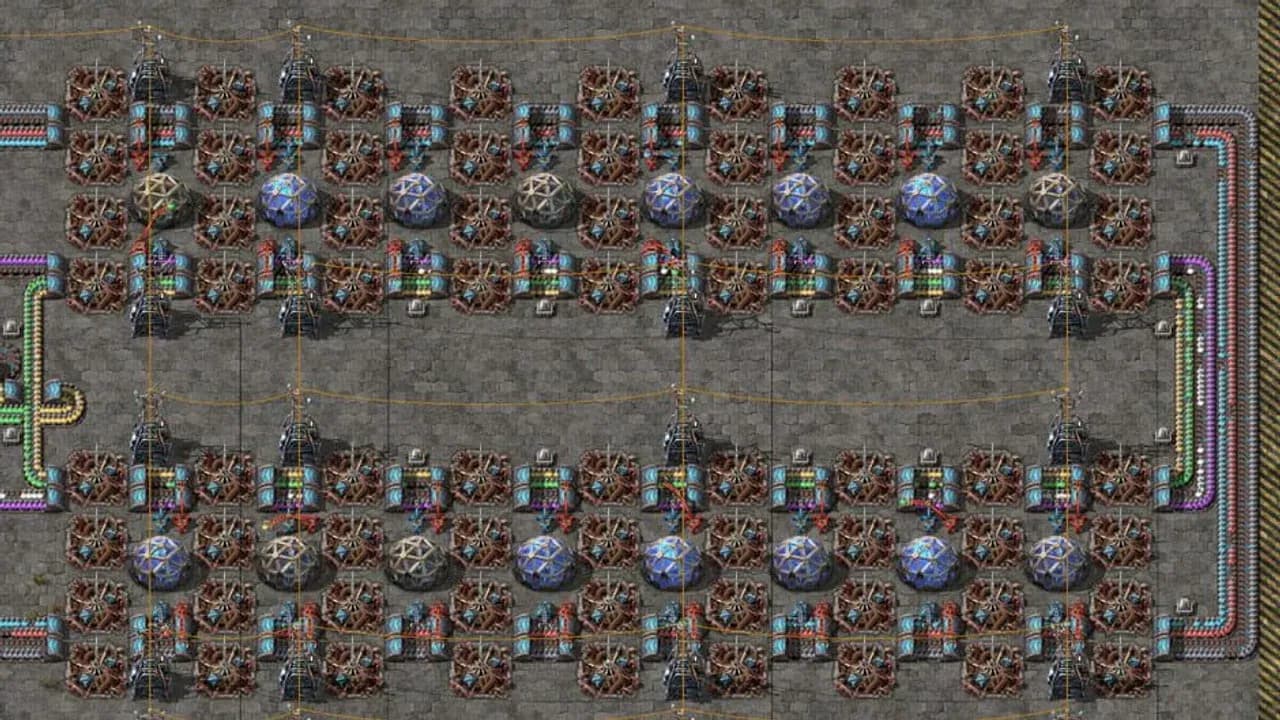
The intricate dance of automation in Factorio.
The Factory Is the Puzzle
Factorio turns industrial failure into its most reliable source of pleasure. You begin by mining iron and copper by hand, feeding stone furnaces, and assembling basic components yourself; soon, the obvious solution is to build machines that mine, smelt, transport, and assemble on your behalf. That solution immediately creates another problem: automated iron production demands more coal, expanded power, better belt routing, and eventually additional manufacturing capacity. Factorio’s central loop is therefore not simply “build a factory,” but solve the consequence of every successful improvement. A working production line is never the finish line—it is the mechanism that reveals what will break next.
Factorio’s greatest trick is making a shortage feel less like a setback than a design brief.
This progression feels earned because the game introduces scale through necessity rather than scripted spectacle. Manual mining gives way to drills and furnaces; electricity replaces the limitations of early coal-powered machinery; belts and inserters turn individual crafting into continuous production; oil processing and advanced manufacturing then force the player to rethink how materials are sourced and transformed before rocket construction becomes possible. Each tier arrives as an answer to a problem the player has already encountered, so research never feels like a checklist of arbitrary unlocks. The rocket is a clear milestone, but the satisfaction comes from recognizing that every component exists because the factory had to evolve to produce it.
Factorio also refuses to identify one correct way to build that evolution. A resource patch can be connected with belts, reorganized around a different machine arrangement, or eventually incorporated into a broader transport system; even an inefficient first attempt remains useful because machinery can be rearranged without cost on the default difficulty. That freedom turns experimentation into the game’s actual language: a production line that jams teaches more than a tooltip promising perfect ratios, while a successful workaround becomes a solution the player understands rather than one they merely copied. The absence of an optimal layout matters here. Every base carries the marks of its owner—the hurried belt junction, the rebuilt furnace block, the awkward expansion that somehow became permanent—and that accumulated history creates a sense of ownership few management games can match.
The design has a demanding cost. Factorio’s rewards depend on accepting long sessions, unfinished redesigns, and the knowledge that fixing one shortage may expose another in power, transport, or raw materials. This is not a casual management game built around quick victories; its most satisfying achievements emerge after repeated observation, rebuilding, and gradual improvement. The same constant stream of self-generated problems that makes the automation loop so absorbing can also turn the factory into a second job, particularly when “one more fix” becomes an entire evening spent rebuilding a system that was already functional. Fair warning: Factorio’s compulsive design is not a side effect—it is the direct result of making every solved problem a persuasive argument for continuing.
That tension defines the game’s identity. Factorio does not offer immediate gratification, but it offers something more durable: the feeling that a sprawling industrial system works because you understood it, tested it, and made it yours. For players willing to invest the time, the factory’s growth becomes an endlessly renewable engineering puzzle; for everyone else, the same depth can feel like unpaid labor. That narrow audience is a genuine limitation, but it is also why Factorio remains such a singular factory-building simulation: its best moments are not scripted rewards, but the instant a chaotic chain of machines finally begins to run.
Factorio Logistics and Progression: From Belt Spaghetti to Megabase Engineering
Factorio’s logistics are where a functioning factory stops being a collection of machines and becomes an engineering discipline. Every production line depends on a precise conversation between mining drills, smelters, assemblers, inserters, belts, pipes, power generation, and storage; starve any one part and the entire system can quietly stall. An iron shortage may look like a mining problem until the real culprit turns out to be insufficient belt capacity or an assembler consuming plates faster than the smelters can produce them. The game’s resource flow is readable because failures leave physical evidence: empty belts, idle machines, backed-up outputs, and power systems unable to keep pace. Factorio makes debugging an industrial network feel less like maintenance and more like solving a machine that is explaining its own mistake.
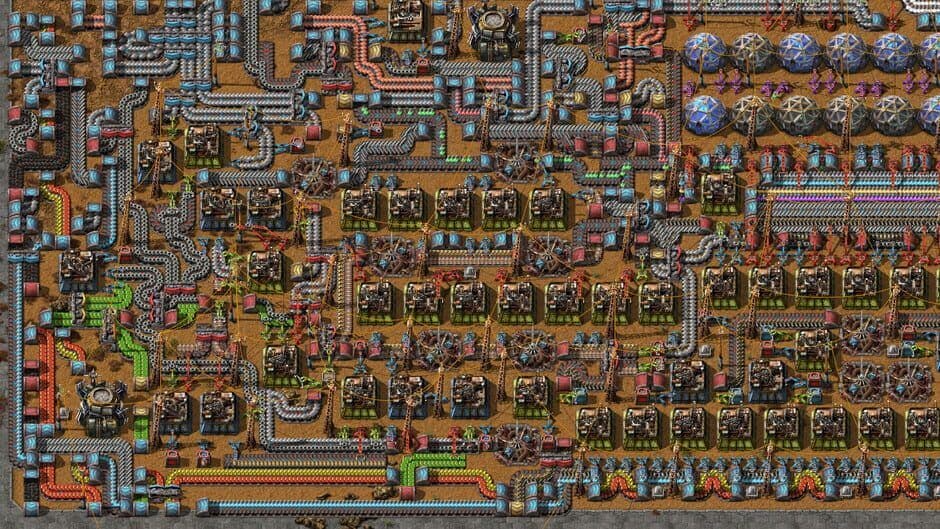
Automated production lines.
Every Shortage Is a Design Problem
This is where bottleneck-driven optimization becomes Factorio’s defining pleasure. Iron, copper, coal, electricity, oil, and transport capacity are not abstract numbers buried in a menu; they are visible pressures that force infrastructure changes. A copper shortage might require more drills and smelters, but scaling those systems can expose a shortage of power, which then demands additional steam generation or a different power arrangement. Likewise, expanding production often creates a transport problem: a belt that handled an early circuit line becomes inadequate once several assemblers compete for the same supply. The game rarely needs arbitrary difficulty spikes because the factory generates its own escalating demands.
Production chains become substantially more demanding once Factorio moves beyond plates and basic components. Circuits require copper wire, plastics depend on oil processing, rocket fuel demands further chemical production, and science packs combine multiple secondary and tertiary materials into research systems that consume resources continuously. This complexity is mostly successful because the game lets players trace each product backward through its dependencies: when advanced science stops, the missing ingredient is usually discoverable by following the interrupted chain. However, the distinction between a satisfying puzzle and tedious administration becomes dangerously thin around oil and higher science tiers. Managing crude oil, heavy oil, light oil, petroleum, lubricant, and water requires complicated recipes, ratios, storage, and conversions, while advancing science can demand repeated expansion into new resource areas and the construction of supply lines that resemble earlier ones with different machinery. The payoff is real—but the path to understanding it can produce a genuine headache before the system finally becomes intuitive.
Factorio’s logistics are brilliant because every failure is legible; they are exhausting for the same reason, because the game expects you to investigate every failure yourself.
The technology curve keeps that complexity from becoming static. Trains change long-distance transport from a belt-routing exercise into a scheduled network; cars and tanks make remote expansion practical; logistics robots allow materials to bypass belts entirely; personal robots accelerate construction and make large-scale rebuilding viable; and improved power options, including later solar infrastructure, change how the factory occupies space. Artillery also expands the practical radius of industrial growth by helping players deal with threats beyond the immediate perimeter, though its importance is tied to the wider defensive economy rather than logistics alone. One reviewer argued that Factorio truly begins around 20 hours in, when trains, vehicles, and autonomous drones start altering the scale of construction. That estimate captures an important truth: the early factory teaches production, but the mid-game teaches infrastructure.
The transport options are especially well judged because they solve different problems instead of forming a simple ladder of obsolete upgrades. Belts excel at predictable local flows between tightly arranged machines; trains move large quantities across the map and make distant resource outposts worthwhile; logistics robots handle flexible deliveries, rare materials, and layouts where another belt would create needless congestion. A player can build a compact belt-fed production block, connect it to distant mines by rail, and reserve robots for the awkward items that do not justify another dedicated line. Factorio therefore supports both carefully planned grids and improvised expansion, while still making each choice carry spatial and throughput consequences. The factory feels larger not merely because it contains more buildings, but because its transport architecture develops distinct layers.
That scale introduces Factorio’s most useful analogy: a large base behaves like software. Modular production blocks—one area for circuits, another for science, another for oil products—are easier to inspect, replace, and expand because their internal complexity is contained. By contrast, improvised shared supply lines often create a sprawling “spaghetti” network in which one adjustment affects half the factory, much like a change to mature code that breaks an unrelated feature. The temptation to share every belt and resource for maximum efficiency can undermine clarity, leaving the player with a system that technically works but cannot be safely modified. Eventually, re-engineering becomes less an optional optimization than the only way to understand what the base is doing.
Factorio is merciful about that re-engineering. On the default difficulty, buildings can generally be picked up and rearranged without cost, so a badly placed furnace block or inefficient belt junction rarely condemns a save. That forgiveness matters because the game’s progression is designed around discovering better methods after the factory already exists; the first layout is allowed to be ugly, inefficient, and temporary. Rebuilding an entire line is still work, especially once oil pipes and science production are involved, but the game does not punish experimentation with irreversible construction mistakes. Factorio’s progression ultimately succeeds because every new technology expands not only what the player can manufacture, but how intelligently the entire industrial system can be organized. Its megabase potential grows from a simple premise: if the factory is difficult to maintain, the next project is not to endure it—it is to redesign it.
Factorio Combat and Pollution: The Cost of Industrial Expansion
Factorio makes every industrial success environmentally—and militarily—expensive. The more furnaces, boilers, miners, and machines you add, the more pollution spreads toward alien nests, agitating the creatures and provoking attacks in waves. This gives expansion a useful consequence: increasing production is never purely an economic decision, because a new smelting block can also create a defensive emergency. Pollution is not a developed ecological story so much as a mechanical pressure system, but it effectively turns factory growth into a race between industrial ambition and the strength of your perimeter.
In Factorio, pollution is the bill for progress—and the bugs are always ready to collect.
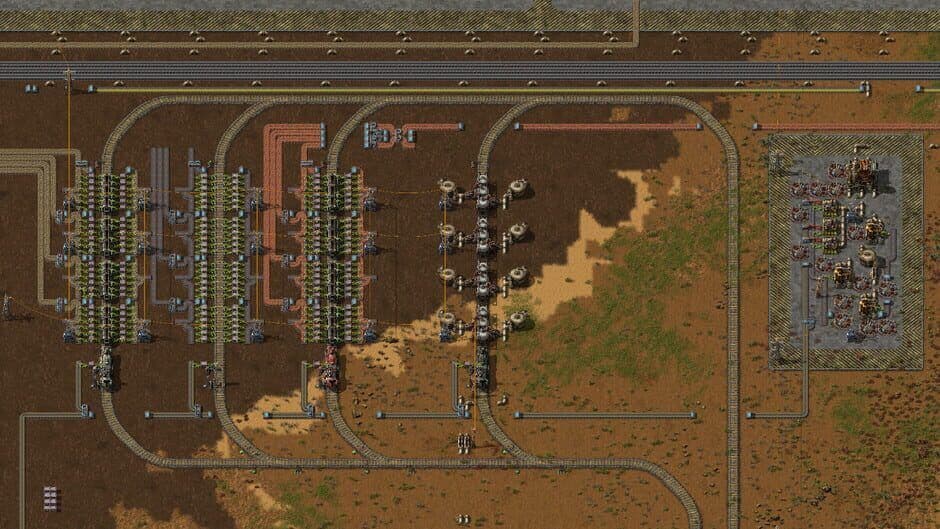
Defensive logistics are a key part of factory planning.
The defense economy works because it shares the factory’s language. Ammunition, walls, automatic turrets, flamethrowers, weapons, and repair supplies must be manufactured and delivered alongside science and construction materials, so military preparation becomes another production problem rather than a disconnected combat mode. A turret that runs dry is not merely a tactical failure; it exposes a weakness in the supply chain. This is the moment Factorio earns its survival premise: defending the base means automating enough of the right materials to keep the defenses operational while the rest of the factory continues expanding. Even the act of producing weapons reinforces the central idea that every threat must ultimately be answered with infrastructure.
Enemy escalation gives that pressure a credible upward curve. Early attacks are manageable with basic firearms, walls, and a few turrets, but alien forces evolve into more dangerous unit types as pollution and time increase; acid-spitting worms make direct assaults hazardous, while larger attacks can overwhelm an unplanned perimeter. The response is not simply to click faster: players unlock stronger weapons and armor, then eventually use tanks, artillery, combat drones, and carefully designed kill zones to control the battlefield. A tank can turn clearing nests from a desperate firefight into an organized offensive, while artillery extends the factory’s reach and forces players to think about defense beyond the immediate walls. The escalation succeeds because it asks the factory to produce the tools of its own protection, although the constant threat can feel more like a tax on construction than a thrilling combat campaign.
That is where Factorio’s combat falls short of its engineering. Reviewers consistently found alien fighting less compelling than designing production lines, and the reason is clear: most encounters are valuable because they expose a defensive or logistical weakness, not because the moment-to-moment action has unusual tactical depth. Fighting nests, dodging worms, and managing ammunition can create tense interruptions, but the richest decisions usually happen beforehand—placing turrets, laying walls, stocking ammunition, or building a kill zone that turns an attack into a controlled procedure. For players who came for the factory, this is tolerable and often thematically appropriate; for players expecting a deep action game, combat is a functional secondary system rather than a satisfying standalone one. Factorio’s best battles are the ones your factory has already won for you.
The game wisely gives players control over how much pressure they want. You can wall off the base and automate static defenses, launch proactive attacks to destroy nests before pollution reaches them, or customize a new map toward a more peaceful experience or a far harsher “death world.” Peaceful mode disables aggressive attacks, allowing players to learn mining, power, belts, and production without combat pressure; that option is especially valuable because the factory’s early systems already demand substantial attention. Conversely, hostile settings make every expansion decision more urgent, as a distant resource outpost may require its own defenses and supply of ammunition. This flexibility prevents combat from becoming a universal barrier, though removing it also removes one of the clearest consequences of careless industrial growth.
The environmental trade-off gives Factorio a sharper edge than its simple survival premise initially suggests. The player clears forests, burns fossil fuels, consumes the planet’s resources, and spreads pollution while treating the alien ecosystem primarily as an obstacle to industrial expansion. The game does not develop that conflict into a substantial narrative argument—the pollution system exists chiefly to trigger enemy pressure—but the mechanical message remains effective: unchecked production changes the world around the factory, and the world eventually pushes back. Combat therefore strengthens Factorio when it operates as a consequence of logistics, not when it tries to replace them. The bugs may never rival the factory as a source of strategic depth, but by making pollution, ammunition, walls, and territorial control part of the same industrial equation, they ensure that growth always carries a cost.
Learning Factorio: A Steep Tutorial and an Exceptional Mastery Curve
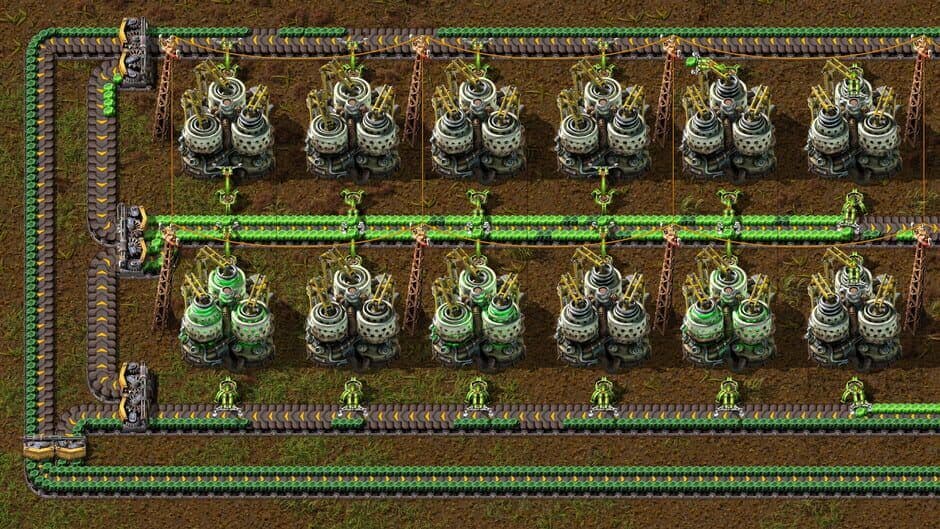
Advanced base design and mastery.
Learning Through Failure
Factorio teaches its basic systems well enough to get a working factory running, then abruptly asks whether you can teach yourself everything else. The opening tutorials put mining drills, stone furnaces, steam power, belts, inserters, and basic production in the player’s hands rather than explaining them as abstract rules. That practical approach works because the lesson ends with a functioning system: you do not merely read about automation, you watch raw ore move through machines and emerge as usable components. Factorio earns trust here by making its first lessons active and concrete, even if the game’s real education begins after the tutorial stops holding your hand.
The problem is that the tutorial’s coverage falls off precisely when the systems become difficult. It does not adequately prepare newcomers for efficient belt layouts, oil processing, chemical ratios, train signals, or advanced logistics, all of which require a different way of thinking from arranging early miners and furnaces. A Switch review describes the tutorial section as taking at least five hours, yet still found its directions vague enough that poor early resource allocation could lead to repeated deaths from ammunition shortages. That is a remarkable commitment for an introduction, and it makes the gaps more frustrating: Factorio can spend hours teaching the fundamentals without explaining the concepts most likely to derail a first serious factory.
Factorio teaches you how to build a machine; it does not always teach you how to understand the machine you have built.
This hands-off design is deliberate, and often brilliant. When an oil refinery stalls because its outputs are full, or a belt layout starves one assembler while overfeeding another, the game gives you a visible failure to investigate rather than a solution to copy. Watching the consequences, changing one variable, and rebuilding the line makes the eventual answer feel understood instead of memorized. The default building system is forgiving enough to support that process: machinery can generally be picked up and rearranged without cost, so an ugly first factory is not a permanent mistake. However, players who do not enjoy diagnosing systems through trial and error can easily mistake that freedom for a lack of guidance.
Most newcomers will eventually need outside help. Fan-made guides, ratio calculators, blueprint libraries, video tutorials, or an experienced multiplayer partner can bridge the knowledge the game leaves unstated, particularly when oil processing and rail networks arrive. A first factory can become a dense knot of belts and pipes long before the player understands why its production keeps stopping; Factorio rarely intervenes to explain that a redesign would be more effective than another patch. That is empowering for players who enjoy engineering by observation, but intimidating for everyone else. The game respects intelligence, yet it sometimes treats access to a community wiki or a knowledgeable friend as though it were part of the tutorial.
The interface adds another layer to this mastery curve. Factorio’s many hotkeys are powerful—Z lets players manually feed an item into a machine, while shift-clicking can duplicate factory output—but they are not immediately intuitive, and their value only becomes apparent once the player is managing several tasks at once. These shortcuts turn routine construction and supply work into fast, precise actions after they become muscle memory; before then, the interface can feel like another system to decode. The same tension applies to the broader control scheme: the game is accessible once its conventions settle into your hands, but it does not make that settling-in process especially gentle. The learning curve is not just about production ratios; it is also about learning how to operate the toolset efficiently.
Factorio does offer meaningful ways to reduce the pressure without diluting the underlying challenge. Peaceful mode removes aggressive enemy attacks, allowing players to concentrate on mining, power, belts, and production without defending a new base; custom map generation can also create a more forgiving starting environment. Buildings can be rearranged freely enough on default settings that experimentation rarely destroys a save, which is crucial when the player is still learning how systems fit together. But these options reduce time pressure, not cognitive load. Even without combat, players must still understand why a belt is empty, how a refinery handles multiple fluids, or why a research chain cannot sustain itself.
The scale of the commitment is easy to underestimate. One review places the first rocket launch at roughly five to ten hours, and that is only the game’s initial win condition—not mastery of trains, circuit networks, large-scale logistics, or megabase planning. The estimate demonstrates why Factorio feels less like a conventional tutorial-driven game and more like a technical discipline with an introductory exercise attached. For players who enjoy gradual competence, the payoff is exceptional: the moment a once-confusing production chain finally becomes legible is more satisfying than any scripted lesson. For players seeking immediate clarity, those first hours can feel like unpaid study.
Factorio’s learning curve is therefore both its greatest accessibility flaw and one of its strongest design achievements. The tutorials successfully teach the vocabulary of automation, while experimentation teaches the grammar; external resources become necessary when the game’s grammar grows too complex to infer comfortably. That arrangement will exclude players who want a guided campaign, but it creates unusually durable mastery for those willing to persist. Factorio does not make expertise effortless—it makes expertise feel earned.
Factorio’s World, Replayability, and Multiplayer: An Open-Ended Industrial Sandbox
Factorio’s world is not a stage for a story; it is a variable in an engineering problem. Each new map rearranges resource patches, water, forests, terrain, and enemy nests, forcing you to solve the same industrial demands with different spatial constraints. A copper field trapped behind a lake produces a different opening from one positioned beside your starter iron, while nearby alien nests can turn an otherwise efficient expansion into a defensive liability. Procedural generation works here because it changes logistics rather than merely scattering collectibles: every map asks where the factory should begin, which resources deserve belts or outposts, and how much territory can safely be claimed.
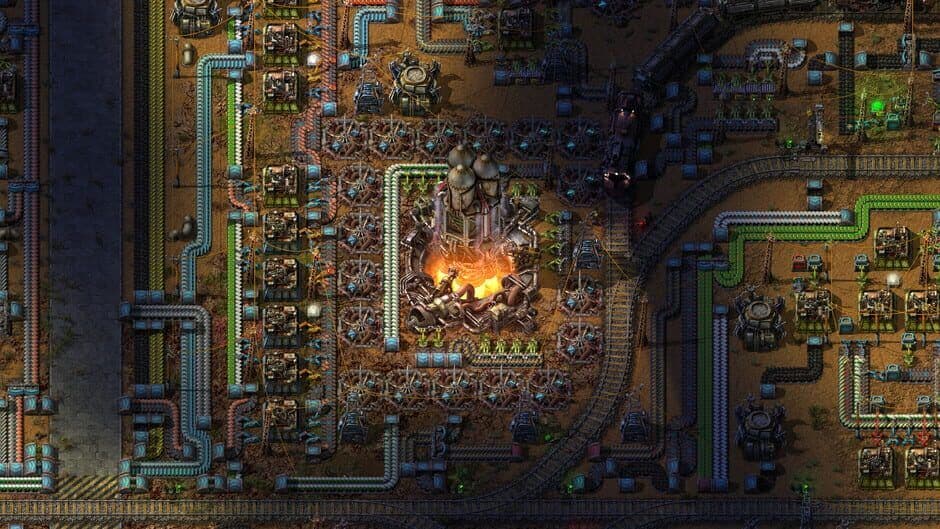
Researching new technologies for expansion.
A Sandbox With a Clear First Goal
The rocket provides Factorio with a welcome sense of direction, but it is a milestone rather than a traditional ending. Launching it proves that the player has mastered the basic industrial arc—from mining and power to oil, science, and advanced manufacturing—yet the game immediately invites a more ambitious question: how much better could the factory have been designed? One playthrough may end with the rocket; another may continue into a megabase built for sustained production, a complete rebuild focused on cleaner ratios, or a personal target such as producing science at an enormous scale. The game’s objectives are therefore open-ended without being shapeless: the rocket supplies a finish line, while optimization supplies the reason to keep moving it.
That structure also supports challenge scenarios and self-imposed constraints more effectively than a conventional campaign would. Players can pursue defensive security, attempt to survive harsher enemy settings, or treat a messy first factory as a draft to be replaced rather than a finished achievement. Factorio’s set challenges add more directed alternatives to Freeplay, including timed missions, restricted building spaces, and races toward specific goals. These scenarios are useful because they compress the game’s sprawling systems into focused tests, although they do not replace the freedom of a procedural world. The strongest long-term objectives still come from the player deciding that a factory should be faster, larger, cleaner, or simply less embarrassing to look at.
Map customization gives that freedom practical shape. A peaceful map with abundant resources and generous space can remove early combat pressure while a player learns production, whereas a hostile world with aggressive enemies and severe resource constraints turns the opening hours into a race to establish power, ammunition, and defenses. Water and forest distribution further affect the cost of expansion: terrain can create natural boundaries, complicate belt routes, or make a distant resource patch worth serving with trains rather than a sprawling conveyor line. These settings are not superficial difficulty sliders; they determine which problems appear first and how much time the player has to solve them. Factorio is at its best when the map’s hostility feels like a design constraint rather than a random punishment.
Factorio does not need a hundred authored objectives when one altered resource patch can invalidate your favorite opening plan.
The game’s thin narrative is the clearest limit to this open-ended approach. The crash-landed engineer, hostile alien planet, and rocket-escape premise establish context, but they provide almost no character development, dialogue, or story-driven motivation beyond the industrial objective. The world does not ask who the engineer was, why this planet matters, or what consequences follow from transforming it into a polluted factory site. That absence keeps the focus on systems, and players who want a pure management simulation may appreciate the lack of interruption. Still, compared with a story-led survival game, Factorio offers little authored reason to care about the planet beyond its resources, geography, and nests.
Multiplayer and the Factory Community
Multiplayer expands Factorio’s sandbox by making specialization a social decision. In a cooperative factory, one player can organize mining and smelting while another handles oil processing, rail networks, research, or defense; the division works because each role feeds a shared production system rather than creating isolated minigames. Communication becomes part of the engineering process as players discuss belt layouts, identify bottlenecks, and share designs instead of each building a parallel base. The scale of a persistent factory also changes the emotional payoff: a sprawling rail network or automated science block becomes a group accomplishment, with every participant able to point to the system they made functional.
Cross-play with PC is available on the Switch version, and stable online sessions can support large cooperative projects, though the platform experience is not completely frictionless. A Switch review reported disconnections from public servers during testing, while stable sessions—particularly with PC players—were described as highly enjoyable. That distinction matters: Factorio’s multiplayer design is strong because it encourages collaboration, but connection reliability and control precision can shape whether that collaboration feels effortless. When the session holds together, the game’s persistent-world structure makes it easy to return to a shared factory and find another unfinished improvement waiting.
The amount of content beyond a first rocket is substantial because the same systems support radically different scales of play. Reviews describe dozens of hours before challenge maps and multiplayer are even considered, while cooperative worlds can grow into projects lasting hundreds of hours. Factorio’s extensive mod ecosystem pushes that horizon much further, adding quality-of-life tools, new technologies, expanded progression, and major overhauls. Angel’s and Bob’s increase complexity, Space Exploration extends the post-rocket game, and Krastorio 2 reshapes the vanilla experience rather than simply adding decorative content. These mods matter because they do not just provide more maps; they alter the questions the factory must answer.
That is the crucial distinction between content quantity and content quality. Factorio does not fill its world with conventional side quests, authored dungeons, collectible hunts, or exploration rewards; its replayability comes from procedural constraints, system interactions, community-created rules, and the player’s appetite for optimization. A new map is valuable because it changes the relationship between resources and infrastructure, not because it contains a new scripted scene. A mod is valuable when it forces a different production philosophy, not merely when it adds another machine to an existing checklist. This is a narrower form of variety than a story-rich open-world game provides, but it is far more durable for players who enjoy solving systems rather than consuming content.
Factorio’s replayability ultimately depends on whether rebuilding sounds like a reward or a responsibility. The procedural maps, configurable hostility, challenge scenarios, cooperative factories, and extensive mods create an industrial sandbox with extraordinary longevity, but none of them can supply motivation that the player does not already possess. Factorio has little authored narrative to carry a reluctant player forward; instead, it offers a world that keeps generating logistical questions and a community that keeps finding new ways to complicate them. For anyone who enjoys turning a fresh map into a personal engineering project, this is nearly inexhaustible content. For everyone else, the absence of a stronger story or exploration layer makes the open world feel less like a place to inhabit than a problem to solve.
Factorio’s Visuals and Sound: Functional Clarity Over Spectacle
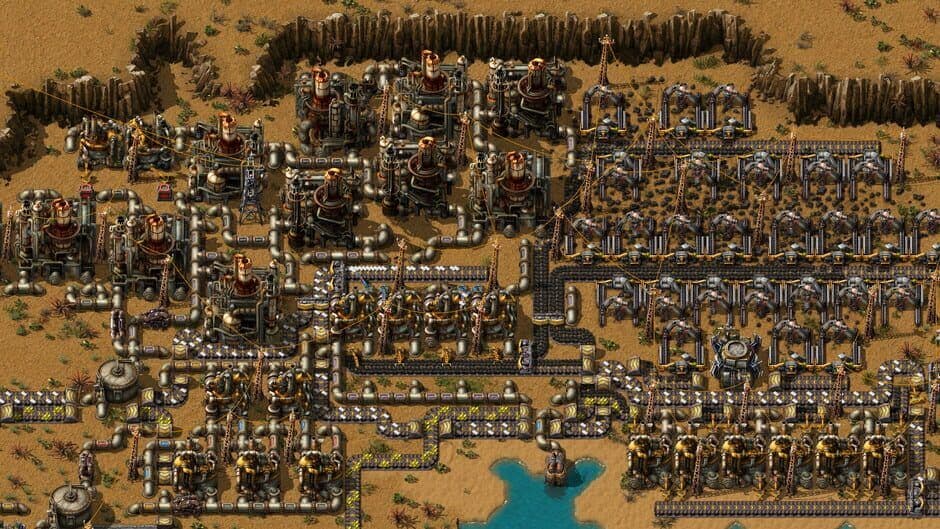
Factorio does not try to make industrialization beautiful; it makes it legible. Its readable visual language uses color coding, distinct machine silhouettes, visible power states, and animated belts to turn a sprawling factory into an information system you can parse at a glance. Iron, copper, coal, fluids, and finished components remain easy to distinguish, while inserters visibly point toward the machines they serve and belts show item-flow direction in motion. That clarity is not cosmetic—it is what lets players diagnose a stalled line by following empty belts, idle assemblers, or a machine whose power status has changed.
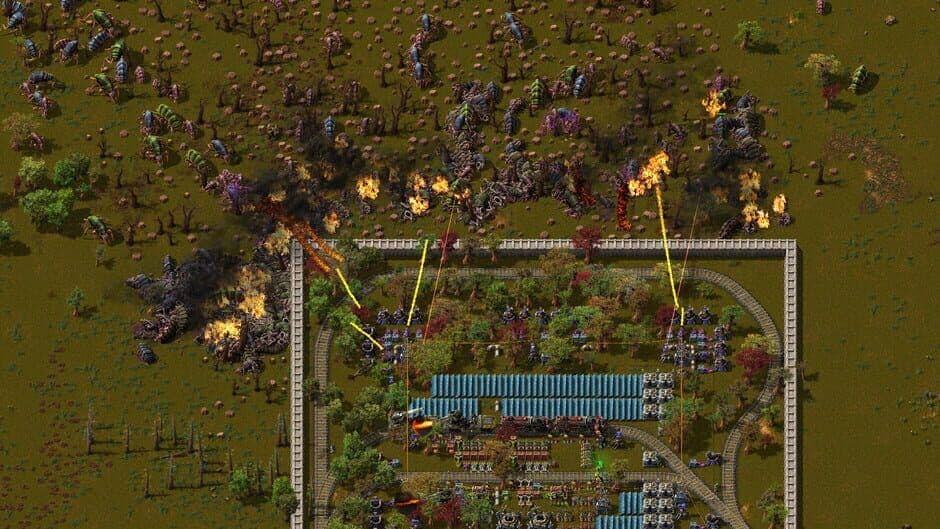
Distinct building silhouettes.
The top-down, isometric perspective gives Factorio an unusually strong sense of scale. Zoom in and individual inserters, drills, and belt junctions become inspectable; zoom out and the same factory resolves into a broad industrial diagram of smelting blocks, power generation, logistics routes, and defensive walls. The game’s zoom function is essential rather than ornamental, because later factories are too large to understand from a single viewing distance. This is where Factorio’s restrained presentation earns its keep: the screen may not deliver the visual spectacle of Satisfactory’s first-person factories or Dyson Sphere Program’s planetary megastructures, but it lets you read the architecture of your own production at a glance.
Factorio’s graphics are not trying to impress you with the factory; they are trying to help you understand why the factory stopped working.
That focus does come with a real aesthetic cost. The functional 2D pixel art and bitmap-style visuals can look plain—even ugly—beside the polished 3D machinery and grand vistas of its competitors, and the game rarely offers visual drama beyond the motion of production itself. More importantly, clarity is not perfect at every scale: a jammed assembler, a missing belt segment, or a small gap in a supply route can disappear into a dense layout until you zoom in and inspect the line directly. The same perspective that makes the whole base comprehensible can therefore hide the tiny mistake responsible for a major shutdown. Factorio’s answer is practical rather than elegant—zoom, inspect, and trace the flow—but that still creates friction when a massive factory fails for a visually insignificant reason.
Sound gives the otherwise utilitarian presentation its physical presence. Inserters click as they move items, belts maintain a steady mechanical rhythm, drills and machines contribute a layered industrial hum, and warning beeps signal stopped production or trouble at the perimeter. Distant gunfire and ominous cues become especially effective when alien attacks interrupt the factory’s routine: the player can hear that the defensive system is under pressure before locating the problem on the map. These sounds do more than decorate the interface; they communicate whether the factory is active, stalled, or threatened without forcing the player to stare at every production block.
The soundtrack is deliberately restrained, often giving way to ambient machinery or near-silence. That sparseness reinforces the almost Zen quality of watching a well-designed production line run: after the frantic work of solving a bottleneck, the steady hum of belts and inserters becomes its own reward. Players expecting a prominent score or memorable melodic themes may find Factorio’s music thin, particularly during long construction sessions where the soundscape leans heavily on repetition. Yet the restraint is ultimately consistent with the game’s priorities. Factorio’s visuals and audio do not compete for attention; they turn factory activity into readable, tactile feedback, strengthening the satisfaction of a system that works because you designed it.
Performance and Platforms in Factorio: Strong Optimization With Control Trade-Offs
Factorio’s biggest technical achievement is invisible: even when the factory becomes enormous, the game usually remains focused on the machinery rather than the hardware struggling to display it. The real limit is more often CPU simulation—calculating belts, inserters, trains, fluids, robots, and production chains—than conventional graphics horsepower. That distinction explains why Factorio can sustain sprawling industrial systems while its modest 2D presentation asks relatively little from a GPU. The game’s technical foundation is not flashy, but it is exactly as disciplined as its factory design.
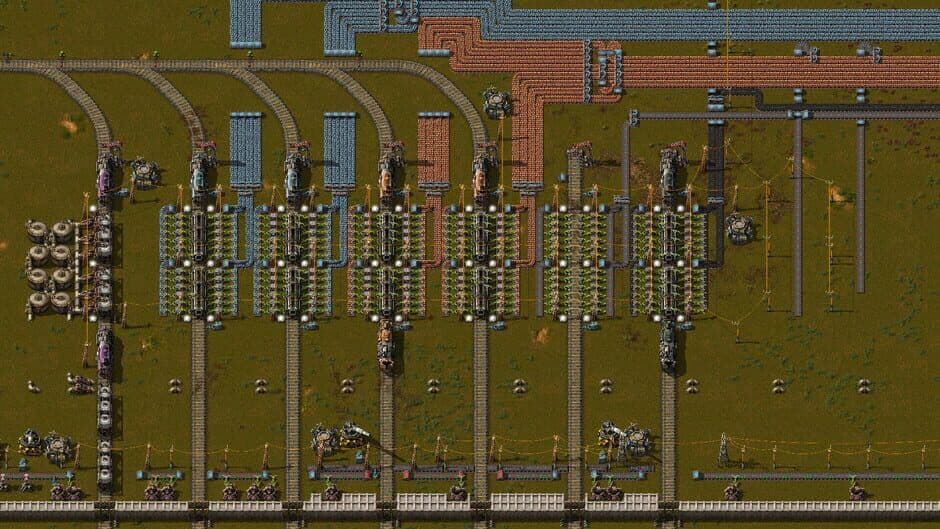
Late-game performance is a key focus of the game's technical design.
A Strong PC Foundation
The available evidence supports that reputation. The Space Age review tested the expansion on an RTX 2080 Super, an AMD Ryzen 5 3600, and 32 GB of RAM, while also reporting Steam Deck Verified status. That is not a universal performance benchmark, but it reflects Factorio’s sensible hardware priorities: a mid-generation gaming PC with a competent six-core processor is a more relevant reference point than an expensive graphics card. Massive factories can still create simulation demands as production networks expand, yet the research identifies no broad PC performance crisis. Factorio’s optimization succeeds because the game’s visual simplicity is matched by an engine designed to process industrial complexity rather than merely render attractive scenery.
Wube’s post-launch stewardship strengthens that technical confidence. The studio’s Friday Facts development posts explain upcoming systems and technical decisions with unusual transparency, while active community engagement keeps player concerns in the development conversation. Regular fixes and improvements have arrived without breaking existing saves, an especially important achievement for a game built around factories that can represent dozens or hundreds of hours of investment. The Version 2.0-era changes that accompanied Factorio: Space Age, released on October 21, 2024, show that Wube has expanded the game’s systems without abandoning that compatibility-minded approach. This is how long-term support should work: not by constantly resetting the player’s progress, but by making the factory they already built more capable.
Factorio’s best technical feature is not a frame-rate number; it is the confidence that a factory built today will still function after tomorrow’s update.
The PC experience remains the clear reference point because mouse-and-keyboard input suits Factorio’s fundamental demand for precision. Selecting one inserter inside a dense production block, placing a belt through a narrow gap, inspecting a machine’s recipe, or tracing a stalled line all benefit from the mouse’s direct targeting and the keyboard’s shortcuts. A controller can reproduce the basic actions, but it adds navigation layers to tasks that are nearly instantaneous on PC. In a game where routine construction is repeated hundreds of times, that small delay becomes cumulative friction rather than a minor inconvenience.
The original Switch version demonstrates exactly where that friction hurts. Its analog sticks struggle to select individual items in a crowded factory, while touchscreen input is supported but imprecise outside menus. Handheld dialogue can also be obscured by cursor instructions, meaning players may miss important information while following objectives. These problems do not damage Factorio’s underlying simulation, but they interfere with the act of managing it: replacing one belt segment, identifying the correct machine, or reading an instruction becomes slower and less reliable. The Switch port makes the game portable, yet portability comes at the cost of the fine control that turns factory maintenance into a fluent activity.
The newer Switch 2 edition makes a meaningful, if incomplete, correction. Faster loading, steadier frame rates, improved scaling, mouse support, and free quality-of-life and bug-fix updates bring the console version closer to PC usability. Mouse control is the decisive improvement: it directly addresses the original Switch’s weakest point by making item placement and menu navigation far more precise, particularly in docked play. The improved scaling also helps large bases remain readable on a smaller display, while the port’s accessibility options cover UI customization, audio controls, graphical adjustments, and controller configuration. This is not a cosmetic upgrade; it changes whether Factorio feels like an exacting engineering tool or a cumbersome console adaptation.
Still, handheld play has limits that no update can entirely erase. Small interface elements can remain difficult to read or target, especially for vision-impaired players, and precise touchscreen interactions are still awkward even with UI scaling. Joy-Cons are functional but initially clumsy, so routine work—placing a splitter, selecting a particular assembler, or repairing a congested belt route—can demand more effort than the problem itself deserves. The Switch 2 is therefore a viable way to play Factorio, particularly with a mouse when docked, but the recommendation is conditional: choose it for portability, not because it matches the precision of PC controls.
Factorio’s current technical state is consequently easy to recommend on PC and more nuanced on consoles. The PC version combines strong simulation performance, sensible hardware demands, Steam Deck Verified compatibility, transparent development, and save-safe updates into an unusually dependable foundation; Version 2.0 and Space Age expand that foundation rather than exposing a serious stability problem. The original Switch version remains playable, but its analog targeting, imprecise touchscreen, obscured handheld text, and loading concerns make factory management noticeably less comfortable. Switch 2 repairs much of that experience through better performance, scaling, updates, and mouse support, though its small-screen interface still imposes real constraints. Factorio is technically robust across platforms, but only the PC version fully respects the precision its own systems require.
Factorio: Space Age Expansion: An Ambitious but More Demanding Factory Game
Space Age does not simply add more factory parts to Factorio; it changes what a factory is. The original game teaches you to think across a map, but the expansion forces you to think across worlds, each with its own resources, hazards, and production rules. That interplanetary scale is exhilarating precisely because established solutions stop working: the factory you perfected on Nauvis becomes a liability once you land somewhere with no natural resources, unstable biology, or lava instead of ore.
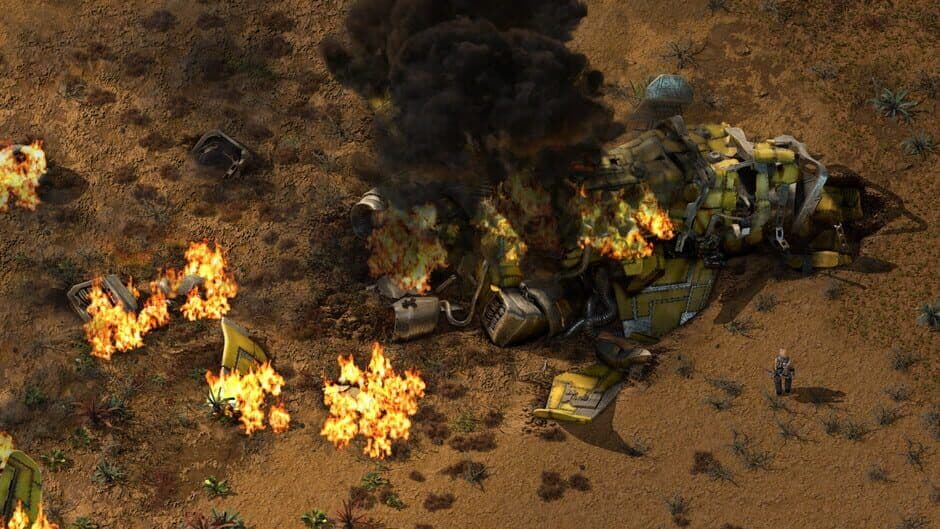
Planetary infrastructure remains the backbone of production.
From Rocket to Orbit
The route to space is more carefully paced than the expansion’s scale might suggest. Before building the first rocket silo, Space Age reduces the required science types from five to three, trimming some early prerequisites without removing the sense of achievement attached to reaching orbit. That is a smart revision to Factorio’s opening arc: the rocket arrives sooner as a gateway to a larger game, rather than functioning as the final reward for completing every layer of the original progression. Veterans lose some repetition, but they gain access to the expansion’s real ideas without having to replay the entire base-game climb at its original length.
The first launch is not an escape. It sends a space platform into orbit, turning the rocket milestone into the beginning of a new factory-building problem. Construction happens through remote view and ghost building: players place designs from a distance, then transport the required components by rocket so the platform can assemble and expand itself. Its foundation is limited, and rockets carry only small quantities, meaning even a basic orbital production line requires repeated launches and careful planning. That constraint makes the platform feel like more than a new map—it is a factory with a restricted footprint, a supply chain of its own, and a construction process that forces players to think about what is worth sending upward.
The platform’s most distinctive production chain begins with asteroid collectors, whose mechanical arms grab passing asteroids before rock threshers process them into materials such as ice and carbon. Unwanted resources can be jettisoned, which makes the first sorting problems manageable, but efficient players will eventually want to extract value from as much of the incoming material as possible. There is an unusual pleasure in watching the collectors work: orbital industry becomes a visible machine ballet, with raw debris arriving from space and being converted into the components needed for space science. Factorio has always made material flow satisfying, but here the flow is literally moving through orbit.
Space Age’s best idea is making the rocket a change of perspective: the factory does not leave the planet; it becomes large enough to include the sky.
The expansion is less successful at explaining the dangers that come with that new perspective. A newly launched platform can immediately face asteroid bombardment, and players who failed to anticipate the need for turrets, spare components, and defensive capacity may watch their expensive orbital factory fall apart before they have properly understood how it works. The failure is not that the hazard exists—protecting a platform is a fitting extension of Factorio’s defensive logic—but that the game does not communicate its urgency clearly enough before the player commits to launch. A warning that arrives only after the first catastrophic encounter turns discovery into avoidable punishment.
Four Worlds, Four Factory Philosophies
Once thrusters transform the platform into a mobile factory, Space Age expands from orbital construction into genuine interplanetary logistics. Travel between planets is seamless, and platforms can be programmed to move resources between worlds like automated cargo trains, collecting material in one place and delivering it to another. This is a powerful extension of Factorio’s logistics because it changes supply lines from horizontal infrastructure into a network of planetary routes. A resource is no longer merely distant; it may be separated by an entirely different production environment, forcing players to decide which planet should manufacture a component and which should merely receive it.
The four new worlds justify that scale by refusing to behave like variations on Nauvis. Fulgora is the most immediately inventive: it has no natural resources, so players drill into rubbish and feed semi-random outputs into recycling units. Advanced products must be broken back down into components, turning the usual factory logic inside out. Instead of asking how to combine raw materials into a finished item, Fulgora asks which finished items can be dismantled to recover the resources needed for the next recipe. Lightning storms add another layer, but they are not just a hazard; lightning rods and accumulators let the player convert environmental danger into power. Fulgora’s reverse-factory design is a genuine triumph because it changes the player’s instincts rather than merely increasing production demands.
Vulcanus and Gleba push that principle in opposite directions. Vulcanus replaces conventional mining with metal smelting from lava and threatens industrial expansion with Destroyer worms capable of demolishing factories, making geology and defense inseparable from production planning. Gleba turns factory building into alien agriculture: players harvest biological materials, sow alien seeds, process strange fruits and berries, and manage products that can spoil over time. These systems are memorable because they make each planet feel like a new manufacturing discipline. Space Age’s interplanetary structure therefore earns its size not through more territory alone, but through radically different rules for what “production” means.
Gleba is also where the expansion’s onboarding problems become most apparent. The planets can be visited in any order, but Gleba’s ecology and spoilage mechanic make it a punishing first destination: organic resources decay, so a player accustomed to stockpiling belts of stable plates and components must suddenly build around timing and throughput. That challenge is intellectually appropriate, yet the consequences of arriving underprepared are severe, particularly because the base game has trained players to treat inventory and storage as reliable buffers. Fair warning: Gleba is not merely difficult; it asks players to unlearn habits that Space Age has spent dozens of hours reinforcing.
The expansion’s route interface compounds that difficulty. Conditional automation is powerful enough to make platforms behave like cargo trains, but the menu for establishing routes is not especially intuitive, particularly when players want to control a platform manually. The absence of obvious GO and STOP controls alongside the more elaborate conditional logic makes a simple test journey feel unnecessarily opaque. This matters because interplanetary logistics is Space Age’s defining promise: when the interface obscures whether a platform is following a condition, waiting for cargo, or simply not moving, the player spends time decoding menus instead of engineering the network.
Space Age does streamline a few systems along the way. Inserters gain filter capabilities, reducing the need for separate sorting solutions and making mixed-resource environments less fiddly. But those conveniences do not offset the expansion’s overall increase in cognitive load. Players must understand orbital construction, asteroid processing, platform defense, planetary specialization, route conditions, and cross-world supply chains on top of the base game’s belts, fluids, trains, science, pollution, and combat. The design intent is clear: Space Age is Factorio’s second act, not a beginner-friendly introduction. Anyone overwhelmed by the original factory should learn the base systems first; otherwise, the expansion turns a steep mastery curve into a wall.
Space Age ultimately succeeds because it expands Factorio by changing its questions. Fulgora asks how to manufacture from waste, Vulcanus asks how to industrialize a hostile volcanic environment, Gleba asks whether a factory can operate on biological time, and orbit asks how production survives while moving through space. Its hazards and interfaces occasionally fail to prepare players for those questions, but the underlying ideas are too strong to dismiss. For experienced Factorio players, this is not disposable add-on content—it is an ambitious reinvention of the factory’s scale, and one that makes the base game’s original rocket feel like the first launch in a much larger industrial career.
Factorio Compared With Satisfactory and Dyson Sphere Program: Depth Over Spectacle
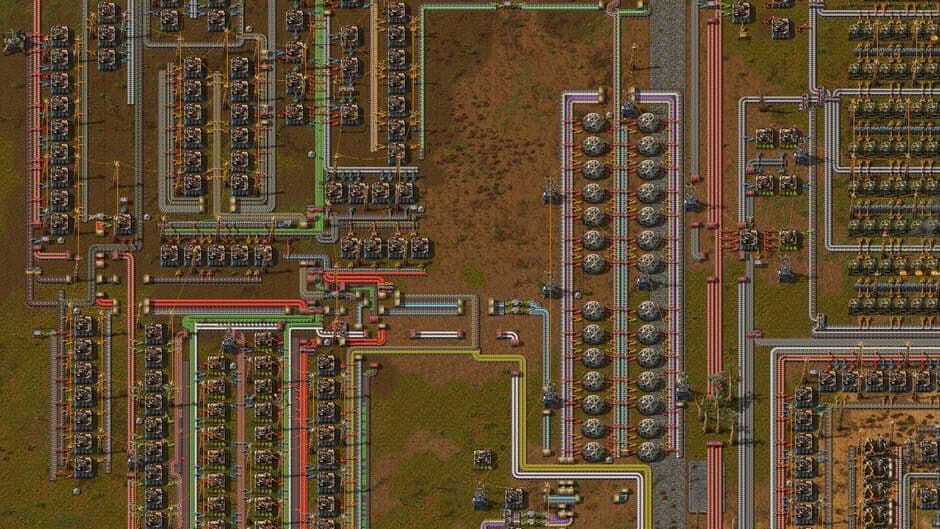
Fluid management adds another dimension to Factorio's logistical puzzles.
The Benchmark for Factory Games
Factorio remains the genre’s clearest expression of automation because every major system feeds the same engineering problem. Belts handle predictable local flows, trains move bulk resources across distant outposts, fluids introduce pressure and byproduct management, circuits enable conditional control, logistics robots bypass physical routes, and defenses force ammunition and wall production into the same industrial economy. None of these mechanics feels bolted on: an oil shortage can become a rail problem, a rail expansion can demand more power, and that larger power grid can increase pollution and threaten the perimeter. Factorio is not merely deeper than its peers because it has more systems; it is deeper because those systems interact coherently enough to make one factory-wide decision produce consequences everywhere else.
Satisfactory makes the factory a place to inhabit. Dyson Sphere Program makes it a place to behold. Factorio makes it a system you must understand.
The comparison with Satisfactory clarifies Factorio’s priorities. Satisfactory offers a more forgiving start, a first-person perspective, and a 3D industrial presentation that makes construction feel tactile: players walk through their factories, explore the surrounding world, and appreciate the scale of elevated belts and production floors. Factorio instead presents the factory from above, asking players to inspect throughput, trace an empty belt, calculate production needs, and rebuild a layout when a shared line becomes a bottleneck. That makes Factorio less immediately welcoming—its early automation can take longer to become intuitive, while Satisfactory reaches basic automation more quickly—but it also gives Factorio tighter control over the relationships between machines. Satisfactory is the better choice for players who want exploration and architectural expression; Factorio is the stronger game for those who want every belt junction and train route to serve an optimization problem.
Dyson Sphere Program takes the opposite route to spectacle. Its appeal lies in planetary-scale construction and the fantasy of industrializing an entire stellar neighborhood, with 3D space environments and megastructures that make the player feel small beside the project. Factorio’s interplanetary ambitions, particularly in Space Age, are substantial, but its attention remains fixed on the logistics beneath the fantasy: whether a platform has enough defenses, whether asteroids are being processed effectively, and which planet should manufacture or receive a given resource. Dyson Sphere Program makes expansion visually grand; Factorio makes a stopped production chain immediately consequential. The former emphasizes the wonder of scale, while the latter delivers a more intimate connection between a single missing component and the failure of an entire industrial network.
That distinction affects pacing as much as presentation. Satisfactory’s more forgiving opening and exploration layer can give newcomers a gentler path into factory building, while Dyson Sphere Program’s progression points toward increasingly ambitious planetary and interplanetary infrastructure. Factorio withholds much of that immediate spectacle and demands that players earn satisfaction by diagnosing problems: oil outputs back up, trains need signals, science consumes a larger web of materials, and a megabase must be reorganized rather than merely expanded. For players who enjoy long-term projects and systems thinking, this is the genre’s purest reward structure. For players who want a strong sense of place, dramatic vistas, or visible megastructural milestones, Factorio’s functional 2D presentation can feel austere even when its underlying simulation is more exacting.
Factorio also has the strongest long-term ecosystem of the three. Its mature blueprint-sharing culture lets players exchange working designs, while the mod scene can transform the game through overhauls such as Angel’s and Bob’s, Space Exploration, and Krastorio 2 rather than merely adding decorative extras. Multiplayer extends that depth into cooperation: one player can manage mining and smelting, another oil and science, and another rail logistics or defense, with all of those specializations feeding a shared factory. Reviews describe cooperative sessions handling dozens of players well, and the appeal is obvious when a sprawling base becomes a genuinely collective engineering project instead of several disconnected builds. Satisfactory has a growing mod ecosystem and Dyson Sphere Program’s is more limited by comparison, so Factorio’s community does more than preserve its lifespan—it continually creates new reasons to learn its systems again.
The trade-off is a sharply defined audience. Factorio is a poor recommendation for players who prioritize story, visual spectacle, relaxed pacing, simple onboarding, or immediate rewards, because the game offers little authored narrative beyond the crash-landed engineer’s rocket objective and often makes progress feel like preparation for the next complication. Its plain visuals do not compete with Satisfactory’s 3D industrial spaces or Dyson Sphere Program’s cosmic scale, and its tutorial gaps around oil, train networks, and advanced logistics can force newcomers toward guides, calculators, blueprints, or multiplayer help. Even its relaxing side has conditions: the steady hum of a functioning factory can be soothing, but reaching that state requires accepting unfinished redesigns and repeatedly investigating why something stopped working. The game’s demands are not incidental flaws; they are the cost of its commitment to depth.
Factorio is therefore best suited to players who enjoy optimization, simulation, engineering puzzles, and the satisfaction of rebuilding a solution simply because it could be cleaner. If your ideal project is a factory that grows from improvised belts into modular production blocks, scheduled trains, circuit-controlled systems, logistics robots, and eventually a megabase or interplanetary network, Factorio remains the benchmark. If you would rather explore a beautiful industrial world or watch a planetary megastructure take shape, Satisfactory and Dyson Sphere Program offer more immediate spectacle and a gentler invitation. Factorio wins by asking more of its player—and by making the resulting mastery feel more personal, because every elegant production line exists only after you understood the messy one that came before.
Final Verdict: Is Factorio Worth Playing Despite Its Demands?
Factorio is one of the few games that can make a failed production line feel like a personal revelation. Its demands are substantial—hours of learning, dense menus, sparse storytelling, and a factory that can consume an evening before you notice—but the reward is an automation sandbox with almost unmatched systemic depth.
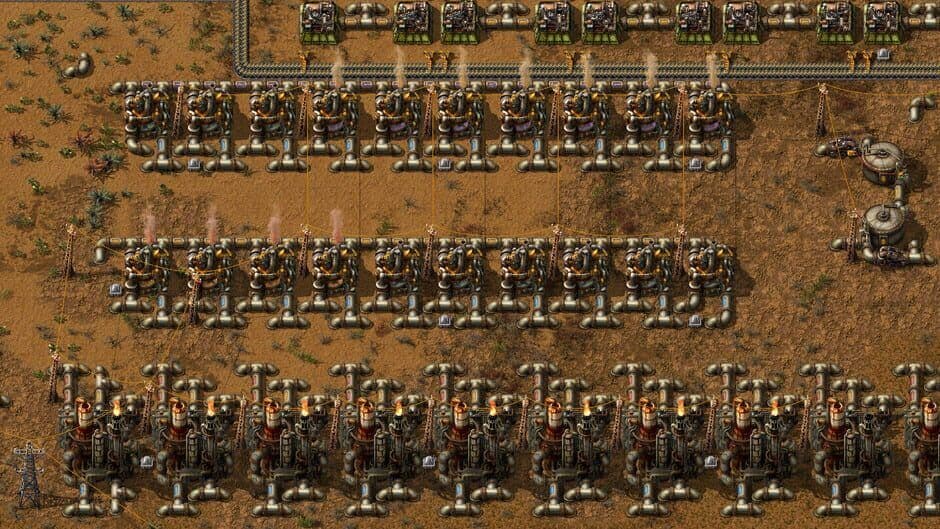
Scaling power production is a constant necessity for large-scale factories.
The breadth of Factorio’s simulation is its defining achievement. Resource chains begin with iron, copper, and coal, then expand into fluids, oil processing, science, trains, logistics robots, circuit networks, power management, pollution, and combat production. Space Age extends that structure into orbital factories, asteroid processing, four specialized planets, and automated interplanetary routes. These systems are not isolated features: a new science requirement can create an oil shortage, which demands more power, which increases pollution, which forces better defenses and ammunition supply. That interdependence is why Factorio feels deeper than a checklist of factory-game mechanics; every new tool changes the relationship between the tools you already understand.
The satisfaction of mastery is even more important than the feature count. Factorio makes inefficiency visible through empty belts, idle assemblers, backed-up fluids, stalled trains, and depleted turrets, then leaves the player to interpret the evidence. When a redesigned line finally produces science without interruption—or when a chaotic belt network gives way to a clean train-and-robot logistics system—the achievement feels earned because the solution came from understanding the failure. Even the first rocket launch is less a conclusion than a diagnosis of the factory you built: you succeed, then immediately see how much cleaner the next version could be. This is the moment Factorio earns its reputation, turning industrial troubleshooting into a form of creative ownership.
Its longevity is equally difficult to overstate. A typical playthrough offers dozens of hours before challenge scenarios and multiplayer enter the equation, while megabase projects can stretch into hundreds of hours as players pursue faster science production, cleaner modular layouts, or enormous resource throughput. Procedural maps and configurable enemy pressure ensure that a familiar opening plan will eventually meet different terrain, resource placement, or defensive demands. Multiplayer adds specialization to the puzzle, community blueprints accelerate experimentation, and major mods such as Angel’s and Bob’s, Space Exploration, and Krastorio 2 can fundamentally reshape progression. Space Age costs $40 / £30 and adds four planets, orbital factories, and interplanetary automation; it is expensive compared with a conventional expansion, but the amount of new engineering space it creates makes the value proposition unusually strong for players who have already exhausted the base game.
Wube Software’s stewardship strengthens that recommendation. Transparent Friday Facts posts make the game’s development unusually visible, while regular updates, performance work, community feedback, and save-compatible support protect factories that may represent dozens or hundreds of hours. Version 2.0 and Space Age expand Factorio without treating existing progress as disposable, which matters more here than in most games: a broken update could invalidate an entire industrial project. That long-term care does not make the game easier, but it makes buying into its complexity less risky. Factorio feels like a platform Wube continues to maintain, not a finished product left to its community after launch.
The caveat is the buy-in. The tutorial can teach mining, furnaces, belts, inserters, and power while leaving oil processing, train signals, chemical ratios, circuit networks, and advanced logistics largely to experimentation or outside guides. Its dense interface and extensive hotkeys become efficient only after they have settled into muscle memory, and the deliberately slow progression means the game may spend hours preparing players for systems they have not yet learned to use. Space Age magnifies that issue: asteroid defenses, planetary hazards, spoilage on Gleba, and route conditions can punish mistakes before their implications are fully explained. Factorio’s generosity with rearranging buildings softens construction errors, but it cannot remove the cognitive burden of understanding an increasingly interdependent factory.
The game’s appeal is narrow by design. Factorio has minimal authored story, limited exploration beyond what the map demands, functional rather than lavish graphics, and combat that works best as a defensive extension of the factory rather than as a compelling action system. Players looking for cinematic presentation, character-driven motivation, or the tactile exploration of Satisfactory will find little here beyond the crash-landed engineer’s industrial objective. The austere presentation and sparse soundtrack support concentration, but they also mean the game rarely supplies spectacle or narrative momentum when the production chain stalls. Factorio is not a broad recommendation for anyone who likes survival games; it is a precise recommendation for people who enjoy systems, optimization, and the satisfaction of making complicated machinery obey.
Factorio is not asking whether you can build a factory. It is asking whether you want to spend the next hundred hours becoming the kind of person who understands why it works.
That distinction should guide the purchase. Newcomers should try the demo or the base game before committing to Space Age, especially if other factory simulators already feel overwhelming; the expansion is designed for experienced players, not as a gentle introduction. Systems-minded players who enjoy engineering puzzles, long-term projects, procedural challenges, multiplayer cooperation, and self-directed mastery should buy Factorio without hesitation. Everyone else should know exactly what they are declining: not a story campaign or an action spectacle, but one of the most coherent and rewarding simulations ever made.
Pros
- Exceptional automation depth: Belts, fluids, trains, robots, circuits, power, pollution, combat production, procedural maps, mods, and Space Age logistics interact as one coherent system.
- Mastery feels earned: Bottlenecks and inefficiencies are visible, understandable, and solvable through redesign rather than arbitrary difficulty.
- Remarkable longevity: Dozens of hours arrive before challenge and multiplayer content, with megabases, mods, cooperative worlds, and interplanetary expansion supporting hundreds more.
- Outstanding developer stewardship: Wube’s transparent communication, regular updates, optimization work, community involvement, and compatibility-minded support protect long-term investments.
Cons
- Steep buy-in: Advanced systems receive limited tutorial coverage, the interface is dense, and many players will need guides, blueprints, or an experienced partner.
- Narrow appeal: The story is minimal, exploration is limited, visuals are functional, and combat remains secondary to factory design.
- Potentially overwhelming scale: Space Age adds brilliant ideas but also more hazards, route-management complexity, and opportunities to fail before the game fully explains the consequences.
Verdict: Factorio is emphatically worth playing for anyone willing to learn its language. Try the demo or base game first, then consider Space Age once the original factory feels less like a crisis and more like an instrument you can redesign. For that audience, Factorio is not merely a great factory simulator—it is the benchmark by which the genre should be measured.