Star Wars: Episode I - Racer: A Relic of Speed That Still Thrills
Star Wars: Episode I - Racer is a game that shouldn’t work. It’s a licensed tie-in for a divisive prequel, rushed to market in 1999, and its modern incarnation is a bare-bones port. Yet, here it is, twenty-five years later, still capable of making your palms sweat. This isn’t about nostalgia; it’s about a core thrill that time hasn’t dulled. The modern ports from Aspyr, available on Switch and PS4, make no grand promises of a remaster. They are faithful, almost clinical, recreations of the technically superior Dreamcast version, offering a smooth 60fps frame rate and a resolution bump that does little to hide the low-poly models and blurry textures of its era. This is not a game pretending to be something it isn’t. It is a relic, polished only enough to run flawlessly on new hardware, and that honesty is its first, strange virtue.
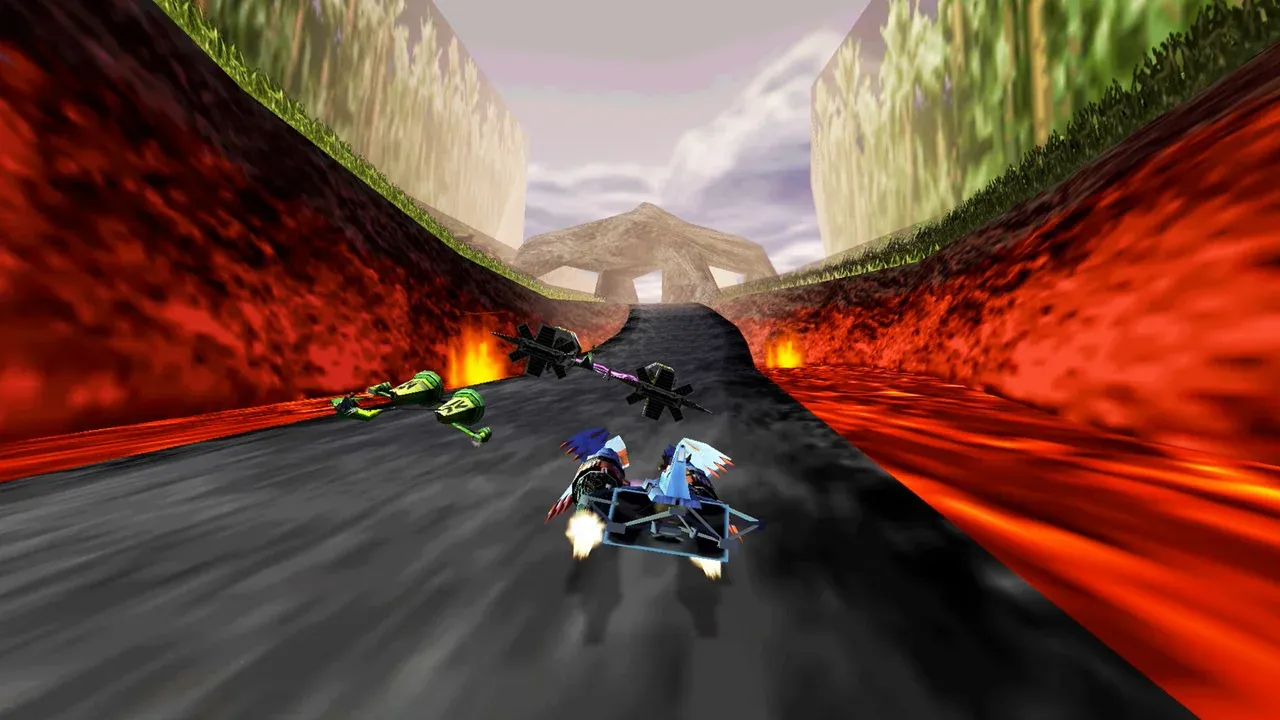
The transition to modern consoles allows the game to run at a smooth 60fps.
The genius of Star Wars: Episode I - Racer is that it understood its single, glorious assignment: to be the podrace. It expands a two-minute film sequence into a full-blown galactic sport, not by adding narrative, but by perfecting a sensation.
That sensation is speed. This is the game’s legacy and its enduring triumph. From the moment you throttle up on Tatooine, the world dissolves into a streaking blur of sand and stone. Podracers hurtle at over 600 miles per hour, and the game’s technical tricks—the motion parallax from textured canyon walls, the horizon that rushes toward you—sell the fantasy with a conviction that modern graphical horsepower often fails to match. It feels blazingly fast in a way that is visceral and immediate, a quality that made it a standout in 1999 and remains its primary reason for existence today. The game successfully bottled the hype and spectacle of Star Wars’ return to theaters, translating the trilogy’s love of high-speed chases into a pure, unadulterated racing loop.
Aspyr’s 2020 release is best understood as preservation, not renovation. By porting the Dreamcast build, they ensured the best possible baseline: the fuller John Williams score that plays across all three laps, the FMV cutscenes (now charmingly dated), and a stable performance far removed from the N64 original’s choppy 20fps. However, this also means you are getting a year-2000 game in HD. Jar Jar Binks’ character model is a low-poly nightmare; reflective surfaces on Anakin’s podracer don’t render correctly. It’s a time capsule, for better and for worse. The “bare bones” approach means there are no quality-of-life overhauls, no new modes, and the most significant addition—motion controls—is a half-baked novelty that only affects steering. This is a direct feed from the past, and your enjoyment hinges entirely on whether that core thrill of velocity still resonates with you.
For a game built on speed, its survival is a testament to focused design. It knew it was a racing game, not an RPG or an adventure, and it honed that one experience to a sharp, exhilarating point. The modern ports simply remove the technical friction, letting that original intent shine through. Whether that’s enough today is the question the rest of this review will tackle, but as an opening argument, Star Wars: Episode I - Racer makes a compelling case that some thrills are timeless.
Gameplay Mechanics: Is Podracing Still the Force to Be Reckoned With?
Here’s the uncomfortable truth about Star Wars: Episode I - Racer: its core racing loop is built on a foundation of contradictions. It asks you to master a bizarre, cockpit-tethered-to-turbines handling model while simultaneously offering opening hours so easy they border on patronizing. The genius—and the frustration—of this game is how these elements coexist in a loop that remains oddly compelling, if only for a short, sharp burst.
The game’s unique handling is its most enduring legacy. Piloting a pod isn’t like driving a car or even a typical anti-gravity racer; it’s the sensation of wrestling two massive, independent engines connected by a fragile energy band. This is where the sliding and twisting mechanics become essential. On harder tracks like the prison colony of Oovo IV or the twisting canyons of Mon Gazza, you don’t just turn—you tilt the entire craft on its side to squeeze through narrow passages or whip around a hairpin. This physicality gives Star Wars: Episode I - Racer a tactile feel that games like Wipeout or F-Zero lack. You’re not just guiding a vehicle; you’re managing a temperamental machine, and when it clicks, banking through a high-speed turn while perfectly managing your pitch is a thrill that hasn’t aged a day.
The essential, yet clunky, speed boost mechanic is a perfect microcosm of the game’s design philosophy: high risk, high reward, and a layer of friction that demands your full attention.
To achieve maximum velocity, you must hold the left analog stick forward until a HUD bar fills, then tap A for a nitro-like burst. It’s an awkward, two-step process that feels divorced from modern racing instincts, where acceleration is usually a single button hold. Yet, it’s also brilliantly strategic. Overuse it, and your engines overheat, requiring an immediate tap of the R button to deploy repair droids—a mid-race “pit stop” that costs precious seconds. This creates a constant risk-reward calculation: do you push for a lead and risk damage, or play it safe? It’s a system that adds a layer of mechanical depth the straightforward racing otherwise lacks.
However, this depth is undermined for the first several hours by a bafflingly gentle difficulty curve. As noted in multiple reviews, you can win the early races on Tatooine and Ando Prime without ever touching the boost mechanic. The AI opponents pose little threat, and the wide, obstacle-free tracks offer a huge margin for error. This isn’t a gentle onboarding—it’s a prolonged hand. The design intent seems to be to let players acclimate to the unusual handling, but it risks boring them before the game ever gets challenging. For veterans, this opening act is a slog; for newcomers, it might falsely suggest the entire experience will be this effortless, which it most certainly is not.
The modern ports offer two control schemes, and neither is ideal. The “modernized” scheme maps acceleration to ZR, which feels more natural but can be awkward to pair with the boost mechanic on the face buttons. The “old-school” scheme replicates the N64 layout, which is authentic but often feels unintuitive on a contemporary gamepad. The lack of remappable controls beyond system-level options is a notable oversight. Yet, once you settle in, the controls themselves are highly responsive. On a Switch Pro Controller or DualShock 4, the pod reacts with precision to every tilt and turn. The 60fps performance in the modern versions eliminates the input lag that might have plagued older builds, making the racing feel smooth and immediate—a critical upgrade for a game where split-second reactions are everything.
Ultimately, the ‘race, win, upgrade, race’ loop works because the moment-to-moment act of racing is so visceral. The sense of speed discussed in the opening section is the engine that powers this cycle. Even when you’re effortlessly winning, you’re still hurtling through the environment at a breathless pace. The promise of new parts at Watto’s shop—better thrust coils, sharper air brakes—provides a tangible goal, even if the upgrade system lacks deep strategy. You race to feel the rush, and you win to make your pod race even faster. It’s a simple, potent feedback loop that compels you through the game’s short tournament mode.
This is where Star Wars: Episode I - Racer earns its reputation as a focused arcade experience. It doesn’t waste time with weapons or power-ups. Its challenge comes from mastering your machine and memorizing the tracks. The early ease is a flaw, but it’s a gateway to the more demanding, satisfying races later on, where that unique handling and the risk of your boost mechanic finally get their moment to shine. The core gameplay isn’t balanced, but it is, unequivocally, fun.
The Economy of Watto’s Shop: Upgrades and Junkyard Strategy
The economy of Star Wars: Episode I - Racer is a fascinating, slightly broken machine. On paper, the loop of racing for credits to buy upgrades from Watto's shop or gamble on damaged parts in the junkyard adds a layer of strategic depth to the arcade racing. In practice, it’s a system that offers the illusion of complexity but rarely demands it, functioning more as a thematic reward than a mechanical necessity.
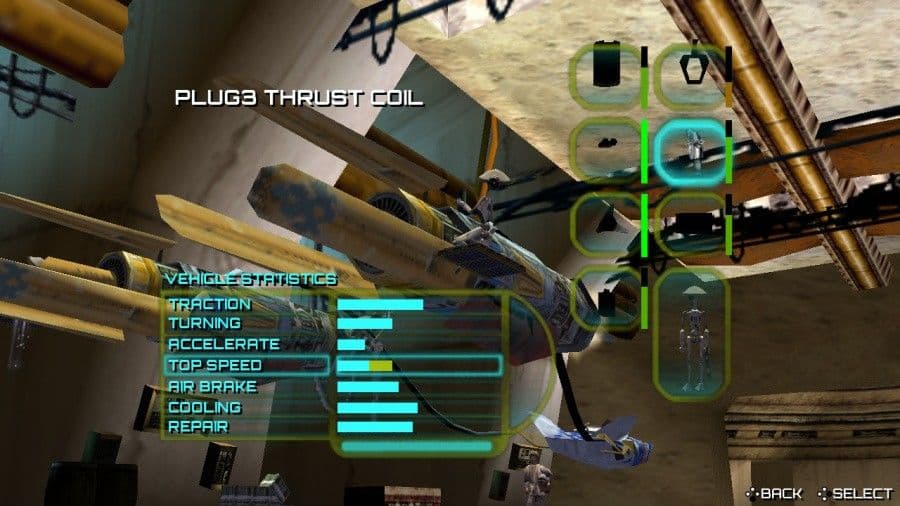
The upgrade system itself is straightforward. After each race, you can spend your winnings on new parts like thrust coils and air brakes to incrementally improve your pod’s top speed, acceleration, or traction. The alternative is the junkyard, where you can buy damaged versions of high-end parts at a discount and use your Pit Droids mid-race to repair them. This creates a compelling risk-reward scenario on paper: do you invest in a cheap, broken part and manage its repair during a critical moment, or save up for the guaranteed performance of a new component? This is where the system shows its most clever spark. Managing a failing engine while navigating the tight turns of Mon Gazza, desperately tapping the repair button as you lose speed, injects a genuine moment of strategic tension into the otherwise pure racing.
The junkyard economy is the game’s most interesting idea—a mini-game of speculative repair that mirrors the scrappy, lived-in aesthetic of the Star Wars universe. It’s a shame the core racing rarely forces you to engage with it.
However, this potential for deep customization is undermined by the game’s lenient difficulty, a point established in the previous section on gameplay. Because you can win most early and mid-game races with the starter pod or through sheer, unoptimized speed, there’s little pressure to min-max your build. The upgrades feel less like essential tools for survival and more like incremental bonuses for success you’ve already achieved. You don’t pore over stat sheets to solve a specific track’s challenge; you just buy the best thing you can afford. This lack of strategic necessity makes Watto's shop feel like a victory lap rather than a crucial pit stop.
This problem is exacerbated by a flawed prize system that actively discourages experimentation. Once you win money from a race, you cannot earn it again on a replay. If you finish third and earn a pittance, the only way to get a proper purse for upgrades is to restart the entire race before crossing the finish line. This isn't a strategic choice—it’s an immersion-breaking exploit that turns progression into a save-scumming chore. It highlights how the economy is bolted onto, rather than integrated with, the racing experience. You’re not incentivized to master a track with a subpar pod; you’re incentivized to reset until you win, bypassing the economic struggle entirely.
The roster of over 25 racers, including Anakin Skywalker and the villainous Sebulba, should theoretically feed into this customization meta, offering different stat baselines to build upon. Instead, it highlights the imbalance. Anakin’s starting pod is objectively superior to most, making him the easy choice for a smooth playthrough and further reducing the need to engage with the shop. The unlockable aliens are fun fan service, but their wildly uneven stats—from the sluggish Dud Bolt to the overpowered top tiers—make them feel like pre-built curiosities rather than vessels for meaningful player expression.
Ultimately, the economy of Star Wars: Episode I - Racer is a suite of great ideas in search of a game that needs them. The damage repair mechanic is a standout moment of tactical play, and the junkyard adds wonderful flavor. But because the core racing is so forgiving for so long, these systems remain optional extras. They provide a satisfying sense of progression for those who want it, but they never become the essential, strategic backbone that could have elevated this arcade racer into something deeper.
Track Design and Environmental Variety Across the Galaxy
The true test of any racing game is its tracks, and this is where Star Wars: Episode I - Racer reveals its most ambitious design and its most dated technical limitations. The game’s commitment to variety is staggering, with over 25 levels spread across eight distinct planets, from the icy tundras of Ando Prime to the underwater tunnels of Aquilaris and the industrial hellscape of Mon Gazza. This isn’t just palette-swapped scenery; each world introduces unique environmental hazards and visual identities that were a technical marvel in 1999. The developers avoided the era’s cheap trick of mirrored tracks, instead creating entirely new layouts when you revisit a planet later in the tournament. This dedication to fresh scenery keeps the visual journey compelling, ensuring that the breathtaking sense of speed discussed earlier is constantly framed by a new, fantastical backdrop.
The track design philosophy is one of rewarding mastery. Shortcuts and branching paths are woven into the geometry, not signposted. Finding the high-altitude bypass on the Tatooine dunes or the hidden tunnel in the Mon Gazza factories feels like a genuine discovery, a secret reward for players who learn the tracks beyond the obvious racing line.
However, the ambition of these courses often crashes against the technical ceiling of its era, particularly in the modern HD port. The most notorious offenders are the zero-gravity segments, found on tracks like Oovo IV. Here, the game wrests control from you, sending your podracer careening through tube-like corridors filled with floating debris. The concept is trippy, but the execution is pure jank. The transition back to normal gravity is frequently abrupt, slamming your pod into a wall with race-ending force. These sections aren’t challenging; they’re frustratingly arbitrary, feeling less like a test of skill and more like a chaotic dice roll that can undo minutes of perfect racing. They are, thankfully, rare, but their inclusion highlights a design overreach.
A more consistent technical flaw is the game’s draw distance. While the 60fps performance of the modern port is a godsend, it doesn’t fix the underlying engine. On certain tracks, especially snow or fog-heavy ones like Ando Prime, obstacles and crucial narrow passages are obscured by environmental haze until you’re practically on top of them. This isn’t an artistic choice—it’s a hardware limitation from 1999 laid bare. When you’re traveling at 600 mph, a turn that materializes 50 feet ahead of you isn't a challenge; it’s an unavoidable crash. This issue transforms some races from tests of reflexes into exercises in memorization, punishing new players for factors outside their control.
This problem is compounded by inconsistent collision detection with the environment. Hitting a rock wall will reliably wreck your pod, but clipping a smaller element—a fallen branch on the Baroonda track or a piece of canyon debris—can have wildly unpredictable results. Sometimes you bounce off with a minor speed loss; other times, your pod explodes in a fiery instant. This lack of physical predictability undermines the player’s ability to learn from mistakes. A crash should feel like your fault, not the game’s cryptic physics engine deciding your fate.
Despite these flaws, the fundamental level design of Star Wars: Episode I - Racer remains strong. The tracks are wide, frenetic, and forgiving of minor errors, which complements the high-speed arcade ethos. The shortcuts and alternate routes provide a tangible reward for exploration and replay, offering a skill ceiling beyond simply driving the perfect line. When the technology cooperates—racing through the sun-drenched canyons of Tatooine or the fiery geysers of the Abyss—the fusion of speed, spectacle, and smart track layout creates moments of pure podracing bliss. The tracks are a testament to a team that dreamed big, even if the hardware of the time, and the preservationist nature of the port, couldn’t fully realize that dream without some visible seams.
Visuals and Audio: Does the Star Wars Atmosphere Hold Up?
The visual and audio presentation of Star Wars: Episode I - Racer is a study in preservation versus polish, a direct feed from 1999 where its greatest atmospheric strengths are locked in combat with its most glaring technical flaws. This is where the port’s “bare bones” philosophy is most evident: it delivers the raw, nostalgic data packets of the Star Wars experience but often forgets to clean up the transmission.
On a technical level, the modern ports are a resounding success. The jump from the N64 original’s choppy 20fps to a rock-solid, unbroken 60fps is transformative. This isn't a minor quality-of-life improvement; it’s the single most important upgrade Aspyr made. The sense of speed praised in the opening section is entirely dependent on fluid motion, and at 60fps, the podracing fantasy is fully realized. Tracks like the fiery Abyss or the twisting canyons of Mon Gazza are now navigable at breakneck speeds without the judder that plagued older hardware. However, this smooth performance acts as a high-definition spotlight on the game’s aged assets. The low-poly models and blurry textures that were charming abstractions on a CRT are stark and simple on a modern screen. Character models, particularly in the victory cutscenes, are nightmarish in their simplicity—Jar Jar Binks is a collection of jagged triangles, and the reflective surfaces on Anakin’s podracer cockpit, a neat trick in 1999, fail to render correctly. This isn’t a remaster’s failure; it’s a port’s honesty. You are seeing the Dreamcast game in HD, for better or worse.
The soundtrack is the one element that transcends the port’s technical limitations. John Williams’ iconic score, repurposed from the film’s duel and battle themes, doesn’t just play in the background—it actively engineers the drama of each race.
Where the presentation falters catastrophically is in its sound design. The iconic John Williams score provides the essential Star Wars atmosphere, swelling appropriately to heighten tension, particularly as you enter the final lap of a close race. This dynamic shift is a masterful touch, using music to turn up the psychological pressure. Yet, this praise exists in a vacuum, surrounded by an audio mix that reviewers uniformly describe as a “mess.” Sound effects are muffled and compressed, as if played through blown-out speakers. The satisfying roar of Sebulba’s engine from the film is reduced to a tinny hum. Most egregiously, the classic pre-race taunt encounters, activated by holding ZR and ZL, play out in complete silence in the Switch port—a glaring bug or oversight that sucks the personality out of a beloved bit of fan service. The audio doesn’t feel restored; it feels excavated and left uncleaned.
This creates a bizarre dissonance. Your eyes register the crisp, smooth 60fps motion and the simple, colorful worlds whipping by—a presentation that, while dated, functionally serves the gameplay. Your ears, however, are assaulted by a muddy, unbalanced mix where the glorious music fights against poor-quality effects and outright missing audio. It’s the one area where the port feels actively worse than fondly remembered, breaking immersion in a way that low-poly models do not. For a game so deeply reliant on selling the fantasy of being in the Star Wars universe, this audio degradation is a significant blow.
Ultimately, the atmosphere of Star Wars: Episode I - Racer holds up on the strength of its core ideas—the thrilling speed, the fantastic track variety, and the timeless score—not on the fidelity of its execution. The visual presentation is a well-preserved artifact, and the performance upgrade is crucial. But the audio issues are a stark reminder that this is a direct port, warts and all. It delivers the nostalgic sensation, but often through a layer of sonic static that the passage of time has only made more apparent.
Final Verdict: Is Star Wars: Episode I - Racer Worth Playing Today?
So, who is this for? The answer lies in the price tag and the game’s unapologetic nature. At $14.99, Star Wars: Episode I - Racer is a perfectly justifiable purchase for two distinct groups: those with a deep-seated nostalgia for the 1999 original, and newcomers seeking a pure, unfiltered arcade racing thrill that prioritizes sensation over modern frills. For the former, this port is a lovingly preserved time capsule, a direct line back to the prequel-era hype that runs smoother than ever. For the latter, it’s a masterclass in conveying speed and a focused, if fleeting, adrenaline rush. It is not, however, a deep or endlessly replayable racing package for the modern multiplayer-centric gamer.
The game’s greatest strengths are the ones that have defined it for 25 years. The incredible sense of speed remains unmatched in its visceral, low-tech charm, selling the fantasy of 600mph podracing with motion parallax and a blurring horizon that modern graphical fidelity often over-polishes into sterility. The controls, once you acclimate to the unique two-engine handling and the clunky-but-strategic boost mechanic, are highly responsive, especially in the 60fps environment of this port. Most importantly, it is a faithful adaptation of the movie’s best scene, expanding a two-minute sequence into a full-blown galactic sport through sheer atmosphere and variety, not narrative bloat.
The value proposition is clear: you are paying for a perfectly preserved hit of nostalgia and a specific, timeless thrill. It is not an investment in a deep, modern racing suite.
However, the cons are just as definitive and are largely the flip side of that preservationist coin. The dated visuals—low-poly models and blurry textures stark under HD scrutiny—are a known quantity, but the poor audio mixing is an active detriment. Muffled sound effects and the silent taunt encounters break the immersion the iconic John Williams score works so hard to build. The lack of challenge in the early circuits remains a significant pacing flaw, offering a prolonged hand-hold that risks boring players before the more satisfying later races. And the zero-gravity jank on tracks like Oovo IV is a dated design misstep that feels more like a chaotic penalty than a skill test.
The most glaring omission for contemporary players is the complete absence of online multiplayer. In an era where even classic racers are revived with robust online lobbies, offering only local split-screen severely limits the game’s longevity and social appeal. The single-player Tournament mode can be completed in a few hours, and while time trials and unlocking all 25+ racers offer some replay value, the core loop lacks the depth or competitive infrastructure to command endless attention. This isn’t Mario Kart or Rocket League; it’s a brilliant, short-burst experience that you play, master, and likely shelve.
Star Wars: Episode I - Racer is a cult classic, not a timeless masterpiece. It is flawed, imbalanced, and technically archaic in ways that this port makes no attempt to hide. Yet, its heart—that pure, undiluted sensation of hurtling through a Star Wars fantasy at breakneck speed—beats as strong as ever. For the right player, those flaws fade into the background noise of engines and John Williams trumpets. For anyone else, they are likely dealbreakers. This isn't a game trying to win a new generation; it's a game honoring its own.
Pros:
- An unparalleled, visceral sense of speed that defines the entire experience.
- Responsive, unique handling that makes mastering your pod feel tactile and rewarding.
- A faithful, expansive adaptation of the film’s podrace that captures the Star Wars atmosphere.
- Excellent track variety across eight distinct planets, with rewarding hidden shortcuts.
- A transformative 60fps performance in the modern port that makes the core gameplay fluid.
Cons:
- Dated visuals and notably poor, often buggy audio mixing that break immersion.
- A complete lack of online multiplayer, limiting long-term appeal.
- A poorly paced difficulty curve that is too easy for too long.
- Frustratingly janky zero-gravity segments on some tracks.
- An upgrade economy that lacks strategic depth due to the overall lenient challenge.