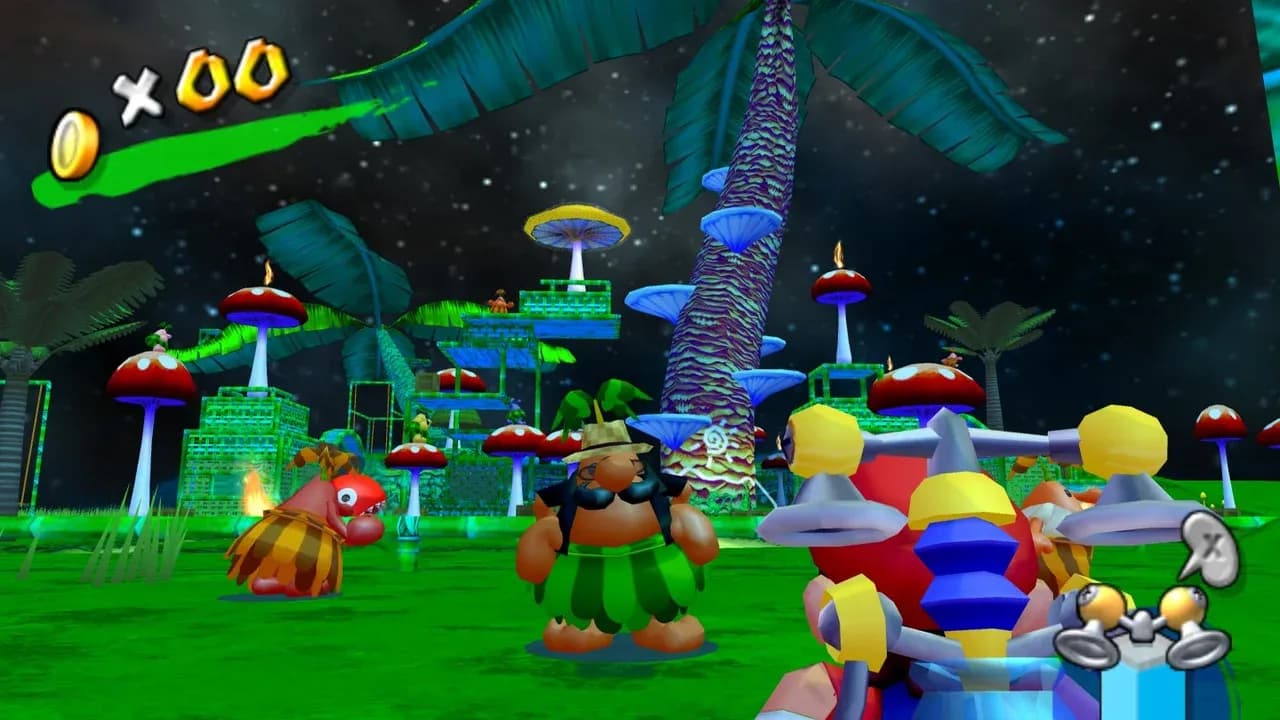
Super Mario Sunshine Setting: A Tropical Departure for the Franchise
Super Mario Sunshine begins not with a castle under siege or a princess kidnapped, but with a vacation gone spectacularly wrong. This opening gambit is a bold departure from the series’ Mushroom Kingdom formula, immediately establishing a unique identity that is both the game’s greatest strength and the source of its most divisive qualities. Instead of rescuing Peach from Bowser’s clutches, Mario finds himself framed for vandalizing the sun-drenched Isle Delfino, his working holiday spent cleaning up a mysterious, goopy graffiti. The premise, involving a doppelgänger named Shadow Mario, is surprisingly narrative-heavy for a Mario game, complete with voice-acted FMV cutscenes that attempt to add a layer of cinematic polish. It’s a setting that trades familiar brick and pipe for palm trees and plazas, promising a fresh, cohesive tropical adventure.
The world design is where this premise truly shines. Isle Delfino is a remarkably unified environment, with the central Delfino Plaza serving as a bustling, sun-bleached hub that connects all seven main areas. This hub isn't just a menu screen; it’s a substantial world in itself, filled with secrets, townsfolk, and its own Shines to collect. From the windmill-dotted hills of Bianco Hills to the bustling docks of Ricco Harbor and the eerie, Luigi’s Mansion-tinged hotel of Sirena Beach, each location feels like a distinct district of the same vibrant island paradise. The art direction masterfully sells the fantasy of a Caribbean getaway, with an impressive draw distance that lets you see other levels in the distance, reinforcing the cohesive geography. This is a world built for exploration, not just a series of disconnected obstacle courses.
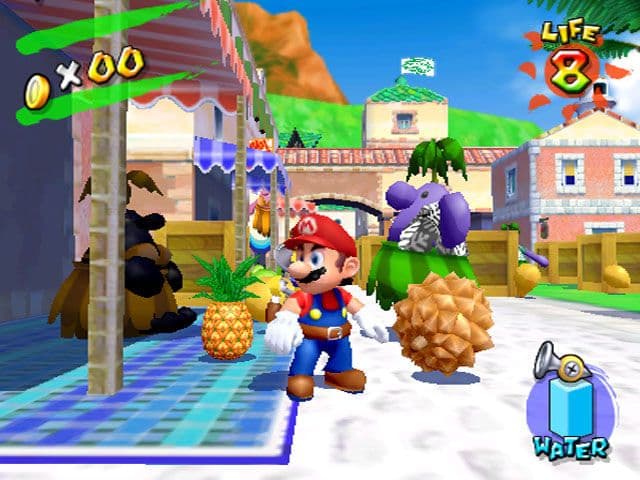
The lush, tropical setting of Isle Delfino marks a departure from the Mushroom Kingdom.
Where this narrative ambition falters is in its execution. The rare inclusion of voice acting, intended to add depth, often feels like a misstep. Princess Peach’s voice is gratingly high-pitched, Mario’s lines are mixed so low they sound like mumbles, and FLUDD’s robotic chatter can be genuinely annoying. The FMV cutscenes themselves are a technical curiosity, often criticized for their artifacting and poor quality that looks no better—and sometimes worse—than the in-game engine.
This clash between a charming, cohesive world and a clumsily told story creates an odd dissonance. You’re tasked with a civic-minded clean-up operation in a breathtakingly beautiful locale, but the characters explaining your mission are barely audible or irritating. It’s a classic case of Nintendo’s gameplay-first philosophy bumping against an uncharacteristic attempt at cinematic storytelling. The result is a setting that feels wonderfully alive and original in its visual and gameplay language, yet oddly stilted in its narrative presentation. For better or worse, Super Mario Sunshine announces from its first moments that it is a Mario game playing by a decidedly different set of rules.
F.L.U.D.D. Mechanics: Does the Water Pump Enhance or Dilute Platforming?
The moment you first pull the trigger and feel the F.L.U.D.D.'s water stream arc across the screen is a small revelation. In Super Mario Sunshine, the water pump isn't just a tool—it's an extension of Mario's body, a Swiss Army knife that redefines his relationship with the world. The initial fear, that this gimmick would dilute the pure platforming of his past, is both valid and masterfully subverted by a design that understands the difference between a crutch and a catalyst.
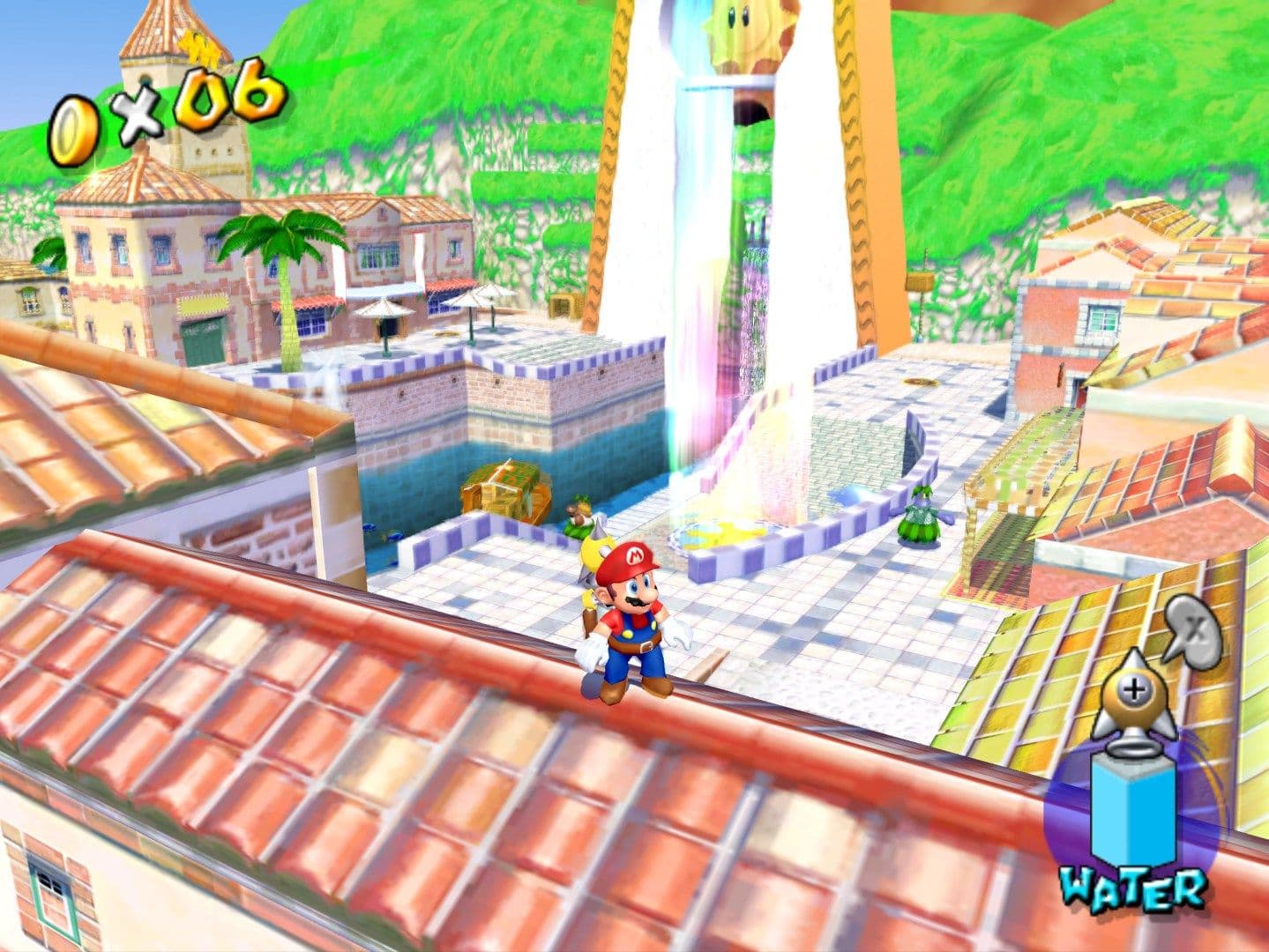
The FLUDD device introduces new movement options like hovering.
At its best, F.L.U.D.D. elevates Mario's movement to a fluid, expressive ballet. The default Hover Nozzle is the star, transforming a mistimed jump from a fatal plunge into a recoverable mistake. This isn't a cheat code; it's a fudge factor that encourages bold, aerial experimentation. You learn to chain a backflip into a hover, slide off a slope and rocket upwards, or use a targeted spray to stun an enemy mid-leap. The movement becomes ninja-like in its agility, with the pump enabling routes and shortcuts that feel illicitly clever. The specialized nozzles—the Rocket Nozzle for vertical bursts, the Turbo Nozzle for blistering ground speed—are fun, situational toys, though their confinement to specific colored boxes feels restrictive, preventing the creative, open-ended use the core mechanics otherwise encourage.
The genius counterbalance to this new power is the game’s secret levels. In these shadowy, often brutal obstacle courses, Shadow Mario steals F.L.U.D.D., stripping you bare. These are pure, unadulterated tests of platforming skill on moving blocks and vanishing panels, and they are excruciatingly difficult. Their purpose is clear: to prove that Mario’s foundational moveset is still robust, and to punish anyone who became overly reliant on the hover safety net. This push-and-pull—giving you immense aerial control, then ruthlessly taking it away—creates a thrilling tension that defines the challenge.
However, the implementation of other F.L.U.D.D. functions is where the seams show. While spraying graffiti to clean the island is a satisfying visual trick, it rarely evolves beyond a simple pointing-and-clicking chore. The “cleaning” theme risks feeling like a tedious obligation rather than an engaging mechanic, especially in episodes that devolve into washing large, empty surfaces. This extends to Yoshi, who feels tragically undercooked. Hatching him requires specific fruit, and his juice-spitting mechanic can turn enemies into platforms, but he’s functionally useless in water and relegated to a handful of mandatory puzzles. He’s a cool idea that never integrates into the core flow, emblematic of a game with brilliant concepts that aren’t all fully realized.
So, does the pump enhance or dilute the platforming? Resoundingly, it enhances. Super Mario Sunshine uses F.L.U.D.D. not as a replacement for skill, but as a complex new variable in the platforming equation. It makes the moment-to-moment traversal more dynamic and forgiving, while using its deliberate absence to deliver some of the franchise's most punishing and rewarding challenges. The water may wash away goop, but it reveals a deeper, more nuanced layer of gameplay beneath.
Super Mario Sunshine Level Design: Brilliance Hampered by Repetition
This is where Super Mario Sunshine’s design philosophy reveals its most profound contradiction. The game hands you a world that begs to be explored with unparalleled freedom, then structures your journey through it with a rigid, often repetitive checklist. It’s a brilliant sandbox trapped inside a confining mission log.
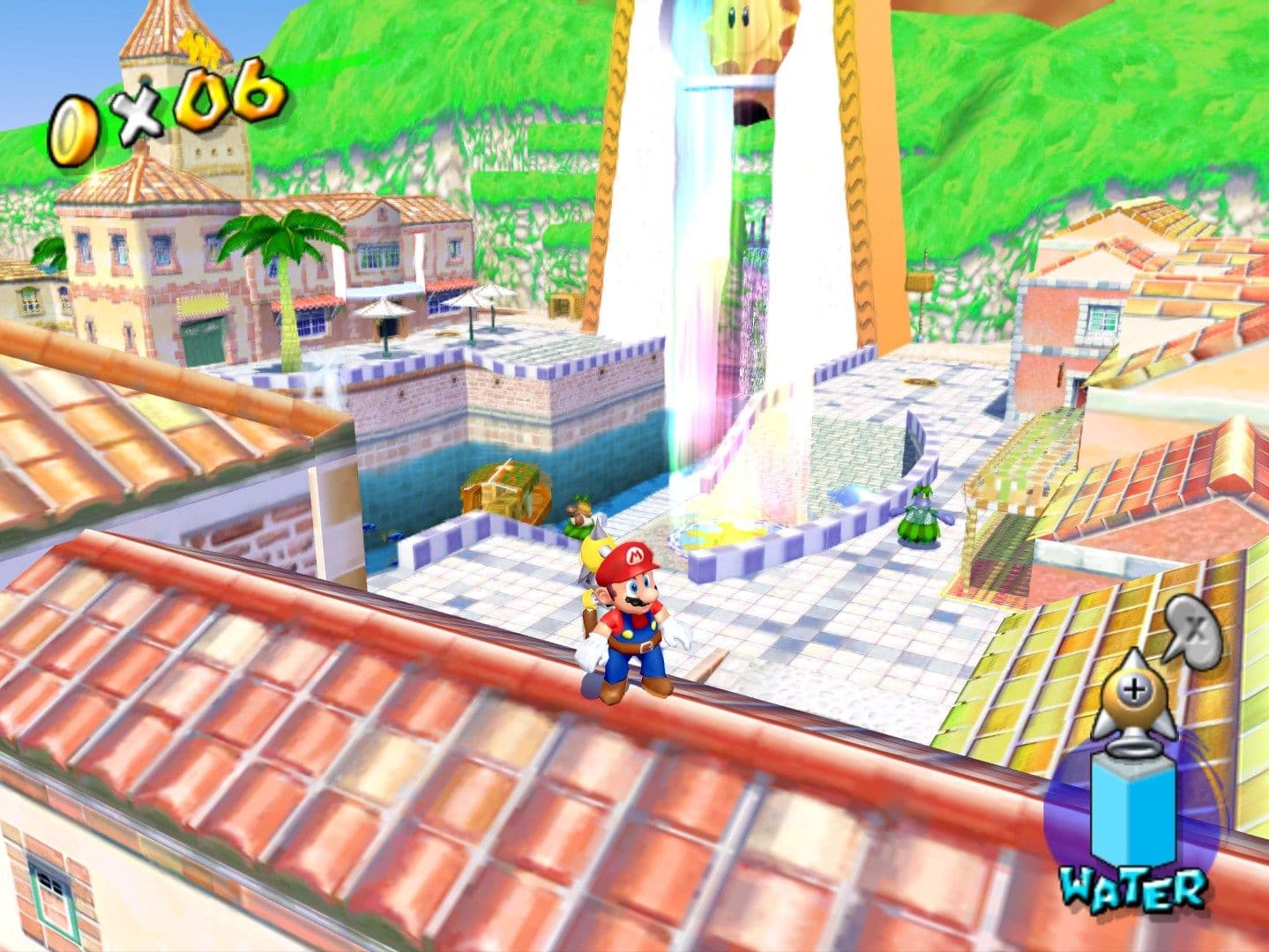
Boss encounters provide some of the most distinct gameplay challenges in each level.
The hub world of Isle Delfino and its seven main areas are playgrounds of immense verticality and clever secrets, designed for improvisation. You can scale a lighthouse in Ricco Harbor using wall jumps and a well-timed hover, or bypass entire sections of Bianco Hills with a daring rocket nozzle blast. This sense of open-ended discovery is the game’s greatest strength. The mission variety within these spaces is initially thrilling: you’ll race a giant squid across the harbor waves, meticulously warm a giant bird egg with reflected sunlight in Gelato Beach, and navigate a haunted hotel’s pool infested with electric stingrays in Sirena Beach. Each of these set-pieces is a creative burst, leveraging F.L.U.D.D. and Mario’s moveset in unique ways.
The brutal, brilliant counterpoint to this freedom is the secret F.L.U.D.D.-less stages. When Shadow Mario steals your pack, you’re plunged into surreal obstacle courses of floating blocks and moving platforms. These are pure, unadulterated tests of platforming skill, and they are merciless. The infamous sandbird climb or the maddening pachinko machine level demand pixel-perfect precision. Their difficulty is staggering, but their design is impeccable—they prove Mario’s core mechanics are robust and deliver a masochistic thrill no other 3D Mario replicates. This is the game at its most demanding and rewarding.
However, the structure governing these brilliant moments is where the repetition sets in. To unlock the final level, you must collect the seventh Shine in every world, forcing you to complete a linear sequence of episodes. You cannot skip the frustrating one. This linear progression kills the “choose your own adventure” spirit that defined Super Mario 64. Worse, the game pads its 120-Shine count with blatantly recycled objectives. Every world has a mandatory Shadow Mario chase, which becomes a tedious exercise in memorizing his route rather than a dynamic pursuit. Every world also contains two red coin scavenger hunts, a concept that feels fresh once but grows stale by the eighth iteration.
The most egregious offender is the blue coin system. A full 24 of the game’s 120 Shines—20%—are locked behind collecting 240 of these cryptic tokens. They’re fiendishly hidden, often requiring obscure actions like spraying a specific wall or returning to a level with a specific nozzle. This isn’t organic exploration; it’s a tedious checklist that artificially inflates playtime. Hunting them down feels less like a reward for mastery and more like a chore, a transparent attempt to extend the lifespan of a game that’s already bursting with more meaningful challenges.
So, you’re left with a world that feels both expansive and constricted. Super Mario Sunshine gives you a magnificent toy box filled with inventive tools and dazzling set-pieces, then insists you assemble them in a prescribed, sometimes repetitive order. The brilliance of its best moments is undeniable, but the grind to reach them can test the patience of even the most dedicated plumber.
The Camera and Controls: Super Mario Sunshine’s Greatest Adversary
Here is the uncomfortable truth about Super Mario Sunshine: its greatest adversary isn't Bowser Jr. or a towering goop monster, but the very tools you use to perceive and interact with its world. For all the fluidity of Mario's enhanced movement, the game is perpetually at war with its own camera and physics, creating moments of pure frustration that feel antithetical to Nintendo's legendary polish.
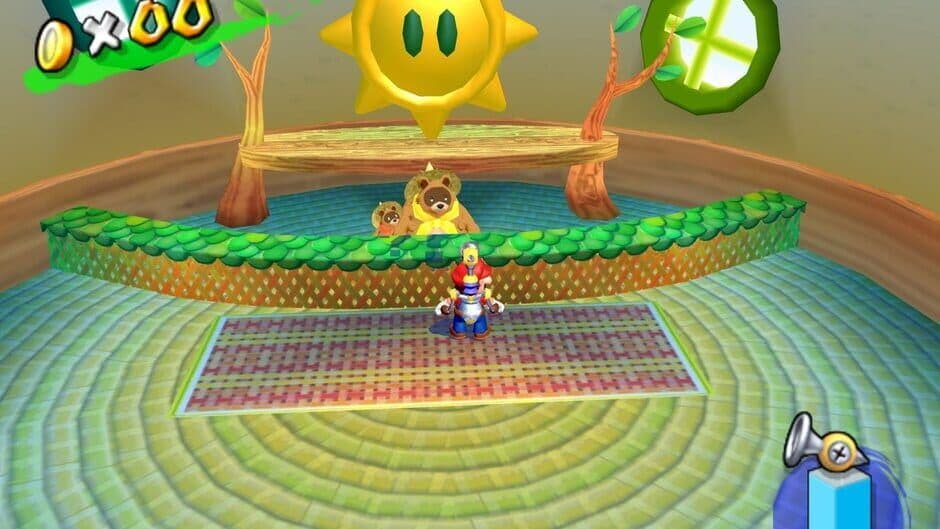
Standard gameplay often reveals the game's physics and control quirks.
The camera is the most persistent offender. While the shift to full C-stick control promised liberation from Super Mario 64's button-bound view, the result is an unrefined, often rebellious system. In open spaces like Delfino Plaza, it functions well enough, but the moment you enter a confined area or press against a wall, it loses its mind. The promised "porthole" effect to see through geometry rarely works as intended, leaving you staring at the back of a stone texture while Mario plummets off a ledge you couldn't see. This becomes agonizing in specific challenges, such as navigating the tight corridors behind the Ferris wheel in Pinna Park, where the camera constantly snaps to useless angles, turning a simple platforming task into a blindfolded guess. You're forced into a constant, minute adjustment of the stick—a distracting juggling act that pulls focus from the platforming itself.
The controls, while an improvement in some areas, introduce their own brand of friction. The wall jump is a welcome refinement, requiring only an A-button press against a surface instead of Mario 64's precise angling, making vertical ascents more intuitive. However, this is offset by Mario's strangely slippery footing. His momentum feels less anchored than in previous games, leading to unintended slides off narrow platforms or accidental backflips when trying to make subtle directional adjustments. This "slippery" physics model is most punishing in the secret, F.L.U.D.D.-less stages, where a pixel-perfect jump onto a moving block can be ruined not by your timing, but by Mario skidding an inch too far upon landing.
This lack of technical polish extends beyond feel to outright glitches. Clipping issues are a documented problem, with Mario occasionally falling through seemingly solid objects like the lily pads in Bianco Hills or getting lodged in geometry. While not constant, these moments are profoundly disruptive, especially when they cost you a life after a long, difficult challenge. They contribute to a sense that Super Mario Sunshine was rushed to market, a feeling cemented by the infamous difficulty spikes in stages like the Sand Bird climb or the Pachinko machine—levels where the combination of precise demands, uncooperative camera angles, and quirky physics can lead to cycles of controller-gripping frustration.
The technical experience is further complicated by the modern Super Mario 3D All-Stars port. Playing on Switch without a GameCube controller removes the nuanced water pressure control of the original's analog triggers, simplifying the F.L.U.D.D. spray to a digital on/off switch. Aiming now requires a cumbersome click into first-person mode. While these changes don't break the game, they subtly alter the tactile connection to the tool that defines the entire adventure, making the cleaning and precision spraying feel slightly less immediate and intuitive.
Ultimately, these technical shortcomings are the grit in the oyster of an otherwise brilliant game. They don't ruin Super Mario Sunshine, but they consistently remind you of its flawed humanity. For every moment of aerial grace, there's a camera that betrays you; for every perfectly chained wall jump, a slippery landing that sends you into the abyss. It’s a testament to the strength of the core gameplay that you persevere despite these frustrations, but they forever prevent the experience from achieving the seamless perfection the series is known for.
Visuals and Sound: The Breathtaking Beauty of Isle Delfino
If the gameplay is the beating heart of Super Mario Sunshine, its presentation is the dazzling, sun-drenched skin that makes you fall in love with it at first sight. This is a game that commits to its tropical fantasy with an artistic and technical fervor that remains breathtaking, even as it reveals a few rough edges upon closer inspection.
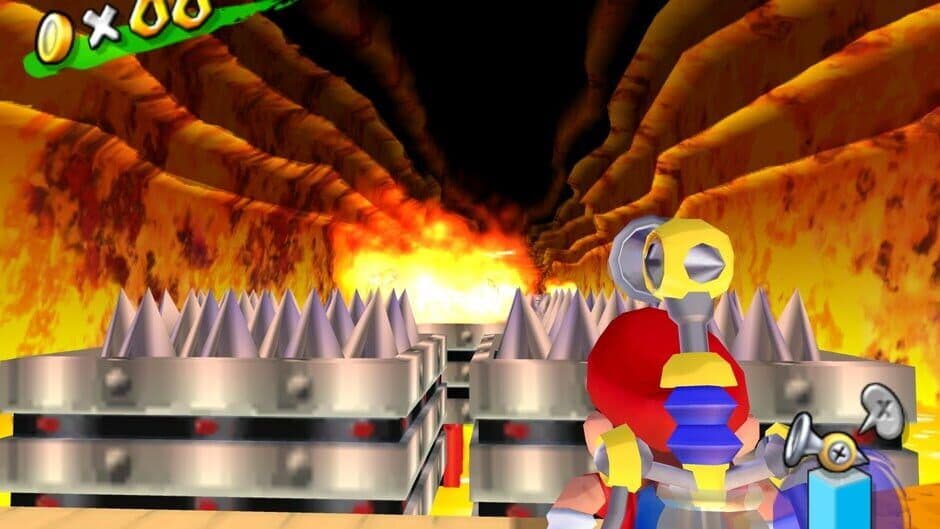
Isle Delfino architecture.
The visual star is, unequivocally, the water. Super Mario Sunshine’s water effects were a generational leap in 2002 and still hold a peculiar magic today. This isn't just a flat, blue texture; it’s a dynamic, interactive substance. When Mario wades through the shallows of Gelato Beach, the water parts around him with convincing ripples. The ocean boasts a remarkable translucency, blurring objects beneath its surface and cresting with realistic foam. The most satisfying feedback loop is using F.L.U.D.D. itself: spraying a jet onto a dry surface creates a spreading, reflective puddle, and washing away the game’s signature sludge reveals the clean texture beneath in a viscerally gratifying cascade. This technical wizardry isn't just for show—it’s the core of the game’s tactile identity, making the act of cleaning feel tangibly rewarding.
This commitment to atmosphere extends to the art direction. Isle Delfino is rendered in a vibrant, sun-bleached palette of azure skies, warm terracotta rooftops, and lush greenery. The game’s most impressive technical trick is its draw distance. Standing in Delfino Plaza, you can clearly see the distant silhouette of Bianco Hills or the roller coaster tracks of Pinna Park winding up a far-off peak. This isn't a mere skybox trick; it reinforces the cohesive geography of the island, selling the fantasy that you’re exploring a single, believable paradise. The lighting dynamically shifts too, with gloomy, overcast skies brightening as you collect Shines, visually charting your progress in purifying the island.
The soundtrack is the perfect aural companion to this visual feast. Composed by Koji Kondo, the score leans heavily into steel drums, laid-back guitars, and breezy melodies that instantly transport you to a vacation state of mind. It’s playful and immersive, shifting seamlessly from the serene exploration theme of Delfino Plaza to the frantic, percussive chase music for Shadow Mario. The most iconic touch is the a cappella rendition of the classic Super Mario Bros. theme that plays in the secret, F.L.U.D.D.-less obstacle courses—a clever, diegetic nod to the series’ past that also, as some reviewers noted, seems to subliminally help with jump timing during those brutally precise challenges.
However, peer past the dazzling surface, and you’ll find the seams. The texture quality is inconsistent, with some surfaces—particularly up close—appearing low-resolution and blocky, a jarring contrast to the otherwise lush environments. Certain areas, often in an attempt to convey intense heat or haze, employ a “washed-out” lighting effect that can drain the color and clarity from a scene, making it feel flat rather than atmospheric. Technically, the game generally runs at a smooth frame rate, but it’s prone to noticeable slowdown in specific, sludge-heavy scenarios. When multiple enemies are spewing goop and you’re spraying water everywhere, the action can chug, a rare but disruptive reminder of the hardware pushing its limits. These aren't dealbreakers, but in a game so focused on aesthetic pleasure, they momentarily break the spell.
Ultimately, the presentation of Super Mario Sunshine is a masterclass in cohesive artistic vision. The water, the music, the vibrant colors, and the staggering draw distance work in concert to create a world that feels alive, inviting, and uniquely charming. It’s a large part of why the game remains so memorable—even when the camera fights you or a level frustrates, you’re doing it in one of the most beautifully realized settings in Nintendo’s history. The flaws are there, but they’re like a smudge on a postcard from a perfect holiday: you notice it, but it doesn’t diminish the beauty of the vista itself.
Final Verdict: Is Super Mario Sunshine a Masterpiece or a Misfit?
Super Mario Sunshine is a game that demands you meet it on its terms. It is neither the genre-redefining revolution of its predecessor nor the cosmic, gravity-bending leap of its successor. Instead, it stands as a brilliant, flawed, and deeply personal experiment—a game whose legacy is defined as much by its soaring highs as by the frustrating lows you must endure to reach them. To ask if it’s a masterpiece or a misfit is to miss the point; it is both, a work of staggering ambition that sometimes buckles under its own weight.

The commitment required is substantial. The main story—collecting the seventh Shine in each of the seven worlds to reach the finale—will take a dedicated player 20 to 30 hours. For those lured by the siren call of completion, the full 120 Shine hunt is a 60-plus hour odyssey. This is where the value proposition splits. The core 30 hours are packed with the game’s most inventive moments: the exhilarating squid race in Ricco Harbor, the tense exploration of the haunted hotel in Sirena Beach, the climactic roller-coaster battle against Mecha Bowser. The additional 30-plus hours, however, are largely consumed by the blue coin scavenger hunt—a tedious, cryptic checklist of 240 tokens that rewards persistence over skill. This artificial inflation of playtime is the game’s most cynical design choice, transforming what should be a reward for mastery into a chore.
This duality perfectly encapsulates the game’s position in the Mario canon. It is an evolution of Super Mario 64, refining its movement and deepening its mechanical complexity, but it lacks the revolutionary, genre-shattering impact of Super Mario Galaxy. It’s a bridge between two eras, carrying the open-ended exploration of the past while hinting at the more curated, cinematic spectacle of the future.
The pros are legendary for a reason. The movement system, when it cooperates, is FromSoftware-level deep, allowing for an incredible array of self-expressive combos. Chaining a backflip into a hover, sliding off a slope into a rocket boost, and wall-jumping to a secret rooftop isn’t just possible—it’s encouraged. The tropical atmosphere is utterly transporting, a cohesive, sun-bleached world that feels more like a real place than any Mushroom Kingdom setting. And the high-difficulty challenges, particularly the brutal F.L.U.D.D.-less secret stages, deliver a masochistic thrill of satisfaction that later, more accessible Mario games deliberately avoid.
Yet the cons are equally impossible to ignore. The camera remains your most persistent foe, especially in tight spaces where it clips through walls or refuses to provide the angle you need, turning platforming into a blind gamble. The mission structure’s linearity—forcing you to complete specific, sometimes frustrating episodes in order—stifles the sense of freedom the world so beautifully creates. And as noted, the blue coin grind is a test of patience, not skill.
Super Mario Sunshine is not a game for everyone. It is emphatically for the hardcore platforming fan who finds joy in mastering a complex, sometimes unwieldy moveset, and who values the raw, unfiltered challenge of a perfect jump over a smoothly guided experience. It’s for the player who can forgive a rebellious camera and occasional glitch because the moment you flawlessly navigate the Sand Bird’s back or finally conquer the pachinko machine delivers a unique, hard-won euphoria. It is a demanding, idiosyncratic, and profoundly rewarding journey—provided you have the grit to see it through.
Pros:
- A movement system of incredible depth and expressiveness, turning traversal into a fluid ballet.
- A uniquely cohesive and breathtakingly beautiful tropical world that remains visually distinctive.
- Some of the most challenging and rewarding pure platforming sequences in the franchise’s history.
- A lengthy adventure packed with creative boss fights and inventive set-pieces.
Cons:
- A frequently frustrating camera that actively hinders play in confined spaces.
- A rigid, repetitive mission structure that undermines the open-ended level design.
- The tedious, artificially padded blue coin collection required for 100% completion.
- Occasional physics glitches and control quirks that can lead to unfair-feeling deaths.