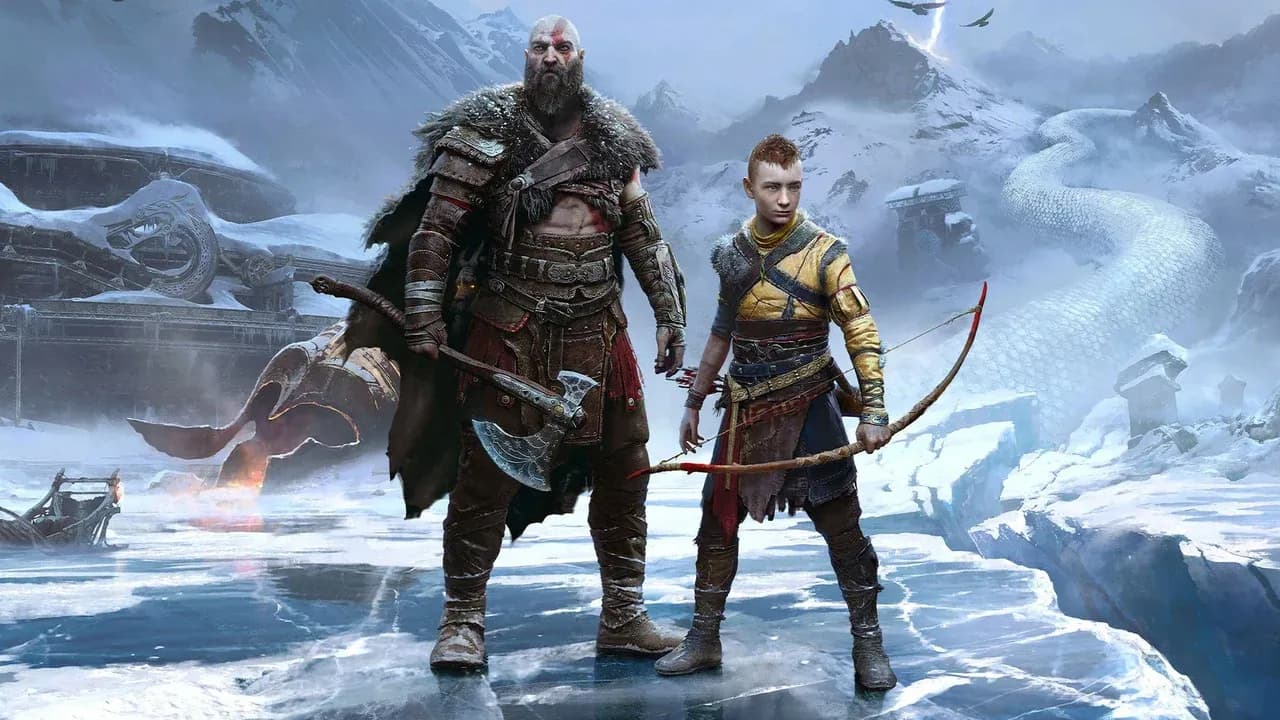
God of War Ragnarök: A Monumental Conclusion to the Norse Saga
God of War Ragnarök arrives not as a simple continuation but as a monumental burden of expectation. It shoulders the dual weight of concluding a beloved two-part saga while surpassing one of the most acclaimed games of the last generation. This is a sequel that cannot afford to be merely good; it must be definitive. Where its 2018 predecessor was a masterful, intimate story of a father and son, God of War Ragnarök expands its gaze into a sprawling epic, weaving the personal with the apocalyptic in a narrative that is both its greatest strength and, at times, its most significant point of contention.
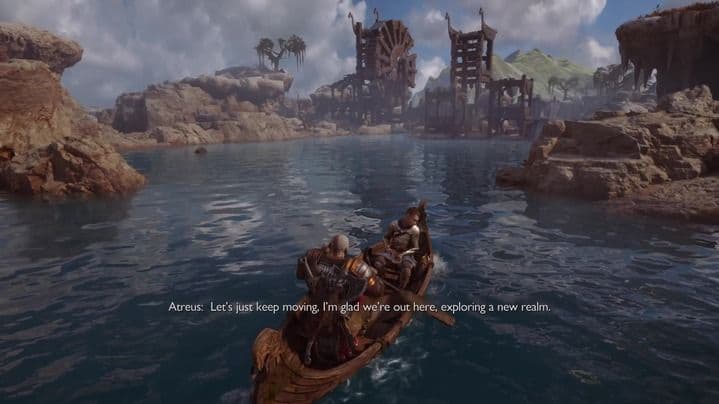
Kratos and Atreus continue their journey across the Nine Realms.
The story picks up a few years after Fimbulwinter has gripped the realms, and the clock is ticking toward Ragnarök. This is not a game you can casually drop into; it is a direct sequel that demands knowledge of the 2018 game’s events, a fact the developers acknowledge with a brief but insufficient recap. The central tension is brilliantly established from the outset: Kratos, haunted by prophecy and his own bloody history, seeks only to protect his son by hiding from fate. Atreus, now a headstrong teenager aware of his identity as Loki, believes they must actively shape their destiny, even if it means confronting gods head-on. This push-and-pull between paternal fear and youthful ambition forms the emotional bedrock of a narrative that ambitiously tries to be everything to everyone—a family drama, a mythological epic, and a blockbuster spectacle.
Where the narrative soars is in its character work. Christopher Judge’s Kratos is a masterpiece of restrained performance, his gravelly voice carrying the weight of centuries, yet now laced with a palpable fear not of death, but of failing as a father. Sunny Suljic’s Atreus, whose voice has matured alongside the character, delivers a teenager’s frustration and idealism with startling authenticity.
This maturity extends to the game’s core themes, which delve deeper into the cycle of violence between parents and children. It’s no longer just Kratos’s story; it’s Atreus’s coming-of-age tale, and the game smartly makes you play through his perspective for significant stretches. These sections, where Atreus operates independently, are not mere diversions but crucial explorations of his naivete, his power, and his desire to define himself outside his father’s shadow. The themes of sacrifice and destiny are wrestled with not in abstract monologues but through wrenching choices that force both characters to question everything they believe.
However, this grand ambition comes at a cost to pacing. With a main story clocking in at 25-30 hours and completionist runs easily doubling that, God of War Ragnarök is a massive undertaking. The narrative scope is both a blessing and a curse. It allows for a richer tapestry, introducing compelling new interpretations of Thor and Odin and giving returning characters like Freya profound arcs. Yet, the middle hours can feel bloated, as the plot diverts to service a crowded cast and the game’s own insistence on being a comprehensive tour of Norse mythology. The tightly focused, almost claustrophobic journey of the first game is exchanged for a saga that is more epic, but occasionally less disciplined.
Ultimately, this opening section establishes God of War Ragnarök as a game wrestling with its own legacy. It seeks to honor the intimate character study that came before while delivering the world-ending spectacle the title promises. The success of this balancing act—between the personal and the epic, between a father-son story and a mythological finale—will define the entire experience. It’s a high-wire act of narrative ambition, and from the outset, it’s clear the game is willing to risk a stumble in pursuit of a truly monumental conclusion.
God of War Ragnarök Combat: Refined Brutality and Tactical Depth
If the 2018 game taught Kratos restraint, God of War Ragnarök unleashes his full, glorious fury. This is a combat system that has shed its awkward teenage phase, embracing the series’ roots of acrobatic monster-slaying while retaining every ounce of the tactical depth that defined its predecessor. It’s faster, more fluid, and demands more from you than ever, resulting in a rhythmic, brutal ballet that stands as the best the series has ever offered.
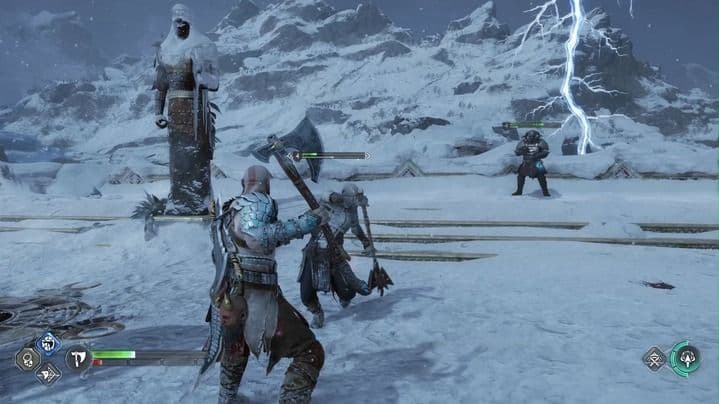
Kratos engages in brutal combat amidst the Fimbulwinter snows.
The core arsenal returns, but each tool has been sharpened. The Leviathan Axe now has a Frost Awaken mechanic, charging on a held Triangle button to unleash devastating, ice-powered heavy attacks. The Blades of Chaos feel closer to their original trilogy incarnation—aggressive, whip-like, and perfect for juggling enemies or hooking them closer—but can also be ignited for increased burn damage. The genius lies in the required synergy: you’re constantly switching, exploiting an enemy’s frost weakness with the axe before cleaving through a crowd with the blades’ wide arcs. This dance is complicated beautifully by the mid-game introduction of the Draupnir Spear, a fast, ranged weapon that offers a third, distinct tempo and introduces its own puzzle-solving and combo potential. Mastering when to use which tool, and in what order, is the game’s central, exhilarating challenge.
Where the combat truly evolves is in its verticality and mobility. Kratos is lighter on his feet, using his blades to grapple to ledges or yank himself into the fray. Taller arena designs mean combat happens on multiple levels, forcing you to manage threats from above and below. This isn’t just visual flair; it’s a fundamental rethinking of space that makes every encounter feel more dynamic and less like a static brawl.
Defense is no longer a passive act. Shields have been transformed into offensive instruments, with different types catering to specific playstyles. One might favor a brutal parry that shatters enemy guards, while another offers a more mobile, blocking-focused approach. The parry itself remains a crucial, satisfying skill, but the game layers on new defensive demands. Unblockable attacks are now color-coded—red for dodge, blue for a shield-break counter—creating a split-second language you must learn to read. This, combined with a vastly improved enemy roster that introduces foes like the Bifrost-wielding Einherjar and scuttling Grims, ensures you’re never just repeating the same pattern. You’re constantly assessing, adapting, and reacting.
This tactical depth culminates in boss fights that are nothing short of spectacular. They are more numerous and of significantly higher quality than in 2018, with multi-phase battles that dwarf even the iconic Stranger fight. The game isn’t afraid to let Kratos feel powerful, either, delivering visceral finishers that are both weapon-specific and brutally creative, a welcome return to the series’ monster-movie excess. Whether you’re ripping the jaw off a Dreki or throttling an Aesir warrior with your own chains, these moments are a cathartic payoff to the strategic build-up.
However, this refined system does have a cost. The sheer number of abilities, cooldowns, companion commands, and resource meters to manage can overwhelm, especially in chaotic group encounters where the over-the-shoulder camera can struggle. The game asks you to juggle runic attacks, Atreus’s arrow types, your Spartan Rage, and weapon stances all at once. For some, this is a masterclass in action-RPG depth. For others, it can devolve into frantic button-mashing when the screen gets too busy. Yet, even in its most chaotic moments, God of War Ragnarök’s combat feels intentional—a system built not just for spectacle, but for players who want to engage with every brutal, beautiful layer it has to offer.
Exploring the Nine Realms: World Design and Metroidvania Elements
The nine realms of God of War Ragnarök are a breathtaking achievement in environmental art, but exploring them reveals a tension between staggering ambition and the practical realities of its cross-gen design. This is a world that constantly pulls you in two directions—one moment, you’re gaping at a vista so painterly it feels like a myth come to life; the next, you’re squeezing through another rocky crevice, waiting for the next area to load. The game’s world design is a masterclass in visual storytelling and environmental variety, yet its structural seams are impossible to ignore.
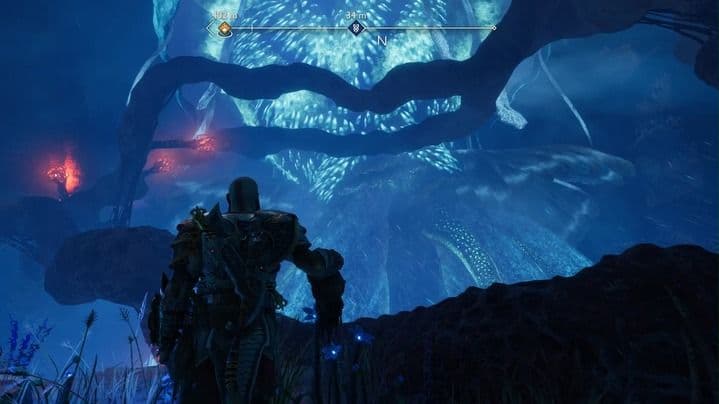
The Nine Realms feature distinct visual designs and unique mythical wildlife.
Santa Monica Studio has outdone itself in crafting realms that are not just visually distinct but mechanically unique. The dwarven forges of Svartalfheim, with their intricate waterways and geysers used for puzzle-solving, feel like a functional industrial city. The overgrown, untamed jungles of Vanaheim are a stark contrast, offering a dense, vertical maze of flora and fauna that begs for thorough exploration. Even returning realms like Alfheim are reimagined with new mechanics, such as reflective crystals that turn your axe throws into a game of deadly angles. Each location is a character in its own right, dripping with lore and a palpable sense of history. The commitment to making every realm feel like a distinct biome, rather than a simple palette swap, is where God of War Ragnarök’s environmental design earns its highest praise.
The scale of these realms, however, is wildly inconsistent. Vanaheim and Svartalfheim are sprawling, multi-layered playgrounds with hours of optional content, feeling almost like self-contained open worlds. Others, like the fiery Muspelheim, are relegated to linear combat trials or brief story beats. This isn’t necessarily a flaw—the variety in pacing is welcome—but it creates a disjointed sense of geography. You’ll spend ten hours lost in the glorious, side-quest-filled depths of one realm, only to pass through another in a brisk twenty-minute story sequence.
This inconsistency is partially masked by a strong Metroidvania structure that smartly encourages revisitation. New tools, like the Draupnir Spear or upgraded Blades of Chaos, act as keys to previously inaccessible paths. Returning to a once-familiar cavern to shatter a sonic crystal or cross a previously impassable chasm with a new grapple point provides a tangible sense of progression. It’s a loop that rewards curiosity and makes the world feel interconnected, turning what could be simple backtracking into a series of satisfying "aha!" moments as you peel back its layers.
The quality of the side content you discover on these return trips is God of War Ragnarök’s secret weapon. The Favors are a staggering leap forward from 2018’s more perfunctory tasks. These aren’t generic fetch quests; they are spectacles with narrative heft. One might involve helping a tortured spirit find peace, revealing a tragic backstory that deepens your understanding of the world’s history. Another sees you hunting a legendary beast in a multi-stage boss fight that rivals the main story for spectacle. Crucially, these quests often serve as vital character development for your companions, particularly Freya, granting them arcs that the main narrative simply doesn’t have time for. They transform optional content from checklist fodder into essential storytelling.
However, the magic of exploration is routinely punctured by the game’s most glaring technical concession: the environmental navigation that serves as hidden loading screens. The constant shimmying through narrow gaps, the slow rowing through misty canals, the laborious crank-turning animations—they are so frequent they become a predictable rhythm. While the seamless, one-shot camera is a marvel, these moments constantly remind you of the PS4 architecture underpinning the experience. They grind the pacing to a halt, especially when you’re eager to return to a newly unlocked area, only to be forced into another slow corridor crawl.
Ultimately, traversing the Nine Realms is a journey of spectacular highs and frustrating lows. You are constantly torn between awe at the artistry on display and impatience with the artificial barriers placed between you and it. The world of God of War Ragnarök is a beautiful, intricate puzzle box, but you can often feel your fingers on the seams.
Storytelling and Performance: The Emotional Core of Ragnarök
At its heart, God of War Ragnarök is a story about fathers and sons, gods and monsters, and the fragile line between them. While its combat thrills and its worlds awe, the game’s true legacy will be its characters—performances so lived-in and writing so sharp that they elevate a mythological epic into a profoundly human drama. This is where the game earns its reputation, crafting an emotional core that resonates long after the credits roll, even if the sheer weight of its narrative ambition occasionally causes the structure to groan.
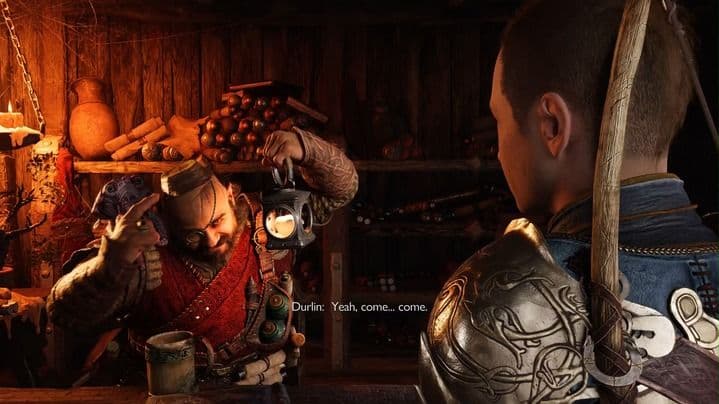
Character interactions like those with Durlin provide significant depth to the narrative.
The performances are nothing short of masterful, setting a new benchmark for the medium. Christopher Judge’s Kratos is a monumental achievement in vocal acting; every guttural syllable carries the weight of a thousand lifetimes of violence and regret, yet now layered with a desperate, quiet fear for his son. You hear the history in his voice, but you see the evolution in his eyes—the subtle softening of his brow, the slight hesitation before a command. Sunny Suljic, maturing alongside Atreus, delivers a teenager’s restless energy and searching vulnerability with startling authenticity. Their dynamic is the engine of the entire experience, and it’s powered by these two actors finding new shades in a relationship we thought we knew. Danielle Bisutti’s Freya is the trilogy’s secret weapon, transforming a grieving mother into a terrifying force of nature. Her fury is palpable, but so is the shattered heart beneath it, making her journey from vengeful hunter to reluctant ally the game’s most compelling arc.
Richard Schiff’s Odin is the performance of the year. He discards the archetype of the thundering, bearded tyrant for something far more insidious: a charismatic, weary mob boss in a worn-out tunic. He speaks in whispers and reasonable bargains, making his manipulations feel personal and his cruelty all the more shocking when it surfaces. This, alongside Ryan Hurst’s Thor—a bloated, tragic brute drowning in mead and self-loathing—redefines Norse mythology through a lens of broken families and toxic legacy, not cartoonish villainy.
This character depth is framed by a cinematic presentation that remains peerless. The commitment to the unbroken, one-shot camera isn’t just a technical flex; it’s the primary conduit for immersion. There is no safety net of a loading screen or a cut to black. When a tense conversation in a cramped cabin erupts into a brawl that spills out into a blizzard, you are there, breathlessly, for every second of it. The seamlessness between gameplay and cutscene isn’t a trick—it’s the language of the story, making the player an inseparable participant in every triumph and heartbreak.
However, the sheer scope of this story introduces God of War Ragnarök’s most significant flaw: narrative bloat. The middle act, in particular, succumbs to a “tropey, misunderstanding-fuelled” stretch where the core cast separates and reconvenes in a cycle that feels like padding. The plot diverts to service a crowded roster of allies and antagonists, and while characters like Tyr offer fascinating philosophical counterpoints to Kratos, others feel underserved. The game’s desire to be a comprehensive Norse finale sometimes comes at the expense of the taut, focused pacing that made the 2018 story so relentless. You feel those extra 10 hours, not always in a good way.
Yet, the game’s genius lies in its tonal balance, its ability to pivot on a dime without breaking character. It can deliver a scene of world-shattering gravitas—Kratos confessing his deepest fears to a ghost from his past—and in the next moment, have him deadpan a complaint about the texture of a sausage. It finds room for Mimir’s wry asides, Brok’s profane wisdom, and Sindri’s fastidious anxiety amidst the apocalypse. These moments of “self-aware silliness” or quiet domesticity don’t undercut the drama; they ground it. They remind you that these gods and giants are, at their core, a dysfunctional family trying to make it through the day, and that makes their epic struggles feel all the more real.
Technical Performance and Accessibility in God of War Ragnarök
God of War Ragnarök is a technical marvel that feels both next-gen and last-gen, a game whose ambition is occasionally tethered by the very hardware it seeks to transcend. It presents a stunning, seamless world, but you’re never allowed to forget the seams. This duality defines the experience: you’ll be awestruck by a cinematic vista one moment, and pulled out of the immersion by a slow squeeze through a rocky crevice the next.
On PlayStation 5, the game offers a trio of performance choices, but the Favor Performance mode is the definitive way to play. Locking to a near-perfect 60 frames per second, it trades a slight resolution hit for a transformative fluidity that makes the already-excellent combat feel even more responsive and visceral. The difference is night and day; parry windows feel more forgiving, camera adjustments in chaotic fights are smoother, and the sheer spectacle of combat gains a cinematic polish. The 4K/30fps Favor Resolution mode is beautiful, but the choppier feel is a tangible downgrade for gameplay. For those with compatible displays, the inclusion of a High Frame Rate Mode (targeting 120fps) is a generous, silky-smooth bonus for the most demanding action. Where this technical package stumbles is in its cross-gen reality. The frequent, disguised loading sequences—slowly rowing through canals, inching through narrow gaps, turning giant wheels—are the game’s most persistent reminder of its PS4 foundations. They are a necessary evil to maintain the flawless one-shot camera, but their predictability and frequency can grind the pacing to a halt, especially during backtracking.
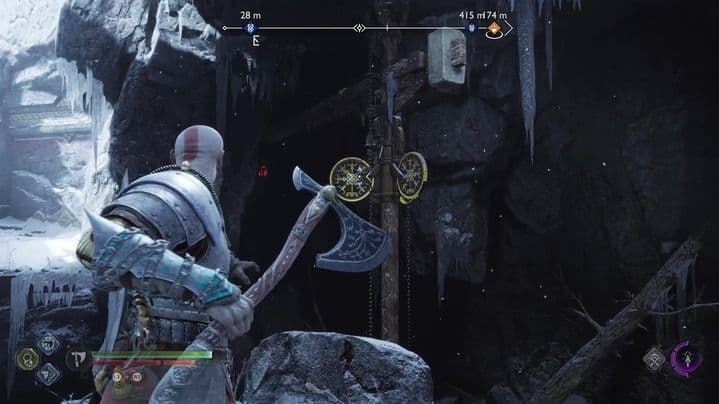
The game features extensive accessibility options, including puzzle hints.
Where the game sets a new industry standard is in its accessibility suite. This isn’t a token menu buried in the options; it’s a front-and-center philosophy of inclusion. From granular difficulty sliders for puzzles, combat, and exploration to a comprehensive range of visual and audio aids, God of War Ragnarök empowers players to tailor the experience to their needs. The presets for motor, visual, and hearing needs are a fantastic starting point, but the depth of customization is staggering—you can remap the entire controller, adjust hold timings, enable persistent icons, and even toggle audio cues for off-screen enemies. This is accessibility as a core design pillar, not an afterthought.
This commitment to player agency makes one baffling omission all the more glaring: the inability to turn off companion puzzle hints. Atreus and Mimir frequently become overbearing backseat gamers, blurting out solutions to environmental puzzles within seconds of encountering them. This isn’t a gentle nudge; it’s the game solving its own puzzles for you, often robbing you of the satisfaction of discovery. In a title that so clearly respects player skill and intelligence in its combat, this hand-holding for exploration feels patronizing and is a significant, frustrating blemish on an otherwise meticulously crafted experience.
The auditory landscape, however, is flawless. Bear McCreary’s score is a character in itself, weaving melancholy Norse motifs with thunderous, heart-pounding combat arrangements that elevate every encounter. The 3D audio implementation on PS5 is exemplary, allowing you to track the scuttle of a Wretch behind you or the distant roar of a Dreki with pinpoint accuracy. The voice acting, as previously noted, is masterclass, but the sound design—the crackle of frozen axe throws, the whip-crack of the Blades of Chaos, the sickening crunch of a finishing move—is what makes the combat feel so brutally tangible. It’s a holistic sensory package that consistently sells the epic scale and intimate brutality of Kratos’s journey, proving that technical excellence isn't just about pixels and frames, but about fully immersing the player in a world.
Final Verdict: Is God of War Ragnarök the Series' Best Entry?
God of War Ragnarök stands as a paradox of modern game development: a masterpiece of craft and ambition that is also, at times, a victim of its own sprawling ambition. To declare it the series' best entry is a nuanced debate, one that hinges entirely on what you value most. If your metric is sheer spectacle, refined combat, and emotional catharsis, then yes, this is the pinnacle. If your benchmark is the laser-focused, disciplined pacing of the 2018 reboot, then the sequel’s occasional bloat might leave you yearning for a tighter experience. Ultimately, this is a game that demands to be played, a monumental achievement that earns its place in the pantheon of great sequels, even if it doesn’t always wear the crown with perfect grace.
The value proposition here is undeniable. For your $70, you receive a 25-30 hour main story campaign, a world dense enough to double that playtime for completionists, and a level of polish so high it feels like every asset was hand-carved. This isn’t a game padded with procedurally generated content; it’s a bespoke epic where even the smallest side quest—like helping a spirit in Vanaheim—carries narrative weight and character development. The sheer volume of unique boss encounters, the meticulously crafted realms, and the depth of the combat system create a package that feels exhaustive yet rarely exhausting. It’s a high-production blockbuster that justifies its price through quality and quantity in equal measure.
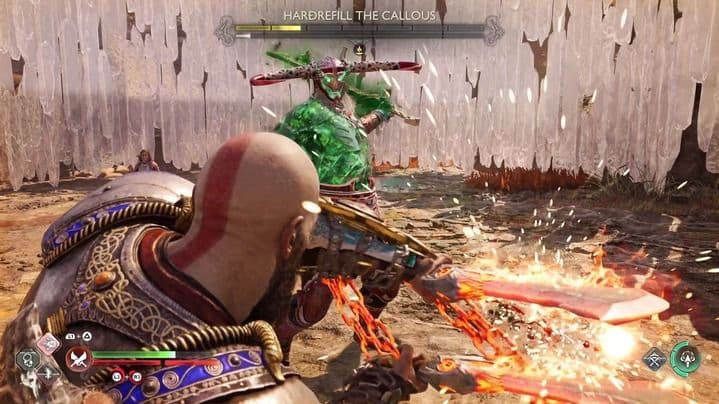
The combat remains a high point, though it feels familiar to returning players.
The comparison to 2018’s God of War is the central tension of this verdict. Ragnarök reaches the heights of its predecessor and, in key areas, surpasses them. The combat is objectively better—more fluid, more varied, and more demanding. The boss fights are more numerous and spectacular. The world is more diverse and explorable. Yet, the 2018 game’s narrative was a tightly wound coil of father-son tension; Ragnarök’s story is a sprawling tapestry that, while richer in character arcs, occasionally sags under its own weight. The middle hours, with their tropey misunderstandings and detours to service a crowded cast, lack the relentless forward momentum that made the first game so propulsive. It’s a trade-off: greater scope for slightly less focus.
This trade-off defines the pros and cons in stark relief. On one side, you have masterful storytelling that delivers the most nuanced portrayals of Odin and Thor in gaming history, and character growth that sees Kratos achieve a poignant, hard-earned peace. You have a combat system so deep that mastering the synergy between your axe, blades, and spear feels like learning a complex instrument. You have art direction that turns Norse myth into a living, breathtaking canvas. On the other side, you have pacing “filler” in the form of simplistic, often mandatory puzzles that your companions solve for you within seconds—a baffling design choice in a game that otherwise respects player intelligence. You have the lingering last-gen technical design, manifesting in frequent, slow environmental navigation sequences that puncture immersion. These aren’t minor quibbles; they are tangible friction points in an otherwise smooth experience.
For its target audience, however, these friction points are unlikely to deter. For PlayStation owners and fans of character-driven action-adventures, God of War Ragnarök is a mandatory experience. It is the culmination of a generation-defining saga, a technical showcase for the console, and a narrative that lands with profound emotional force. The moments of bloat are outweighed by the moments of brilliance: the quiet conversation between Kratos and a ghost from his past, the thunderous clash with Thor, the heartbreaking resolution of Freya’s arc. This is a game that understands the weight of its own legacy and shoulders it with confidence, even when it staggers slightly under the load.
Final Verdict:
God of War Ragnarök is not a perfect game, but it is a necessary one. It concludes a story we needed to see finished, with characters we needed to see grow, in a world we needed to see explored. It improves upon its predecessor in almost every gameplay metric while delivering a narrative finale of staggering emotional resonance. The seams are visible—in the pacing, in the puzzle hints, in the loading corridors—but the tapestry they hold together is so grand, so beautifully woven, that you forgive them. This is the series’ most ambitious, most complete, and most human entry. It earns its title not just as a sequel, but as a definitive chapter in Kratos’s saga.
Pros:
- A masterfully told, emotionally resonant conclusion to the Norse saga, with award-worthy performances.
- Combat system refined to a pinnacle of tactical depth and visceral satisfaction.
- Stunning art direction and world design that makes each realm a distinct, explorable wonder.
- Exceptional character growth, particularly for Kratos, achieving a profound and earned evolution.
- A massive, high-value package brimming with meaningful content and spectacular boss encounters.
Cons:
- Narrative pacing suffers from bloat in the middle act, with tropey detours and a crowded cast.
- Overbearing companion puzzle hints that cannot be disabled, undermining discovery and challenge.
- Lingering last-gen design in frequent, slow environmental navigation (cracks, canals, cranks).
- Some side puzzles feel like simplistic filler designed to pad time between story beats.