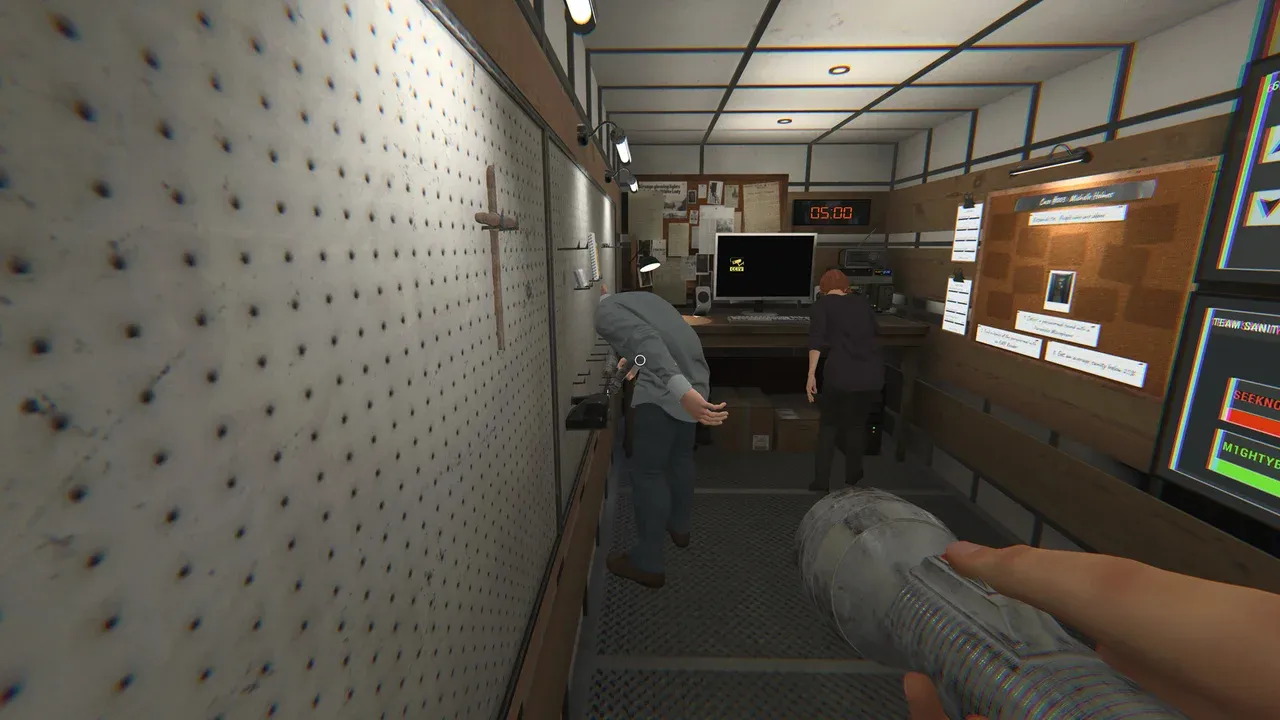
Phasmophobia Review: A Masterclass in Psychological Dread
Most horror games ask you to fight or flee; Phasmophobia asks you to stand your ground and take notes. This is the game’s foundational genius, and the reason its 2024 console debut is such a significant event for the genre. For years, this PC phenomenon has carved out a unique identity not as an action-horror title, but as a methodical, co-op psychological thriller where your only weapons are an EMF reader, a spirit box, and your own fraying nerves. You are not a slayer, but a researcher, and the terror stems from that deliberate vulnerability.
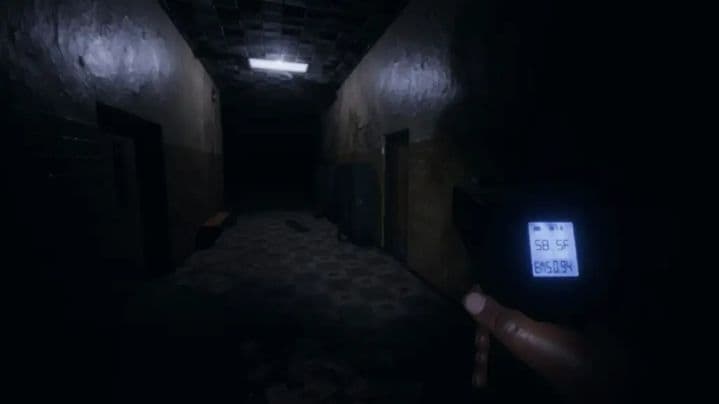
Investigative tools like thermometers are essential for identifying haunted locations.
This shift from power fantasy to forensic dread is what makes Phasmophobia a masterclass in psychological pacing. The game expertly modulates between long stretches of tense, quiet investigation and sudden, heart-stopping aggression.
You spend minutes in near-darkness, watching a thermometer for a temperature drop or listening for a whisper on a radio, with nothing but ambient creaks and the distant sound of your teammates for company. This builds a profound sense of unease that makes the eventual hunt—when the ghost becomes active, doors slam shut, and you must scramble for a hiding spot—feel genuinely catastrophic. The horror isn’t in a monster’s design, but in the palpable shift from passive observation to being the prey.
This is enforced by a core design pillar of helplessness. Unlike contemporaries like Dead by Daylight, there is no combat, no way to fight back. When a ghost hunts, your only recourse is to flee and hide, often in a closet or behind a door, praying your chosen sanctuary is safe. The game weaponizes this passivity; ghosts can interact with your hiding spot, nudging the door open or whispering just outside, turning a moment of supposed safety into an exercise in sustained panic. This mechanic transforms every investigation from a simple puzzle into a high-stakes test of nerve, where the greatest threat is often your own decision to press deeper for one more piece of evidence.
The arrival on PlayStation 5 and Xbox Series X/S on October 29, 2024, with full crossplay support, finally opens this uniquely stressful playground to a massive new audience. The transition, however, is not without a tangible compromise. A signature feature of the PC version is its voice recognition, where you could speak directly to the ghost through the spirit box, asking its name or age. On console, this is replaced by a menu of pre-programmed commands. While functional, this substitution strips away a layer of immersive dread. The organic, unnerving feeling of conversing with an entity that can hear you is diminished, making one of the game’s most distinctive investigative tools feel more like a mechanical checklist than a paranormal conversation. It’s the single largest concession in the port, and while it doesn’t break the core loop, it dulls one of its sharpest edges.
Yet, even with this limitation, the foundational terror of Phasmophobia remains intact on console. It proves that true horror isn’t about gore or jump scares, but about atmosphere, anticipation, and the profound vulnerability of being a curious human in a very dark, very occupied room. This is the identity it forged in 2020, and it’s the unsettling legacy it brings to a new generation of players.
The Ghost-Hunting Loop: How Phasmophobia Rewards the Brave
The true genius of Phasmophobia isn't the scare itself, but the methodical, terrifying path you take to earn it. This is a game that rewards the brave not with loot or levels, but with the profound satisfaction of solving a deadly puzzle while your heart tries to escape your chest. The core loop is deceptively simple: enter a haunted location, find the ghost’s favorite room, and gather three specific pieces of evidence to identify its type before your sanity runs out and it decides to hunt you. What elevates this from a basic checklist is how every tool in your kit turns you from a spectator into an active participant in your own dread.
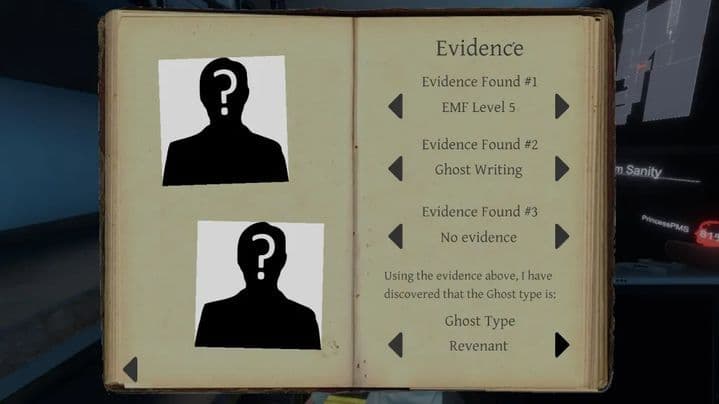
The evidence book is essential for identifying the ghost type.
Your investigation is a process of elimination played against a ticking clock. You’ll sweep rooms with a thermometer listening for the telltale drop to freezing, scan doors with a UV light for fingerprints, or set up a D.O.T.S. projector hoping to catch a fleeting, ghostly silhouette. Each successful reading is a small victory, but it also brings you closer to the entity. The Spirit Box, especially on PC where voice recognition allows for direct questioning, creates moments of unparalleled tension as you stand in the dark asking, “Are you friendly?” into the void, praying for static but fearing a guttural response. This isn't passive observation; it's proactive baiting. The game masterfully ties your success to your vulnerability—the most crucial evidence often requires you to be in the ghost's room, lights off, alone, and utterly exposed.
This is where Phasmophobia’s staggering replayability is forged. With over 20 distinct ghost types—doubled from its original 12—each with unique behaviors and evidence combinations, no two investigations ever play out the same. A Revenant will chase you down relentlessly during a hunt, while a Shade may refuse to appear if players are grouped together.
This variety forces you to adapt your strategy on the fly. Is the ghost throwing objects at a furious rate? It could be a Poltergeist. Are the lights blowing out constantly? You might be dealing with a Mare. This deep behavioral catalog means that even on the same small house map, identifying a Yurei feels fundamentally different from cornering a Jinn. The joy comes from the collective deduction with your team, arguing over evidence in the safety of the truck before someone has to bravely go back in to test a new hypothesis.
However, this brilliant depth is also the source of the game's most significant barrier: a learning curve so steep it feels like homework. Phasmophobia offers a bare-bones tutorial that explains how to hold a flashlight, but it abandons you when it comes to the nuanced behaviors of two dozen ghosts. New players won't know that a Banshee targets one person exclusively, or that a Hantu moves faster in cold rooms. This critical knowledge isn't hinted at in-game; it's community-sourced, found on wikis and fan-made cheat sheets. While this fosters a dedicated community, it creates a frustrating initial experience where failure feels arbitrary. You can do everything "right" by the game's taught mechanics and still die because you didn't know the obscure rule that a certain ghost type is triggered by speaking near it. The progression system, which locks essential tools like sanity pills and advanced thermometers behind a lengthy level grind, further exacerbates this, making the early hours feel unnecessarily punitive.
Yet, for those who persevere, this complexity becomes the game's greatest strength. When you finally correctly predict a ghost is a Mimic because you noticed its Spirit Box evidence was inconsistent, or when you survive a hunt by knowing a Revenant slows down when it loses sight of you, you feel like a true paranormal expert. Phasmophobia doesn't just scare you; it teaches you to think like a ghost hunter. The terror evolves from a fear of the unknown to the calculated anxiety of managing known, deadly variables. It’s a loop that transforms panic into procedure, and that transformation is where the game’s brave heart truly beats.
Atmosphere and Sound: The True Stars of the Investigation
The most terrifying thing in Phasmophobia isn't what you see—it's what you hear in the silence between your own ragged breaths. This is a game where the technical presentation, while uneven, weaponizes its limitations to craft an atmosphere of profound, sustained dread. The true stars of this investigation are the lighting that carves pockets of impenetrable shadow and the sound design that turns every creak into a potential death sentence.
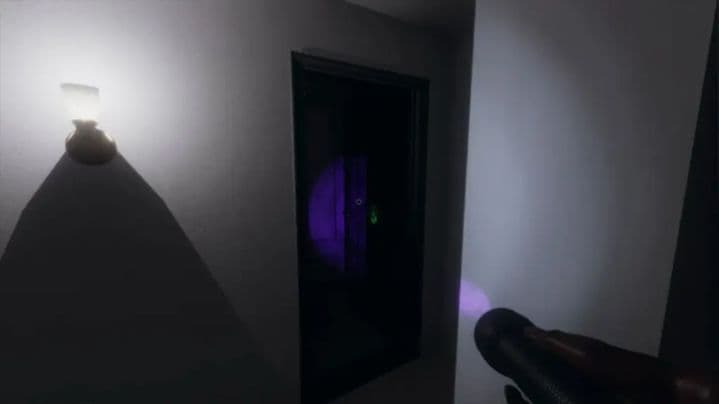
Atmospheric lighting effects like UV light reveal hidden clues.
Phasmophobia’s soundscape is a masterclass in psychological pressure, best experienced with headphones on and the lights off. The horror lives in the details: a distant door slams shut in a room you know is empty; a ghostly whisper cuts through the static of a Spirit Box just as your flashlight battery dies; the heavy, deliberate footsteps of an entity during a hunt, growing louder as it methodically checks your last known hiding spots. These aren't cheap jump scares, but orchestrated moments of panic that exploit your imagination. The game’s deliberate lack of a traditional soundtrack is its smartest decision, forcing you to parse every ambient noise and leaving you utterly vulnerable to the sudden, violent shift when a hunt begins. This audio design doesn't just set the mood—it is the primary antagonist for vast stretches of gameplay.
Visually, however, the game presents a stark and often conflicting picture. Phasmophobia’s character models and environmental textures are, by any modern measure, dated and unimpressive. Walls can feel paper-thin, and objects lack physical heft. Yet, to dismiss this as simply "bad graphics" misses the point of its intentional horror aesthetic. The low-fidelity look, with its functional lighting and slightly janky animations, evokes the scrappy, earnest charm of a 70s or 80s haunted house film. It feels less like a technological shortcoming and more like a stylistic choice that enhances the grounded, "found-footage" authenticity. Flickering lights cast long, distorted shadows that are far more frightening than any high-polygon monster model could be. The terror is in the suggestion, in the glimpse of something moving just beyond the cone of your flashlight, and the game’s visual simplicity often serves that goal better than photorealism ever could.
This atmospheric foundation is poured across a solid variety of playgrounds. The 13 distinct maps—categorized into 8 small, 3 medium, and 2 large locations—are more than just backdrops; they are tactical puzzles. A cramped suburban house amplifies claustrophobia, forcing tense encounters in narrow hallways. In contrast, the sprawling asylum or prison maps introduce a different kind of fear: the dread of distance. With the ghost's room potentially minutes away from the safety van, every foray deeper feels like a monumental commitment, and the sound of a hunt beginning while you're in a far-flung wing is pure, unadulterated panic. Each location is dressed with a lived-in, mundane detail that makes the supernatural intrusion feel all the more violating.
For the utmost in immersive terror, the PS VR2 version promises an unparalleled level of fear. By literally placing you inside these environments, the sense of scale and presence is magnified tenfold. A ghost appearing in your physical space is reportedly heart-stopping. However, this peak immersion comes at a significant cost: finicky, janky controls that several reviews describe as a "total mess." Navigating menus becomes a chore, interacting with objects like doorknobs or equipment can be frustratingly imprecise, and the general "first-gen" feel of the mechanics can shatter the very immersion it seeks to create. It’s the ultimate high-risk, high-reward way to play—offering the most potent scares for those willing to wrestle with its technical shortcomings.
Ultimately, Phasmophobia’s presentation is a study in compelling contradictions. It pairs a dated visual package with world-class sound design, and it offers a VR experience that is both the most terrifying and the most awkward way to play. Yet, these elements coalesce into a cohesive, unnerving whole. The game understands that true horror is a feeling, not a rendering, and it uses every technical tool at its disposal—especially your own ears—to make you feel hunted long before the ghost ever officially starts.
Progression and Technical Hurdles: The Early Access Reality
The thrill of solving Phasmophobia's deadly puzzles can be intoxicating, but the game's early access scaffolding is impossible to ignore. This is where the brilliant core loop collides with the grind of progression and the technical reality of a console port, creating a barrier that will test your patience as much as any ghost.
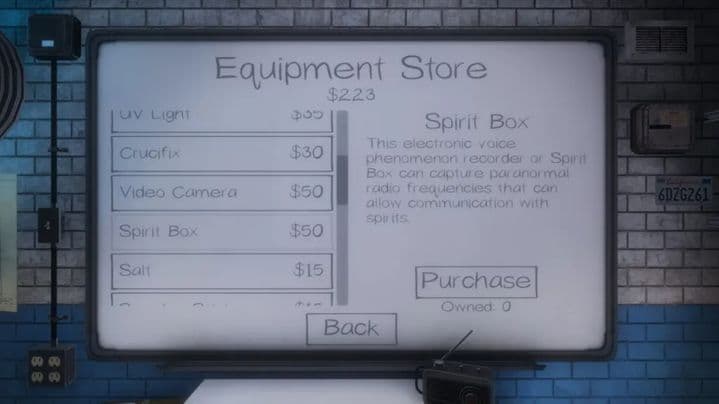
Managing gear through the UI is a core part of the progression loop.
Phasmophobia’s progression is a double-edged sword. The 80-level system provides a tangible long-term goal, but it does so by locking essential quality-of-life tools behind a punishing grind. You don’t just earn better gear; you earn the very basics of a manageable investigation. Sanity pills, crucial for mitigating the ghost’s aggression, are locked until level 14. The reliable thermometer is a distant dream at level 65. This means new players are saddled with the game’s most frustrating starting equipment for dozens of hours, turning the already steep learning curve into a sheer cliff. The risk-versus-reward dynamic is compelling when you’re weighing a high-stakes photo opportunity, but it feels unnecessarily punitive when the core frustration is simply not having the right tool for the job. The developers have acknowledged this as an issue, but as of the console launch, the slow drip-feed of unlocks remains a significant hurdle to enjoyment.
Where the console experience truly stumbles, however, is in its user interface and controls. Navigating Phasmophobia’s menus feels like performing a seance with oven mitts on—a clunky, confusing ordeal that saps momentum before you even step into a haunted house.
The cursor-based menu system, ported directly from PC, moves with a frustrating lethargy. More egregious is the control scheme, which inexplicably splits basic interactions across multiple buttons: R2 to ‘Interact’ with a light switch, X to ‘Use’ a placed camera, Square to ‘Grab’ an item, and Circle to ‘Drop’ it. In the calm of the truck, this is merely annoying. During a panicked retreat from a hunting ghost, fumbling to remember which button closes a closet door versus which one drops your precious evidence is a recipe for a cheap, controller-throwing death. This isn't a matter of complexity; it's a fundamental failure of intuitive design that the PC version, with its mouse and keyboard, simply doesn't have to contend with.
Technically, the port is a mixed bag. On the positive side, performance is solid: the PlayStation 5 version maintains a smooth 60 frames per second with quick load times, providing a stable foundation for the scares. Yet, this is wrapped in a layer of persistent early access jank. Reviewers cite ghost glitches, cameras that malfunction for no reason, and inconsistent lighting that can break the atmosphere. One noted the audio cue for rain playing without any visual rain effects—small bugs that collectively chip away at the carefully constructed immersion. The much-anticipated PS VR2 version reportedly amplifies these issues, offering unparalleled immersion at the cost of what one critic bluntly called "first-gen" and "finicky" controls that can make simple interactions a struggle.
This technical friction is felt most acutely in solo play. While viable, single-player Phasmophobia transforms from a tense cooperative deduction game into a tedious, chaotic chore. You are solely responsible for ferrying every piece of equipment from the truck, monitoring your own sanity, and gathering all evidence alone—a process that feels less like brave investigation and more like running a paranoid errand in the dark. The intended rhythm of teamwork is gone, replaced by a punishing slog where death means a complete mission failure and loss of all earnings. It’s a mode that exists more as a hardcore challenge or a practice range than a fulfilling way to experience the game, and it starkly highlights how much of Phasmophobia's magic is woven from shared panic and collective problem-solving.
Ultimately, this section of the experience serves as a crucial reality check. Phasmophobia on console delivers its signature scares on a stable technical base, but it asks you to forgive a litany of interface sins and commit to a lengthy, often frustrating grind to unlock the full investigative toolkit. Your enjoyment will hinge directly on your tolerance for this early access roughness and whether you have a dedicated crew to share the burden—and the screams.
Final Verdict: Is Phasmophobia Worth the Scare on Console?
So, is Phasmophobia worth the price of admission on console? The answer is a resounding, albeit heavily qualified, yes. For the right player, this is a uniquely compelling horror experience that justifies its modest $13.99–$14.00 price tag with staggering replayability. The procedural nature of its over twenty ghost types across thirteen maps means no two hunts ever play out identically. A session in the same suburban bungalow can swing from a tense, silent standoff with a Shade to a chaotic, object-throwing rampage from a Poltergeist. This variability, combined with the sheer depth of its evidence-gathering mechanics, creates a game you can return to for dozens of hours, chasing that perfect, terrifying investigation. It’s a testament to the core loop’s strength that, even in its early access state, the value proposition is clear and compelling.
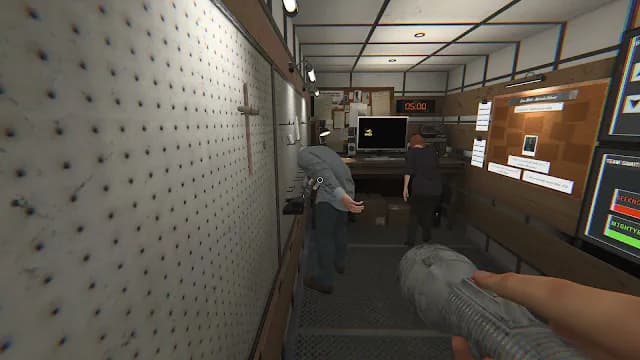
High-stakes ghost hunts are the core of the Phasmophobia experience.
The true magic, however, is almost entirely social. Phasmophobia is a masterclass in cooperative horror, transforming what could be a lonely, frustrating slog into what one critic perfectly described as “hysterical enjoyment.” The game’s genius is in how it engineers shared panic. It’s in the frantic, whispered arguments in the truck over whether the freezing temperatures point to a Hantu or a Phantom. It’s in the scream that echoes through your headset when a teammate rounding a corner comes face-to-face with a manifestation. It’s in the collective, breath-holding silence as you listen for footsteps during a hunt, followed by the relieved, manic laughter when you all survive. This emergent storytelling—the inside jokes, the heroic sacrifices, the cowardly betrayals—is where the game earns its legendary status. Playing with a dedicated group isn't just recommended; it's the definitive way to experience everything Phasmophobia has to offer.
The moment the game clicks, when your team moves from confused tourists to a semi-competent ghost-hunting unit, is one of gaming’s great cooperative highs. You’re not just playing a game; you’re starring in your own chaotic, terrifying paranormal reality show.
This social scaffolding is vital because, for some, the terror does have a shelf life. A minority of critics noted that once you’ve internalized the ghost behaviors and mastered the equipment routine, the tension can curdle into boredom or procedural grind. The investigation can start to feel like checking boxes rather than exploring the unknown, especially during slower contracts. This is the inherent risk of a game built on systems rather than scripted scares. Your mileage will vary dramatically based on your appetite for its particular brand of repetition and your willingness to role-play the fear even when you know the rules. For most, the unpredictable nature of ghost hunts and the sheer comedy of human error keep it fresh, but it’s a valid caveat for those who need constant novelty.
Your final verdict, then, hinges entirely on context. Phasmophobia is a game of brilliant highs and frustrating lows, and your ability to endure the latter will determine your enjoyment.
Pros:
- Innovative, Tense Gameplay Loop: The shift from power fantasy to forensic investigation creates a unique and consistently engaging form of horror.
- Peerless Social Co-op: Few games engineer shared panic and hilarious, emergent stories as effectively. This is the heart of the experience.
- Masterful Sound Design: The audio is a relentless, terrifying antagonist that does more heavy lifting than any visual effect.
- Exceptional Replayability: With over 20 ghost types and 13 maps, no two investigations are the same, offering tremendous value for the price.
Cons:
- Abysmal Console UI & Controls: The menu navigation is a chore, and the counter-intuitive button mapping (separate ‘Interact’ and ‘Use’ buttons) is a constant source of friction and frustration.
- A Steep, Opaque Learning Curve: Essential ghost knowledge is locked behind community wikis, and vital tools are gated behind a lengthy leveling grind.
- Early Access Jank: From visual bugs to ghost AI glitches, the technical imperfections are ever-present reminders of its unfinished state.
- Dated Visuals: While the aesthetic has charm, the character models and environments are objectively unimpressive by modern standards.
Phasmophobia is not a polished, AAA horror title. It is a rough-hewn, brilliant, and deeply flawed gem. It is highly recommended for co-op groups and paranormal enthusiasts who are willing to forgive its technical sins and invest the time to learn its intricate language. For them, it offers an experience unlike anything else on console—a perfect storm of deduction, dread, and delirious friendship-testing chaos. For the solo player or those with low tolerance for clunky interfaces and a “learn-by-dying” philosophy, however, the frustrations will likely outweigh the fears. This is a game that demands patience, friends, and a willingness to be scared not just by ghosts, but by its own design.