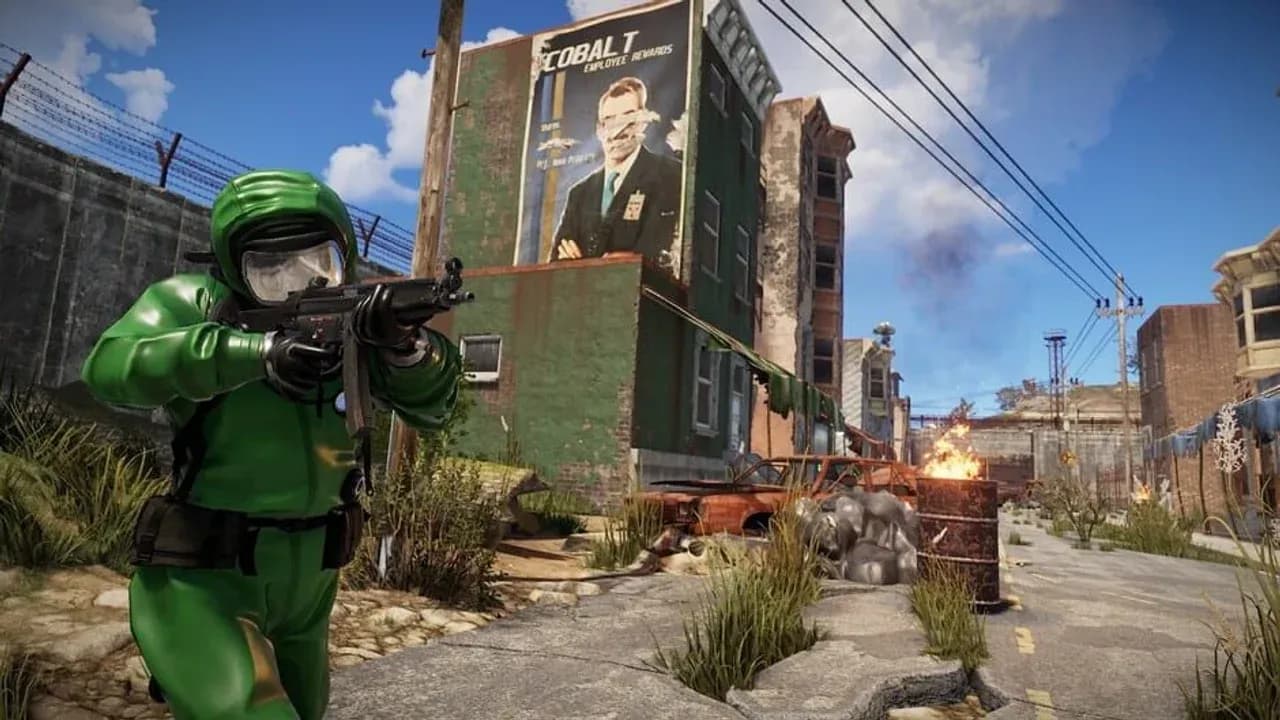
Rust armor is not a simple ladder from cloth to metal. The useful question is which body zone a piece protects, which damage types it answers, what slot it consumes, and whether it is still intact. A Coffee Can Helmet is a strong mid-wipe head choice against firearms; a Hazmat Suit is the practical answer when radiation and cold control the route; Heavy Plate is for fights where explosive resistance and raw protection justify slower movement. Read the panel as a set of tradeoffs, then take the kit that matches the next threat.
Start With the Body Zone, Not the Armor Tier
Rust groups protection around three body zones: head, chest and legs. Clothing and armor worn in those zones contribute their listed protection values. Gloves contribute to the upper body and boots to the legs, while a full-body suit replaces the normal slot layout.
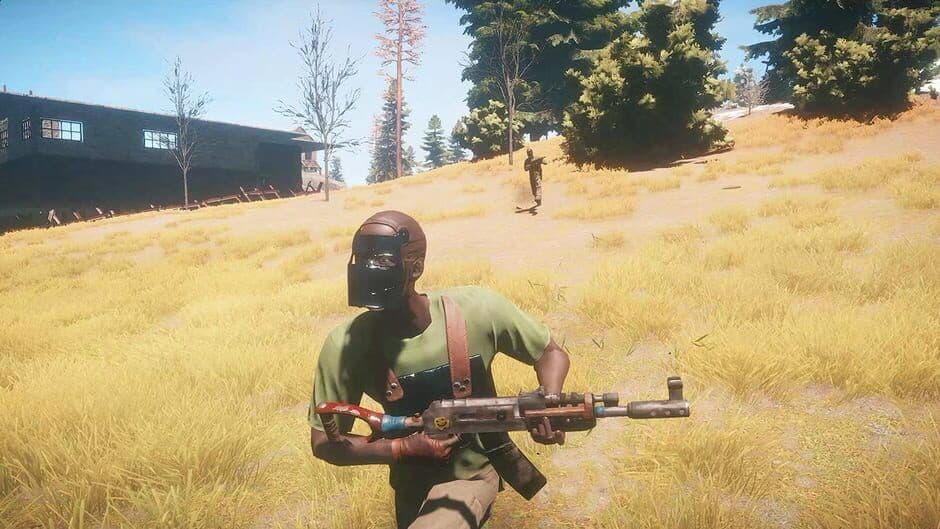
Head protection changes the result of a rifle roam.
The percentage is damage reduction for that protection type in the zone the item contributes. Projectile protection answers gunfire and other projectile damage; melee covers attacks such as rocks and blades; bite matters against animals. Explosion, radiation and cold are separate values, so a kit that wins a rifle fight may be a poor choice for a radioactive monument or a snow biome.
The numbers create clear comparisons. Metal Facemask gives 50% projectile and 70% melee protection for the head, but its listed cold value is -4%. Hazmat Suit gives 50% radiation and 50% cold across the full body, but only 30% projectile protection. Heavy Plate Helmet reaches 90% projectile and 100% explosion protection, while its listed movement-speed reduction is 10% and its restricted view changes how you take a fight.
“Best armor” therefore depends on the damage type and route. Prioritize the zone most likely to be hit, then pay for environmental protection only when the environment is part of the encounter.
Use the Two-Layer Slots to Stack Protection
Head, chest and legs each have a clothing layer and an armor layer. A hoodie can occupy the chest clothing layer while a Road Sign Jacket occupies the chest armor layer; pants and a Road Sign Kilt work the same way on the legs. Both items contribute their protection, so the underlayer adds real projectile, melee, bite, radiation and cold values.
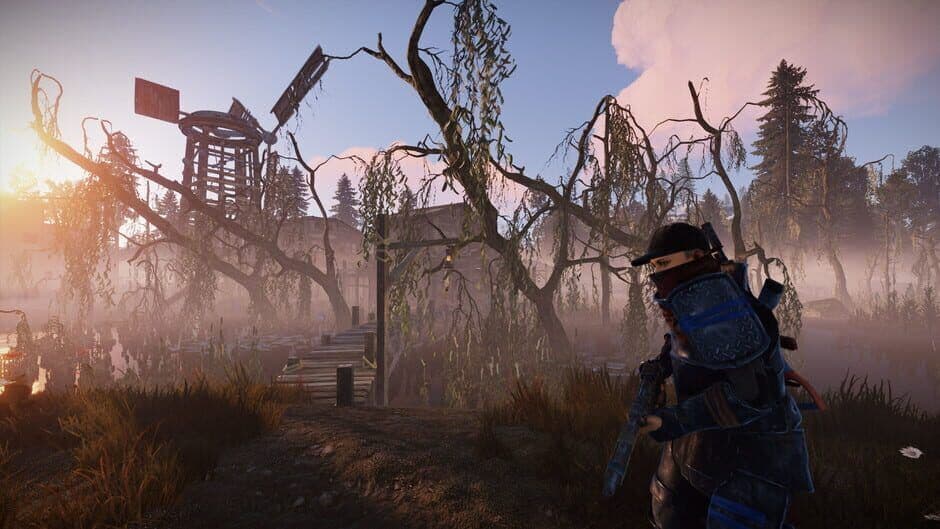
Layer occupancy decides which clothing can add protection.
Hands and feet have one slot each. Full-body suits occupy everything, which is why a Hazmat Suit is compact but cannot be combined with a hoodie, helmet or boots. A Wetsuit is a special case: it uses the chest and legs clothing layers while leaving the armor layers open.
Some pieces consume both layers in one zone. Metal Facemask and Coffee Can Helmet take both head layers, so you cannot add a bandana or other head clothing beneath them. Heavy Plate Jacket and Heavy Plate Pants do the same on the chest and legs. Heavy Plate Helmet is different in the current slot data: it occupies the head armor layer, leaving the head clothing layer available.
Use that rule to avoid dead slots. A hoodie under Heavy Plate Jacket and pants under Heavy Plate Pants do not fit; with those pieces equipped, use the remaining slots for gloves, boots, head clothing or other uncovered needs.
Use This Protection Table to Pick the Tradeoff
The table below is a current PC Rust snapshot from Facepunch’s Rust Wiki item pages. Check the in-game protection panel after a patch. A dash means the item page does not list that value; it is not a calculated estimate.
| Piece | Projectile | Melee | Bite | Explosion | Radiation | Cold |
|---|---|---|---|---|---|---|
| Boonie Hat | 15% | 15% | 3% | — | 2% | 6% |
| Jacket | 15% | 20% | 27% | — | 5% | 40% |
| Hoodie | 20% | 15% | 23% | — | 5% | 34% |
| Pants | 15% | 15% | 3% | — | 5% | 8% |
| Hide Pants | 10% | 10% | 8% | — | 2% | 4% |
| Leather Gloves | 5% | 5% | 7% | — | 4% | 20% |
| Tactical Gloves | 10% | 5% | 7% | — | 5% | 27% |
| Wood Armor Helmet | 15% | 25% | 3% | — | 2% | 6% |
| Wood Chestplate | 10% | 40% | 20% | 30% | 5% | — |
| Wood Armor Pants | 10% | 40% | 5% | 30% | 5% | — |
| Bone Armor | 25% | 40% | 67% | 40% | 4% | — |
| Road Sign Jacket | 20% | 20% | 40% | — | — | -34% |
| Road Sign Kilt | 20% | 20% | 10% | — | — | -8% |
| Coffee Can Helmet | 35% | 50% | 8% | 50% | 5% | — |
| Metal Facemask | 50% | 70% | 8% | 50% | — | -4% |
| Metal Chest Plate | 25% | 20% | 13% | — | — | -34% |
| Riot Helmet | 25% | 80% | 13% | — | 5% | 6% |
| Hazmat Suit | 30% | 30% | 50% | 30% | 50% | 50% |
| Heavy Plate Helmet | 90% | 80% | 13% | 100% | 7% | -16% |
| Heavy Plate Jacket | 75% | 70% | 47% | 100% | 7% | -67% |
| Heavy Plate Pants | 75% | 70% | 12% | 100% | 7% | -17% |
Use the values with a scenario, not as a single ranking:
| If the next threat is… | Prefer… | Because… |
|---|---|---|
| Rifle fire during a normal roam | Metal Facemask plus clothing layers | The facemask gives the strongest listed projectile protection for the head without forcing Heavy Plate’s movement penalty. |
| Radiation or cold on a monument route | Hazmat Suit | Its 50% radiation and 50% cold protection apply across the full body. |
| Animals or melee pressure | Riot Helmet or Bone Armor | Riot Helmet lists 80% melee protection; Bone Armor lists 67% bite protection and covers multiple body slots. |
| Explosives while defending or raiding | Heavy Plate pieces | Each listed Heavy Plate piece provides 100% explosion protection, but the set trades mobility, aiming and cold resistance for it. |
| Snow or a cold-weather roam | Hoodie, pants and positive-cold pieces | Metal Facemask, Metal Chest Plate and Heavy Plate impose negative cold values that can outweigh their combat advantage in the environment. |
A Riot Helmet is excellent against melee but weaker against bullets than a Coffee Can Helmet. A Metal Chest Plate is only 25% projectile protection by itself, so the rest of the chest and leg layers still matter. Treat bite and explosion as situational strengths: they matter when the threat is an animal, trap or raid, not in every gunfight.
Broken Armor Keeps Only 25% of Its Protection
Armor condition is a damage budget, not another percentage to add to the protection table. Facepunch described armor condition as hitpoints: damage absorbed by armor reduces its condition. When a piece reaches zero, it becomes broken and provides only 25% of its original protection value.
That is the breakpoint to act on. A broken Metal Facemask is not a 50% projectile head piece in the fight that matters; under Facepunch’s rule it retains only a quarter of that original protection. The same applies to a Heavy Plate piece that reaches zero. Repair or replace it before taking it into a fight where its headline number is the reason you equipped it.
Current repair-bench entries show a 20% condition loss for a repair operation on many craftable pieces. That describes the repair system; it is not a claim that protection smoothly drops at every visible condition percentage. Use the clear rule: intact armor provides its listed protection, and broken armor provides a sharply reduced version of it.
Choose a Kit by Threat, Then by Wipe Stage
Fresh spawn and primitive fights: Use Hoodie, Pants, Leather Gloves and a Boonie Hat for baseline projectile, melee and cold protection. Add Wood Armor Helmet, Wood Chestplate or Wood Armor Pants when bows, melee or animals are the immediate threat. This kit is for surviving the first exchange, not for challenging a rifle.
Mid-wipe roaming: Choose Coffee Can Helmet, Road Sign Jacket and Road Sign Kilt when firearms are likely but Heavy Plate is unnecessary. Keep the clothing layers where the armor leaves them open; the hoodie and pants offset some environmental cost and add their own protection. Choose Hazmat Suit instead when radiation or cold is the route’s limiting threat.
Late-wipe PvP: Start with the head. Metal Facemask gives 50% projectile protection, 15 percentage points above Coffee Can Helmet’s 35%, and its 70% melee protection is 20 points higher. Add Metal Chest Plate when the chest needs more protection, then fill the remaining open slots with clothing, gloves and a Road Sign Kilt. The chest plate’s 25% projectile value is an upgrade, not a complete body plan.
High-risk defense and explosive work: Use Heavy Plate when you expect sustained damage in a fixed position or when explosion protection is the reason for the kit. The helmet, jacket and pants impose 10% movement-speed reductions; the jacket also blocks aiming down sights, and all three carry negative cold values. The listed 100% explosion protection is the piece’s protection value for explosion damage on its covered zone, not a promise that every explosive event becomes harmless.
Before every roam, compare the next threat with the table, verify which layers are actually open, and replace any piece that has reached the broken state.
Early-wipe armor should protect the next fight without wasting scarce resources.