
Softcore mode is built around recovery. A field death returns part of your kit, a destroyed container can keep part of its contents for its owners, and the current default raid schedule gives a small group time to repair between attacks. None of those rules protects a death at your own Tool Cupboard, so the useful question is not whether Softcore is easy; it is where its protection applies.
Check the Tool Cupboard Before You Risk Your Kit
The death rule is simple once you separate location from item type:

Field death recovery
| Situation | What you keep |
|---|---|
| Death outside a building privilege radius | 50% of eligible inventory and hotbar items |
| Death inside your own Tool Cupboard range | None of that recoverable inventory |
| Armor and clothing | Not kept after death |
| Stackable items | Half of the total count, calculated across the stackable amount |
Outside building privilege, the game returns the recoverable half automatically when you respawn. For stackable items, the current system calculates half of the total count instead of merely preserving half of one stack. That makes small collections of ammunition, medical items, food, or components behave more predictably.
The boundary that matters is your own Tool Cupboard range. Die while roaming beyond it and Softcore gives you a route back into the wipe; die inside it during a defense and the mode gives you no inventory recovery. Armor and clothing are excluded in either case, so a returned kit is a restart supply, not the same loadout you carried into the fight.
The Outpost reclaim terminal is no longer part of this loop. The 2025 Soft Refresh removed it and made field-death recovery automatic. You still need to respawn somewhere sensible, but there is no terminal trip to plan around.
Make Destroyed Storage Your Second Reserve
Softcore’s raid protection works on storage rather than on your player inventory. When an enabled container is destroyed, it leaves a destroyed version behind: half of the contents drops for anyone to take; the other half stays inside and is accessible only to the player owners.
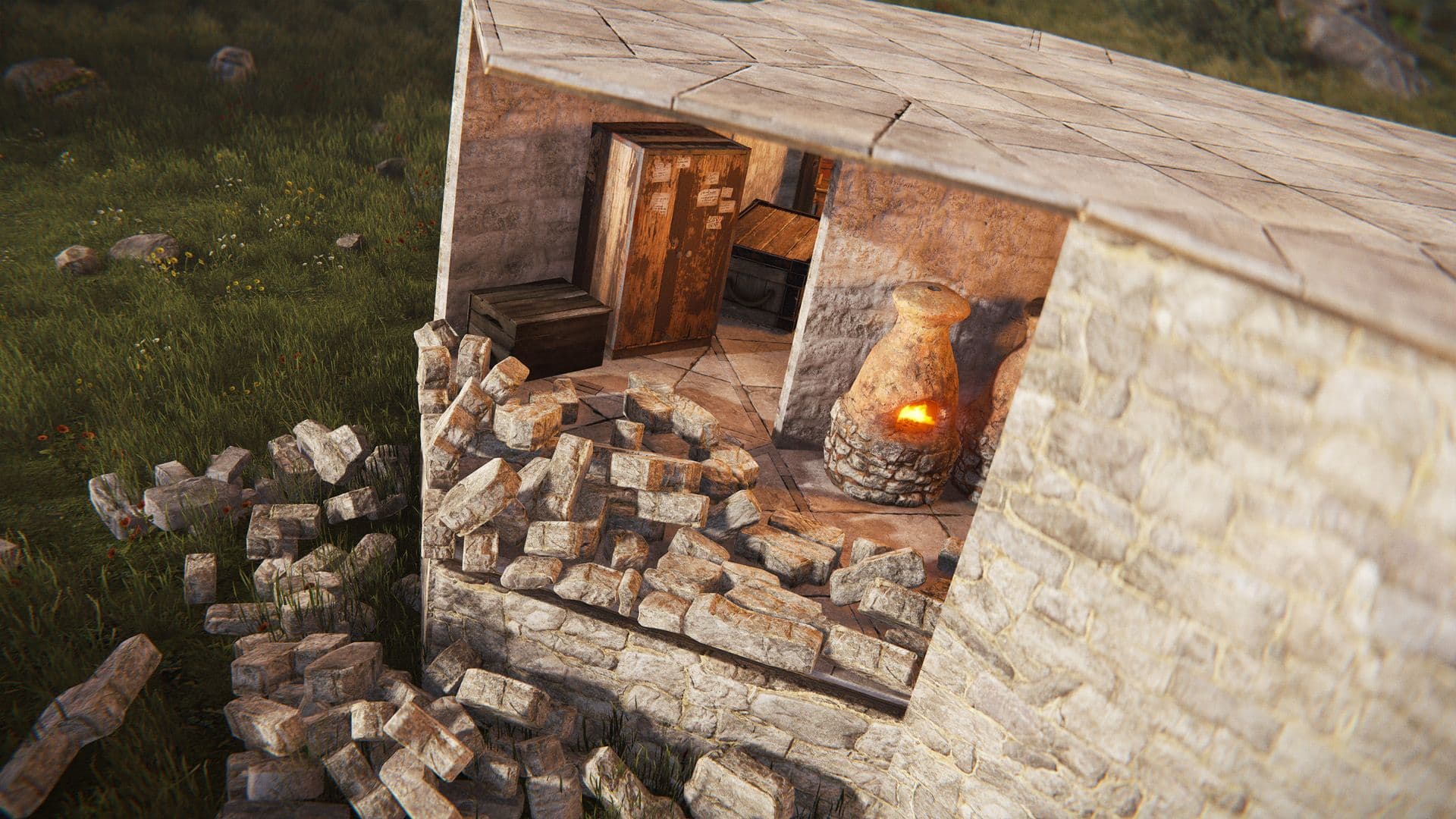
Repairing a raided base
You can repair that container in place when it has stayed on its foundation. If the destruction made it lose its ground, pick it up with a hammer and repair it later at a Repair Bench. The system covers large and small wooden boxes, storage barrels, coffins, small and electric furnaces, lockers, Tool Cupboards, fridges, vending machines, and workbenches.
That owner-only half is the closest thing Softcore has to a personal stash. It is not an invisible box and it does not stop the exposed half from being looted. Its value is that a raid does not erase every repairable resource at once. Split your recovery supplies between owned containers so that one destroyed room does not decide whether you can rebuild.
A destroyed Tool Cupboard is a special case: it continues to provide building authorization for 48 hours, and only players who were authorized on it can repair it. That turns a broken TC into a repair deadline, not an automatic loss of the base.
Use the Default Raid Window as Repair Time
The current Facepunch server guide describes Softcore with a default raid window from 6 PM to 9 PM in the server’s local time. During that window, building raids work normally. Outside it, the raid-blocking system protects building blocks and doors inside an established Tool Cupboard radius.
Treat that schedule as a default, not a guarantee for every server. Server owners can change the settings. The protection also has hard edges: deployables can still be attacked outside the window, an exposed Tool Cupboard can still be destroyed, and a Tool Cupboard must be at least one hour old before it can project the building protection.
For a solo or small group, the practical use is clear: use the protected hours to repair destroyed storage, replace doors, and restore your production chain. Do not wait until the raid window to discover that your new Tool Cupboard is too young or that a vulnerable deployable is holding the resource you need.
Build Tighter Because Door Upkeep Is Higher
Softcore changes the cost of a large base without changing building-block upkeep. In the April 2025 Soft Refresh, Facepunch described average large-base door upkeep at around 90% in Softcore compared with around 30% in vanilla. Those figures are an example from the update, not a promise that every server uses the same configuration.
The design direction is still useful: a door-heavy base pays more to maintain in Softcore, while a compact base is less exposed to that extra burden. Start with a short route from the entrance to the Tool Cupboard, keep storage close enough to recover after a raid, and add doors only when they protect a meaningful route or room. A sprawling honeycomb is not automatically the efficient choice here.
Softcore also limits teams and Tool Cupboard or autoturret authorization to four players. That rule makes the mode a natural fit for solo players and small groups; it also means you should decide who needs access before the base fills with locks and turrets.
Choose Softcore When Recovery Matters More Than Total Loss
Softcore is a strong choice when you are learning monument routes, playing in short sessions, or running with at most three teammates. It also adds a 2x resource-gathering multiplier, 25% less player-versus-player bullet damage, and respawns at Compound or Bandit Camp while you are not hostile. Those are concrete reductions in the time between mistakes, not replacements for positioning or base security.
Standard vanilla is the better fit when total loss is the point of the server’s economy. Vanilla does not return half of a field inventory, preserve an owner-only half of destroyed containers, or use Softcore’s default raid schedule. Before joining, read the server’s mode and raid settings, then plan your first base around the one boundary that decides every death: whether you are inside your own Tool Cupboard range.