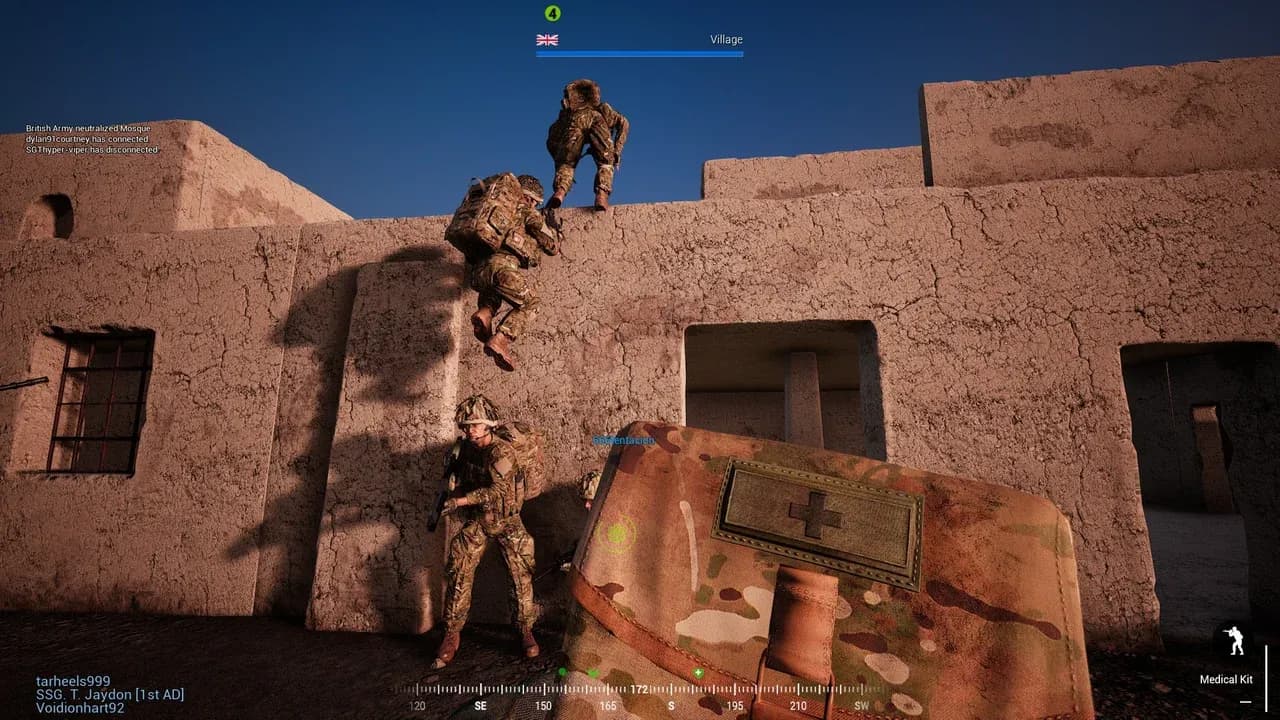
Something changed about walls in Squad, and it was not the walls. If you played before September 2023 and came back to find yourself bouncing off a compound wall you used to clear without thinking, you did not lose the technique — Offworld Industries removed the half of it that happened in mid-air. Vaulting and climbing from a standing start still work exactly as they always did — that half of the action was never touched. What dropped was the ceiling above it. Above that line, the game now expects a second person.
That second person is the entirety of "buddy boost", and the first surprise is how little there is to it. There is no ability to unlock, no keybind to hunt for, no interaction prompt to wait for. It is the ordinary climb input pointed at a teammate's body instead of at a wall, and it has worked that way since February 2018 — more than five years before the Infantry Combat Overhaul made anyone care. OWI did not add buddy boost to the ICO. They took away the alternative, on purpose, to stop "lone wolves from negating environmental obstacles to get easy flanks."
So the real subject here is the ceiling, not the mechanic: where it sits now, how you test for it at the wall instead of guessing, what a boost costs the player who has to stand still while you climb on their head, and — the part that kills far more people than the climb ever will — how you get back down. Reaching a roof got harder in 2023. Deciding whether you should be on one got harder at the same time.
Buddy Boost Is Just the Climb Key, Pointed at a Teammate
Start with the name, because it is the only part of this that is official. Offworld Industries writes it "Buddy Boost" — their capitals, their quotation marks — in the v2.12 release notes of 9 February 2022, and "buddy-boost" with a hyphen in the Infantry Combat Overhaul dev blog of 8 June 2023 and the v6.0 notes that September. That is the full extent of its existence as a named thing: patch-note language. It has never been a UI string, never a prompt, never a line in a tutorial. The phrase your squadmate is shouting at you lives in developer documentation and in the community, and nowhere inside the game you are looking at.
The definition OWI wrote is not complicated. The feature "allows a soldier to climb on top of another soldier to boost over a wall." The plainest version they ever published came in the December 2021 announcement of the v2.12 playtest: "being able to jump on your teammates to get over walls." Two players, one obstacle. One of you provides the height; the other climbs onto them and carries on up.
Which brings you to the controls menu, and the reason it is a dead end. Vaulting and climbing entered the game in Alpha 10 on 5 February 2018, announced as "Vaulting and Climbing (Default: Spacebar) have been added as a new feature to the game." Space has carried both ever since. There is no boost bind underneath that because there is no boost input — the community wiki's complete default controls list contains no boost, mantle, lift or assist entry of any kind, and across ten years of official patch notes not one adds a dedicated bind, prompt or UI affordance. Nothing was ever added because nothing needed adding. You are not performing a new action; you are performing the action you already use on a low wall, with a teammate standing where the wall isn't tall enough.
That was true from the very first build that had climbing in it. The same Alpha 10 notes that introduced the key also spelled the trick out: "Another trick would be to use a vehicle or even another player as a booster which would allow you to climb over higher obstacles." A community video demonstrating exactly that — boosting friends over tall walls — went up in December 2017, during the public test, before the patch was even live for everyone. When OWI finally used the words "Buddy Boost" four years later, they did not present it as new. The v2.12 notes describe the feature as being "updated" with "a focus on making it easier to use," which is not how anyone announces something they just built. Nothing about faction, kit or role has ever been documented as gating it, either; treat it as part of the character movement system every soldier shares, rather than an ability some kits get.
The other thing standing between you and a straight answer is a name collision, and it is not your fault for falling into it. Buddy Rally is a completely separate system: a Squad-Leader rally-point mechanic added in Alpha 13 on 1 May 2019, then removed from every faction except the Insurgents in Beta 18 that December, and surviving since as a server-configurable option most conventional factions simply do not have. It moves spawns around the map. Buddy Boost is two soldiers and a wall. They share the word "buddy" and nothing else — and if you searched the community wiki for "buddy boost," the top result you got back was the Rally Point page, which is precisely how a reasonable person ends up more confused after researching than before.
So close the keybinds menu. There is nothing in it for you. Confirm that climb is still on Space — and it is, for practically everyone, because update 10.4 on 30 April 2026 reworked the keybinding system and reset every player's settings to default with no way to import an older configuration file. Unless you deliberately rebound it after April 2026, your climb key is the one OWI shipped in 2018. What remains is not a control you are missing; it is positioning, an agreement with another player, and a key you already press twenty times a match.
All of which raises the obvious question. If the mechanic shipped in February 2018, was tidied up in 2022, and has not changed since, why is your whole squad suddenly talking about it — and why did that compound wall you used to clear on your own stop letting you up?
The ICO Didn't Delete Solo Climbing — It Deleted the Mid-Air Save
The change you are feeling is one sentence long, and Offworld Industries published it on 8 June 2023 in the dev blog announcing the Infantry Combat Overhaul: "You can no longer climb or vault while in mid-air."
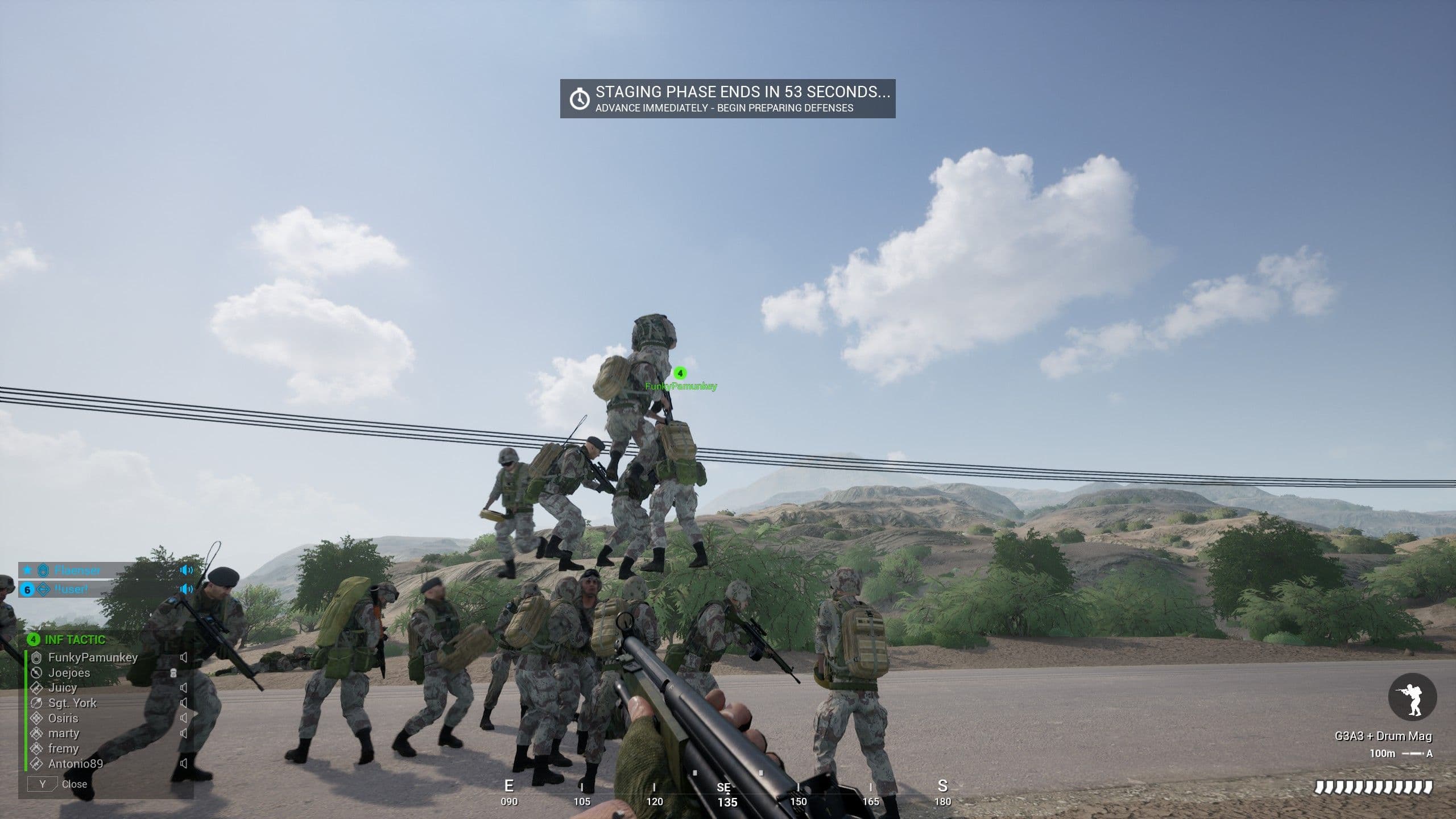
Players messing about in staging phase in October 2024. It is not a tactical boost, but it is dated proof that standing on a teammate survived the Infantry Combat Overhaul.
Read what that does and does not say. It does not remove vaulting. It does not remove climbing. It removes the mid-air case — the moment after your feet have left the ground in which the old game would still accept a vault or a climb and let you convert a jump into a grab. That moment used to be worth real height, because the jump and the climb stacked: you could run at an obstacle, leave the ground, and catch the top of something you could never have taken hold of standing still. Since v6.0, airborne means airborne. The obstacle is the same obstacle; the approach you were using to beat it is the thing that stopped existing.
Everything that begins from the ground survived intact. OWI's shipped v6.0 notes are careful about this in a way the community summary of them usually is not: "Overcoming tall obstacles will be more challenging for individual infantry players than before." More challenging, for individuals, than before — three qualifications and no removal anywhere in the sentence. The dev blog is equally precise about the consequence it expected, saying the restriction "significantly affects which rooftops and ledges are accessible" — which ones, not whether any are. A player writing in October 2023, a few weeks after the patch shipped, put it about as plainly as it can be put: "you can vault any wall you can reach."
There is one wrinkle, and it is honest to name it here: the same blog carries a second bullet reading "Vault and climb heights were adjusted," with no values attached — not there, and not anywhere since. So the line itself moved as well as the mid-air rule above it, and OWI has never said in which direction or by how much.
None of this was collateral damage from a physics change. The blog states the intent in the same breath: the restriction "prevents lone wolves from negating environmental obstacles to get easy flanks or overcome FOB fortifications," and "removes ninja moves from the list of options to win a fight." And the bullet that removes the mid-air save closes by naming its own replacement — "This also encourages the use of the teamwork-oriented buddy-boost ability." The deletion and the prescription are one sentence. Nor did it slip through unnoticed: OWI announced the overhaul on 8 June 2023, ran a testing phase they closed out on 20 September with a second blog whose shipped-feature list still read "Vaulting and climbing adjustments," and released it as v6.0 on 26–27 September. It survived its own playtest as a stated goal.
It has survived everything since. No official patch note after v6.0 reverts, relaxes or re-tunes the mid-air rule — not one, anywhere in the ten years of them. Through 10.5.1 on 18 June 2026, it stands exactly as written.
That matters because you have probably heard that the ICO got walked back, and you heard correctly — about other things. Across update 10.3 on 17 February 2026 and update 10.4 on 30 April, Offworld Industries:
- made aim-down-sights transitions on all infantry weapons "faster and snappier," "especially for scoped weapons and heavy weapons";
- reworked sway so that it is "slowed and made more predictable and less frustrating";
- reworked horizontal and vertical recoil on every infantry weapon, ending the version of it that "pulled far to the left and right far too much";
- increased stamina outright and cut the standing-sprint burn rate by 30%;
- and, in 10.3, raised the minimum fall height required to trigger fall damage at all.
OWI stated the reason in the 10.4 notes: to "reduce the frustration that the community feels." Gunplay got easier. Stamina got more generous. Short falls got cheaper. Not one line in either update touches vaulting, climbing or the mid-air rule — and the December 2025 roadmap that set both updates up named fall damage and stamina behaviour as the movement problems worth fixing. Traversal was not on the list. Of everything the ICO did to you, the teamwork tax on getting over things is the part OWI has chosen to keep.
So do not wait this out, and do not try to relearn the jump. There is no timing to recover: the sprint-and-catch is not a skill that got harder, it is an input the game no longer accepts, and no amount of practice in front of a wall will make it fire. The set of obstacles you can clear on your own is permanently smaller than it was in 2022, and the intended answer is the one OWI wrote into the same sentence as the removal — a second person.
Which leaves the question that actually matters when you are standing at the wall. If solo climbing still works on everything you can reach, then "can I climb?" was never the right question. "Can I climb this?" is — and that is precisely the thing nobody has ever answered for you. The heights were adjusted, the numbers were never published, and there is nothing in the game that tells you which side of the line the compound wall in front of you sits on.
Before You Ask for a Boost, Walk Up and Press Climb
Nobody can tell you, and that is worth saying plainly before someone hands you a rule of thumb. In ten years of patch notes, dev blogs and monthly recaps, Offworld Industries has never published a single number for how high a soldier can vault, climb, or be boosted. Not a distance, not a multiple of player height, not a "you can clear anything under X." The heights exist — the game clearly has them — but they have never once been written down anywhere a player can read them.
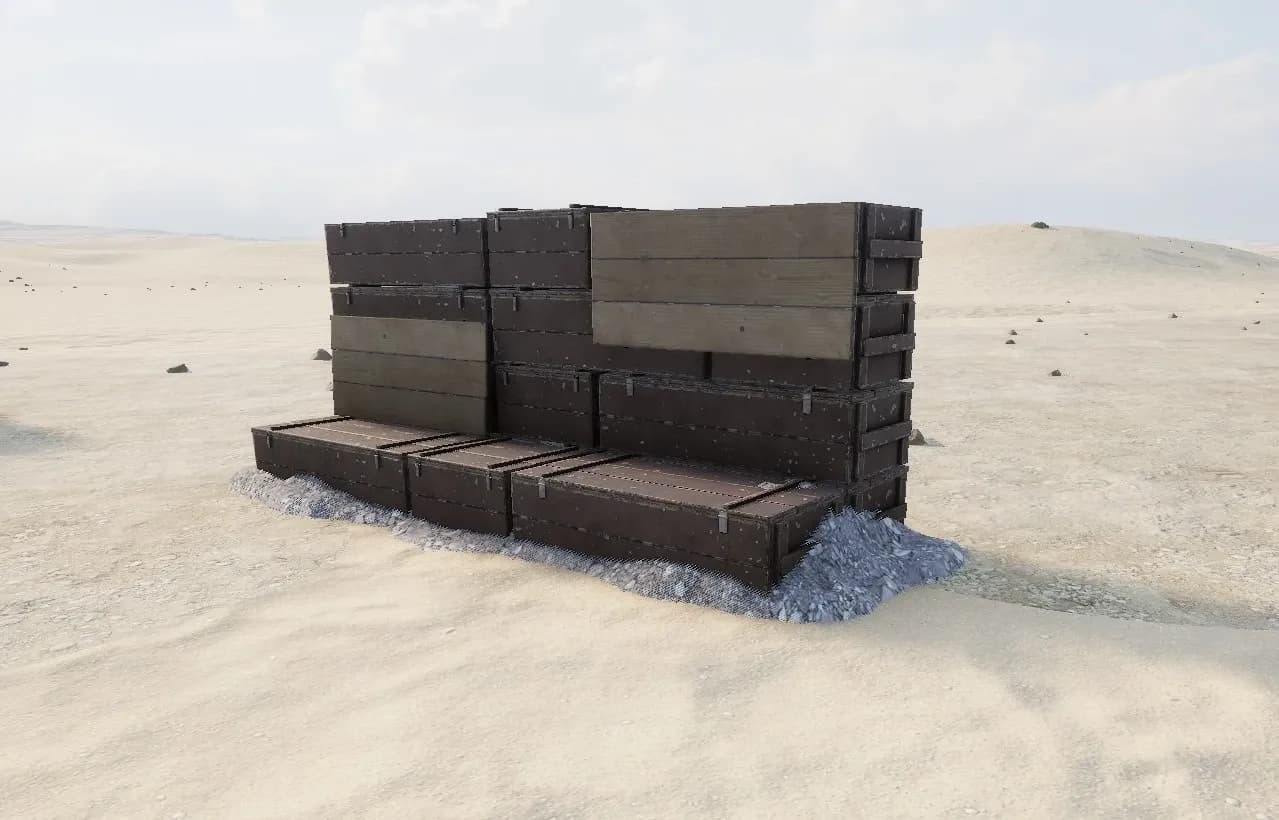
A buildable high wall, the kind of obstacle the standstill test exists for. There is no published height for any of them, so the only answer is the one you get at the wall.
The closest thing on record is a line from the August 2017 monthly recap, six months before climbing shipped: the system would let players traverse obstacles "up to chest height unaided." That is the entire published history of the number. And it is a design statement about a build nobody outside the studio had played, written before the feature existed, with the ICO's unannounced height adjustment sitting between it and the game currently installed on your machine. It tells you what OWI intended in 2017. It does not tell you anything about the wall in front of you.
So you are not going to get a figure. What you get instead is a test, and it takes about a second.
Walk up to the obstacle until you are almost touching it. Stop moving. Then press climb, from a standstill. That is the whole diagnostic. If your soldier goes up, the obstacle was always within solo reach and you never needed anyone. If nothing happens — no animation, no lift, no scrabble — the obstacle is above your standing ceiling and it needs a second person. There is no third outcome to interpret.
The reason the test has to be run this specific way is that the wrong approach produces a false negative that looks exactly like a real one. Sprint at a wall, jump at the last moment, and you will hit it, slide down, and end up on the ground having learned nothing — because you were not testing the obstacle, you were attempting the one input the game stopped accepting in September 2023. A wall you could clear standing still and a wall you genuinely cannot reach both reject a running jump, identically, every time. If jumping at things is your habit, half the walls you have written off as "too tall since the ICO" were never too tall.
That is not a theory invented for this guide; it is the diagnosis a player offered in a Steam discussion in October 2023, a few weeks after the overhaul shipped, in a thread whose entire subject was a wall that would not let anyone up. It is worth looking at that argument properly, because it is still unresolved and it is the best evidence available on either side.
The player who started the thread was blunt: brick walls slightly taller than your character cannot be vaulted, full stop. He supplied a screenshot of one and pointed at the right-hand section, which he said was "only slightly taller than your character" and refused every attempt. Another player replied that he had "not seen a single wall that is reachable not work so far," and blamed the perception rather than the geometry — that players are "misjudging the size of walls/distance because FOV, 2D image on a screen, inexperience with these objects," or, failing that, "trying to jump and catch yourself, rather than standing closer to the wall and simply climbing."
Nobody won. Neither position can be proved, because there is no published height to check the screenshot against and no way to measure a wall from inside the game. Two experienced players looked at the same problem in the same patch and came to opposite conclusions, and that disagreement is the most accurate picture of the situation anyone can give you.
But look at what both of them accept. The first player's complaint is only meaningful if you approached the wall properly — he is describing a wall that fails a fair attempt. The second player's diagnosis is that you did not approach it properly. Both positions, held together, point at exactly one action: get close, stand still, press climb. Do that, and either the wall opens or you have the first genuinely reliable piece of information about it that anyone has been able to produce.
So run the test before you call anybody over. It costs one keypress and it settles the question that a screenshot argument could not, for that wall, on that map, in that patch. And run it once rather than six times — every failed running jump you throw at a wall spends stamina you are going to want on the other side of it, and repetition cannot fix an obstacle that is out of reach.
One caveat, for the case where the answer stops making sense. Vaulting and climbing have a documented habit of quietly ceasing to respond — not failing on one wall, but doing nothing anywhere, on obstacles you cleared minutes earlier. It is old: the Alpha 10 public test in December 2017 shipped with the known issue "Unable to vault or climb, especially after deploying bipod. Go prone and stand to fix," and players were still reporting it in February 2023, with the same fix plus resetting the double-tap time setting in the controls menu. A commenter on that thread said later updates resolved it, so do not assume it is current behaviour. Just recognise the shape of it: if climb has stopped working on everything rather than on this, you are troubleshooting the game, not measuring a wall.
Assume, though, that the test did what tests do. You stood close, you stood still, you pressed climb, and your soldier stayed exactly where he was. The obstacle is above your ceiling, and the answer is a second person. Which is where it gets interesting — because the two of you are about to use a mechanic with a real, documented rule set that neither of you has ever been shown.
One Rider at a Time, and the Booster Has to Hold Still
The rule set is four lines long, and you can read all four of them — just not in the game. Two are in the v2.12 release notes of 9 February 2022. The complete version is in a forum post: the release notes for the v2.12 playtest weekend of 2–3 October 2021, written by OWI four months before the patch shipped. That post is also where the two roles get their names. The player underneath is the booster; the player going up is the boostee. Nobody in your squad will use those words, but OWI does, and it is the only vocabulary anyone ever published for this.
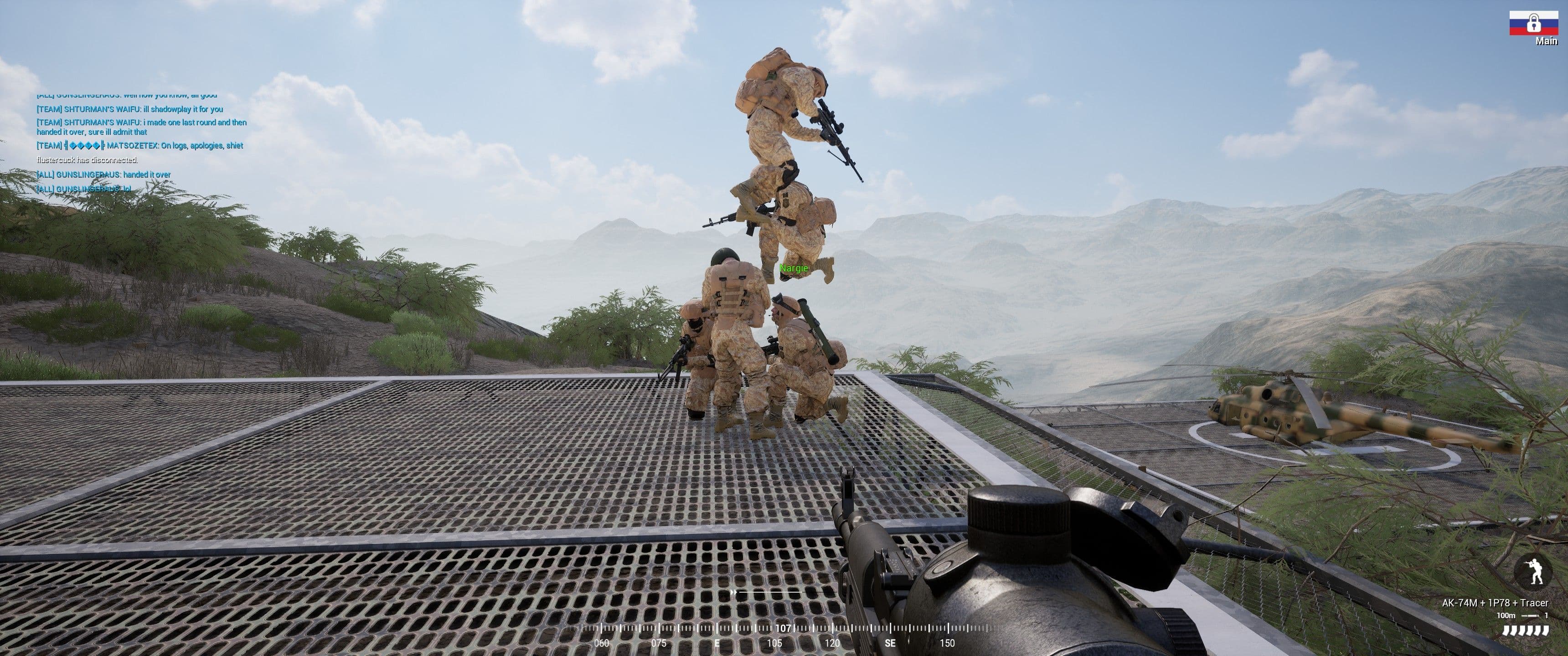
What standing on a teammate physically looks like, photographed a week after v2.12 landed in February 2022. Note this is a multi-player stack, not the one-rider-at-a-time boost the rules describe — a queue is what you actually want.
Start with the change that made the rest possible. Before v2.12, the game actively pushed players off each other — OWI's phrasing is that they "removed the force which previously prevented players from standing on each other's heads." That is what "easier to use" meant in the notes you may have seen quoted: not a new feature, but the deletion of an invisible physics behaviour that had spent four years fighting anyone who tried this. Two soldiers standing on each other is now a supported state rather than something you wrestle the engine into.
One player on one player. The shipped notes are explicit: the system is "limited to only one player being able to stand on another at a time," and the playtest notes give the reason in plainer terms — "so it will not be possible to create a giant tower of players." Read the limit precisely, because it is narrower than it sounds. It caps how many people can be stacked at one moment. It says nothing about how many people can use the same booster, one after another, or how many can end up on the far side of the wall.
The booster must be stationary and must not be prone. OWI's wording: "It is only possible to stand on top of stationary players who are not in a prone position." So the booster picks the spot, plants themselves against the obstacle, and stops — and stays stopped. If they are still walking into position when you press climb, there is nothing to stand on. If they drop flat, the same.
Where the booster looks does not drag you around. "The rotation of the 'boostee' is not affected by where the 'booster' is looking." You are standing on a person who can turn their head, and the game does not couple you to them: your view is yours for the whole ascent. Face the top of the wall, or the corner you are worried about, and the booster checking their own arc underneath you changes nothing about where you are pointed.
Those last two rules deserve one honesty note, and then no more hedging. They appear in the October 2021 playtest notes and were not repeated in the shipped February 2022 changelog, which compressed the list. That is how OWI designed the system to behave, documented in their own words for the build immediately preceding release; no patch in the years since contradicts either one. It is the best specification that exists, and it is a real specification — just not one anyone has re-published recently.
Inside those constraints, there is no technique to learn. It is positioning and the key you already tested the wall with. The booster stands still at the base; the boostee walks in, comes to a stop, releases Move Forward, and presses climb — the same standing start that answered the wall. Letting go of the movement key matters because since v6.0 that key is what separates climbing onto something from vaulting over it, and only one of those ends with you on your partner's shoulders. Be straight about the status of that instruction, though: OWI wrote the Move Forward rule for obstacles, and never said whether a teammate's body counts as one. Nothing published contradicts it and nothing published confirms it — so take the stop-and-release version as the one that cannot go wrong, rather than as a documented requirement.
Which is why the actual starting move is a sentence. Here is a player describing a match on Manicouagan a few weeks after the ICO shipped: his squad "took the Defenders of the small fort on Manic by surprise by using buddy boost to get 8 guys over a wall inside at a spot noone wacthed before the enemy noticed us." Eight players over a fort wall, at a place the defenders were not covering, without anyone building anything the rules forbid — because they queued. One at a time is a limit on the stack, not on the squad, and a wall that takes one soldier a few seconds takes eight soldiers rather more than that but nothing else. His instruction for how to begin was nine words: "Just ask a squadmember to give you a boost."
That really is the entire social protocol, and it is the part most people overthink. There is no callout, no formation, no role that has to volunteer. Ask, agree who is boosting whom before either of you moves, and then hold to it: the booster commits to standing still and staying off the ground, and the rider goes up looking wherever they need to look. If more of you are crossing, form a line and take turns — the tower is the one thing the rule set actually forbids. One question that line raises has never been answered anywhere: how the last player over gets up, or whether the booster can be boosted in turn. Eight men crossing a wall proves the queue works and says nothing about the man at the back of it.
It is also worth knowing that the rules read this way on purpose. OWI's designer note for the change says the intention was "to reward players who move and work together to overcome obstacles, encouraging and rewarding players who move in closer proximity and work as a squad rather than as individuals." The constraints are not engine limitations they apologised for. Proximity and cooperation are the point, and the rules are shaped to force both.
Which leaves one uncomfortable detail sitting in the middle of that rule set. Somebody has to stand still, in the open, next to a wall, for as long as this takes — and that somebody is not you.
The Boost Costs Stamina, and the Booster Pays for Standing Still
Asking a squadmate to be your step-up is asking for a favour, and it is worth knowing exactly what you are asking for — because a boost is not free for either of you, and the bill does not arrive in a currency you would guess. It is charged to stamina, and in Squad stamina is not a movement resource that lives off in its own corner. It is the same bar your rifle handling is wired to. Every obstacle you cross is billed to your aim.
That has been true for almost as long as climbing has existed. Alpha 10.1, on 2 March 2018 — one month after vault and climb shipped — added the line: "Vaulting, climbing and jumping now consume stamina in addition to sprinting and prone movement, which already did so previously." The same notes added the qualifier that turns it into a price rather than a gate: "Low stamina will not prevent you from vaulting, climbing, jumping or sprinting." Nothing ever locks you out. An empty bar does not stop you climbing; it just means you arrive at the top of the wall with nothing left. Offworld Industries reduced those costs in Alpha 10.2 that April and tweaked them once more in Alpha 11 in May, so the figure has been under adjustment since the first months of the system's life.
Then, in February 2022, OWI raised it deliberately. The same v2.12 patch that deleted the repulsion force made two changes to what traversal costs: "Updated soldier stamina to no longer regenerate during vaulting and climbing. Soldier stamina regeneration will be paused until these actions complete," and, in the full changelog, "Stamina cost for these actions has also been increased." The designer's note says why in plain terms — the intention was "to incur a more noticeable effect on soldier stamina when navigating obstacles, to bring more nuance to stamina management and navigating terrain."
Read those two bullets together, because they compound. Every vault and climb you perform is charged twice: once for what the action burns, and once for the recovery it suspends while the animation plays. And this is the mechanism behind the standstill test's warning to run it once rather than six times at a wall you cannot reach. Jumping has consumed stamina since 2018 as well, so a run of failed running jumps is a straightforward transfer of your bar into the ground in front of an obstacle, with nothing bought.
None of that was an isolated tuning pass, either. In the October 2021 playtest notes — the same document that lists the boost rules you just read — OWI stated what they were building: "This change, along with Better Buddy Boost and Stamina tweaks, is the first in a set of more realistic locomotion and traversal tweaks which are currently under development." Buddy boost, stamina, and fall damage were one design package from the start, two years before the ICO shipped the rest of it. Stamina is the half of that package you pay on the way up. The other half is charged on the way down, and it gets its own section.
So what does a drained bar actually do to you? The only itemised list anyone has published lives on the community wiki's Movement page, and it is worth handling honestly: that page is marked as a stub, carries no date, and predates v2.12's regeneration pause, the ICO's stamina rework and 10.4's stamina increase. Treat what follows as the shape of the penalty rather than a current spec sheet. It says stamina below half gradually reduces your movement speed, until a sprint at zero is "barely faster than normal movement at full stamina" — and that this drag applies to crouched and prone movement too, so you cannot duck under it. It says low stamina increases weapon sway. And it says that at zero stamina you can no longer hold Left-Shift to focus your optic while aiming down sights.
The direction of all three is corroborated by OWI's own ICO blog, which reworked sway and then told players outright: "Taking regular stamina breaks is now advisable, especially with the weapon sway changes." What nobody can give you is a magnitude: no absolute stamina value has ever been published, so anyone who tells you a boost costs a third of your stamina is inventing the fraction. You get direction and ordering, and that is the whole of it.
The meter itself has also moved under your feet. The ICO slowed stamina regeneration slightly and rebalanced the costs of individual actions; 10.4 then increased stamina and cut the standing-sprint burn rate, which is why the current build is more forgiving than the one that launched in 2023. What none of those patches touched is the traversal rules. The price got easier to pay. The thing you are paying for did not change.
Now put two soldiers at the same wall and price them separately, because they are not paying the same bill.
The rider spends a climb. They arrive on top of the obstacle with less stamina than they started with, more sway than they had at the bottom, and — if the bar is genuinely low — a slower reposition across the roof and no focus zoom if they need the optic. That is a position they may well have to shoot from, reached by the one action guaranteed to degrade shooting.
The booster spends the same seconds doing nothing at all, and pays more for it. The rule that makes them standable is the one you already have: stationary, and not prone. That leaves exactly two stances, standing or crouched, and the published stance table puts standing still at the slowest rate of stamina regain, with crouching quicker and prone quickest of the three. Prone is off the table by rule. So the booster is locked out of the best recovery stance, and if they stand — which is what most people do without thinking about it — they are in the worst one available. That is an observation about the regeneration table and nothing more. It comes from the same undated stub page, and no source anywhere describes how a crouched booster behaves during a boost, so read it as economics, not as a technique. There is no crouch trick here.
What the booster is definitely doing is holding a state. The stationary, non-prone stance is not a pose they strike once — it is the condition that keeps something under your feet, and it has to hold for the whole climb. They cannot step aside, cannot drop flat when something starts shooting, and cannot recover well while they wait. For those seconds they are a motionless silhouette standing against a wall in the open, and both of your bills come due in whatever firefight happens next.
Which is why the boost gets briefed behind cover, not negotiated while somebody is standing on a teammate's head. Agree the spot, the order and who goes first while you are still somewhere you can move. Do not boost into a contested position on an empty bar — if you sprinted the last two hundred metres to get here, that sprint is already coming out of the rider's sway and the booster's recovery. Keep the exchange short, and let both of you settle before either engages, which is exactly the habit OWI recommended when they shipped the sway changes.
All of which sharpens one question. If the true cost of a boost is one squadmate frozen in the open, in the worst stance for recovery, unable to react to anything — then the obvious thing to ask is whether something other than a squadmate can hold still for you.
The Other Booster Is a Vehicle — Under 30 km/h
A vehicle can hold still indefinitely, and it is the answer Offworld Industries gave first — before they ever thought to mention a teammate.
Go back to the pitch. The monthly recap for November 2017, published that December, described the climbing system OWI were about to ship and offered exactly one way to extend it: "Another trick would be to use a vehicle as a booster which would allow you to climb over higher obstacles." That is the whole clause. There is no other player in it. Two months later, when Alpha 10 went live on 5 February 2018, the same sentence had grown four words: "Another trick would be to use a vehicle or even another player as a booster." The human boost — the thing your squad now organises itself around, the thing the ICO made compulsory — was a late addition to a paragraph that was originally about parking something next to a wall. The vehicle is not the workaround. It is the original.
It also comes with the only hard number this article can give you. On 2 September 2025, Squad 9.0 shipped the line: "Fixed an exploit that allowed players to stand on very fast moving vehicles. Players can now only stand on top of a vehicle if it's driving under 30 km/h. If the player is on a vehicle that exceeds that speed, they will lose their balance and fall off." Read the framing, because it matters: OWI classed riding a speeding hull as an exploit and closed it. They did not touch standing on a stationary one. And notice the shape of the rule against the one you already know — a human booster has to be genuinely stationary to be stood on, while a vehicle only has to be slow. Under 30 km/h, a crawling truck is a valid surface. Over it, the game takes you off, and the landing is charged to your health exactly like any other fall, on the percentage-of-remaining-health terms this guide comes to when it reaches the way down.
None of this is an accident of physics that OWI have quietly tolerated. Standing on vehicles is a maintained system with a paper trail either side of the boost itself: Alpha 10.2, on 3 April 2018, "Fixed player rotation getting permanently offset when standing on a vehicle that's rotating" — a bug you can only have if players standing on hulls is intended behaviour. Eight years later, update 10.4 on 30 April 2026 fixed the wreck collisions on the PLA WZ551 IFV and the Lynx 8x8 LTV, which were "inaccurate and blocked players from climbing onto them." Even the burnt-out shells are meant to be climbable, and when they are not, that is filed as a bug. Which hulls and which surfaces qualify has never been published, so treat the specific vehicle in front of you the way you treat a wall: the test is the test.
Now put both boosters at the same obstacle and price them, because this is a decision about what your squad spends.
Boosting off a squadmate costs you a rifleman. For the duration he is not watching an angle, not moving with the squad, and not able to drop flat when something opens up — he is paying the bill already priced — motionless, exposed, and recovering stamina at the slowest rate open to him. He also had to agree to it, which means someone had to ask, explain and coordinate before anyone moved. A logi or a transport truck parked against the same wall costs none of that. It does not have to volunteer, does not have to be briefed, does not have to be talked into standing still, and it does not stop doing its own job permanently — once you are up, it drives off and carries on being a truck. The only thing it demands in return is patience: try it while the thing is still rolling at speed and the rule takes you off the roof rather than putting you on the wall.
So the decision turns on one question: is there a vehicle here at all? If one is already sitting against the wall, or one is going past and can be stopped for a moment, use it and keep both players free to fight. Most of the time nothing is parked where you need it, which is why the human boost is the version worth knowing cold — it works anywhere, and it costs nothing but a squadmate who agrees. And if the vehicle is moving, wait until it is genuinely crawling before you step up — the balance rule is not a guideline the game applies loosely, and falling off is not free.
However you bought the height — a teammate's shoulders or a truck roof — you are now level with the top of the obstacle with your hand on the climb key. And here the game is about to make a decision on your behalf, one you will not like, unless you know how to make it yourself.
Hold W and You Go Over — Let Go and You Go On Top
You may have already met this without ever getting an explanation for it. You press climb at the top of something, and depending on the run you either end up standing on it or you sail clean over and land on the far side. Same key, same wall, two results. It reads as flakiness — the kind of thing you shrug at, blame on the netcode, and stop thinking about. It is not flakiness. There are two separate actions sharing your climb key, and which one fires is decided by a second key you were almost certainly holding without noticing.
Offworld Industries wrote it down exactly once, in the infantry movement section of the shipped v6.0 release notes of 26 September 2023: "Vaulting over obstacles is now triggered only when also holding the 'Move Forward' key. Otherwise the character will instead attempt to climb on top of the obstacle."
Read it as two commands rather than one. Vault means over the obstacle and down the other side. Climb means up onto it, and stop there. Since v6.0 those are no longer the game's decision to make — Move Forward, W on a default layout, is the switch between them. And note that it is a modifier, not a bind. Nothing new appeared in your controls menu, which is why nobody found it there. It is the key you were already using to walk.
Note also the word OWI chose: the character will "attempt" to climb. Releasing W guarantees what you asked for, not what you get. Whether a given ledge actually has somewhere to put your feet is the ledge's business. What you control is which of the two actions you requested.
Try it deliberately, once, on something harmless. Take a low wall — one that already passed your standstill test without needing anybody. Walk into it with W held and press climb: your soldier goes over the top and lands on the far side, facing away from where he started. Now back off, approach the same wall again, come to a stop, take your finger off W, and press climb: he goes up and stands on it. Identical approach, identical keypress, two completely different positions — one of them behind a wall with an angle over it, the other one standing in the open on the wrong side of it, with the wall now between him and his squad.
On a garden wall that is embarrassing. At the lip of a roof it is something else entirely, because the far side of a parapet is not the street you walked in from. It is however far it happens to be down to whatever sits behind that building. And this is precisely where the reflex bites, because everything you did to get there involved pushing forward: the approach, the run-up, the climb onto a teammate's shoulders. Your left hand is still on W when your right thumb finds Space, and the game does what you told it to do.
OWI knew. The rule's own sentence names the failure it was written to prevent: "This is intended to give you more control over your actions in combat and help prevent accidental vaults causing deadly falls." They did not split the input for tidiness. They split it because players kept vaulting off things by accident, and the fall was killing them — a bill this article settles in the next section, and one you would rather not open.
It is worth knowing that the game used to make this call entirely without you. When OWI first described the climbing system — in the August 2017 recap, six months before it shipped and the same note that produced the only reach figure anyone has ever published — the deciding factor was the obstacle: "Depending on the thickness of the obstacle, you will either vault right over it or, if there is room to stand, climb on top of the obstacle." The geometry chose. A thin wall threw you over; a thick one let you stand. That is still the mental model a lot of long-serving players carry, and it is exactly why the outcome feels random to them — if you believe the wall decides, a wall that behaves two different ways on two runs looks broken. The ICO took that decision off the obstacle and put it on your keyboard. The wall still decides whether there is anywhere to stand; what it no longer decides is which of the two things you were trying to do.
The instruction OWI printed in the same breath was about intent, too: "work together with your teammates to buddy-boost over taller objects and plan your movements through urban areas more deliberately." Deliberately is the load-bearing word. A boost is a briefed, coordinated, stamina-priced piece of work involving a squadmate standing motionless against a wall — and all of it is thrown away if the person who goes up vaults straight off the far side by muscle memory.
So make this a habit rather than a decision you make under fire. Release Move Forward before you press climb, every time the point is to end up standing on something — a wall, a parapet, a roof, and, on the same reasoning, the teammate holding still underneath you. Stop moving, then climb. That is the same physical instruction the standstill test gave you back at ground level, and the overlap is not a coincidence: a standing start is what makes both halves of this predictable. Keep W held only when you genuinely want the other side, and only when you have already looked at what is on it.
Which leaves the half of the trip nobody briefs. You can now choose, reliably, to finish a climb standing on top of the thing you climbed — a roof you picked, at whatever height that roof happens to be. Getting off it again is the part that gets charged to you, and not in stamina.
The Climb Is Free — the Drop Is Charged to Your Health Bar
Stamina is a loan. You get it back by standing still for a few seconds, and the last two updates made the terms easier. Health is not a loan. Everything the last few sections asked you to spend is recoverable — the rider's climb, the booster's motionless seconds against the wall, the truck stopped at the base of it. The trip down is the only part of the whole operation billed in a currency you cannot regenerate by waiting, and it is also, incidentally, what the game charges you for stepping onto a vehicle that turns out to be moving faster than you thought.
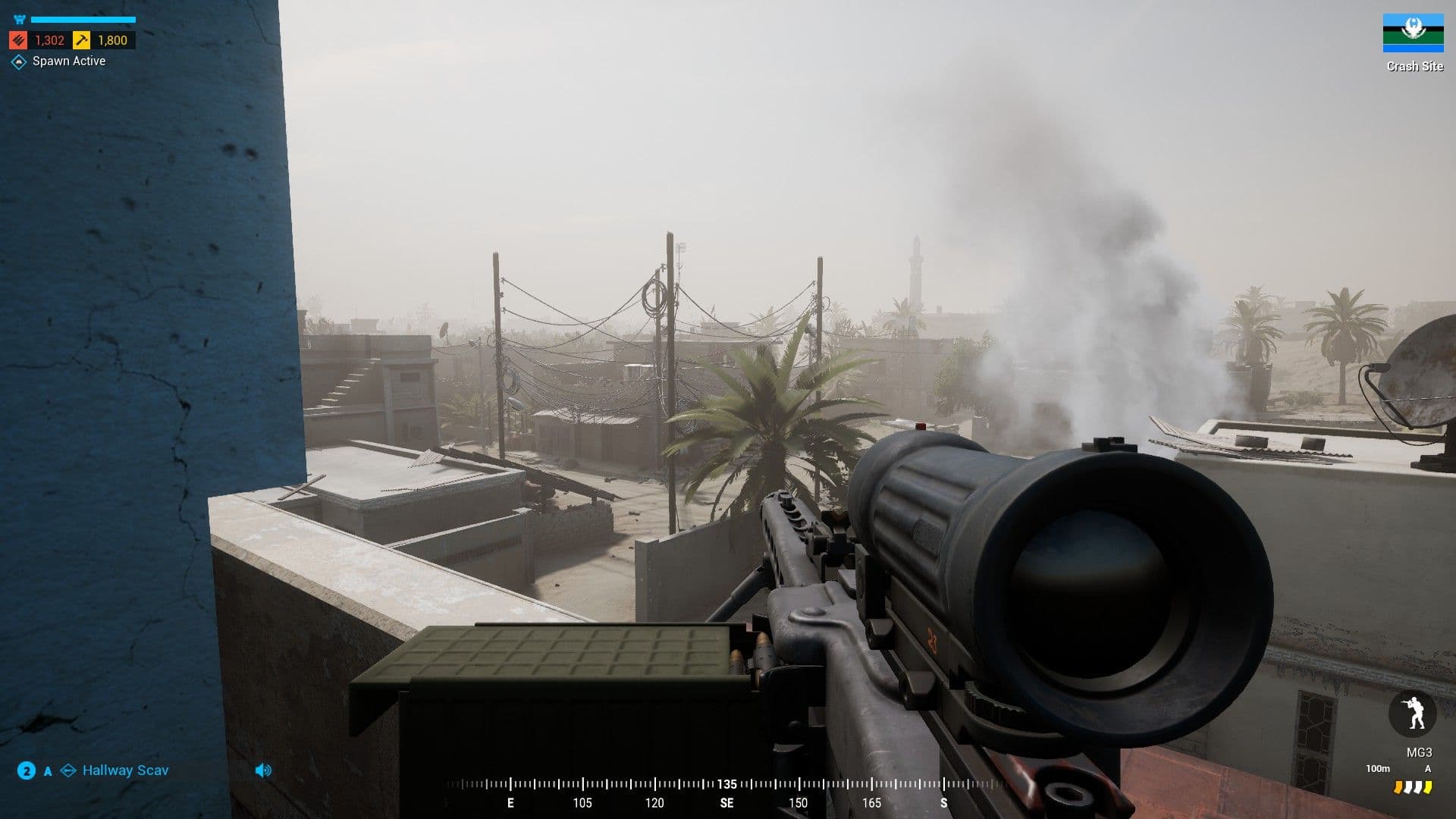
The position this section is about leaving. Everything below the parapet is a drop charged as a percentage of whatever health you have left when you take it.
Offworld Industries published the model in the same 8 June 2023 blog that deleted the mid-air save, and the pairing was not a coincidence — they shipped the two changes as one thought:
"Reworked fall damage to be more punishing, but also more consistent and predictable. Fall damage is now applied as a percentage of remaining health based on the height of the fall, down to a minimum value. The effect is that you can no longer survive multi-story drops when at full health, but you should always be able to predict whether a fall could kill you before you risk the drop."
Three separate statements are packed into that. Damage scales with the height of the fall. It is taken as a percentage of the health you still have rather than as a fixed subtraction. And the scaling bottoms out — there is a minimum value below which it does not go.
The middle one is the one that makes the promise at the end possible. Under a flat-damage system, a drop has no fixed identity: the same ledge is a scratch on a healthy soldier and a coffin on a hurt one, so every time your health changes you have to re-solve the same jump. Scaled proportionally, the drop keeps its size relative to you. It is a small drop or a big drop, and it stays that regardless of what you are carrying into it — which is precisely the property that lets OWI claim you can judge it before you step off, rather than discovering the answer on the ground.
Be clear about what "predictable" is doing in that sentence, though, because it is not a synonym for safe. The other half of the same bullet says multi-storey drops stopped being survivable from full health. The game shows you no height, no percentage and no preview — predictable means the system is consistent enough to be learned, not that it is legible while you stand on the parapet deciding.
Which is where anyone teaching you this has to stop, because the figure you have almost certainly heard does not survive being checked.
The line in circulation is that the maximum survivable fall is roughly two storeys. It has exactly one source: the release notes OWI wrote for the v2.12 playtest weekend of 2–3 October 2021 — the same pre-release document that supplied the buddy boost rule set. That build did overhaul fall damage, it did state a maximum survivable height in storeys, and it did work through a percentage example. Then v2.12 shipped on 9 February 2022 with no fall-damage rework in it at all. Not the figure, not the example, not the overhaul — a full-text check of the shipped changelog turns up nothing on the subject. The percentage-of-remaining-health model does not reach shipped documentation until the ICO blog of June 2023, and it arrives there without a number attached.
So the two-storey figure is not a slightly dated measurement of the live game. It is a measurement of a build that was never released, taken from a fall-damage pass that did not ship in that patch. Passing it to a new player is passing on the spec of a playtest weekend from nearly five years ago.
And even if you were inclined to gamble on it, Offworld moved the ground under it again. Squad 10.3, on 17 February 2026, carried one movement-relevant line: "Increased the minimum fall height required to trigger fall damage." That delivered the pledge Squad Command made in the roadmap of 15 December 2025, where they said they would be "making adjustments to fall damage to make it more reasonable." Read what the patch line actually moves — it is the bottom of the range, the height at which damage begins to exist at all. Short drops that used to cost you something now cost nothing, up to a height OWI did not publish. Another number withheld, on top of the one that was never real.
Nor has any of this been sitting still. Squad 9.0, on 2 September 2025, "Fixed a bug with calculating fall damage." Squad 10.0, on 10 November 2025, "Fixed an exploit where players could avoid fall damage." One patch corrected the arithmetic; the next closed a way of dodging it; 10.3 then re-tuned where it starts. Three touches in six months. Whatever threshold you internalised playing in 2023 has been through all three since, and you would not have been told about any of them in-game.
So you end up with the same shape of answer the standstill test gave you at ground level: no number, and a procedure in its place.
Plan the descent before you plan the ascent. Concretely, and it costs nothing: before the first player steps onto the booster, the two of you look at the building and name the way off it. An internal stairwell. A ladder. A lower adjoining roof — an outbuilding, a wall, a container — that turns one long drop into two short ones. Or the same wall you came up, with your partner staying on the ground to tell you what is underneath before you commit to it. That exchange takes about as long as the boost itself and belongs in the same conversation behind cover, alongside agreeing who is boosting whom.
Now run it the other way. Nobody looks. The boost is clean, you are on a compound roof with an angle nobody expected, and for a few minutes it is the best decision anyone in the squad made. Then the fight moves and the position goes bad — you are behind it rather than above it, or someone has the building ranged. Now you need to leave, and you learn on the way out that there is no internal access you can reach, that the low adjoining roof you half-noticed is at the far corner in the open, and that the only exit still under cover is straight over the parapet: at whatever height that particular building happens to be, into ground you have never looked at, at whatever health the last four minutes left you with. Every one of those variables was fixed before you climbed. Every one of them was knowable in the ten seconds or so you never spent looking.
Treat the descent as part of the plan, then, not as the aftermath of one. Where a drop cannot be avoided, take it at the lowest point you can find — walk the parapet to the corner where the ground comes up, drop onto the outbuilding instead of past it — and take it at the best health you have rather than after the firefight that made you want to leave. Because the bill is a percentage of what remains, leaving hurt does not just risk the landing; it guarantees you arrive at the bottom with a fraction of a fraction, in the open, next to a building you have just given up. And whatever you learned about which ledges were fine in 2023, do not assume it still holds. The model has not changed since the ICO. The numbers under it have been fixed, patched and raised, and were never published in the first place.
You can now get onto a roof on purpose, and off it alive. Which finally makes the question worth asking properly: should you be up there at all?
Decide Whether the Roof Pays for Itself Before You Climb
Notice what Offworld Industries never actually promises. Every shipped line about this mechanic points at a wall. In v2.12 it lets a soldier climb on another soldier "to boost over a wall." In v6.0 the instruction is to "buddy-boost over taller objects." Even the sentence that made the whole thing compulsory is carefully scoped: removing the mid-air save "significantly affects which rooftops and ledges are accessible." Which ones. Not whether any are.
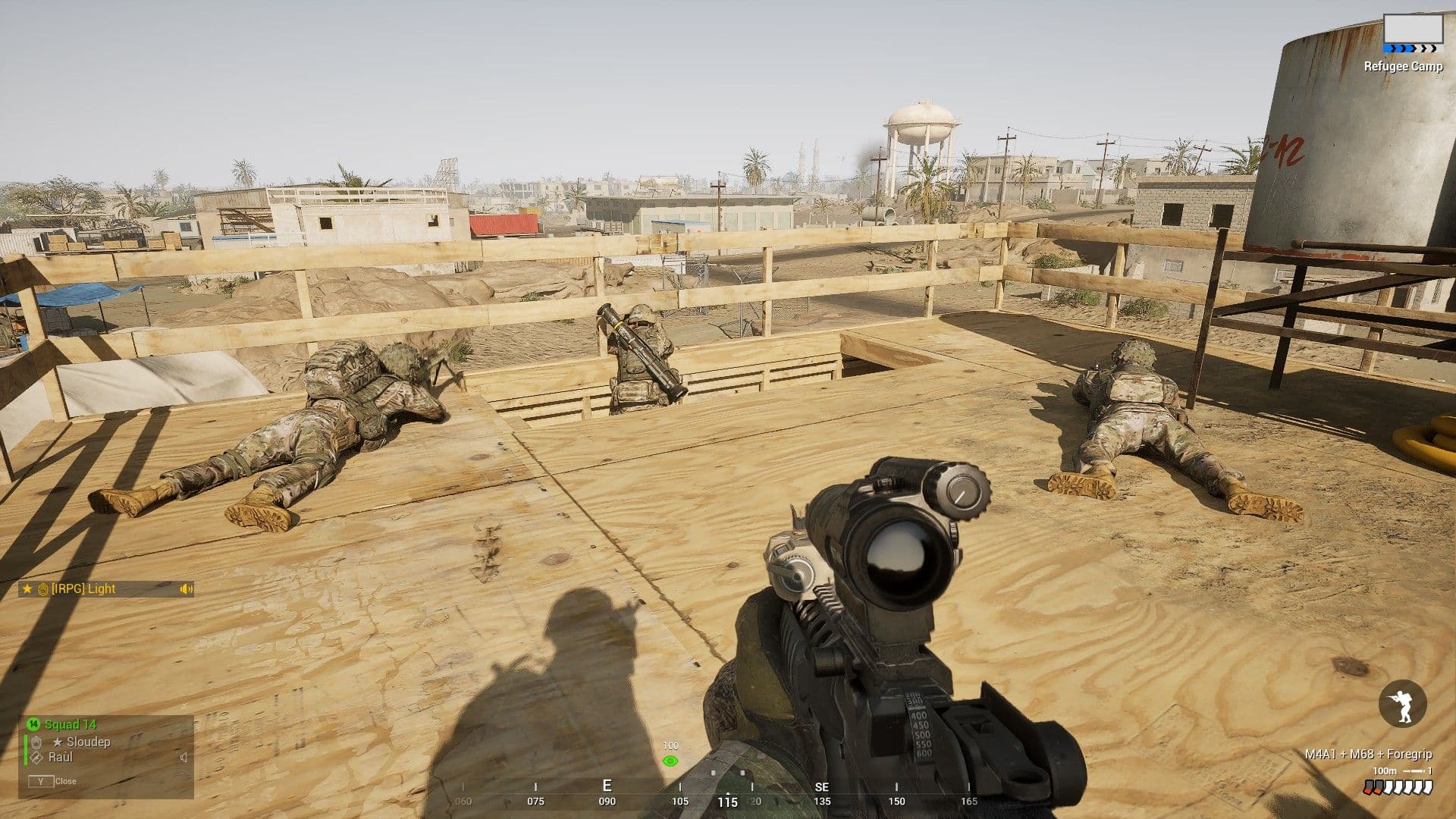
A rooftop that pays for itself: four players on it, covering each other's arcs, close enough to talk. The version that loses is the same climb with one person on top.
So rooftops are one class of obstacle a boost can beat, not the purpose of the boost. What the ICO changed was the membership of that class — some roofs left it, some stayed reachable alone, and a great many of the best uses of a boost end with nobody higher than a compound wall's parapet on a side of the building the enemy is not looking at. The headline result of a boost is not altitude. It is arriving somewhere your feet could not otherwise take you, which is a much wider category than "up."
That distinction is worth holding onto, because in the same overhaul that made the boost necessary, elevation got more expensive to occupy.
What a roof buys you is sightlines, and it charges in four currencies. The first is mobility. OWI reduced base movement speed on purpose — "slightly slower movement creates more time to react and coordinate in combat" — which is excellent when you are advancing with people and much less excellent when the position turns and you are the only one on it. The second is suppression, which the ICO turned from a visual flourish into a genuine debuff: fire landing near you blurs the middle distance, throws sway and flinch into your aim, and takes away the instant accurate reply. An enemy who cannot actually hit you at that range can still stop you shooting, and there is nothing on a roof to displace behind.
The third is the optic itself, which is usually the entire reason someone wanted the height. Magnified scopes trade a narrow field of view, blurred peripheral vision and a slower aim-down-sights for range you may never use, and OWI's own advice on them is blunt: "Scopes will suffer much more in close quarters. Rely on Point Firing, or ideally, move with a buddy who has CQB-oriented sights." That second half is the part people skip. Their recommendation for a scoped player is not a better position — it is a second player. And while the ICO's launch line was that "muzzle climb is controllable, but recoil misalignment is not," 10.4 reworked recoil across all infantry weapons, so how hard that bites has moved. What has not moved is the shape of the problem: the case where you lose is someone appearing at fifteen metres, and you do not solve that with the optic you climbed up there to use.
The fourth cost is the one nobody prices, because it is not on any patch line about combat. v6.0 added proximity indicators to the squad list — a dot beside the name of every squadmate inside local voice range, bright white from 0 to 25 m and grey from 25 to 50 m — and it made nametags require direct line of sight. One of those is a pure distance check and the other is a line-of-sight check, and a boost is a device for putting both distance and geometry between you and your squad. Go over a wall alone and you can walk out of the white dots and then the grey ones on distance alone, and out of the nametags the moment a building stands between you and everyone you were talking to. You are still on squad radio. You are no longer part of the local conversation, and they can no longer see at a glance where you are.
Set that against what OWI says the post-ICO game actually rewards, because they were unusually direct about it. "Gone are the days of launching reckless assaults; now, carefully picking your battles is crucial for success. The new ideal is to attack with overwhelming force and fire support, dissuading premature, uncoordinated assaults that can deplete valuable tickets." And the tactic they name for getting there is bounding overwatch — one element covering another's advance — which they expect to "become key, especially for unsupported and smaller groups." Right down at kit level the same instruction repeats: designated marksmen "struggle in CQB and close range, so it is ideal to stick with your squad"; medium machine gunners need "a Squaddie nearby to watch your flanks and cover you during your long reloads."
Now run the same boost twice and judge each one against that.
Version one: a marksman goes up alone. He takes a compound roof over a dense urban street. Fallujah is the canonical version of this: a dense Middle Eastern city of narrow streets and multi-storey buildings, and exactly the terrain OWI had in mind when they said fewer approaches would make it "easier to think tactically about locking down lanes and access points, since there are fewer possible approaches, especially in urban combat." He has a magnificent view for about ninety seconds. Then somebody works out where the fire is coming from, and every cost above arrives at once: he is slower to reposition than he would have been in 2022, suppressed by fire that does not need to be accurate, holding the wrong optic for anyone who gets into the building, and possibly outside both the dots and the nametags of the squad who would otherwise be covering him. He is the lone wolf the mid-air restriction was written to price out, put back on the map by the very mechanic that was meant to make him cooperate. The height did not buy a position. It bought an angle, briefly, for one person.
Version two: two players go over a wall the defenders are not covering. Same boost, same seconds, same stamina. But they arrive together, inside voice range of each other with the white dot still lit, and each of them can watch while the other moves — the bounding overwatch OWI explicitly says the post-ICO game rewards. Neither of them is holding an angle alone. Neither of them is the only person who knows where they are. And the reason the position works is not that it is high; it is that it is somewhere the enemy did not plan an approach from, which is the same insight the developers described from the defender's side of the fence. Fewer approaches means the ones nobody watched are worth more.
So before anyone steps onto a teammate's shoulders, answer two questions out loud. What is this position for — an angle, a foothold inside a compound, a flank onto a lane somebody is holding? And who is holding it with you? If the honest answer to the first is "a better view for one person," and the answer to the second is nobody, the exposure is not paid for and no amount of height will pay it. Spend the boost somewhere it puts two people where the enemy is not looking instead. Go up only when the position is one you can hold, one somebody can support, and one you have already decided how to leave.