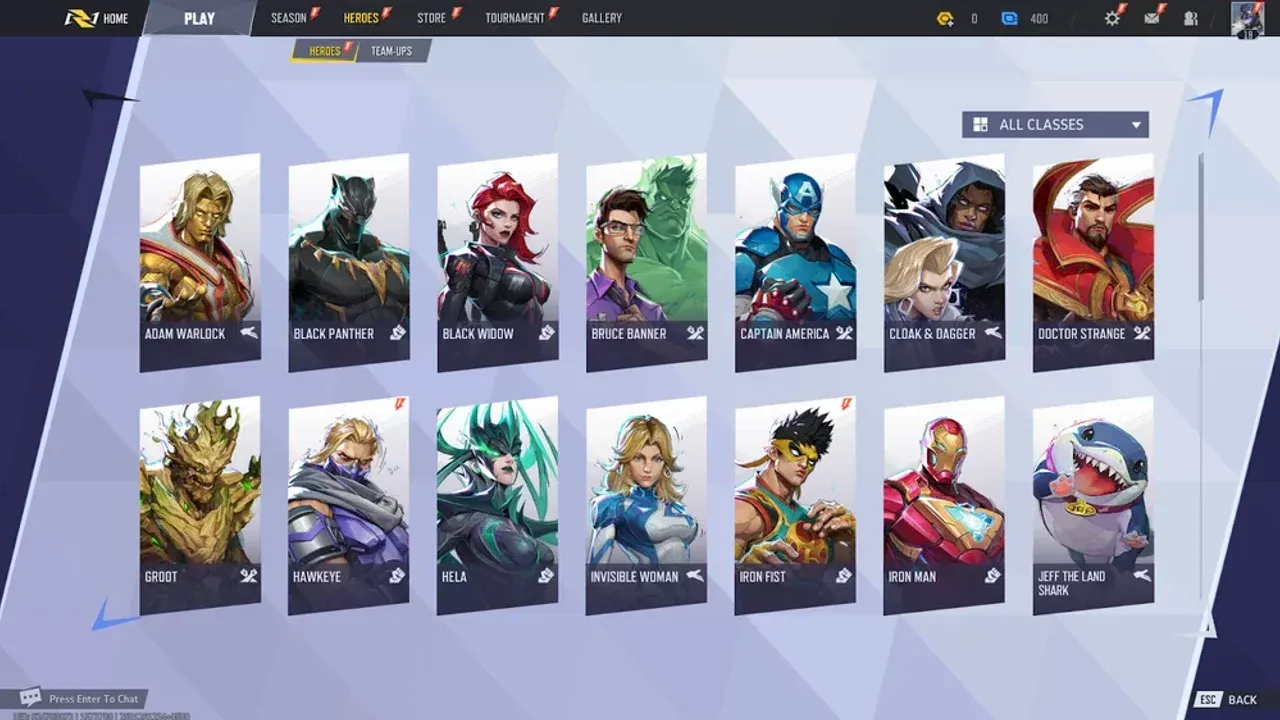
Marvel Rivals Hero Roles and Team Composition Basics
Welcome to the arena—Marvel Rivals is a 6v6 hero shooter where victory is decided by team coordination, not just individual skill. Your first and most important decision in every match happens before the fight even begins: understanding the three core roles and how they fit together to form a winning team. This guide will give you the foundational knowledge to build a balanced squad, communicate effectively, and dominate the battlefield from the very first spawn.
Players must select heroes carefully to ensure the team has adequate durability and healing.
The Three Pillars of Victory: Vanguard, Duelist, Strategist
In Marvel Rivals, every hero is permanently assigned to one of three distinct roles, each with a critical job. Think of them as the pillars holding up your team’s strategy.
- Vanguard (The Space Creator): These are your frontline anchors. With the largest health pools (typically 500 to 1,000 HP), they use damage mitigation and crowd control to create a safe zone for your team. They dictate where the fight happens.
- Duelist (The Space Converter): This is the largest and most diverse role, with 27 heroes. Duelists are the damage dealers, responsible for turning the space created by Vanguards into eliminations and objective pressure. They answer the question, what does it cost the enemy?
- Strategist (The Timing Controller): These are your support heroes. With powerful healing, utility, and fight-swinging ultimates, they control how long your team can stay in a fight and survive enemy bursts. They are the glue that holds your team's tempo together.
Deadpool is the only hero who can flex across all three roles, with a unique form for each. For everyone else, their role is locked, so the depth comes from mastering the different playstyles within each role.
The Flexible Foundation: No Role Queue
Here’s a key difference from other hero shooters: Marvel Rivals does not have a role queue. The game gives you complete freedom to choose any hero, meaning team composition is a shared responsibility. You can check your team’s makeup at any time and use the [TAB] or [ESC] menu to swap heroes at your spawn point or after being eliminated. This flexibility is a double-edged sword—it allows for creative strategies and mid-match adaptation, but it also means an unbalanced team is a structural handicap you can't overcome with skill alone.
This is why understanding roles is so crucial. You must be able to look at your team screen, identify what’s missing, and be willing to fill that gap. A team without a frontline or without enough healing is starting the fight at a severe disadvantage.
The Golden Rule: The 2-2-2 Standard
So, what’s the ideal team shape? While you can experiment, the most reliable and consistently successful template is the 2-2-2 Standard: 2 Vanguards, 2 Duelists, and 2 Strategists.
This composition isn’t just a random suggestion; it’s the default balanced template because it provides everything a team needs:
- Space & Durability: Two Vanguards ensure you can hold the objective line while still having someone to peel for your vulnerable backline.
- Damage & Pressure: Two Duelists provide enough focused firepower to actually secure eliminations and prevent fights from stalling out.
- Sustain & Utility: Two Strategists guarantee your team can survive prolonged objective fights and cycle through powerful defensive ultimates.
Trust me, when you’re starting out or playing with a random team, sticking to a 2-2-2 structure is the fastest way to make your matches feel more stable and winnable.
The Game-Changer: Team-Up Abilities
Season 9 overhauled Marvel Rivals' signature Team-Up Abilities, adding a deep strategic layer. Every hero now has two independent loadouts that can grant entirely new powers, modify existing abilities, or even replace base skills. This means you’re not just picking a hero; you’re choosing which of their two Team-Up identities best fits your team’s plan. While memorizing every combo isn't necessary at first, the key is to draft heroes whose powerful moments—like their ultimates—have synchronized timing. A well-timed Team-Up can erase an enemy's advantage or secure a game-winning push.
With these fundamentals in mind—the three roles, the flexible 6v6 format, the 2-2-2 standard, and the power of Team-Ups—you’re ready to step into Marvel Rivals with confidence. You now know what makes a team work. Let’s break down how to master each role next.
How to Master the Vanguard Role in Marvel Rivals
In Marvel Rivals, the frontline isn’t just about absorbing bullets—it’s about dictating the entire battlefield. As a Vanguard, you are the team’s Space Creator, the anchor that decides where the fight happens and who gets to play comfortably. With the largest health pools in the game (500 to 1,000 HP) and kits built for damage mitigation and crowd control, your job is to forge a path for your damage dealers to thrive.
Official game artwork
Your responsibility is twofold: establish the battle line and block enemy sightlines. This isn’t passive tanking; it’s proactive control. You create the “safe zone” where your Duelists can deal damage and your Strategists can sustain. Every inch of ground you take is territory your team can use. The moment you falter, that space collapses, and your team is forced into a desperate retreat.
The Two Faces of the Frontline
The Vanguard role splits into two distinct archetypes, each with a different approach to creating space. Choosing the right one for the situation is your first major decision.
Frontline Anchors are your immovable objects. Heroes like Groot, Doctor Strange, Magneto, and The Thing excel at walling off ground with barriers, roots, and area denial. Their limited mobility is a trade-off for incredible positional control. Your goal is to plant yourself at the critical choke point or objective corner and become an obstacle the enemy must solve. You absorb the initial burst so your teammates don’t have to.
As an Anchor, your survival is the team’s survival. Communicate with your Strategists to ensure you’re within their healing sightlines. If you go down, the entire frontline often collapses.
Dive Tanks are your mobile disruptors. Venom, Thor, and Bruce Banner (Hulk) specialize in chaos. Instead of holding a line, you jump the enemy backline to soak attention and scatter their formation. Your goal is to create openings by forcing enemy Duelists and Strategists to deal with you, pulling their focus away from your advancing team. This is high-risk, high-reward—a successful dive can win a fight instantly, but a failed one leaves your team without a frontline.
Mastering Vanguard Fundamentals
Regardless of your archetype, two core practices separate good Vanguards from great ones.
First is Corner Discipline. In Marvel Rivals, cover is everything. Your positioning should be a cycle of using corners to absorb pressure, then resetting behind them to recover cooldowns and health—never retreating in a panic through open space. Fight from one piece of cover, and always know where your next one is. This deliberate pacing makes you incredibly hard to kill and turns what looks like a retreat into a controlled reset.
Second is using your environment intelligently with Chrono Vision. By pressing [B] on PC or [D-pad Right] on console, you highlight destructible terrain. This is a game-changer for finding new flanking routes, creating unexpected angles for your team, or simply identifying when the enemy’s precious cover is about to vanish. Use it when leaving spawn or when you feel stuck at a choke.
Common Pitfalls and How to Fix Them
The most frequent Vanguard mistake is engaging alone. You are the tip of the spear, but a spear needs a shaft. Pushing forward without your team’s support turns you into a free ultimate charge for the enemy. Always move with your team’s tempo.
Another trap is chasing kills. Your primary metric is space controlled, not eliminations secured. If you abandon the objective line to pursue a low-health target deep into enemy territory, you leave your backline exposed. Let your Duelists convert the space you create into picks.
Remember, in Marvel Rivals, a Vanguard’s value is measured in the safety and opportunities they provide. Hold the line, create the angles, and trust your team to fill the space you fight for. With this mindset, you’ll be the unbreakable foundation every winning team needs.
How to Master the Duelist Role in Marvel Rivals
The Vanguard has carved out the space—now it's your turn to make it count. In Marvel Rivals, the Duelist role is where the game's action culminates. As the Space Converters of the team, your job is to turn that hard-won territory into decisive eliminations and objective pressure. With a whopping 27 heroes to choose from—over half the roster—this role offers the widest variety of playstyles, from silent snipers to chaotic brawlers. Mastering it means learning not just how to aim, but when and where to strike.
The Duelist's Arsenal: From Flankers to Fliers
Your hero choice dictates your battlefield role. Think of these as the core archetypes within the Duelist class:
- Flankers and Divers (Spider-Man, Black Panther, Magik): You are the silent blade. Your goal is to avoid the main brawl and use side angles or mobility to delete vulnerable backliners like enemy Strategists. This isn't about taking fair fights—it's about timing your strike when the enemy is distracted by your frontline.
- Ranged Poke and Snipers (The Punisher, Hela, Hawkeye, Black Widow): You control the lanes. From a distance, you apply relentless pressure, forcing enemies to respect your sightlines. Snipers like Hawkeye and Black Widow are pick threats that can win a fight before it starts, but you must rotate positions frequently to avoid becoming a predictable target.
- Flying Ranged (Iron Man, Storm): You own the vertical plane. Characters like Iron Man use flight to create angles that ground-bound heroes can't contest. The key to survival here is constant movement; strafing and hovering unpredictably makes you a nightmare to hit. Your positioning isn't just about where you are on the map, but how you use the air above it.
Damage that gets healed is just free ultimate charge for the enemy support. As a Duelist, your priority isn't just dealing damage—it's securing the kill. Focus fire with your team to confirm eliminations.
The Art of the Off-Angle
The most powerful concept for any Duelist in Marvel Rivals is Off-Angle Pressure. This doesn't mean going on a solo mission behind enemy lines. It means positioning yourself 10-25 meters to the side of your team's main frontline.
Here's why it works: When you and your Vanguard are shooting from the same direction, the enemy can hide behind a single piece of cover. When you create a crossfire from a soft flank, you force them to choose which threat to face. Suddenly, that cover isn't safe anymore. This split in attention is what creates openings for picks and causes entire defenses to collapse.
⚠️ Watch Out: The most common Duelist mistake is taking this angle too early. If you peek before your Vanguard has drawn the enemy's focus, you'll become the first and easiest target. Wait for the clash to begin, then reveal yourself to punish distracted enemies.
From Positioning to Victory
Your positioning dictates your effectiveness. A flanker who attacks from the front is just a melee fighter waiting to be focused down. A sniper who never moves is a free kill. Your playstyle must match your hero:
- For Flankers: Your engagement timer starts when your tank engages. Use your mobility not just to go in, but to have a guaranteed escape route. If you don't have a plan to get out, don't go in.
- For Ranged Damage: Play near natural cover and health packs. Your job is to provide consistent, reliable damage that your team can play around. Ask yourself constantly: "Am I safe here if a diver finds me?"
- For Fliers: Use your altitude to support the main fight, not to start a solo one. Your unique angle is a force multiplier for your team's damage; isolate yourself, and you become an easy pick.
Trust me, the moment you stop stacking directly behind your tank and start claiming those off-angles is the moment you'll feel your impact in Marvel Rivals skyrocket. You're not just dealing damage anymore—you're controlling the fight. Now, go convert that space into a win.
How to Master the Strategist Role in Marvel Rivals
In Marvel Rivals, the difference between a chaotic wipe and a decisive win often comes down to a single, well-timed heal or a perfectly placed shield. You’re the Strategist—the Timing Controller. While Vanguards dictate where the fight happens and Duelists decide what it costs, you control the most crucial variable: how long your team can stay in the fray. This isn't about being a passive heal-bot; it's about wielding fight-swinging utility and making split-second decisions that outlast the enemy.
The Core of Timing Control
Your kit is built around three pillars: healing, utility, and fight-defining ultimates. With only 12 heroes in this role, each brings a unique flavor, but they all share a common goal: to extend your team's lifespan and shorten the enemy's. A key recent change is the healing-to-ultimate conversion. After the July 11 hotfix, this rate increased from 60% to 70%, meaning your healing now charges your powerful ultimate even faster. This makes every point of healing more valuable and accelerates your ability to swing fights.
With the boosted 70% conversion, don't just heal reactively. Look for "tempo healing"—topping up your team before an engagement to keep them above the enemy's burst damage threshold. This proactive healing builds your ultimate faster and wins the fight before it even starts.
Mastering Healing Triage and Survival
Your first and most important job is to stay alive. This is the Oxygen Mask Principle: you can't save anyone if you're dead. Always position near cover and have a retreat path in mind. Your survival is Priority 0.
Once you're secure, healing triage kicks in. Don't just heal the lowest health bar; heal based on win conditions:
- Priority 1: Keep the Vanguard alive. They create the space your team needs to operate. If your anchor falls, the entire fight collapses.
- Priority 2: Save the teammate being hard-focused. Even if it's a Duelist, preventing that first pick is crucial to stop a snowball.
- Priority 3: Stabilize the team after the immediate danger has passed.
- Priority 4: Heal chip damage only when it's completely safe.
A good habit is the 3-second rule: ask yourself if your next heal will matter in the next three seconds. If not, it might be time to reposition, reload, or prepare a utility ability instead.
Utility Usage and Cooldown Staggering
Your non-healing abilities—shields, speed boosts, anti-heal, crowd control—are often the real fight-winners. The key is staggering cooldowns. Never use all your major defensive tools at once. If you blow your shield, speed boost, and stun in the same moment, you have nothing left for the enemy's next, often more committed, push.
⚠️ Watch out: A common trap is panic-using every ability when your team takes initial poke damage. Hold one major cooldown in reserve for the enemy's real commit wave. This discipline of saving a tool for the critical moment is what separates good Strategists from great ones.
Positioning for Maximum Impact
Your position is dictated by your ability to influence the fight while minimizing risk. Central Strategists like Rocket Raccoon or Jeff the Land Shark need clear sightlines to the frontline to maximize multi-target heals or strong single-target sustain. Roaming Strategists like Cloak and Dagger or Loki can take more aggressive, peripheral angles when healing demands are low, often pairing with a flanker to create pressure.
Regardless of your hero, always maintain the Tether Habit: know where your nearest peel (usually a Vanguard) is and position so they can protect you. If you get dove, you should be one movement ability away from safety and team support.
With your focus on triage, cooldown economy, and smart positioning, you become the backbone that allows your team to weather any storm and seize every opportunity. You don't just watch the fight—you control its tempo.
Advanced Positioning and Map Strategies for Every Role
Here’s the secret to turning a chaotic Marvel Rivals brawl into a controlled win: it’s not about your aim, it’s about the ground you stand on. The best players don’t just react—they position themselves so the next three seconds are low-risk and high-impact. This section breaks down the map geometry and advanced rules that let you dictate every fight.
The Core Rules: Cover, Angles, and Timing
Before you even think about specific heroes, internalize these three universal laws. They apply to every role in Marvel Rivals and will save your life more than any ability.
First, live by the One-Step-to-Cover Rule. This means you should only commit to a fight from a position where safety is reachable in a single movement or quick dash. If you have to cross open space to find a wall, you’re already out of position. Trust me, this habit alone will cut your deaths in half.
Next, master the High Ground CAR Rule. High ground is powerful, but it’s a trap if you treat it like a permanent home. Before you take it, check for Cover to duck behind, a good Angle to pressure key targets, and ensure you’re within your hero’s effective Range. Use it as a temporary resource for 3-8 seconds to support a push, then drop down before the enemy dedicates resources to flushing you out.
Finally, respect the 2-Second Rule. If you’re under fire and the nearest solid cover is more than two seconds away, you’ve already overstayed your welcome. Back up immediately. Greed is punished brutally in Marvel Rivals, and that “one more shot” often leads to a respawn timer.
Controlling the Battlefield: Map Geometry and Destruction
Maps in Marvel Rivals aren’t just pretty backgrounds—they’re a toolkit. Smart teams use the geometry to their advantage, while great teams actively reshape it.
Chokepoints are the most critical areas on any map. These are narrow lanes or doorways that funnel enemy movement. This is where area denial abilities like Punisher's Remote Mines shine, punishing stacked teams trying to push through. Control the choke, and you control the fight’s tempo.
When defending, don’t stand in the choke. Stand at an angle beside it. This lets you deal damage to enemies in the funnel without being their primary target.
Your most powerful tool isn’t always on your ability bar—it’s Environmental Destruction. Blowing up walls and cover isn’t just for show. Use it tactically to break enemy support cover, suddenly exposing their backline. Or, open a new entry route to an objective to create an unexpected flank for your team. Just be careful not to destroy your own team’s safe spots in the process.
Role-Specific Positioning Priorities
Now, let’s apply these rules to each role. Your job changes how you use the map.
Vanguards: Own the Corners
Your mission is to make the next five seconds safer for your team. Fight from corner to corner, using the One-Step-to-Cover Rule aggressively. As a defensive anchor like Groot, you hold the main corner of the fight. As a dive tank like Venom, you use corners to hide your approach before leaping on a support. Never cross a dangerous open lane without a movement ability ready to escape.
Duelists: Master the Off-Angle
Your default should be a “soft flank,” positioning 10-25 meters to the side of your team. This creates a crossfire, forcing enemies to split attention. A sniper like Hawkeye uses the High Ground CAR Rule for a few shots before rotating. A flanker like Spider-Man uses cover to stalk until the enemy Vanguard is distracted, then strikes. Always have your Escape Route Rule in mind before committing.
Strategists: Intersect Safety and Sightlines
Your perfect spot is at the intersection of cover, a sightline to your frontline, and within peel range of a teammate. Use the 2-Second Rule religiously. If you can’t reach cover quickly, you’re too exposed. As a central healer like Rocket Raccoon, use walls to bounce healing spheres. As a roamer like Loki, you can take more aggressive off-angles, but only when your team is stable and you have a clear path back.
Putting It All Together: The Positioning Loop
Advanced positioning is a cycle: Stage, Scout, Pressure, Convert, Reset.
- Stage: Before the fight, move with your team to a strong position using the rules above.
- Scout: Use third-person peeks around corners to gather information without taking damage.
- Pressure: Apply damage or threat from your chosen angle to force enemy reactions.
- Convert: If you get a pick or force a key cooldown, move as a team to take better ground (like the next corner or high ground).
- Reset: If the fight is lost, disengage together to a safe, playable position. Do not trickle back in one by one.
If you’ve ever felt like you were always the first to die or that fights were chaotic, this structure is your remedy. By mastering these rules, you control the pace, the sightlines, and the outcome of every engagement in Marvel Rivals. Now, get out there and own that high ground.
Best Team Compositions and Synergy Templates
Here's the thing about Marvel Rivals: you can win with any heroes you love, but you win more when they work together. This section is your playbook for turning a random hero select into a winning formula. We’ll break down the proven team comps that feel like cheating—because they cover each other's weaknesses and amplify strengths. Let’s build your team.
Universal 2-2-2: Your Go-To Baseline
If you only learn one composition, make it this one. The 2 Vanguards, 2 Duelists, 2 Strategists setup is Marvel Rivals' most reliable and consistently high-performing team structure for good reason. It’s balanced, forgiving, and works on every map and against most enemy lineups. Think of it as your team’s safety net: two Vanguards ensure someone can always touch the objective while the other peels, two Strategists provide enough sustain to survive long fights, and two Duelists guarantee enough damage to actually finish kills.
When in doubt during hero select, just lock in a 2-2-2. It’s the easiest way to ensure your team has the tools to start fights, survive them, and finish them.
The Specialist Comps: When You Need a Specific Answer
Sometimes the standard setup isn't enough. Maybe the map favors long lanes, or the enemy keeps diving your backline. That’s when you swap to a specialized composition designed to exploit a specific weakness or playstyle.
The Fortified Comp (2 Vanguards, 1 Duelist, 3 Strategists)
This is your ultimate “we will not die” setup, built to win long objective holds through extreme sustain. It’s perfect for chaotic, messy fights on tight Domination points or overtime pushes where survival is everything. You trade raw damage for incredible staying power, cycling defensive ultimates one at a time to outlast the enemy's cooldowns. The key rule here? Never stack two big defensive ultimates in the same fight—space them out to make your team virtually unkillable over a prolonged engagement.
The Dive Collapse Comp
Built for coordinated aggression, this comp aims to delete one target instantly then snowball. It pairs mobile, disruptive Vanguards like Venom and The Thing with bursty flanker Duelists like Star-Lord and Black Panther. The playbook is simple: identify a single high-value target (usually an enemy Strategist), engage in layers, and erase them before they can react. The moment that pick is secured, your whole team collapses onto the objective to clean up. The one non-negotiable rule? If you can’t see at least two teammates ready to commit, you’re not diving—you’re feeding.
The Long-Range Poke Comp
For maps with wide-open sightlines and long lanes, this composition uses heroes like Magneto, Doctor Strange, Hela, and Phoenix to deny entry and force enemies to cross open space under fire. You win by controlling angles and making it too costly for the enemy to approach the objective. Your team should claim a lane, pressure from distance, and kite backward as a unit if the enemy gets close. The most common way this comp fails? Standing still. Keep rotating and repositioning to avoid getting picked apart by enemy divers.
The Brawl Deathball Comp
When the fight is in a tight corridor or on a small objective point, you want to get up close and personal. This comp, featuring brawlers like Hulk, Groot, Wolverine, and Storm, is built to stay grouped and overwhelm in tight corridors. You move as one terrifying unit, using your combined sustain and close-range damage to win wars of attrition. Your win condition is forcing the fight into a phone booth where the enemy can’t kite you. Just remember: don’t chase a mobile hero into open space. You win by forcing the brawl, not by racing them across the map.
The Anti-Dive Fortress Comp
Tired of getting jumped by mobile flankers? This is your answer. Built around peel and punishment, heroes like Peni Parker, The Thing, Winter Soldier, and Namor create a safe zone that punishes mobile divers who enter. Instead of chasing the divers, you let them come to you, then delete them while they’re out of position. The key is for your supports to stay within peel range of your tanks. If they wander too far, the fortress crumbles.
Putting It All Together: How to Choose
Don't overthink it. Use this quick decision tree at hero select:
- Open map with long lanes? Go Poke Comp.
- Tight, claustrophobic objective? Go Brawl Deathball.
- Enemy supports never die? Go Dive Collapse or an Anti-Triple Support burst comp.
- Your backline keeps getting deleted? Go Anti-Dive Fortress.
- Unsure or playing solo queue? Default to the reliable Universal 2-2-2.
The most important rule for any comp, though, is to fight at one distance. If half your team wants to poke from afar and the other half wants to brawl up close, you’ll feel disjointed and lose. Pick an identity—poke or brawl—and have everyone commit to it.
With these templates in your arsenal, you’re not just picking heroes; you’re drafting a game plan. Now go build a team that can’t lose.
Marvel Rivals Role Mastery Tips and Beginner Recommendations
This is where your Marvel Rivals journey truly begins—taking all the role knowledge and turning it into consistent, confident wins. The final step isn't about mastering a single character; it's about building the right habits and mindset to succeed in any match, especially when you're flying solo.
For new players, the best advice is to start with a hero that teaches fundamentals, not one that demands them. If you're coming from tactical shooters, The Punisher is a perfect Duelist entry point, letting you leverage your existing aim skills while learning the flow of team fights. For a more supportive start, Rocket Raccoon is a top-tier Strategist recommended for beginners due to his familiar shooter-like mechanics and massive team impact. And if you want to learn how to control the battlefield, Jeff the Land Shark offers simple Vanguard mechanics for creating space, or straightforward single-target healing if played as a Strategist, making him an excellent teacher for core positioning.
When you're new, focus on one hero per role. Master their rhythm—when to engage, when to retreat, and what their job is in a fight. This focused practice builds a rock-solid foundation faster than bouncing between a dozen characters.
Your impact skyrockets when you adopt two non-negotiable team habits. First, resetting after fights. If you lose two teammates, the round isn't over, but the fight is. The single biggest mistake is trickling back in one by one to die. Regroup at spawn and push as a full unit. Second, master objective conversion. Winning a team fight is only half the victory. The real win is using that advantage to capture the point, push the payload, or secure the checkpoint. Immediately after a won fight, stop chasing kills into nowhere and focus on the objective. This one discipline alone will turn close losses into easy wins.
For climbing the solo queue ladder, your flexibility is your greatest weapon. Since Marvel Rivals has no role queue, be ready to fill. Aim to have a "main" role with 2-3 heroes you're excellent with, and a "fill" role with 1-2 heroes you're serviceable on. If your team locks in four Duelists, be the player who swaps to a needed Vanguard or Strategist. That adaptability is what carries games.
Ultimately, Marvel Rivals rewards the player who understands the team, not just their own screen. Start with a forgiving hero, commit to the macro habits of resetting and converting, and be the teammate who fills the gap. Do that, and you're not just playing—you're winning.