
The post-Update 2.0 Cool tree is not a general kill-buff investment. It is a set of thresholds that decide how V opens a fight, how accurately a precision weapon can finish it, and how much room you have to recover when detection starts. Spend Cool to support a specific loadout and combat loop; stop when the next tier no longer solves the problem you are trying to solve.
The Cool Tree Is a Threshold System, Not a Kill Buff
Update 2.0 removed the Cold Blood perk and its dedicated skill tree. A pre-2.0 guide that tells you to build around Cold Blood stacks is describing a different system. The post-2.0 Cool tree replaces that old all-purpose loop with separate tools for quiet openings, crouched movement, precision shooting, and throwable weapons.
All perk values below use the post-Update 2.0 tree. That matters because the attribute is easier to waste now: Cool is excellent when you want stealth or precision damage, but it is not a universal damage stat. If your build is really asking for mobility, hacking support, or cyberware capacity, those points belong in another attribute after Cool has reached the tier your weapon needs.
At Cool 4, 9, 15, and 20, Buy for a Specific Job
Treat each gate as a decision point instead of filling every connected node.
| Cool | Take | The job it solves |
|---|---|---|
| 4 | Killer Instinct, then Feline Footwork | Killer Instinct gives knives, axes, and silenced guns 25% more damage outside combat. Feline Footwork adds movement speed and mitigation while crouched, improving both the opening hit and the approach. |
| 9 | Focus | Focus adds 10% headshot and weak-spot damage for pistols, revolvers, precision rifles, and sniper rifles, then unlocks Focus mode when you aim with full Stamina. This is the first major breakpoint for a ranged Cool build. |
| 15 | Ninjutsu or Deadeye | Ninjutsu rank 3 lets you sprint while crouched, while Deadeye turns high-Stamina precision shooting into a more reliable kill chain. Choose Ninjutsu for silent movement and Deadeye for deliberate headshots. |
| 20 | Nerves of Tungsten-Steel, only if Deadeye is active | While Deadeye is active, Nerves of Tungsten-Steel guarantees critical hits on headshots and weak spots and increases damage with distance. If you chose Ninjutsu and rarely use precision weapons, stop before this capstone. |
At Cool 4, the stealth nodes pay back immediately. At Cool 9, Focus is worth buying only for the four ranged weapon families it affects. At Cool 15, Ninjutsu and Deadeye solve different problems: one changes where you can move, the other changes how confidently you can finish a target. Do not take both just because the tree allows it; the next attribute point may be more valuable than a second Cool branch.
Let the Loadout Choose the Branch
Start with the weapon you will actually use, then follow the branch that improves its first job.
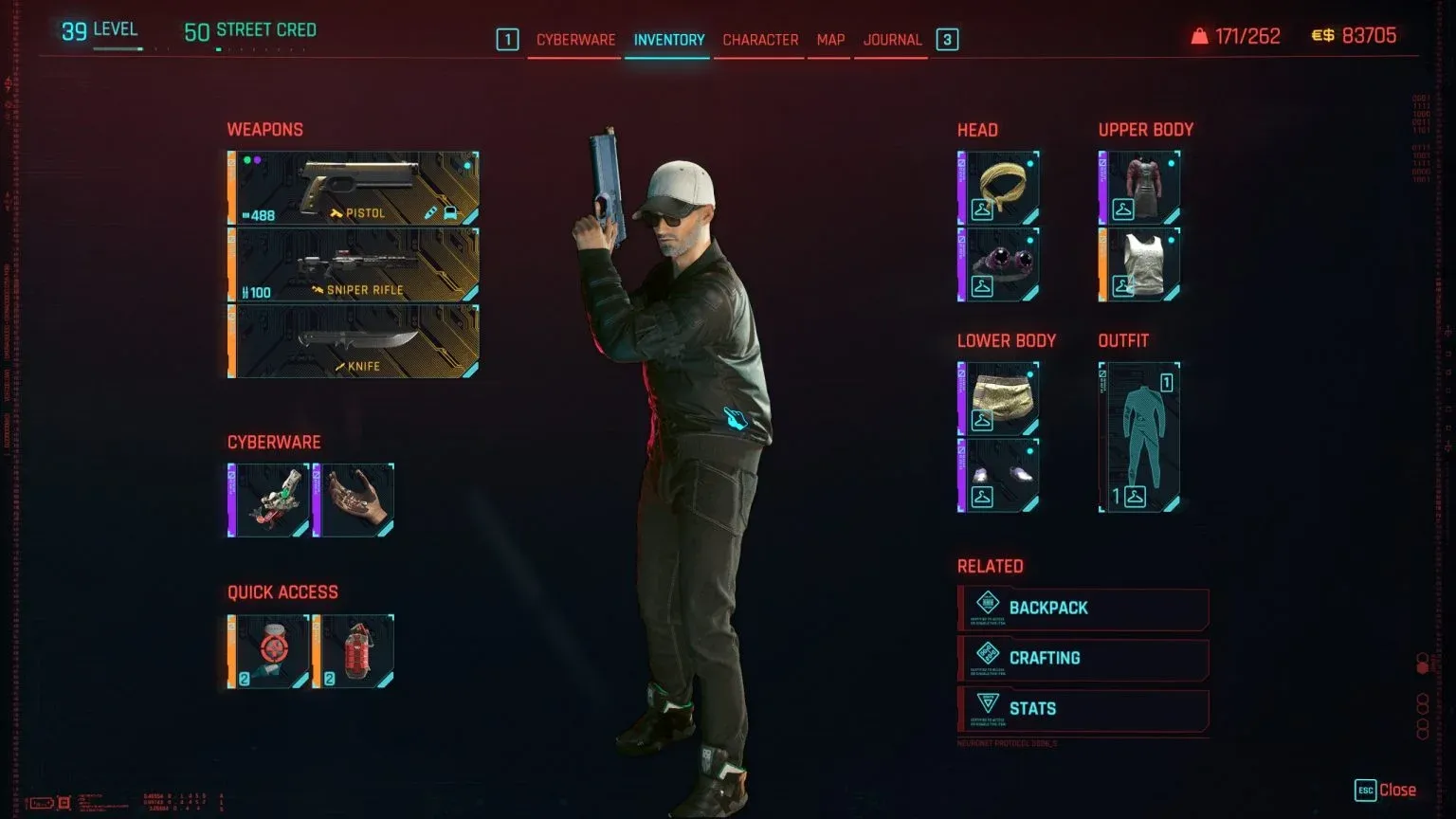
A stealth inventory makes the Cool branch decision concrete.
| Loadout | Route | Why |
|---|---|---|
| Silenced pistol plus knife | Cool 4, then Focus at 9 | Killer Instinct improves the opening hit, while Focus supports the pistol once the encounter becomes a sequence of aimed shots. |
| Revolver, precision rifle, or sniper rifle | Focus at 9, Deadeye at 15, then Nerves of Tungsten-Steel at 20 | This is the precision route. Preserve Stamina so Focus and Deadeye are active when the important shot arrives. |
| Knife, axe, or throwable-focused build | Cool 4, then Ninjutsu at 15 if you need silent repositioning | Killer Instinct supports the first throw or takedown. Ninjutsu adds movement; Focus is a detour unless a pistol or precision rifle is also doing the work. |
There is one practical trap: Update 2.0 removed the silencer slot from revolvers. A revolver can benefit from Focus and Deadeye, but it is not the same quiet opener as a suppressed pistol. If the first shot must stay invisible, use a silenced weapon or a thrown knife; if you want revolver precision damage, accept that the shot may start the fight.
Every point beyond the tier your weapon needs has an opportunity cost. Reflexes buys mobility, Intelligence helps with cameras and distractions, and Technical Ability supports cyberware-focused builds. Cool 4 is a strong stealth dip; Cool 9 is a deliberate precision investment; Cool 15 or 20 should be a commitment to the branch you will use.
If Detection Breaks, Cool Should Buy You Time
Start crouched, use cover to control the angle, and spend the first attack on a target whose death will not expose the rest of the room. Feline Footwork and its connected mitigation nodes make that approach safer. With Ninjutsu, crouch-sprinting gives a high-Cool infiltrator a way to cross space without standing up.
When the detection meter starts to fill, do not fire just to avoid waiting. Break the sightline and move before the room shares your position. Optical Camo creates the gap; Phantom Liberty players can add Emergency Cloaking, which makes enemies lose track of V when the camo activates. If the room is already fully alerted, stop buying stealth damage and solve the new problem with your combat attribute, armor, or cyberware instead.