
Spoilers through the end of The Heist.
By the time Yorinobu Arasaka kills Saburo, V and Jackie have already done the job Dexter DeShawn sold them. They reached the penthouse, stole the Relic, and hid before the family drama found them. The catastrophe arrives during the handoff, not the burglary.
That distinction makes Dex's role more interesting than simply calling him a bad fixer. A fixer owns the connections between client, crew, information, and escape. Dex can assemble those pieces, but once the situation changes, he has no visible way to keep them aligned. The bullet that begins the lockdown is Yorinobu's. The decision that leaves V in a landfill belongs to Dex.
Dex's Setup Depends on People He Doesn't Trust
The Afterlife briefing contains the parts of a professional operation. Evelyn Parker has seen Yorinobu's penthouse through a braindance. T-Bug can work the hotel network. The Flathead can open a route through Konpeki Plaza's security system. A Delamain cab is waiting for the extraction. Dex turns those separate advantages into a quiet theft with no bodies.
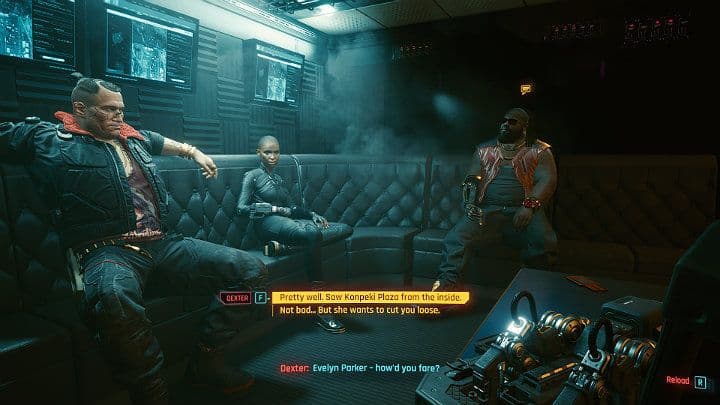
Dex tests the crew's loyalty before explaining the Konpeki Plaza job.
The weakness is not any one tool. It is the way the information is divided. Evelyn knows what she saw, T-Bug knows what she can breach, and V and Jackie are expected to improvise inside a building controlled by Arasaka. Dex is the person connecting those pieces, but the briefing does not give the crew a shared picture of what happens if the Relic is touched at the wrong moment.
His first question at the Afterlife is about Evelyn, which makes the meeting a loyalty test as much as a mission briefing. When Jackie asks for a better share, Dex calls them “fresh talent,” starts at 30 percent, and lets V negotiate or reveal Evelyn's plan to cut him out. Those choices alter the conversation and the proposed split, but not the mission. Dex is measuring who controls the deal; he is not adding another layer of safety to the job.
That is the limit of his preparation. He has sourced the Flathead, the netrunner, and the ride, but he has not turned their separate knowledge into a common contingency. The operation is assembled; its risks are not.
Yorinobu Changes the Job Before Dex Can React
The first half of the heist proves that the setup can work. V and Jackie get through reception, guide the Flathead, reach the penthouse, and recover the Relic. Then Yorinobu returns with Saburo. Their confrontation is a private family crisis that the crew happens to witness. Yorinobu kills his father, the hotel raises an alarm, and T-Bug loses the connection after Arasaka traces her.
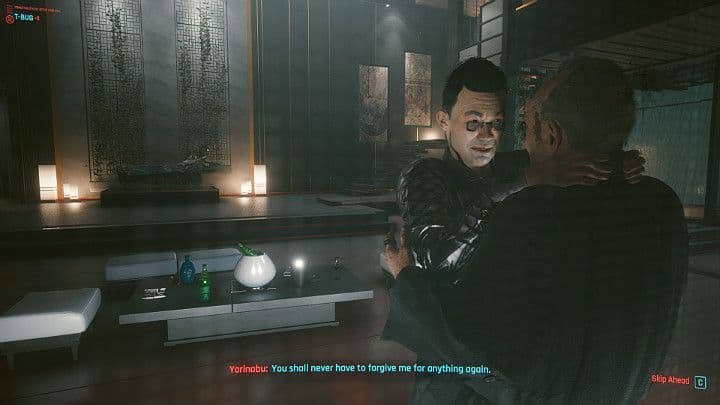
Yorinobu's family confrontation turns the theft into an emergency.
Dex did not cause the murder, and no dialogue choice at the Afterlife could have prevented it. The event still exposes the missing piece in his plan: the job was designed for a clean exit from a secure hotel, not an escape from a corporate crime scene. Once the alarm sounds, V and Jackie are working without T-Bug's support and without a fixer on the line.
The Relic is damaged during the fall, so Jackie plugs it into his neural socket to keep it alive. The pair still reaches the Delamain, but the vehicle is chased out of the garage and Jackie is dying in the back seat. Their objective has changed from delivering a stolen chip to getting a wounded friend and a degrading prototype to the next room. The plan has not merely become harder; it has become a different job.
At the No-Tell Motel, Dex Chooses a Body to Blame
Dex gets one last chance to become the fixer the situation requires. At the No-Tell Motel, he can see that the original handoff is gone: Jackie is critical, the Relic is no longer a package V can simply pass across a table, and Arasaka has turned the crew into evidence. He tells V to wash the blood off and talks about meeting Evelyn, but he does not rework the deal in front of him.

The planned extraction becomes a running fight through the hotel garage.
After V leaves the bathroom, a security guard attacks. Dex draws his gun and shoots V. The scene does not explain every calculation behind that decision, and it does not need to. It shows Dex abandon the surviving merc instead of testing whether the job can be salvaged.
That is why his betrayal matters more than the bad luck at Konpeki Plaza. Yorinobu creates the emergency; Dex decides who will carry its consequences. V is the person with the Relic in their head, the least protected person in the room, and the easiest part of the original arrangement to discard. Whether Dex wants the chip, an exit from the mess, or both, his response is the same: the crew stops being a resource and becomes a liability.
A Fixer Owns the Handoff, Not the Trigger
The causes of the disaster remain separate. Evelyn withholds part of the deal. Yorinobu kills Saburo. Arasaka locks down the hotel. T-Bug loses the network. Jackie is mortally wounded. Dex does not author every event, but he is the person who turns the failed extraction into a betrayal.
A fixer cannot control every variable in Night City. The job is to keep a live line between the client, the crew, and the exit when those variables change. Dex's plan has components for entry and movement, but The Heist shows no fallback handoff, alternate contact, or revised extraction once the hotel goes loud. His authority lasts as long as the original script does.
That is the practical lesson V carries forward: a clean briefing proves that someone prepared for the expected version of the job. It says nothing about who will speak for the crew when the unexpected version begins. In The Heist, Dex answers that question with a gun.