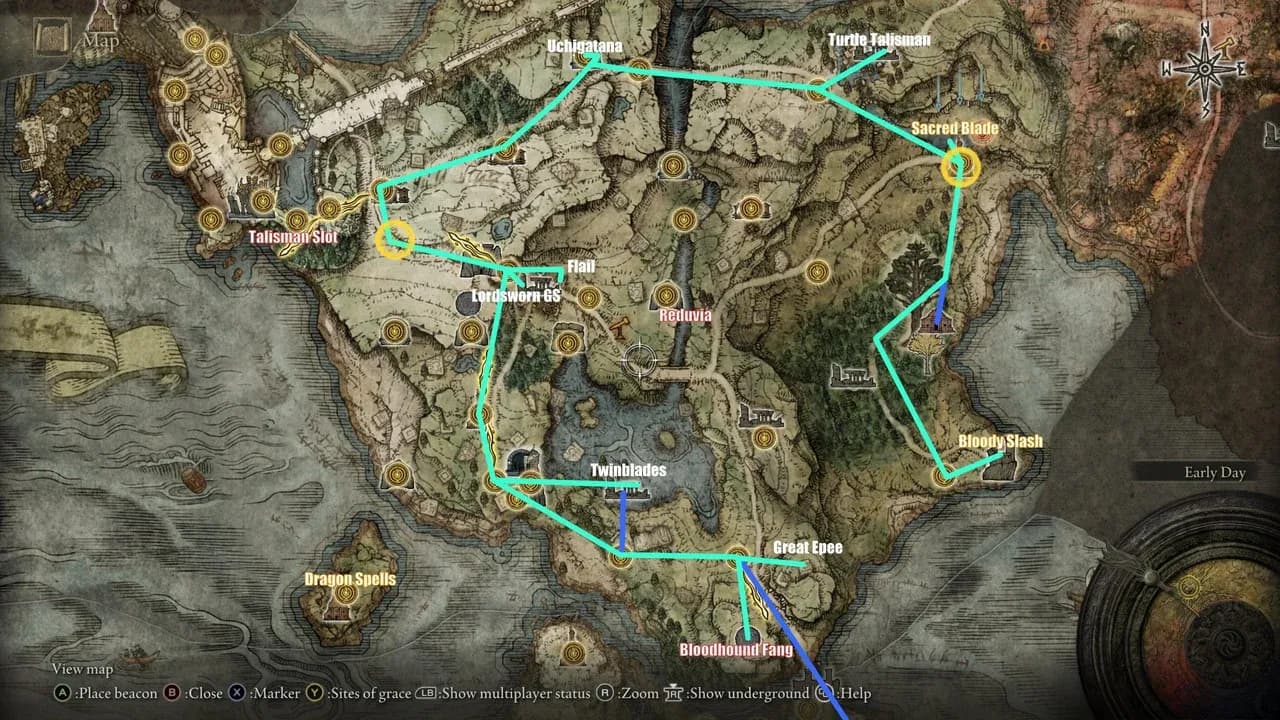
How to Start Your Journey in Elden Ring: First Steps and Objectives
Your adventure in Elden Ring begins the moment you step out into the blinding light of Limgrave, a vast, open world that doesn't just invite exploration—it demands it. While the sheer scale can feel overwhelming, your first few hours are about gathering the essential tools and allies that will keep you alive in the Lands Between.
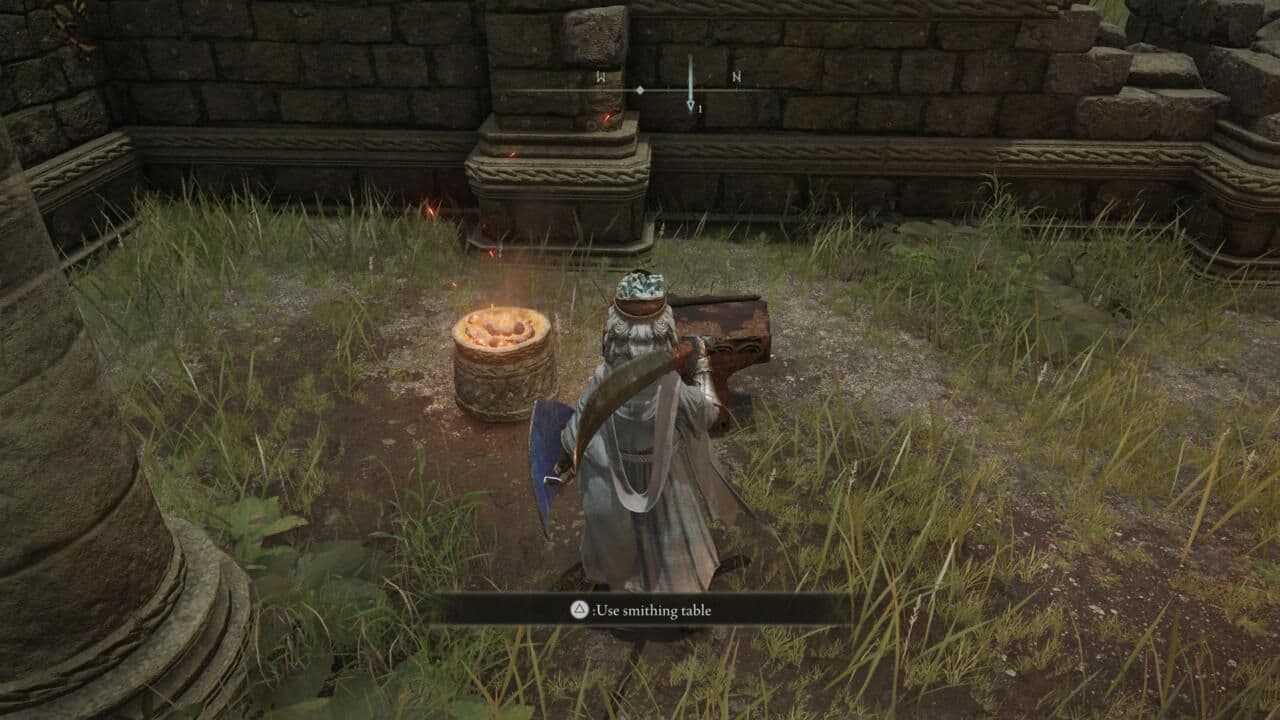
The Church of Elleh is one of the first safe havens you will find in Limgrave.
Finding Your Way with Grace
The first thing you’ll notice are the Sites of Grace, glowing points of light scattered across the landscape. Approach one and press [Y] press to rest; this action restores HP/FP/Flasks but be careful, as it also respawns world enemies. These act as your checkpoints and fast-travel hubs. Many of these sites emit Guiding Grace, a visual mechanic where golden light trails from Sites of Grace and points toward main story objectives. If you ever feel lost, just look at your map or the horizon for that golden shimmer to find the "critical path."
Essential Tools at the Church of Elleh
From your starting point, follow the light north to the Church of Elleh, a ruined sanctuary that serves as your first major base. Inside, you will meet Merchant Kalé, the first vendor you’ll encounter, who sells essential crafting kit and telescope. Trust me, you’ll want that crafting kit immediately to turn the plants and bones you find into helpful consumables. The church also contains first smithing table, where you can begin strengthening your armaments before things get truly dangerous.
Buy the telescope from Kalé early. In a world this big, being able to scout enemy camps from a distance before charging in will save you from plenty of unnecessary deaths.
Meeting Melina and Unlocking Torrent
Once you’ve done some light scavenging, continue following the road north to the Gatefront Ruins Site of Grace. Resting here triggers a pivotal meeting with Melina, a mysterious maiden who provides leveling ability and Torrent. She will offer you a pact to act as your finger maiden, allowing you to finally turn your hard-earned runes into stat increases.
To help you traverse the massive distances of Limgrave, she grants you the Spectral Steed Whistle. This key item is given by Melina and is used to summon Torrent, your spectral horse. Having a mount changes the game entirely, allowing you to leap over obstacles and outrun enemies that are currently too strong for you to handle.
⚠️ Watch out: While resting at a Grace heals you, remember that those soldiers you just painstakingly cleared out will return the moment you stand up. Plan your rests carefully!
With your horse secured and the ability to grow stronger, the world of Limgrave is officially your oyster. Whether you follow the golden light toward the castle or strike out into the unknown, you now have the foundation to survive. Let's go.
Best Vigor Leveling Strategy for Elden Ring Beginners
In Elden Ring, that first death can feel brutal—you’re exploring Limgrave, feeling confident, and then a random enemy combo sends you back to a Site of Grace. Here’s the secret veterans know: your early survival isn’t about hitting harder; it’s about being able to take a hit. Pumping your damage stats right away is a trap, and Vigor is your ticket out of it.

Surviving the Lands Between requires a solid investment in Vigor.
Think of Vigor as your lifeline. Each point directly increases your maximum HP, and in a game where boss combos can delete you in seconds, having a larger health pool is non-negotiable. The game has built-in soft caps for efficiency: 40 is a good baseline to aim for early, but pushing it to 60 is the optimal endgame target for serious survivability. Beyond 60, you’ll see severe diminishing returns, so that’s your stopping point.
Don’t just look at your HP bar—feel it. If a standard enemy can nearly kill you in two hits, you need more Vigor. Being able to survive three or four mistakes completely changes the pace of a fight.
This leads to the core strategy: survivability over raw damage. A build with high Vigor has fewer healing breaks, maintains more consistent uptime on the boss, and ultimately delivers higher real DPS over a fight because you’re not constantly running away to sip a Flask. While your +3 sword might hit for bigger numbers on paper, you’ll contribute far more by staying alive and attacking relentlessly.
Your other best friend early on is Endurance. You level this up at any Site of Grace, and it’s crucial because it increases your Stamina (used for every attack, block, and dodge) and your Equip Load (which determines if you can medium-roll in your chosen armor). Without enough Stamina, you can’t attack effectively or escape danger, making even simple fights a struggle.
Your early stat focus should be clear: get both Vigor and Endurance to 20+ before you invest heavily in Strength, Dexterity, or other damage attributes. This foundation lets you learn enemy patterns without being punished instantly for every mistake, and it ensures you have the stamina to actually use your weapon’s moveset. Trust me, a player with 30 Vigor and a +5 weapon will have a much smoother time than a player with 15 Vigor and a +8 weapon.
With a robust health pool and plenty of stamina, you’ve built the tanky foundation needed to face Elden Ring’s challenges head-on. Now you’re ready to start making those enemies hurt.
How to Use Torrent and Explore Limgrave Effectively
Your adventure truly begins the moment you meet Melina at the Gatefront Ruins Site of Grace. She doesn’t just give you the ability to level up—she gifts you Torrent, your spectral steed and the single greatest tool for exploration in Elden Ring. This isn’t just a faster way to travel; it’s a game-changer for both navigating the vast landscapes of Limgrave and engaging in combat on your own terms.
To summon Torrent, open your inventory and use the Spectral Steed Whistle, or simply press [L3] at any time while on foot. This same button press will also let you dismount. Once you’re riding, the world opens up. Torrent’s double-jump lets you scale small cliffs and cross gaps that would stop you on foot, and his speed lets you outrun most overworld threats. But his real secret is combat mobility.
Mounted combat is a unique and powerful system. While on Torrent, you can attack from either side. Press [R1] or [R2] for swift attacks with your right-hand weapon, and [L1] or [L2] for attacks with your left-hand weapon or shield. This lets you circle larger enemies, striking them repeatedly as you pass by without ever stopping to become a stationary target. It’s especially effective against groups of weaker foes and for hit-and-run tactics on tougher overworld bosses.
Don’t sleep on Torrent’s sprint. Holding the sprint button drains his stamina, but it’s often the safest way to disengage from a fight that’s turning against you. A quick retreat to a Site of Grace is always an option.
Now, with Torrent under you, it’s time to properly chart Limgrave. Ride north from the First Step to the Gatefront Ruins. This fortified camp is swarming with Godrick soldiers, but you can use Torrent to speed through, grab the loot, and locate the key item here. Look for a stone monolith near the main road—interacting with it gives you the Map Fragment: Limgrave, West. This will reveal the entire western half of the region on your map, marking important landmarks and making navigation infinitely easier. Also, thoroughly search the ruins for a cellar; inside you’ll find the Whetstone Knife, which unlocks the ability to change your weapon’s Ash of War.
Your next major stop should be the Limgrave Tunnels. You’ll find this mine on the north end of Agheel Lake. It’s a primary source for early Smithing Stones, the materials you’ll need for your first weapon upgrades. The tunnels are also a great, relatively safe place to practice combat, gather runes, and get a feel for dungeon exploration.
As you ride across Limgrave, keep an eye out for Spirit Springs. These appear as swirling wind vortexes on the ground. Ride Torrent directly into one and press [A] at the right moment to perform a massive super-jump. These springs are designed to launch you and Torrent onto high cliffs, plateaus, or other areas that are otherwise inaccessible, unlocking shortcuts and secret areas.
With Torrent summoned, your map unfurled, and the knowledge to fight from horseback, you’re no longer just surviving in Limgrave—you’re conquering it. Let’s go.
Why Weapon Upgrades Outperform Stat Scaling in Elden Ring
In Elden Ring, you’ll face countless enemies that demand more than just swinging your starter sword. But here’s the secret most guides miss: pouring levels into Strength or Dexterity early on is a trap. Your damage output is governed by two distinct forces, and understanding which one to prioritize will save you from wasted levels and frustratingly slow boss fights.
Your weapon’s damage comes from two sources: Base Damage and Scaling Damage. Base Damage is the weapon’s innate power, listed in its stats. Scaling Damage is the bonus you get from your character’s stats like Strength or Dexterity. In the early game, your stats are low, so scaling contributes almost nothing. The biggest leaps in power come from upgrading your weapon, which directly boosts that Base Damage. Later, when your weapon is fully upgraded and your stats are high, Scaling Damage becomes the dominant factor. This is why chasing high stats with a weak weapon feels so ineffective.
Think of it like building a house. Upgrades are the foundation and walls (Base Damage). Stats are the interior decor (Scaling Damage). You can’t decorate a house that hasn’t been built.
This leads to a critical strategy: Upgrade Priority. The math is clear—a Level 35 character with a +12 weapon will consistently outperform a Level 50 character with a +3 weapon. Those extra 15 levels in your damage stat provide a tiny scaling bonus on a low base, while the +12 upgrade provides a massive base damage increase. Your runes and Smithing Stones should flow into your favorite weapon first, not your attribute screen.
When you do look at scaling, you’ll see letters like S, A, B, C, D, or E next to your stats on a weapon. These Scaling Grades indicate how efficiently that stat converts into bonus damage. An S grade is exceptional, an E grade is minimal. But an S-scaling weapon isn’t automatically stronger than a B-scaling one; the total damage is the sum of its (upgraded) base damage and its (stat-boosted) scaling damage. A weapon with high base damage and B scaling can outdamage a low-base, S-scaling weapon.
Because early upgrade materials are scarce, Resource Management is essential. You must focus your Smithing Stones or Somber Smithing Stones on 1-2 primary weapons rather than spreading upgrades thin across many. Pick a weapon that fits your playstyle and commit to it. Upgrading five different weapons to +3 will leave you weaker than upgrading one to +8.
If you’ve been struggling with damage, you’re not alone—this is the most common early-game mistake. By prioritizing weapon upgrades over stat levels, you’ll feel a dramatic power spike that carries you confidently into the mid-game. Let’s go upgrade.
How to Upgrade Weapons in Elden Ring: Smithing Stones Explained
Your weapon is your lifeline in Elden Ring, and upgrading it transforms it from a simple tool into a true force of nature. Here’s everything you need to know about the upgrade system, from your first Smithing Stone [1] to the legendary Ancient Dragon Smithing Stones.
Finding Your First Smithing Stones
Your journey begins in Limgrave, where you’ll find the two essential starter stones. For standard weapons, head to the Limgrave Tunnels north of Agheel Lake to find Smithing Stone [1]. For unique Somber weapons, your first Somber Smithing Stone [1] is located near the entrance to Lakeside Crystal Cave, also in Limgrave. Stock up on these early—you’ll thank yourself later.
The Smithing Tables and Blacksmiths
You can perform your first upgrades at the smithing table inside the Church of Elleh. This table lets you reinforce standard weapons up to +3, which is a massive early-game power spike. Trust me, getting your main weapon to +3 before facing Margit is a game-changer.
For upgrades beyond +3, you must visit the Roundtable Hold, your main hub. To unlock it, simply rest at any Site of Grace outside Limgrave. Once there, head to the right wing and find Smithing Master Hewg, the imprisoned blacksmith. He can upgrade any weapon to its maximum level and is also the NPC who applies Ashes of War to customize your armaments.
Understanding the Two Upgrade Paths
Elden Ring has two distinct upgrade systems, and it’s crucial to know which one your weapon uses.
Standard Weapons (like most swords, axes, and spears) use regular Smithing Stones and can be upgraded to a maximum of +25. The upgrade sequence is strict and sequential: you must go from +1 -> +2 -> +3, and so on, all the way up. You cannot skip levels.
Special Weapons (often boss rewards or unique finds) use Somber Smithing Stones and max out at +10. This path also follows the same sequential rule. While the max level is lower, each upgrade on a Somber weapon provides a more significant boost to its base scaling.
Focus on fully upgrading one or two weapons you love. Spreading your early stones too thin will leave you underpowered when you hit tougher areas.
The Cost and Climb to Maximum Power
Upgrading is an investment. Taking a standard weapon to +24 costs a staggering 129,000 Runes, assuming you can buy all the stones. The final step to +25 requires a rare Ancient Dragon Smithing Stone. These are limited—you can only find 13 per playthrough, so choose your final upgrade wisely.
The payoff is immense. Each upgrade significantly boosts your weapon’s base damage and improves its attribute scaling (the letter grades like Strength: B). This means your invested stats become far more effective. A fully upgraded weapon, even with modest stats, will massively outperform an un-upgraded weapon with perfect stats.
With your weapon upgraded and Hewg at your service, you’re ready to face the escalating challenges of the Lands Between with confidence. Let’s go.
Best Early Game Weapons and Affinities for New Players
Alright, you’ve learned why upgrades matter more than levels and how to get those Smithing Stones. Now, let’s talk about what to actually swing. In Elden Ring, your starting gear can carry you through the entire game if you build it right. The key is pairing a solid early-game weapon with the right Ash of War to make it truly yours.
First, you need a reliable weapon. Here are three of the best you can grab almost immediately, each serving a different playstyle:
- Uchigatana: Found in the Deathtouched Catacombs in Limgrave, this katana is an early-game powerhouse for Dexterity builds. It has fantastic reach, a quick moveset, and, most importantly, causes Bleed buildup. This passive effect can chunk bosses for massive damage once the meter fills.
- Lordsworn's Straight Sword: A classic and dependable choice. It’s dropped by the Godrick Soldiers at the Gatefront Ruins in Limgrave. It’s a great all-rounder that works wonderfully for Strength builds, especially once you modify it.
- Meteorite Staff: For aspiring sorcerers, this is your ticket. It’s located in the Street of Sages Ruins in Caelid (you can grab it early via a teleport trap or a brave sprint). It has S-tier Intelligence scaling right out of the gate, meaning your spells will hit incredibly hard from the moment you pick it up.
The Meteorite Staff can’t be upgraded, but its innate S-scaling is so strong that it will outpace other staves until they reach about +15. It’s the perfect early-game catalyst.
Now, here’s the magic that makes early weapons shine: Ashes of War. You get your first one from a chest at the Gatefront Ruins. Equip it at a Site of Grace, and it does two things: it gives your weapon a powerful new Skill (like a shield-piercing thrust or a sweeping slash), and, crucially, it lets you change your weapon’s Affinity.
Affinities are how you customize a weapon’s scaling to match your stats. Two of the most important for pure physical builds are:
- Heavy Affinity: This increases a weapon’s Strength scaling. It’s the best choice for pure Strength builds, turning something like the Lordsworn's Straight Sword into a Strength-focused beast.
- Keen Affinity: This boosts a weapon’s Dexterity scaling. Slap this on your Uchigatana to maximize its already great Dexterity damage and Bleed potential.
To apply an Ash of War, rest at a Grace, select “Ashes of War,” and choose your weapon. You can then select the Ash and its accompanying Affinity. Remember, you need the Whetstone Knife (also found at Gatefront Ruins) to unlock this menu.
⚠️ Watch out: Changing a weapon’s Affinity with an Ash of War is free and reversible at any Grace. Don’t be afraid to experiment to see which scaling letter (like B or A) gives you the highest Attack Rating for your current stats.
With a reliable weapon in hand and the right Affinity applied, you’re not just surviving the Lands Between—you’re building a foundation for a character that can conquer it.
How to Find Bell Bearings for Unlimited Smithing Stones
You’ve learned that upgrading your weapon is the fastest path to power in Elden Ring. But scouring every cave for a few stones is a grind. The real secret to effortless upgrades? Bell Bearings. Once you find them, you’ll unlock unlimited purchases of Smithing Stones, letting you focus on your build instead of your inventory.
Your destination is the Roundtable Hold. In the left corridor, you’ll find the Twin Maiden Husks, the silent merchants who manage your Bell Bearings. To unlock their expanded inventory, interact with them and select ‘Offer Bell Bearing’. Hand over any Bell Bearing you find, and they’ll add its corresponding materials to their shop for purchase with Runes. This is your one-stop shop for upgrade materials once you start collecting.
Smithing-Stone Miner's Bell Bearings
These unlock the ability to buy regular Smithing Stones for standard weapons. The first one is crucial for early progression.
The Smithing-Stone Miner's Bell Bearing [1] is found in Liurnia, inside the Raya Lucaria Crystal Tunnel. This is a crystal mine guarded by a Crystalian boss. Defeat it, and the Bell Bearing will be among your rewards. Offering it to the Twin Maiden Husks unlocks unlimited purchases of Smithing Stone [1] and Smithing Stone [2]—the stones you need to push a weapon to +6. This alone solves your early-game upgrade woes.
The boss here, a Crystalian, is resistant to standard slashing and striking attacks. Use a blunt weapon or jump attacks to break its poise and deal real damage.
Later Bell Bearings for higher-tier stones are found deeper in the world—in the Sealed Tunnel (Bell Bearing [2]), near the Zamor Ruins (Bell Bearing [3]), and finally in Crumbling Farum Azula (Bell Bearing [4). Collecting them all lets you buy every tier of regular Smithing Stone, paving the way to +24 on any standard weapon.
Somberstone Miner's Bell Bearings
For your unique, special weapons like boss rewards, you need Somber Stones. The first of these bearings is equally accessible.
The Somberstone Miner's Bell Bearing [1] is located in Caelid, within the Sellia Crystal Tunnel. This area is notoriously dangerous, but the tunnel itself is manageable. Another Crystalian boss awaits at the end. Claim its Bell Bearing and offer it to the Twin Maiden Husks. This unlocks unlimited Somber Smithing Stone [1] and Somber Smithing Stone [2], letting you upgrade any special weapon to +2 right away.
The subsequent bearings are found in the Altus Tunnel ([2]), at the First Church of Marika in the Mountaintops of the Giants ([3]), and again in Crumbling Farum Azula ([4]). With all four, you can purchase every Somber Stone up to [9], making it easy to get any unique weapon to +9.
⚠️ Watch out: While Bell Bearings let you buy stones infinitely, the final upgrade materials—Ancient Dragon Smithing Stones and Somber Ancient Dragon Smithing Stones—are limited per playthrough. You’ll still need to find these for that final +25 or +10 push.
With these bearings in hand, your adventure in Elden Ring transforms. No more backtracking to mines or worrying about stone counts. You can experiment with new weapons, power up your favorites, and keep your damage scaling in perfect sync with the game’s rising challenges. Go collect them, offer them, and upgrade with freedom.
Elden Ring Combat Tips: Staggering and Poise Damage
Here’s the secret Elden Ring doesn’t tell you: every enemy, from lowly soldiers to towering demigods, has a hidden poise meter. When it breaks, they crumple, and you get a free, devastating critical hit. Mastering this stance-breaking mechanic is the single biggest upgrade to your combat skill—it turns brutal slogs into manageable duels.
The key is Poise Damage. Every attack you land chips away at an enemy’s invisible poise bar. Heavier weapons and certain moves deal more of this hidden damage. Crucially, upgraded weapons deal more poise damage, making it easier to stagger bosses as you reinforce your armament. This is why a +15 weapon doesn’t just hit harder—it also controls the fight better.
Your best tools for breaking stance are charged heavy attacks and jump attacks. Hold [R2] to wind up a powerful charged heavy, or press [Jump] + [R2] for a leaping smash. Both deliver massive poise damage. Time these against boss recovery animations to safely fill their poise meter. When it empties, you’ll hear a distinct sound, the enemy will stagger, and a glowing orange spot will appear on them. This is your cue: move in close and press [R1] to perform a Critical Hit, dealing massive damage.
Jump attacks are often safer than charged heavies. You close distance, deal high poise damage, and can often bounce away from a counter-swipe.
Don’t overlook the Guard Counter, either. It’s a fantastic poise-breaking tool for shield users. Hold [L1] to block an incoming strike, then immediately press [R2] right after the impact. Your character will perform a special, high-poise-damage follow-up that can often stance-break regular enemies in one go and significantly chunk bosses.
If you’ve been struggling with tanky foes that just won’t stop attacking, you’re not alone—the game rarely explains this system. But once you start intentionally aiming to break poise, everything changes. You create your own openings, cancel deadly combos, and turn the tide of battle. Start incorporating these moves into your rhythm, and you’ll feel your power in Elden Ring grow exponentially.
Essential Items and Rewards in Elden Ring
Your journey through the Lands Between is about more than just your sword and spells—it’s about the tools you carry. Finding the right talismans and key items in the first ten hours can define your entire adventure, turning a desperate struggle into a triumphant march.
While you’ll eventually chase legendary items like the Dragoncrest Greatshield Talisman for its massive physical damage reduction or the Shard of Alexander to supercharge your weapon skills, your early hours in Elden Ring are about securing the essentials that fuel your exploration and survival. Let’s focus on the items you can and should get immediately.
First, find the Golden Seed. You’ll spot your first one almost immediately after leaving the tutorial. Head north from the Church of Elleh toward Stormveil Castle, and you’ll see a small, glowing golden sapling on the side of the main path, just past the Stormhill Shack. Picking it up gives you a resource to permanently increase your total number of Flask charges at any Site of Grace—your most important early upgrade.
Golden Seeds are always found at the base of small, glowing Erdtree saplings. Keep an eye out for their distinctive golden light as you explore; collecting a few early on makes a huge difference.
Next, you need to make those Flasks stronger. For that, seek out a Sacred Tear. The closest one is in Limgrave at the Fourth Church of Marika, located on the peninsula’s western cliffs. This item doesn’t increase the number of Flasks but instead boosts the amount of HP or FP each swig restores. One Sacred Tear will noticeably improve your survivability.
Your most versatile tool, however, is the Flask of Wondrous Physick. You can find it in Limgrave at the Third Church of Marika, east of the Gatefront Ruins. This flask lets you mix two Crystal Tears at a Site of Grace to create a custom, one-time-per-rest buff. Early tears you might find can grant a massive heal, temporary infinite FP, or a damage negation bubble. It’s a game-changer for tough fights.
While the legendary talismans come later, you can secure some incredibly powerful ones right from the start. Here are a few to hunt down in your first ten hours:
- Green Turtle Talisman: Found in a cellar east of Summonwater Village in northeast Limgrave (requires one Stonesword Key). This talisman significantly boosts your stamina recovery speed, letting you attack, block, and dodge more aggressively. It’s useful for literally every build.
- Axe Talisman: Located in an underground cellar in the Mistwood Ruins in eastern Limgrave. It increases the damage of all charged attacks by 10%, a huge boost for players who use heavy weapons or stance-breaking charged R2s.
- Claw Talisman: Grab this from a corpse atop a watchtower in Stormveil Castle. It increases jump attack damage by 15%, synergizing perfectly with the combat tip of using jump attacks to break enemy poise.
- Radagon’s Scarseal/Soreseal: A more advanced but powerful early grab. The Radagon’s Soreseal, found in Fort Faroth in Caelid, dramatically raises Vigor, Endurance, Strength, and Dexterity by +5 each—a massive stat boost for early game. The trade-off is you take 15% more damage, but the extra health and damage output often outweigh the risk for aggressive players.
Trust me, taking a short detour to grab even one of these talismans will make the challenges of Limgrave and Stormveil Castle feel much more manageable.
With a few Golden Seeds, a Sacred Tear, your Flask of Wondrous Physick, and a key talisman or two, your foundation is rock solid. You’re not just surviving the Lands Between—you’re building the loadout that will carry you to victory.