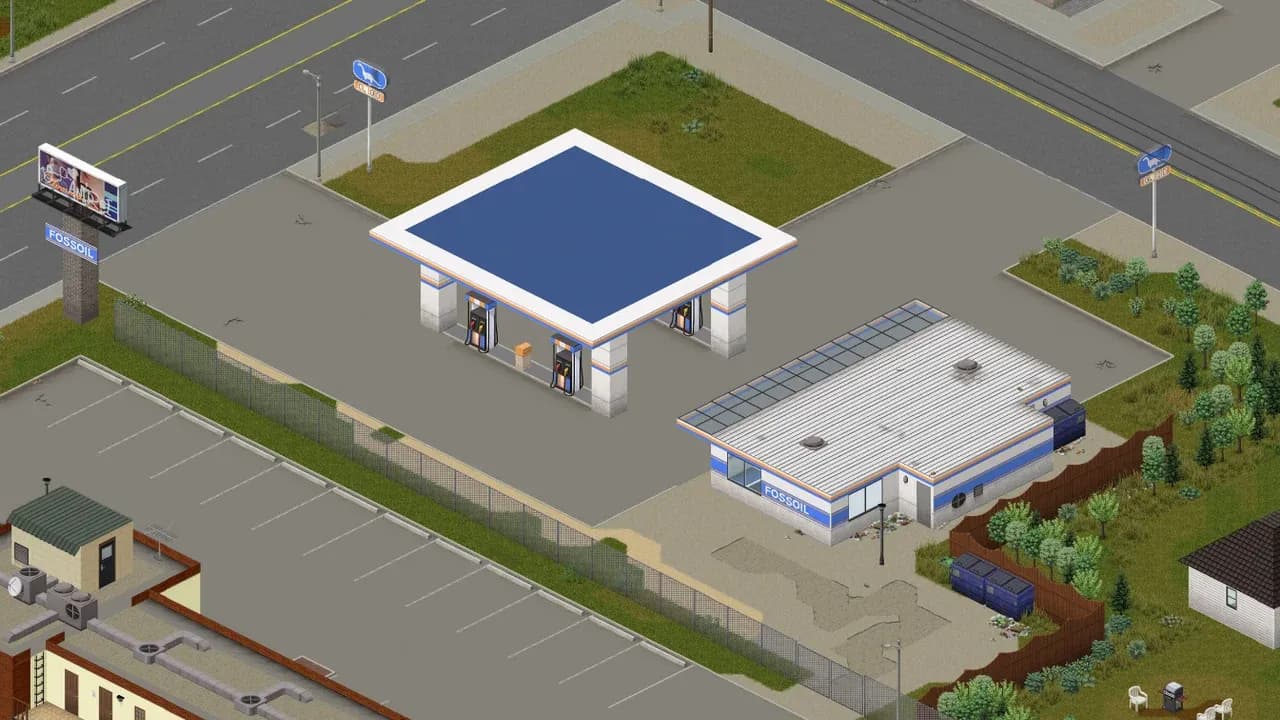
A gas station is not a fuel source. It is a fuel multiplier, and a multiplier needs something to multiply — the generator you bring has to arrive already fuelled, out of gasoline you pulled from parked cars. That much most survivors work out on the first failed trip. What they carry on getting wrong is everything after it: they ration the generator as though running it were the expensive part, when the fuel it burns at a forecourt is a rounding error, and they walk away from stations that still had fuel in them because they tested one tile out of eight.
The Trip Fails Before You Leave
Two things can sink this run while you are still at home, and both are silent.
The first is your character sheet. Connecting a generator needs Electrical level 3, the Electrician or Engineer occupation, or a read copy of the magazine How to Use Generators. Without one of those three you can carry a generator to a station, set it down, fill it, and never get the option to connect it. The magazine is ordinary loot and does not announce itself, so this is worth confirming before you plan a route around it.
The second is the tank. A generator holds 10 litres and a Gas Can holds exactly 10 litres, so one full can fills an empty generator completely — a Jerry Can holds 20 and fills it twice. You can only add fuel while the generator is switched off, and there is no option to siphon fuel back out. That one-way valve is a convenience rather than a trap: fuel stays in the tank when you pick the machine up and carry it, so you fuel it at home on your own schedule and it arrives ready.
Getting that first 10 litres means siphoning cars, and Build 42 wants a Rubber Hose for it plus a container that is either empty or already holds petrol with room left — a half-full can keeps taking fuel until it hits 10. The hose is only for pulling fuel out of a vehicle. Filling a can at a powered pump, pouring a can into a car, and adding fuel to a generator all work without one, which is why a hose belongs permanently in the car you loot from.
Ignore any guide that tells you a full Gas Can fills 8% of a generator. That figure comes from a retired model where a can was 8 units and a generator was 100. Build 42 measures both in litres, and one can is the whole tank.
Powering the Pumps Is Almost Free
Here is the arithmetic nobody does. A generator idling with nothing attached burns 0.002 L/h. A gas pump draws 0.003 L/h per tile, and a pump is two tiles wide, so one working pump adds 0.006 L/h. One pump on a generator is 0.008 L/h — less than the 0.009 L/h a single stove costs you back at base.
A full 10-litre tank divided by 0.008 gives 1,250 in-game hours, or about fifty-two days of continuous running. Switch on a four-pump forecourt instead, which is eight tiles, and you are at 0.026 L/h: two kitchen fridge-freezers' worth of draw, and still sixteen days on one fill. You will not be standing there for sixteen days.
Fuel remaining divided by power demand gives runtime in in-game hours, and right-clicking the generator to open Generator Info gives you the demand figure for everything currently in range.
So rationing is the wrong instinct. Do not power one pump, fill two cans, and shut down to be careful — that caution saves you fractions of a litre and costs you a second trip. Power everything the placement reaches and take the station in one sitting, because what you are actually spending at a gas station is time on an open forecourt and the noise that time buys.
Half a Pump Can Be Dry
Build 42 lets pumps spawn empty, marked with an out-of-gas sign propped beside them. That much is easy to read. What catches people is that emptiness resolves per tile, and a pump is two tiles: one half can be bone dry while the other half is full, and a pump can be empty with no sign beside it at all.
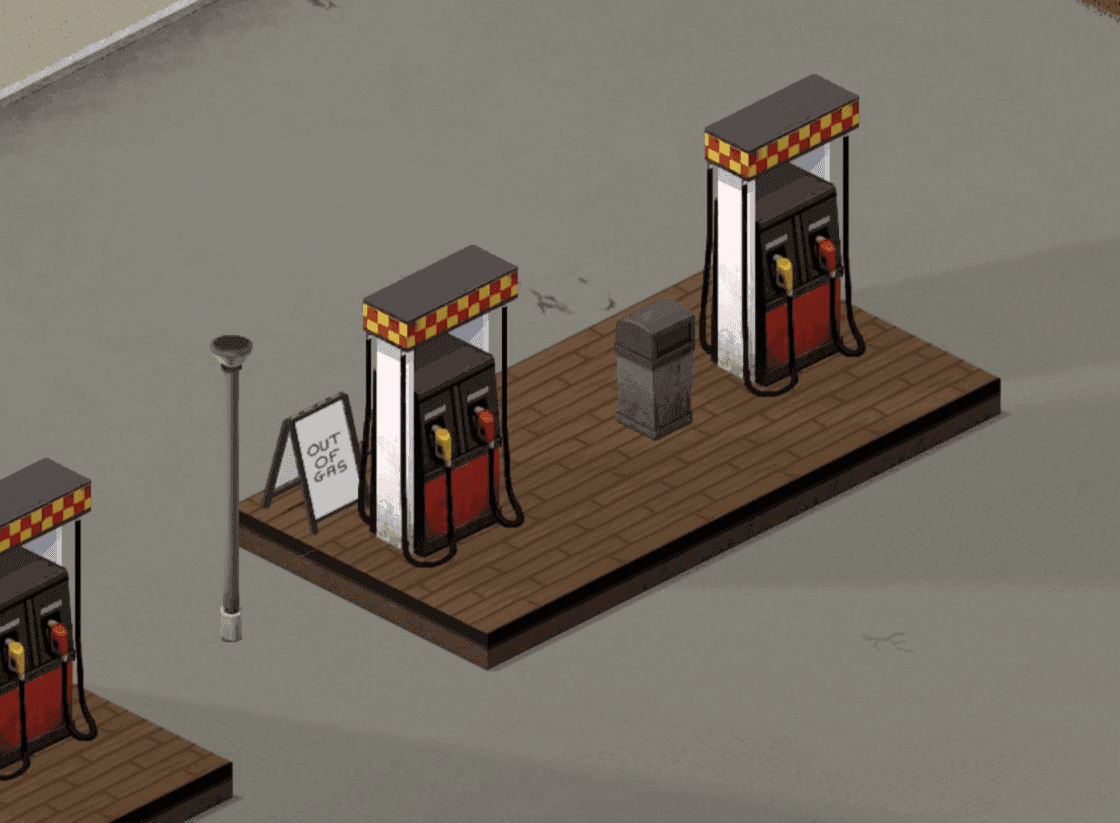
The sign marks a dry pump, but emptiness is resolved per tile, so an unmarked pump beside it can still be half dry.
So a survivor tries the pump in front of them, gets nothing, and writes off the station — a verdict drawn from one of the eight tiles on a four-pump forecourt. Try both halves of every pump before you decide a location is spent.
The amount rarely matters once you find a live tile. With the Initial Gas Station Amount option at its default — Normal, which is what Apocalypse, Builder and Six Months Later all run — a single pump holds between 1,000 and 14,000 litres. Even the low roll is a hundred Gas Cans, far past anything you can carry away in a visit. The question at a gas pump is therefore binary. Not how much is in this one, but is this tile empty or not.
The flip side is real and no generator repairs it. Power operates a pump; it does not put fuel in the ground beneath it. A single-pump station that rolled dry at world generation is dead on arrival, and the hour you spent hauling a generator there is gone. That is the case for picking your target by pump count rather than by distance — and pump count is something you can see from the road, because the stations worth the carry are the ones with two separate pump islands rather than one.
Put It on the Forecourt, Never in the Store
The setting that makes any of this work is Generator Working In Exterior, and it is on by default. It is what lets a generator power a pump rather than only the building it stands in, and it also means you never have a reason to take the machine indoors.
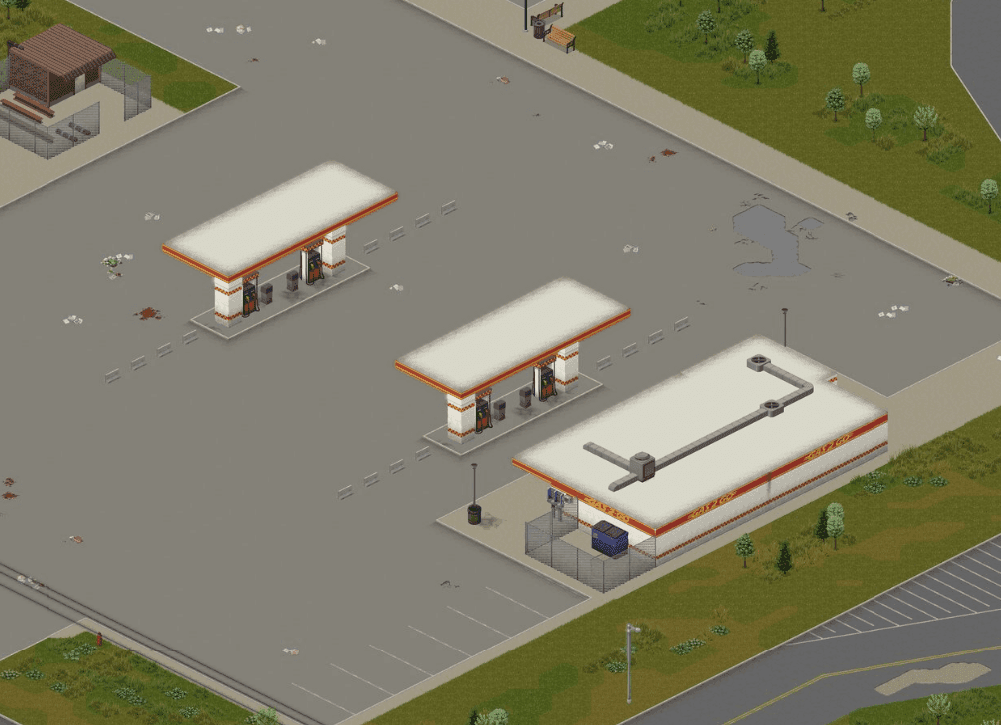
One generator on the forecourt reaches 20 tiles in every direction, enough for both pump islands without ever going inside the store.
Take that seriously, because the instinct runs the other way. The convenience store is right there, out of the rain and out of sight, and tucking the generator inside feels tidy. Exhaust from a generator running in a structure you occupy drives your health down to 1 very quickly. It does not kill you outright — it leaves you at one point of health, which means the next scratch on the way out does. Stepping outside stops the damage, but the building stays lethal until the generator itself is switched off, so a character who ducks back in for the shelves is finished.
Outside, the coverage is generous: 20 tiles horizontally, three floors up and three down. On most station layouts a single placement in the middle of the forecourt reaches every pump island and the shop, which is the whole reason one visit can clear a station.
Pick a Generator for Its Noise, Not Its Power
All four generators power an identical area — a 20-tile radius, regardless of model. There is no such thing as a stronger generator, so the choice is entirely about what the machine costs you while it runs.
Noise is the first axis, and gas stations already draw heavy zombie populations. Lectro-Max and Premium Technologies carry 20 tiles, ValuTech 23, and the Old generator 25.
Durability is the second, and it decides whether the machine survives being used. Premium Technologies rates 36, Lectro-Max 30, the Old generator 25, and ValuTech 24. Below 20% condition a generator can catch fire or explode, and you have chosen to stand this one beside several thousand litres of gasoline.
Weight is the third. Every model encumbers you by 40 except ValuTech, which is 30.
Read across those and the ranking is not the obvious one. Premium Technologies wins outright: it is tied with Lectro-Max for the quietest at 20 tiles and beats it on durability, 36 to 30, at the same 40 encumbrance — there is no reason to prefer a Lectro-Max if a Premium is available. ValuTech is the interesting trade, buying you 10 points of encumbrance on a walk where you cannot fight, at the price of three extra tiles of noise and the worst durability in the game. Carry Electronics Scrap either way; one piece repairs 4% plus half a percent per level of Electrical.
Leave the Generator Where It Works
When the cans are full, the reflex is to pick the generator up and take it home. For any station you mean to visit again, don't.
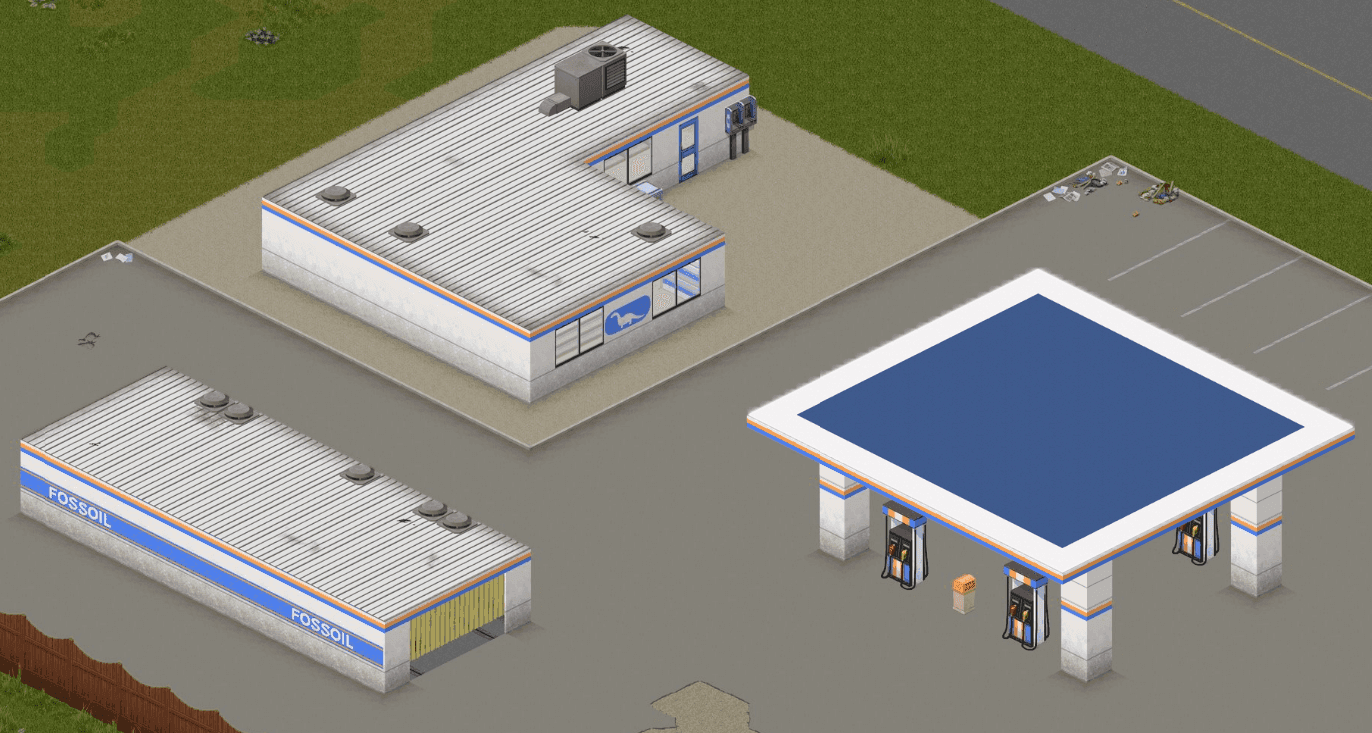
A station you will come back to. Leaving the generator connected turns the return trip into switch on, fill, switch off.
Carrying a generator is the most exposed you will be all trip. It never enters your inventory — you carry it in your hands, which means 40 points of encumbrance, no attacking, and a machine that drops on the spot the instant you select a weapon. That is the walk you are volunteering to repeat, in both directions, every time you come back.
A generator you switch off costs nothing to leave. The fuel stays in the tank, the connection stays made, and nothing in the world comes along to break it. So the second visit is arrive, switch on, fill, switch off, leave — the whole trip reduced to the part that was ever worth doing.
The station generator stops being equipment the moment you set it down and becomes part of the station, like the pumps it powers. The only one you carry home is the generator at a station you have just emptied and have no reason to see again.