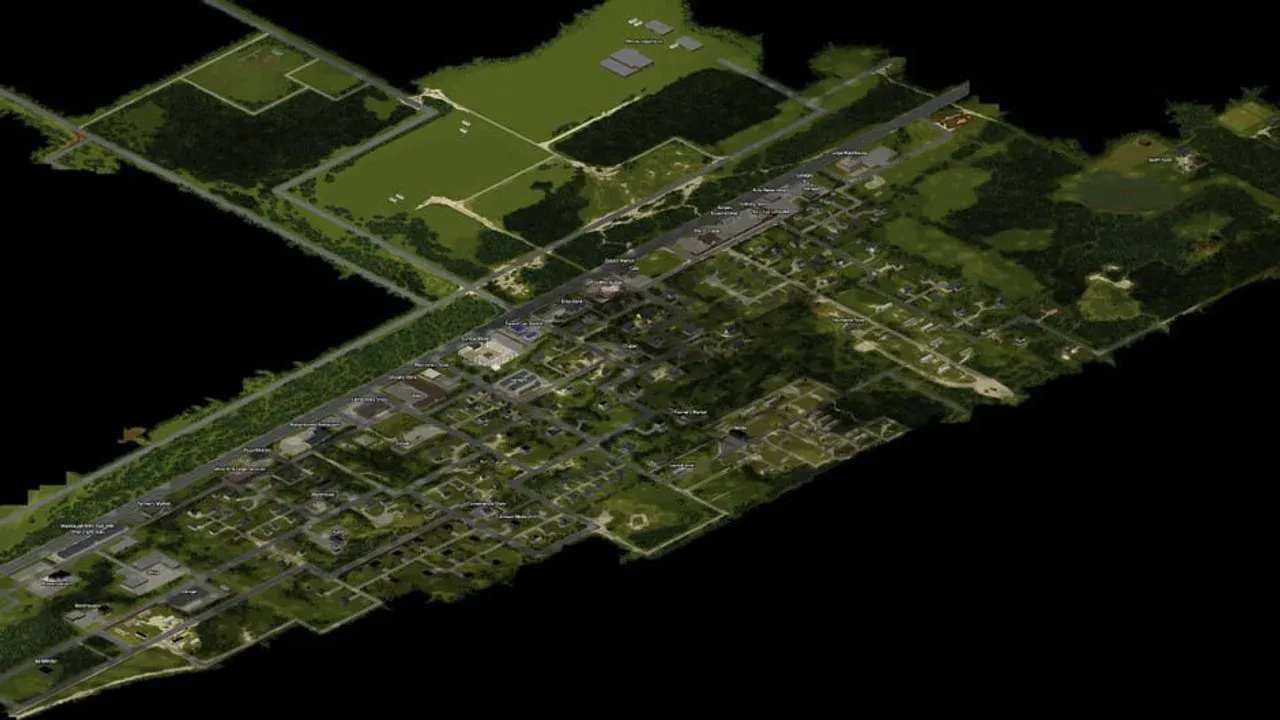
Carrying a generator home is not a hard version of carrying loot home. It is a different activity, and the numbers say so plainly: the highest carry capacity any character can reach is 20 units, and a generator weighs 40. No Strength score, no trait and no empty backpack lets a survivor pick one up and still be able to run. So this is not a loot problem you solve when the fridge stops humming. It is a transport problem with a floor written into your world's preset file, and Build 42 sharpened it by handing out more generators while making them harder to move.
Your Deadline Is Already in the Preset File
All four Build 42 presets — Apocalypse, Outbreak, Extinction and Rising — ship with ElecShutModifier = 14 in their 42.20 preset files. That integer is a floor, not a roll, and it is identical across all four. Nothing in a stock world can cut the power before day 14.
What differs is the range stacked on top of it, held in ElecShut: 2 on Apocalypse and Extinction, which the sandbox screen labels 0–30 days, and 3 on Outbreak and Rising, labelled 0–2 months. Apocalypse therefore gives you a fortnight guaranteed and up to six weeks if the roll is kind — and no way to tell which you got by looking.
There is a way to tell by listening. The Automated Emergency Broadcast System reports the power grid's stage at the top of every in-game hour, so a character who has found its frequency gets the blackout announced in advance instead of discovered. That single detail converts an unknown deadline into a countdown, which is worth more than any individual piece of loot in the first two weeks.
Two weeks sounds generous until you count what has to fit inside it. You need the generator. You need the means to connect it — Electrical level 3, the Electrician or Engineer occupation, or a copy of How to Use Generators. You need fuel. And you need to physically move the thing from wherever it spawned to wherever you sleep. Three of those are searches; the fourth is the one that kills people.
Build 42 Spawns More Generators — Unless You Picked Extinction
GeneratorSpawning is an integer from 1 to 5, mapping onto the sandbox screen's Extremely Rare, Rare, Sometimes, Often and Very Often. Build 42 ships it at 4 on Apocalypse, 5 on Outbreak, 4 on Rising and 2 on Extinction.
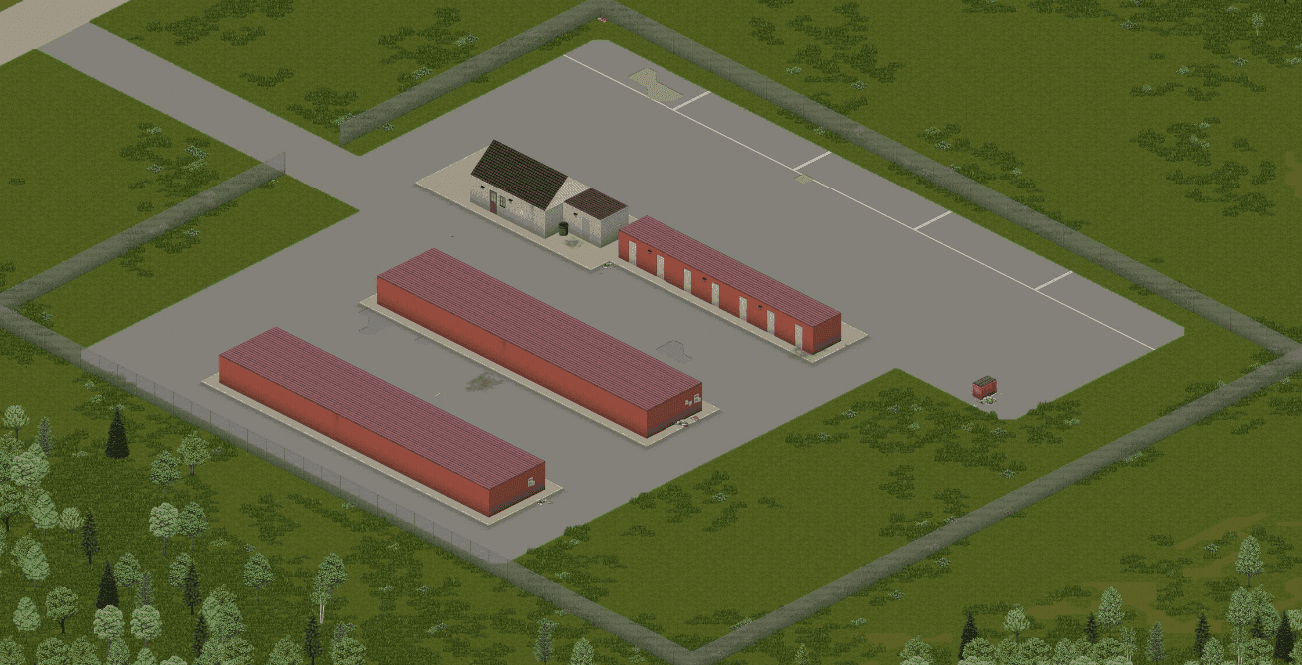
Storage lots put a block of high-variance containers directly onto tarmac — the haul is solved before the looting starts.
Build 41's Apocalypse sat at Sometimes, so the current default apocalypse is a full step more generous and Outbreak is the most generous setting in the game. Extinction is the outlier the other way: at GeneratorSpawning = 2 it is the only stock preset where generators are genuinely scarce, and it is also the preset that repeats the helicopter event rather than firing it once — so it punishes the long searches it forces on you.
Generators concentrate in warehouses, garages, tool sheds and self storage. Those are room types, not building names, which is why a suburban house with a detached garage can produce one and the hardware store next door cannot. The underlying room definitions are shed, garagestorage and storageunit, though that list has not been re-checked since 41.78.16 — treat it as where to look first, not as a complete specification.
Self storage is the best of those four, and not because the units hold more. The lot-style sites are rows of individual garage doors facing an open parking area, and those doors cannot be dismantled — you need keys or brute force. Keys turn up on zombies near the premises, and one key usually opens every unit on the site. So a storage lot gives you a dense block of high-variance containers, all opening directly onto tarmac, with room to reverse a van up to the door. The haul is solved before you start looting, which is the opposite of how every other generator site works.
While you are in there, take every electronics magazine you see. How to Use Generators is a separate loot roll from the generator itself, and finding the machine without the manual — with no Electrical 3 and no Electrician start — leaves you with 40 units of dead weight in your trunk.
Guaranteed Spawns Are Only Worth What the Drive Costs
Beyond the room-type rolls, a handful of places always have a generator. Two of them sit at opposite ends of the same lesson.
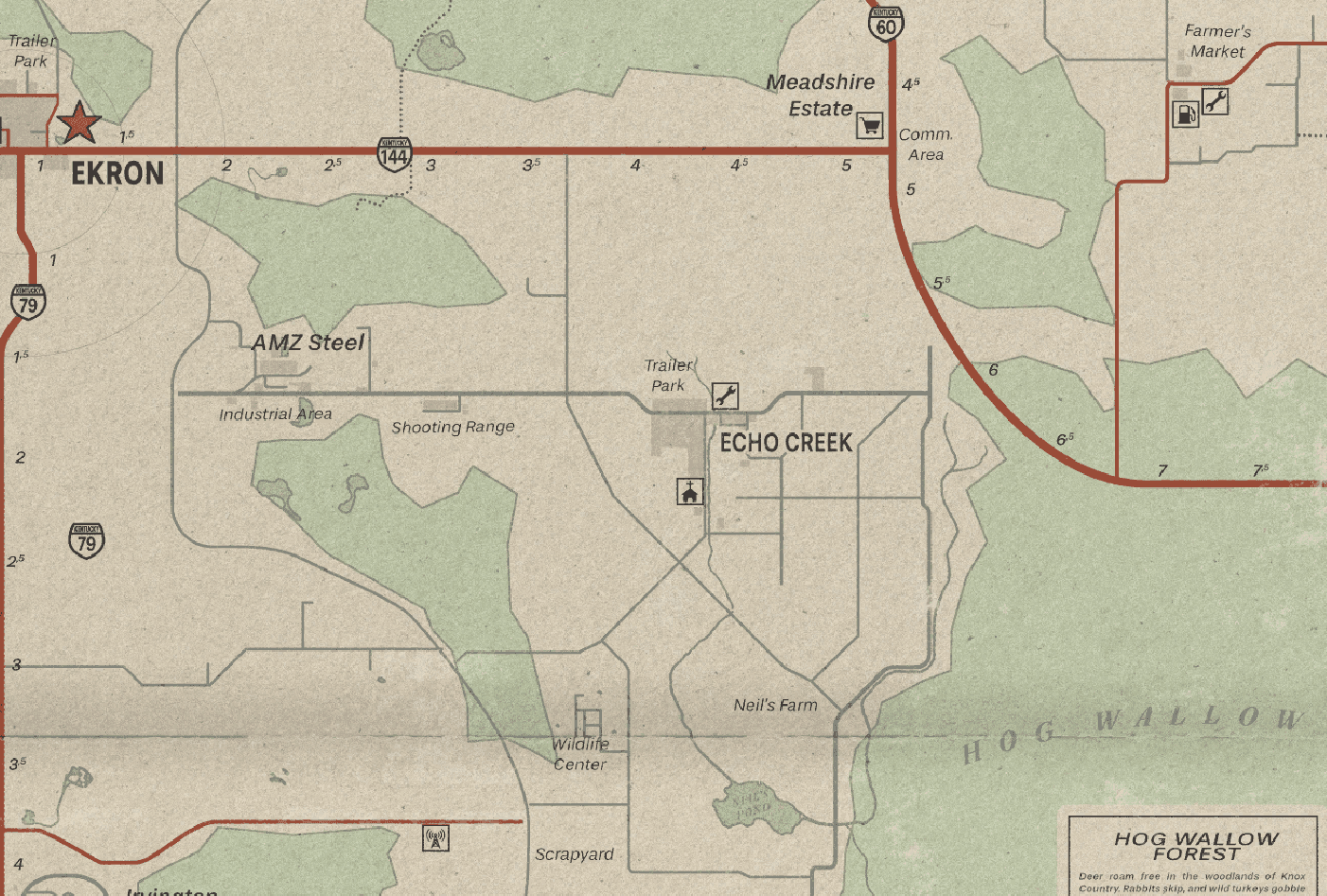
Echo Creek sits on a road, which is the only statistic that matters when the cargo weighs 40.
The Echo Creek festival is the good one. West of the town's main street lie the remains of an outdoor event, and it is guaranteed to contain a generator. Echo Creek itself is small, rural and quieter than Muldraugh, with roads running straight in off Kentucky 60, so you can park within a few tiles of the pickup. Its weakness is that it guarantees no strong melee weapons and refills through migration from surrounding cells faster than its size suggests, so arrive already armed and do not linger. Measured in metres between the generator and your tailgate — which is the only measure that counts — the Echo Creek festival is the cheapest guaranteed spawn in the game.
The Doe Valley bunker is the one to skip, and the reason has nothing to do with what is inside it. The bunker sits in woods west of Fallas Lake, near the Jamieton Army Surplus, with no road to it. You are not driving a generator out of there, and a generator you cannot drive out is not a generator you own. Sources disagree about both its exact coordinates and whether the promised generator is actually down there — that dispute is real and unresolved, and it changes nothing, because the walk out is disqualifying either way. Doe Valley is a region you import into rather than loot: its own entry lists a generator among the things you have to bring with you.
The Louisville Border Camp Has Five, and Wants Them All Back
The Louisville border camp is the richest generator site on the map and the one most likely to kill you. Five separate units are documented across it:
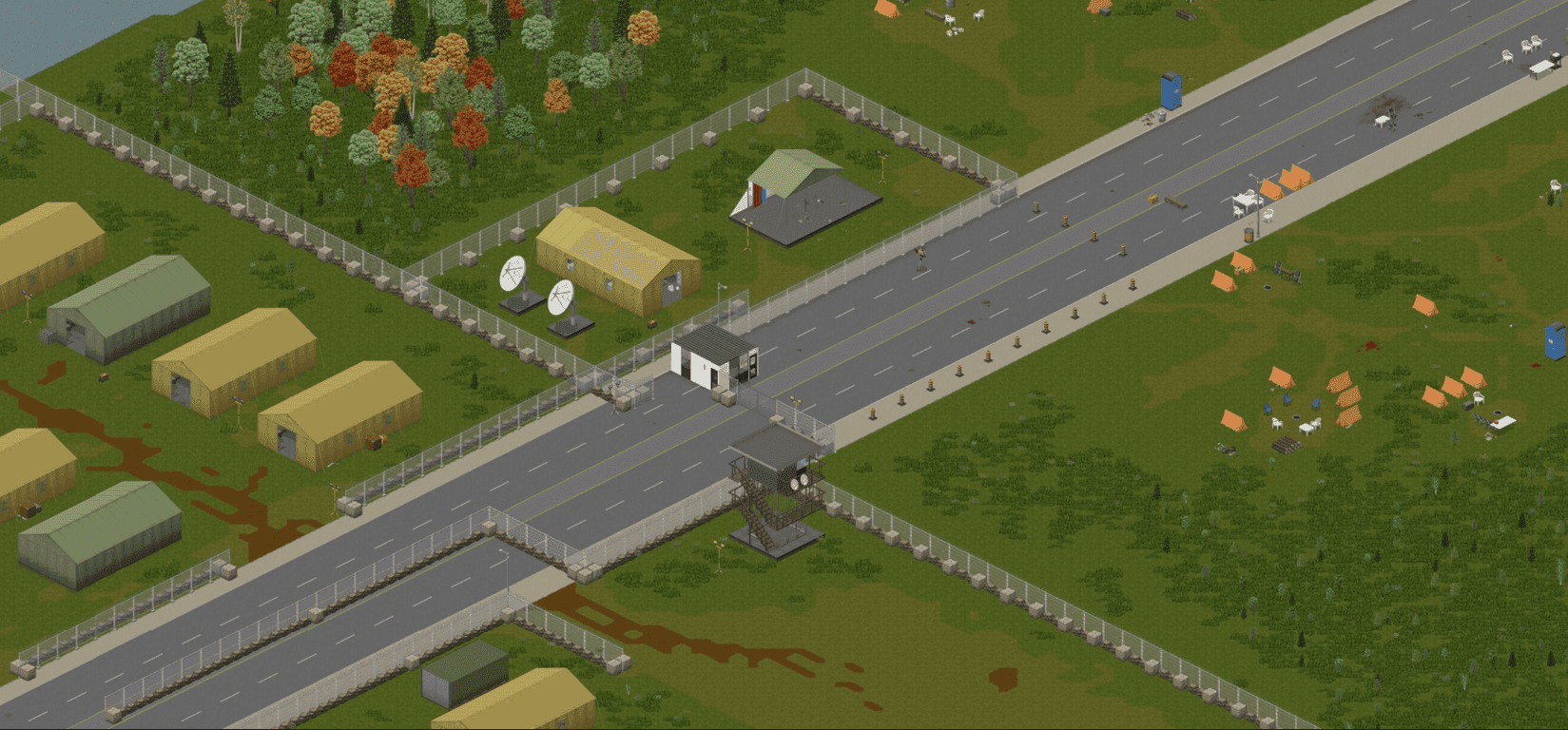
Five generators sit inside the Louisville border camp, behind fencing that admits a person but not a vehicle.
- Beside the medical tent, south-east of the army checkpoint
- On the West barracks
- At the kitchen tent
- In the refugee area, next to the burger store
- At the LBMW radio shack, at the far north end of the camp
The problem is not the zombies in the abstract — it is the geometry. The main route through the Louisville border camp is fenced and gated in a way you cannot simply open. The way in is a breach on the eastern side, reached by approaching from the south, turning east through the train yard and following the fence line to the gap. That gap admits a person and not a vehicle, unless you spend time and noise clearing trees with an axe.
Read that back against the encumbrance numbers and the camp stops looking like five generators. It is five objects that each have to be walked out on foot, at the slowest movement state in the game, by a character who cannot swing a weapon, through a hole in a fence, past the heaviest zombie concentration in Knox Country. For weapons and armour the camp has a well-known substitute: Louisville's army surplus store carries the same equipment at far lower risk. Generators have no such substitute, which is exactly why people keep walking into the wire. If you go, go with a van already parked on the highway outside, a corridor cleared to the breach, and the acceptance that you are making one trip and not five.
Forty Encumbrance Is a State, Not an Inventory Slot
A generator never enters your inventory. You pick it up and you are carrying it, in both hands, and three things follow.
You cannot attack while holding one. Selecting a weapon does not merely interrupt you — the generator is set down on the tile you are standing on, so the reflex that saves you from a lone zombie is also the reflex that dumps your cargo wherever you panicked.
And you are over capacity, always. Carry capacity runs from 6 at Strength 0 to 20 at Strength 10. A generator is 40 units on every model except the ValuTech, which is 30. Even a maxed-Strength survivor carrying nothing else is at 200% of capacity the instant they lift a standard generator, past the 175% threshold for Extremely Heavy Load:
- Walking speed down 75%; running and sprinting already disabled below this tier
- Attack speed down 28%, critical chance down 20%
- Endurance recovery stopped entirely, and endurance draining while you move
- Continuous damage until health reaches 75% of maximum
At the default Strength 5 you are past three times capacity. The lightest case in the game — a ValuTech, at Strength 10, with an empty inventory — is 150%, which is Very Heavy Load and still disables running. Every plan that walks a generator further than a car park is a plan that has not been costed.
The Trunk Is the Part of the Car That Decides This
At full condition almost anything on the road will take a generator, so the figure that matters is not the biggest trunk but the margin above 40.
| Trunk capacity | Vehicles |
|---|---|
| 160 | Chevalier Step Van |
| 130 | Ambulance, Dash Bulldriver, Franklin Valuline, LBMW Radio Van |
| 110 | Chevalier D6 |
| 85 | Franklin All-Terrain |
| 60 | Chevalier Cerise Wagon |
| 55 | Chevalier Nyala |
| 50 | Franklin Valuline (6-seater) |
| 45 | Chevalier Primani, Dash Elite, Mercia Lang 4000 |
| 40 | Chevalier Dart, Dash Rancher, Masterson Horizon |
| 30 | Chevalier Cossette |
| 20 | Race Car |
Only the Cossette and the Race Car fail outright. Everything else clears 40 — while undamaged, which is the catch, because trunk condition scales capacity down proportionally. A damaged trunk does not spill what is already inside it; it stops accepting anything new, and can end up rated below the load it is currently carrying. A trunk you have reversed into things all week is not the trunk in that table.
Three consequences, and all of them are settled before you leave:
- A trunk rated exactly 40 has no margin at all. A Chevalier Dart, Dash Rancher or Masterson Horizon with any trunk damage will refuse the generator you just walked out of a storage unit. A Step Van still clears 40 at a quarter of its original condition, which is the real argument for taking the slow vehicle.
- Trunk repair is a base job, not a roadside one. A metal sheet restores 61% and a small metal sheet 25%, but both need a propane torch, Welding 3 and Mechanics 2. Read the condition in the mechanics screen at home, not in a car park in Louisville.
- Organized pays for itself here, if you took it. The trait gives 130% container capacity, vehicles included, turning a 40-unit trunk into 52 and absorbing about a fifth of accumulated damage before it starts to matter.
Then load it from outside. Open the trunk while you are still standing next to the car, drag the generator in, and get in afterwards. Climbing into the seat while carrying it sets it back down on the ground — which, at the end of a generator run, is the last place you want to be standing still.
One more errand belongs on the same trip. Fill every gas can you own while the pumps are still on the grid, because after the shutoff a pump only runs off a generator parked on the forecourt, and the generator you are hauling home cannot be in two places at once.