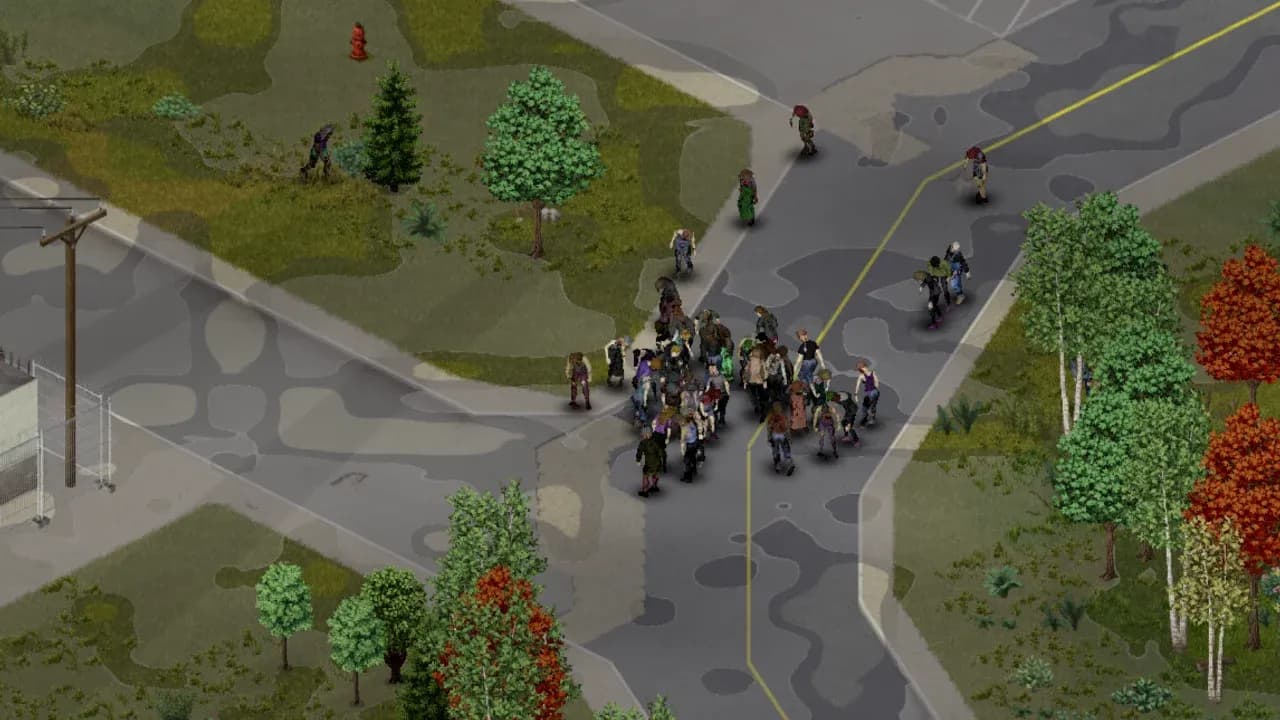
Every other crowd in Project Zomboid is a noise problem, and noise problems have noise answers. Drop a noise maker across the street, honk a horn, leave an engine idling by the treeline — the dead walk toward the sound and you walk somewhere else. The helicopter takes that entire toolkit away, because the sound it makes is not a place on the map. It is bolted to your character, it is louder than anything you are capable of producing, and it goes where you go. There is no decoy to throw. You are the decoy.
On a default Build 42 Apocalypse world the helicopter event happens exactly once in the entire life of that save, on some day between the sixth and the ninth. Everything that determines how badly it goes is settled before the rotors are audible, and the decision is not tactical. It is a question of where your body is standing between 9 AM and 6 PM, and whether you put it there on purpose.
That schedule is a setting rather than a law. In Sandbox, under the Sadistic AI Director group, the Helicopter option offers Never, Once, Sometimes and Often: Apocalypse and Outbreak ship it on Once, Rising switches it off, and Extinction brings it back roughly every ten to fifteen days after the first. Turn that dial up and you are not making one day harder — you are making everything below a recurring tax.
The Warning Comes at 7 AM, at the Very End of the Broadcast
The Automated Emergency Broadcast System announces the event on the morning it happens, and the line updates at 7 AM. The helicopter cannot arrive before 9 AM, so anyone listening at the top of the hour has at least two hours.
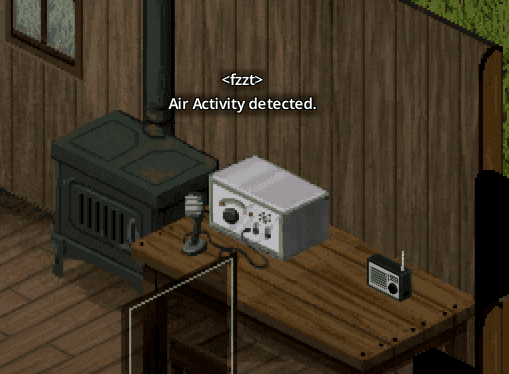
The line arrives at the very end of the hourly report, seconds after the weather forecast finishes.
Most players never hear it, and the reason is structural. The AEBS runs a fixed script every hour — station identifier, the state of the Knox power grid, then a full weather block covering today and tomorrow, then any extreme weather two to five days out. Air Activity detected comes after all of it. The natural moment to switch off is when the forecast ends, which is a few seconds before the only line you were listening for.
The fastest way to find the station is to stop scanning for it. Every police car and ambulance in Knox County has the AEBS saved as a radio preset, and a vehicle radio runs off the car battery without the key. One wreck gives you the number for the rest of that world's life. Searching manually also works — you start at 88.0 MHz and step up by 0.2 — but the AEBS never occupies a frequency another station is using, so it is hiding among 95 candidates and you will spend a morning finding it.
You Cannot Out-Shout It, So Stop Trying
Project Zomboid scores sounds numerically, and the helicopter sits at 500. That figure only means something against the rest of the scale:
| Sound | Value |
|---|---|
| Helicopter | 500 |
| Vehicle, running or idle | 55–220 |
| Firearm | 30–200 |
| Vehicle horn or car alarm | 150 |
| Sneezing or coughing, unmuffled | 40 |
| Shouting | 30, tripled with a megaphone |
| Noise maker | 17 |
| Alarm clock | 15 |
| Sprinting | 14 |
The noise maker is the item the game hands you specifically for pulling a crowd off a target, and it reaches 17 tiles for thirty in-game minutes — about one twenty-ninth of the helicopter's radius. The loudest things you can deliberately produce, a fired rifle or a badly muffled engine, peak at 200 and 220 and are over in seconds. Nothing in your inventory is in the same argument.
There is a second axis that kills the last clever idea. The engine tracks a sound's radius, its raw carrying distance, separately from its volume, how strongly it pulls a zombie that hears it. For most sounds the two numbers are identical, which is why the table above reads as a single scale — but not always. A police lightbar siren carries 100 tiles at a volume of only 60, which is why a zombie will sometimes ignore a wailing squad car and shamble after the survivor who coughed at 40. The helicopter is 500 on both axes. It is not just the loudest thing in the county; it is also the most interesting.
One sound does beat it, and you cannot schedule it: a burglar alarm runs at 600 for twenty in-game minutes. Alarms are fitted to about one house in ten, they fire once per building, and you find out which houses have them by breaking in. That is a way to lose an afternoon, not a way to plan around a date you already know.
For one day, then, the decoy layer of this game is switched off. What is left is where you stand.
Hiding Works, But Only If You Are Never Seen
The two outcomes are not close. Undetected, the helicopter spends up to an hour drifting around your general area and then goes. Spotted, it parks directly over your head for sixty real seconds first.
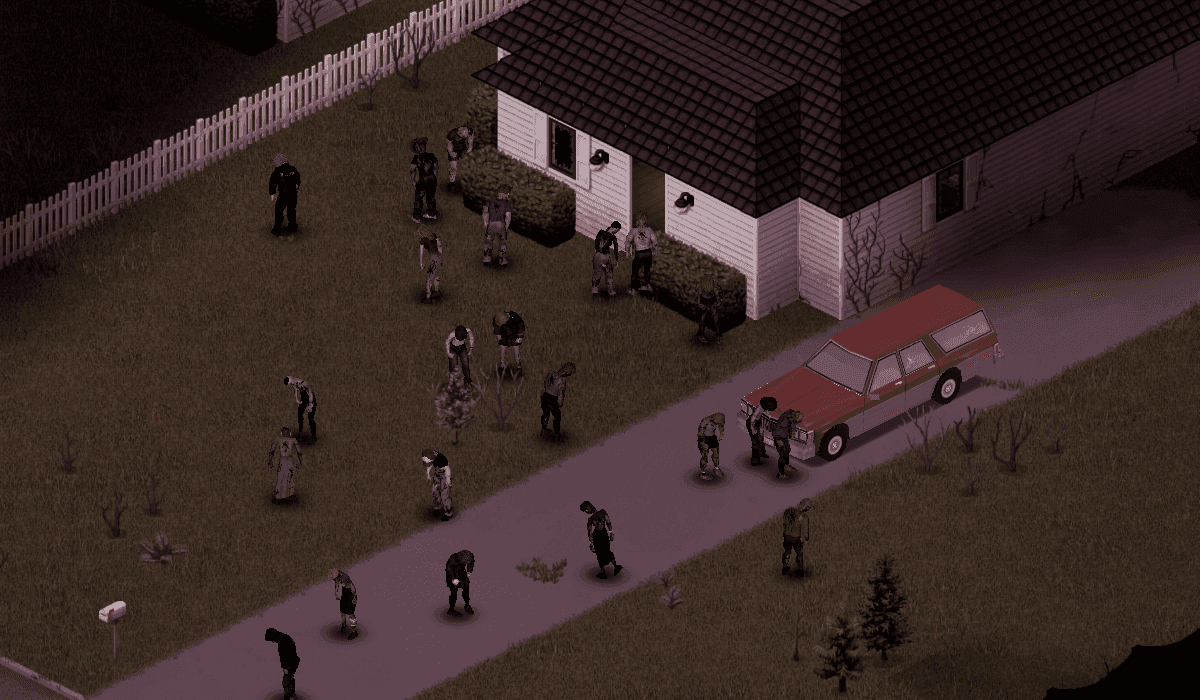
Undetected or not, the migration still arrives — and it walks through whatever is in the way.
Sixty seconds sounds survivable until you notice the word "real". That timer runs on wall-clock time regardless of game speed, so holding fast-forward to get it over with does not shorten it — it simply buys the approaching crowd many more in-game minutes of walking while a 500-volume beacon sits on your roof. If you are spotted, drop back to normal speed, get indoors and out of sight immediately so the counter can start, and then do not open a door again that day. The noise is already spent; what you are protecting now is the information about where you live.
Staying unseen in the first place is a checklist, and it has to be finished before nine:
- A full day of food and water already inside the building. Stepping out to the rain barrel at noon is the single most common way this goes wrong.
- Sheets or curtains over every window, and the lights off.
- Something to do. Skill books, a VHS and a working TV, or the Automated Emergency Broadcast System itself, which suppresses the boredom moodle while the text plays. Boredom and unhappiness are what talk a player into "just one quick trip outside".
- Ideally a basement. Build 42 seeded procedural basements across the map, and a floor below ground is the strongest version of indoors the game has.
Plan for the whole day rather than the first hour. Air Activity detected names the day, not the hour, and one occurrence is not the same as one pass — the helicopter can return to an area after leaving it. Sit out the daylight instead of trying to time a gap.
Two things hiding does not buy you. It stops the helicopter finding you; it does not stop the migration, and ground you had painstakingly cleared is not cleared any more. And zombies take the most direct route available to a sound, with no regard for whether that route runs through your walls. A crowd converging on a helicopter hovering near your safehouse walks into the safehouse. Barricades and a second exit are part of this preparation, not a separate project.
Driving Away Is a Geography Play You Have to Be Able to Afford
Leaving is the stronger option and most players cannot take it. The event fires between days six and nine; a repaired, fuelled, tyre-checked car by day seven of an Apocalypse start is a good run, not a normal one. If you do not have one, hide. That is not the consolation prize — it is the correct play, and it works.
If you do have one, the logic is worth understanding, because it is the opposite of escape. You will be spotted. You are meant to be spotted. The helicopter follows the player, so the crowd assembles wherever the player is — and that means you get to nominate the ground.
Three things decide whether it works:
- Leave before nine, loaded with a day of food and water, in a vehicle whose engine and tyres you have actually checked and whose tank is full.
- Keep moving slowly, far from anything you own, all day. Coming home at two in the afternoon means running the event twice, the second time on your own doorstep.
- Take a different road back. The fields and treelines you drove out through are now holding the zombies you led there.
The payoff is that this does not merely avoid damage, it exports it. Every zombie loitering in the woodlot behind your base spends the day walking toward a noise in the middle of nowhere, which leaves you a cleared perimeter and a crowd standing in open ground where a car can deal with it. Weigh that against the failure modes, which are all logistical rather than dramatic: a breakdown far from home, a tank you misjudged, and a return leg driven in the dark.
The Bill Arrives When You Get Home
Whichever way you played it, the population around you has changed permanently.
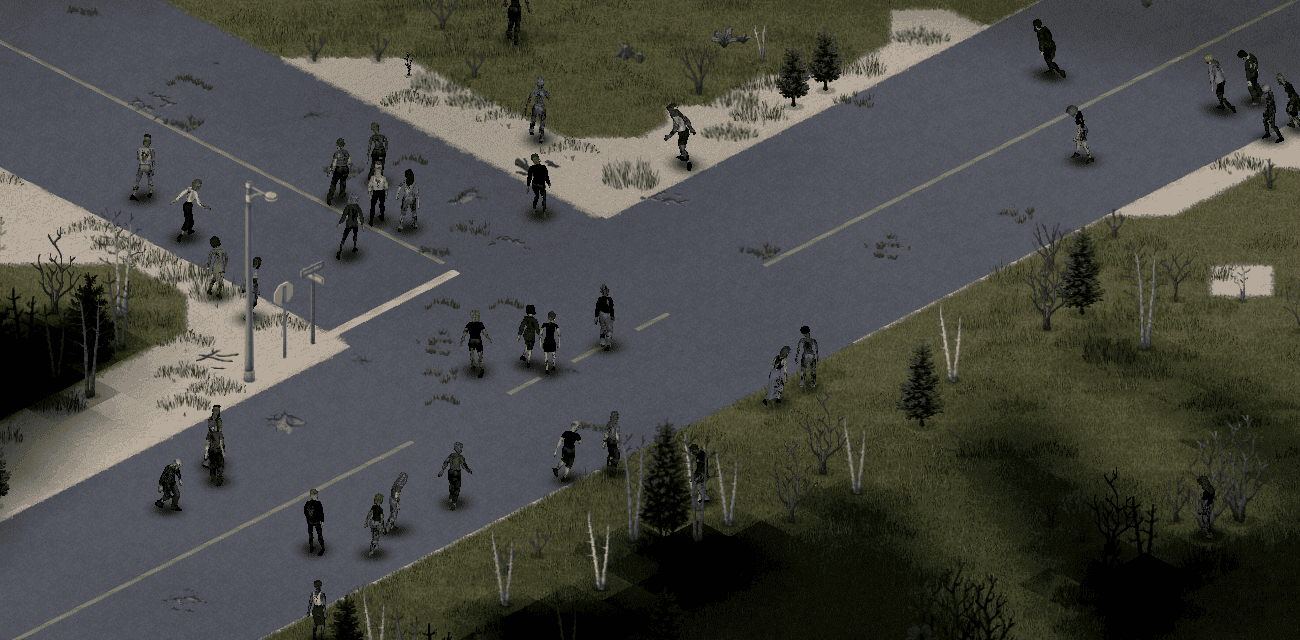
Migration reshuffles whatever survives the event around the same cell every twelve hours.
The Apocalypse preset ships with zombie respawn switched off entirely and migration switched on, redistributing zombies within their own cell on a twelve-hour tick. Nothing that walked into your neighbourhood walks back out because the noise stopped, and nothing new spawns to replace what you kill. The crowd the helicopter delivered is now the standing population of that area until you personally reduce it. That cuts both ways — it is a large, unwelcome job, and it is a job that stays done.
So treat the return as its own operation. Park short of the base rather than driving up to it, because a running engine can reach 220 and you are about to teach a fresh audience exactly where you sleep. Walk the perimeter before you open anything. Fight at a chokepoint you built earlier — a fence line, a stairwell, a doorway — and do not open with a firearm, which at up to 200 recalls the half of the crowd that had already wandered off.
Then finish it in one campaign rather than chipping at it. That twelve-hour migration tick keeps shuffling whatever survives around the cell, so a horde you half-clear this week is a horde you meet again next week, in a street you were not expecting.