Understanding Armor and Damage Reduction in Counter-Strike 2
That first shot lands, your screen shakes violently, and you're dead before you can react. In Counter-Strike 2, understanding what just happened—and how to prevent it—is the difference between a frustrating death and a clutch win. It all comes down to armor and damage reduction, two core mechanics that silently shape every single gunfight you take.
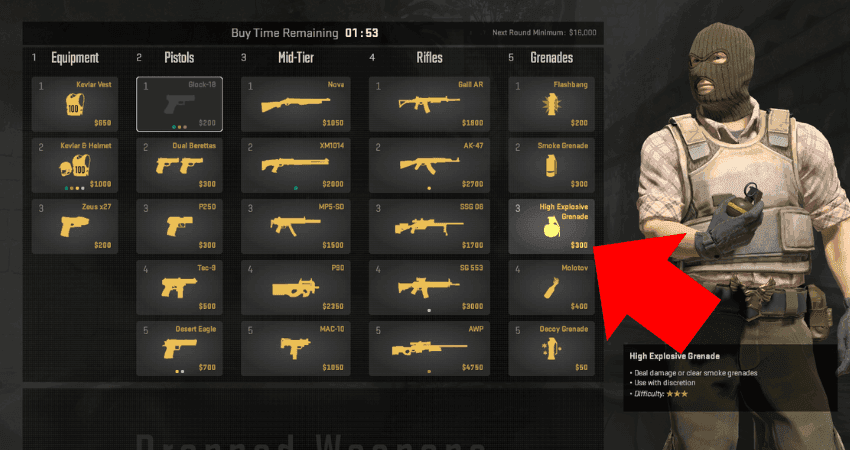
Armor and helmet protection values in Counter-Strike 2.
Let's break down how damage works. Your shots don't deal the same damage everywhere. Counter-Strike 2 uses specific damage multipliers based on where you hit your opponent. A headshot deals a punishing 400% of a weapon's base damage, while shots to the abdomen deal 125%. Shots to the torso or arms deal the standard 100%, and hits to the lower body only deal 75%. This is why aiming for the head is so critical; it’s the fastest way to secure a kill.
Your Kevlar armor is your primary defense against this damage, but it doesn't cover everything. The vest protects your Torso, Stomach, and Arms. Notice what’s missing? Your Legs and Head are completely unprotected by the basic vest. That’s where the helmet comes in for headshots, but your legs will always take full damage from any shot that lands there. This is why skilled players will sometimes "leg" an opponent—firing at the unprotected lower body can be a viable tactic with certain weapons.
⚠️ Watch out: The lower body damage multiplier is not affected by body armor penetration at all. If you're hitting legs, you're doing the same damage whether your target is naked or fully armored.
But armor does more than just soak up bullets. Its most underrated benefit is aim punch reduction. When you're shot without armor, your crosshair kicks wildly—this is aim punch. Wearing armor reduces this crosshair recoil by a massive 95%. In practice, this means firing back while being hit is 20x more stable with armor than without it. This isn't just about surviving more bullets; it's about being able to accurately return fire under pressure, turning potential panic sprays into controlled, winning duels.
Finally, you need to understand armor penetration. Not all weapons chew through armor equally. Each gun has a penetration stat that determines how much of its damage bypasses armor. Take the AK-47: it has a base damage of 36 and an armor penetration of 77.5%. A shot to an unarmored chest deals the full 36 damage. Against an armored opponent, that same shot deals approximately 28 damage (77.5% of 36). This is why it takes four AK-47 chest shots to kill an armored target, versus just three on an unarmored one. Knowing which of your guns can punch through armor effectively is key to choosing your buys.
Mastering these mechanics means you'll stop wondering why you lost a fight and start knowing exactly how to win the next one. Let's build on this foundation.
How to Buy and Manage Armor in Counter-Strike 2
Your money is your lifeline in Counter-Strike 2—it dictates the guns you can hold, the grenades you can throw, and ultimately, whether you survive the next engagement. Armor is your most consistent and critical purchase, and managing it wisely is what separates players who win rounds from those who just win duels.
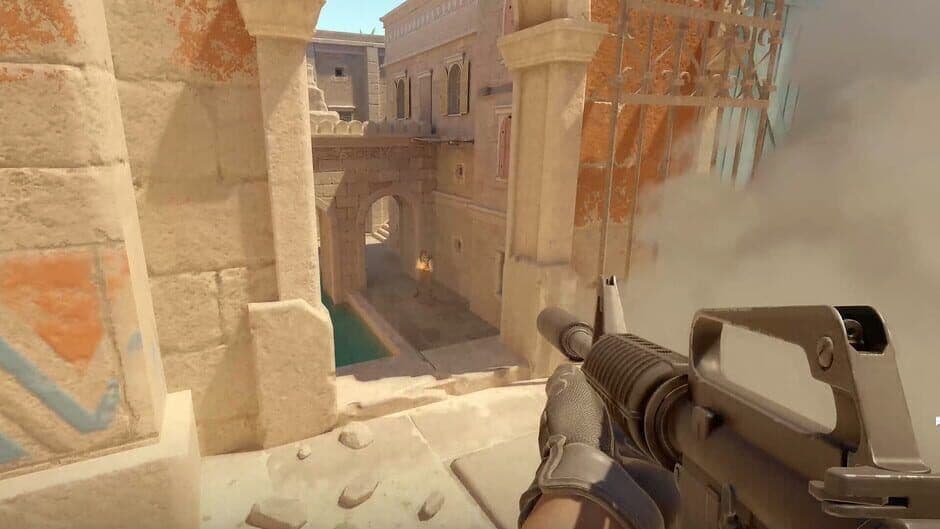
In-game view of player equipment.
Let’s break down the two essential pieces of protective gear and the simple rules that will keep your economy healthy.
The Armor Basics: Vest and Helmet
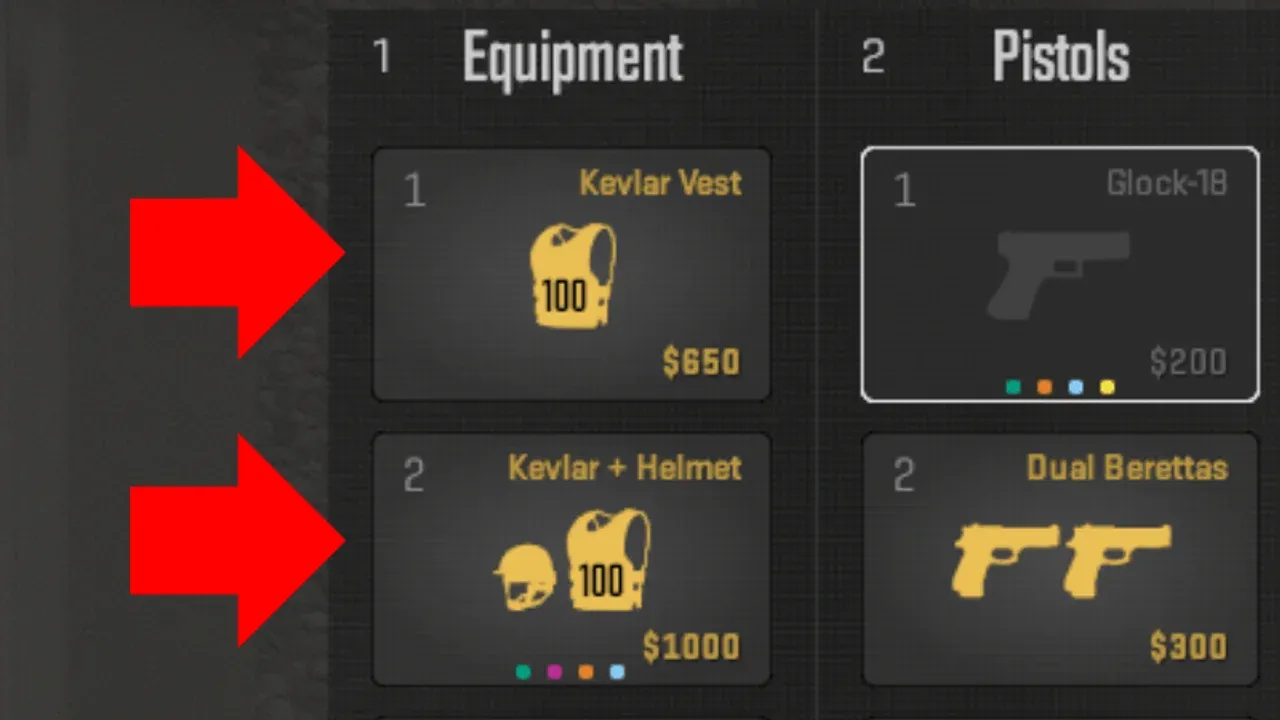
In the Buy Menu under Equipment, you have two options: the Kevlar Vest for $650 and the Kevlar & Helmet combo for $1000. The vest covers your torso, stomach, and arms, while the helmet adds crucial head protection.
Here’s the trick most guides miss: you can’t just slap a helmet on a damaged vest. The Helmet Purchase Rule is strict. If your vest is at 100% durability, you can buy a helmet separately for $350. But if your vest is even slightly damaged, you have to pay the full $1000 for the new set. This means if you get shot once and survive, you’re locked into that vest for the next round unless you want to spend big.
Always check your armor durability in the buy menu before purchasing. A $350 helmet is a smart upgrade; a forced $1000 set is a budget killer.
When to Buy and When to Save
You should aim to have armor in almost every round that isn’t a pure eco. But a common, costly mistake is repurchasing it when you don’t need to.
Follow the Armor Durability Threshold. Don’t rebuy your vest unless its wear drops below 50% (or roughly 35 points). Armor effectiveness doesn’t degrade with damage—a vest at 1% durability protects as well as a new one until it’s destroyed. Spending $650 to replace a vest that’s still at 60% is wasting money you could spend on a smoke, flash, or better pistol.
This applies to your helmet too. If you have a helmet and it gets dinged, you keep it. You only need to buy a new one if you lost it in the previous round.
Strategic Considerations for Each Side
Your role and the enemy’s expected weapons change the value of that $1000 kit.
- As a Terrorist: Always buy the full Kevlar & Helmet. The CTs’ default pistol, the USP-S, can kill you with a single headshot at medium range if you lack a helmet. That’s a risk you never want to take on an attack.
- As a Counter-Terrorist: You can sometimes skip the helmet. High-powered rifles like the AK-47 and the AWP will kill you with a headshot regardless. On a tight budget, buying just the Kevlar Vest for $650 can free up cash for essential utility like a Defuse Kit or extra grenades.
Trust me, mastering these simple purchase rules will let you stretch your economy further, ensuring you have the tools you need for the fights that matter. Let’s get you geared up.
The Strategic Value of Defuse Kits for Counter-Terrorists
For CTs in Counter-Strike 2, the bomb timer is your worst enemy. A late plant can turn a perfect retake into a heartbreaking loss. This is where the Defuse Kit, a small $400 piece of equipment, becomes your most clutch investment. It’s not just a purchase; it’s a round-winning insurance policy that can single-handedly swing the economy in your favor.
Professional match data highlighting equipment utility.
In the Buy Menu under Equipment, the Defuse Kit costs $400 and is CT-side only. Its sole purpose is to dramatically alter the math of a post-plant scenario. The standard defusal time without a kit is 10 seconds—a painfully long window that requires you to clear the site and start the defuse with over 10 seconds left on the bomb timer. With the kit equipped, you simply press and hold [E] to defuse for just 5 seconds. This cuts the defusal time in half, turning impossible last-second retakes into routine defusals.
Listen for the bomb plant sound. If you hear it with less than 10 seconds left in the round, you know a defuse is impossible without a kit, but with one, you’ve still got a fighting chance.
Because of its high-impact, low-availability nature, teams coordinate kit distribution. The standard strategy is 1 kit per team on full buys, and it’s usually held by the Anchor or a Defensive player who is most likely to survive for a retake. Buying more than one is a waste of precious utility money, and buying one on an eco round is throwing away $400 you’ll desperately need next round.
This coordination enables post-plant retakes that would otherwise be lost causes. Think about it: if the Terrorists plant with only 15 seconds left, a CT without a kit needs 5 seconds to get to the bomb and 10 more to defuse—it’s mathematically impossible. With a Defuse Kit, that same player needs only 5 seconds, making the retake not only possible but probable if they can secure the site. This small time difference is the line between a 1v4 clutch and a round loss.
Trust me, forgetting this $400 item on a full buy is one of the most common and costly mistakes in Counter-Strike 2. It directly enables round wins from seemingly hopeless situations, pays for itself by saving your team’s expensive rifles, and is non-negotiable for any coordinated CT side. Make it a habit, coordinate with your team, and watch those “impossible” retakes become your signature plays.
Best Economy Strategies for Buying Equipment
Money wins rounds just as often as aim does in Counter-Strike 2. Your bank account is your most powerful weapon, and knowing when to spend it on a rifle versus when to save for the next fight is what separates good teams from great ones. This is about planning your economy, not just your next spray.
Strategic positioning requires proper equipment investment.
The core of CS2's economy is understanding the different round types and sticking to a plan. You and your team need to be on the same page, buying the same "tier" of equipment to avoid disastrous "split-tier" rounds where two players have rifles and three are stuck with pistols.
The Four Pillars of Your Economy
A standard half is built around four key buy strategies. Master these, and you'll control the game's pace.
- Full Buy: This is the standard. Every player has a rifle (or AWP), Kevlar & Helmet ($1000), and a full set of utility. This costs upwards of $4,500 per player. You go for a full buy when your team's economy is healthy, typically after a win or once the loss bonus has stacked.
- Eco Round (Save): This is an investment. You spend as little as possible—maybe just a P250 or some utility—to save $4000+ for a full buy next round. The goal isn't to win (though it's a nice bonus), but to damage the enemy's economy with cheap kills and guarantee your next round is strong. Eco round discipline means spending ~$400 max and playing for picks, not heroics.
- Force Buy: This is a calculated gamble. You spend most of your money on a sub-optimal buy (like MAC-10s, UMP-45s, or Galil ARs) to try and steal a round and break the enemy's economy. Do this when you're deep in a loss streak, have a numbers advantage (like 5v4), or on the last round of the half.
- Anti-Eco: This is how you punish the enemy's save. When you know they're on pistols, you buy cheaper, high-reward weapons like SMGs and extra utility to secure the round without blowing your own bank. Think of it as a "discounted" full buy.
Always think in a 2-round plan. Before you buy, ask: "Can we win this round? And if we lose, can we still full buy next round?" This stops you from making desperate, game-losing half-buys.
Strategic Spending: Armor & Kits vs. Firepower
Your $1000 Kevlar & Helmet is a massive investment—that's a smoke, two flashes, and a P250. Knowing when it's mandatory versus optional is key.
- Pistol Round Buy: On the opening round, your $800 is precious. The Kevlar Vest for $650 is often the best purchase. It gives you high survivability against the low-penetration starting weapons and drastically reduces aim punch, letting you win duels you otherwise wouldn't.
- CT vs. T Helmet Priority: This is a classic money-saver. As a CT, if you know the Ts have AK-47s or AWPs, you can often skip the helmet. Why? Those weapons kill with one headshot anyway. Use that $350 on a flash and smoke instead. As a T, always buy the helmet. A USP-S headshot from a CT can end your round from surprising range.
- The 'AWP No Armor' Glass Cannon: Sometimes, the math is brutal. If you only have ~$4750, you face a choice: an AWP with no armor, or a rifle with full kit. The 'AWP No Armor' strategy is a high-risk, high-reward play for elite aimers who believe their first shot will win the duel. It's a glass cannon approach—devastating if you hit, fragile if you miss.
Putting It All Together: A Round-by-Round Blueprint
Let's walk through a common scenario. You lose the pistol round. Here’s the smart economic play:
- Round 2 (Loss Bonus: $1900): You eco. Buy a P250 or stick with your pistol, play for a cheeky pick, and save every dollar. Your goal is to have ~$4000+ next round.
- Round 3 (Loss Bonus: $2400): Now you force buy. You should have ~$4200+. Buy a Galil or FAMAS, Kevlar & Helmet, and maybe one piece of utility. This is your chance to stop the enemy's momentum and break their economy.
- Round 4: If you won the force buy, you can often full buy. If you lost but did damage, you might need to eco again to reset for a solid Round 5 full buy.
Trust me, if you've felt stuck in an economic death spiral, you're not alone—everyone gets caught forcing at the wrong time. The trick is to communicate with your team, track the enemy's loss bonus on the scoreboard, and commit to the plan. With disciplined spending, you'll consistently field the better gear and control the game.
Common Equipment Mistakes and Economic Pitfalls
You've mastered the fundamentals of the Counter-Strike 2 economy, but this is where games are truly won or lost. The final hurdle isn't just knowing what to buy—it's avoiding the subtle, expensive mistakes that drain your team's financial lifeblood round after round.
Utility and gear management in a standard match.
Here are the most common equipment errors that cripple teams, and how to steer clear of them.
Over-Investing on Eco Rounds
This mistake single-handedly ruins the essential '2-Round Plan' we discussed earlier. An eco round is an investment in your next gun round. The goal is to spend as little as possible, typically just a pistol and maybe Kevlar, to save over $4,000 for the following round. Throwing $400 on a Defuse Kit or $1,000 on a Kevlar & Helmet set when your team is collectively saving is a catastrophic waste. That $400 could be a crucial smoke or flash in the next round's full buy. Trust me, you won't reach the bomb on a pistol save, so that kit does nothing but delay your team's comeback.
Wasting Cash on Minor Armor Damage
This is a silent economy killer. Your armor works just as effectively at 1% durability as it does at 100%. Repurchasing 90%+ armor is burning $650-$1,000 for virtually no benefit. That money is desperately needed elsewhere.
Only replace your vest when its durability drops below roughly 50-75%. Until then, that $650 is better spent on Smokes and Flashes that can win you the round. Wasting it on minor damage is how you end up in a full buy with zero utility—a surefire way to lose.
Skipping Utility for a Slightly Better Gun
You have $4,300. You could buy an M4A1-S ($2,900) and Kevlar & Helmet ($1,000) with no grenades. Or, you could buy a FAMAS ($1,950), full armor, and a full set of utility. The second option wins rounds; the first loses them. Prioritizing rifles over utility leaves your team unable to safely cross angles, block vision, or flash into sites. Your shiny AK is useless if you get smoked off and mollied out before you can even see an enemy.
Forgetting the $400 Game-Changer
On a CT-side full buy, forgetting the Defuse Kit is a $400 mistake that costs you the round. This isn't a minor oversight. A kit cuts the defusal time in half, turning impossible post-plant retakes into winnable clutches. Losing a round to a 'ninja defuse' or because the bomb timer expired while you were halfway through defusing is the most frustrating way to throw away a round you otherwise earned. One player must carry this on any round you expect the bomb to go down.
Mastering Counter-Strike 2 isn't just about hitting shots; it's about making every dollar work for your team. Avoid these four common pitfalls—over-spending on ecos, rebuying armor too early, skipping nades for guns, and forgetting your kit—and you'll consistently field stronger, more coordinated buys. With this discipline, you're not just playing the opponents; you're mastering the economy that decides the match.