
Padre's Heywood is not defined by which gang controls a street. It is defined by who can ask for a favor without turning that favor into a feud. The Valentinos are the district's strongest local presence, 6th Street presses against them, and Sebastian "Padre" Ibarra decides which disputes are worth V's time.
That makes Padre more than a mission giver. His jobs show how Heywood's gang identity overlaps with family, commerce, and neighborhood reputation. Follow the jobs as a connected picture and the district's central conflict becomes clear: Padre keeps the Valentinos useful by making violence selective.
Heywood's Conflict Starts With Relationships
Heywood stretches across The Glen, Wellsprings, and Vista del Rey. The Valentinos are rooted in those neighborhoods, while 6th Street competes for influence. The result is not a clean line between civilian space and gang space. A bar can be a Valentino hangout, a garage can be a workplace, and a family dispute can become a cross-gang crisis.
The game uses those spaces to put pressure on V's assumptions. A marked enemy inside a Valentino location is still an enemy in combat, but the people who surround that enemy and the reason for the contract change what the target represents. Padre's calls are where that context becomes explicit: he knows which job is a recovery, which is a warning, and which could trigger a larger problem.
The official Cyberpunk material identifies Padre as Heywood's fixer. His connection to the Valentinos gives him access, but it also gives him something to lose. Every contract tests whether he can protect his network without making the neighborhood pay for it.
Padre Protects Deals Before He Protects Pride
The Lord Giveth and Taketh Away is the clearest example. The gig begins in Wellsprings, and Padre sends V to recover a Militech SUV from a Valentino garage. Nomads bought the stolen vehicle from the Valentinos, then lost both the vehicle and their money when the deal went bad. The walkthrough lists Street Cred 13 as the requirement and identifies the job as a Search and Recover gig.
The important instruction is not the theft. Padre tells V that getting back at the Valentinos is not part of the gig; he will handle that himself. He separates the client's property from his own grievance. V restores the deal, the nomads receive the SUV, and Padre keeps the retaliation inside his own chain of responsibility.
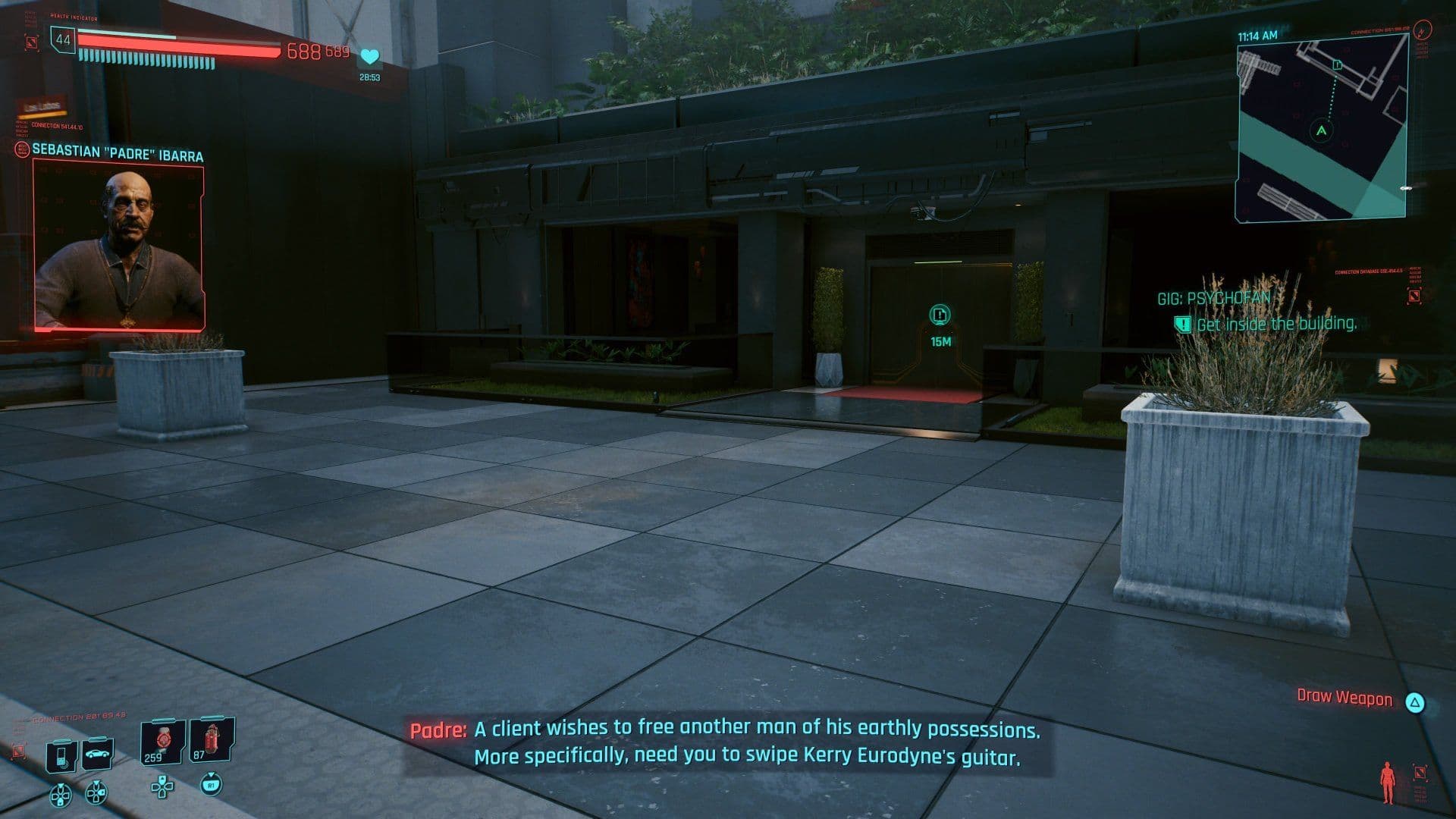
Padre expands his work beyond Valentino turf in Psychofan.
That same reach explains Psychofan, another Padre gig in The Glen. The job is to steal one of Kerry Eurodyne's guitars from a fan's apartment, with Johnny reacting to the Samurai memorabilia inside. It has nothing to do with taking Valentino territory. It shows why Padre's influence matters: his network is broad enough to turn a celebrity burglary into local work, while his Heywood base still gives the job its social texture.
His Gigs Turn Gang Violence Into a Choice
Old Friends puts V in Vista del Rey, inside a bar crowded with Valentinos, to neutralize Karubo Barei Sanguinario. A loud attack completes the core objective, but the location also supports a quieter route. Scan the room first, use the roof for a line of sight, or enter through the back door with Technical Ability 16. If you take Karubo alive, the objective changes to carrying him to a waiting vehicle.
The mission is useful because it makes the gang visible as a group rather than as a row of health bars. The people around Karubo are not interchangeable with the target, even though the game allows V to treat the room that way. Padre's contract gives you a name; the environment tells you what that name is attached to.
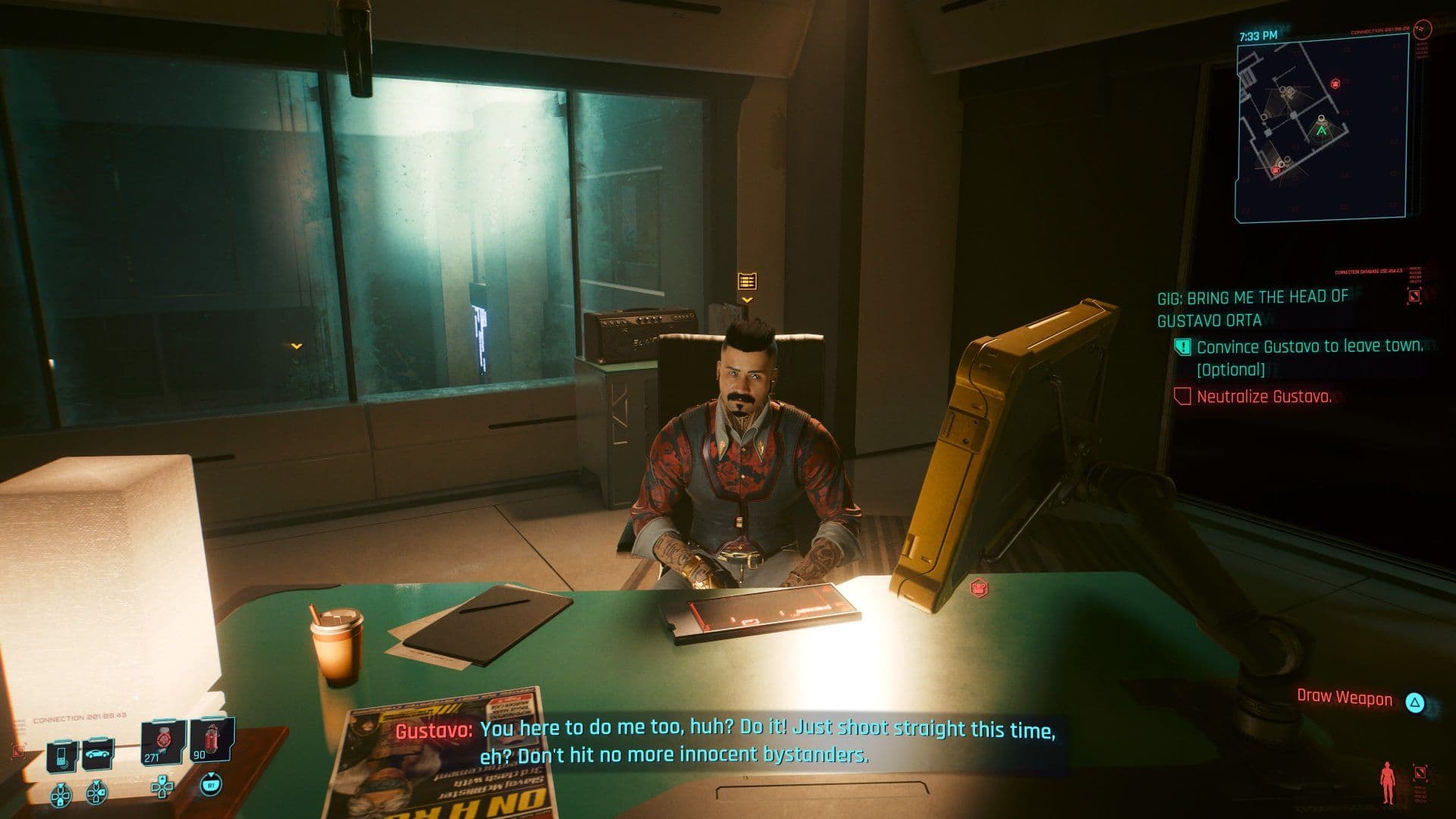
Gustavo Orta offers V a choice before the contract is settled.
Bring Me the Head of Gustavo Orta makes the same point through a family conflict. Gustavo is a high-ranking Valentino in Vista del Rey. His girlfriend belongs to 6th Street, and her father blames Gustavo after she falls into a coma. When V reaches Gustavo, he gives a different account of what happened. You can kill him or tell him to leave town, and a Street Kid background provides an additional way into the conversation.
The choice is not a simple "spare the good guy" outcome. Sending Gustavo away removes one source of pressure without repairing the relationship that caused the job. Killing him satisfies the contract while giving the feud a body. Padre's value is visible in the space between those outcomes: he hands V a problem that can be solved in more than one way, then lives with whichever version of Heywood V leaves behind.
Use Padre's Calls to Read the Room
Treat Padre's gigs as local disputes before you treat them as combat arenas.
- In The Lord Giveth and Taketh Away, recover the SUV first. Padre's explicit separation between the delivery and retaliation tells you what the job is really asking for.
- In Old Friends, scan the bar before choosing a route. The roof and the Technical Ability 16 back door make stealth possible, but the more useful information is who is sharing the room with Karubo.
- In Bring Me the Head of Gustavo Orta, hear Gustavo's account before deciding. The contract names a target; the dialogue supplies the conflict.
- In Psychofan, notice the range of Padre's work. A fixer tied to one district can still arrange jobs involving Kerry, Johnny, and a high-rise apartment far from a gang shootout.
Heywood rewards the player who distinguishes a target from the people and obligations around that target. That is Padre's real lesson: in a district built on overlapping loyalties, the best mercenary is the one who knows exactly which part of the deal they were hired to change.