
Suicide and System Reset sit in the same Ultimate Quickhack family, but they solve different problems. Suicide converts RAM into a lethal finish; System Reset converts it into a silent opening. The choice matters because both programs are expensive: spend the wrong one early and the rest of the encounter becomes a resource problem.
Unlock the route that fits your build
You need a cyberdeck installed before either program can be equipped, and your deck must have enough RAM for the upload. The Intelligence tree is the long-term route: Hacker Overlord unlocks Epic quickhack crafting, while Bartmoss' Legacy at 20 Intelligence unlocks Tier 5 quickhack crafting. If you do not want to commit that many attribute points, watch Netrunner inventories and loot Access Points with the Breach Protocol minigame; quickhack drops are random, but the Datamine Virtuoso perk improves your odds.
For System Reset, the most dependable named reward is the Spellbound side job. When Nix sends you to retrieve the Book of Spells, decrypt the shard to obtain the System Reset crafting specification. You still need the lower-tier version and quickhack components to craft upward, so keep the programs you need for the next tier.
Kold Mirage is a useful supply run, not a replacement for Spellbound. At the Badlands dump where V was left after The Heist, take Rache Bartmoss' cyberdeck to Nix. When Nix starts convulsing, jack into the nearby terminal and finish the Breach Protocol instead of cutting the power; saving the deck preserves its quickhack haul.
Suicide turns RAM into a kill
Upload Suicide when a normal enemy needs to disappear immediately and you can afford the RAM. The target puts a gun to their head and is neutralized, so the hack does not ask you to win a damage race or expose yourself to finish the job. It is especially good against a lone guard, an enemy blocking a route, or the first target in a room whose removal gives you space to work.
The cost is commitment. Suicide is an Ultimate hack with a long upload and a high base RAM cost, so throwing it at the first disposable enemy can leave you unable to answer the second wave. Its Tier 5 version returns 10% Health when Suicide neutralizes an enemy; the Iconic version raises that return to 20%. The other cost-reduction hook is more tactical: performing a melee Finisher reduces Suicide's RAM cost for a short window, and the effect can stack twice.
The efficient sequence is to create an opening with a cheap control hack or a weapon, take a melee Finisher when it is safe, then upload Suicide against the threat you actually need removed. Treat the Tier 5 health return as recovery attached to a kill you already wanted, not as permission to spend 24 RAM on every patrol.
System Reset buys a silent opening
Use System Reset when the objective is to preserve stealth rather than maximize body count. It cripples the target's nervous system and knocks them unconscious without making noise, which lets you remove a guard from a camera lane or a doorway without triggering a gunshot or explosion. The alert stays quiet, but the body still needs to be hidden.
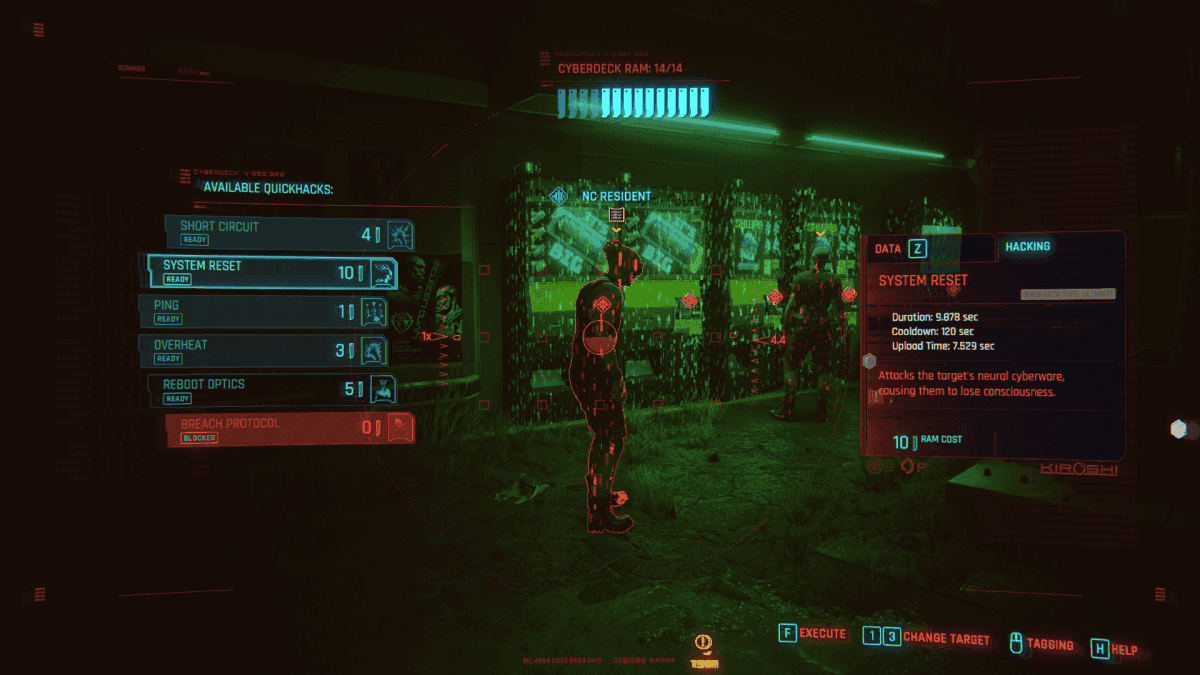
System Reset is selected from the scanner as a silent knockout option.
System Reset is still expensive and carries a long cooldown, so target the person whose position controls the next move: a sentry watching your path, an isolated netrunner, or the guard you cannot safely reach for a takedown. Upload it through a camera when the network gives you that angle, then move the body before another enemy finds it. The hack solves the alert; it does not solve careless body placement.
At Tier 5, defeating an enemy reduces the RAM cost of your next quickhack by 1, stacking up to six times. The passive turns a successful silent takedown into momentum, but it pays off only if you keep moving through the encounter. Follow System Reset with cheaper queued hacks, recover the RAM you just spent, and save Suicide for the moment when a lethal neutralization is worth breaking the quiet plan.
Spend the Ultimate only when it changes the encounter
The practical split is simple. Upload Suicide when a target must be dead immediately, when combat is already open, or when a safe melee Finisher has reduced its cost. Upload System Reset when an isolated guard controls your route, when body discovery is manageable, or when a silent neutralization will let its Tier 5 RAM reduction carry into later uploads.
If neither condition applies, keep your RAM. Ping, Reboot Optics, or Sonic Shock can create the opening; the Ultimate should be the action that closes it.