
A gate looks like the door, so both sides treat it as one. Builders save their rarest lock for it. Raiders form up in front of it. But a wooden gate is a wooden fence with one length of Metal Wire added to it, its panels carry exactly the health every other panel on the perimeter carries, and the lock hanging on it is not a target you can attack at all.
The price of a breach is set long before anyone arrives, by three decisions the builder already made: which way the frame is facing, where the loot is sitting relative to the walls, and which two lines a server operator left in a config file most players never see.
A Gate Is a Fence With One Wire In It
Compare the recipes and the illusion collapses. A Wood Fence takes a Fence Kit, 2 wooden logs, 18 planks and 36 nails. A Wood Gate takes the identical list plus one Metal Wire and a pass with Pliers. The gate step does not add a plank. It adds a hinge.
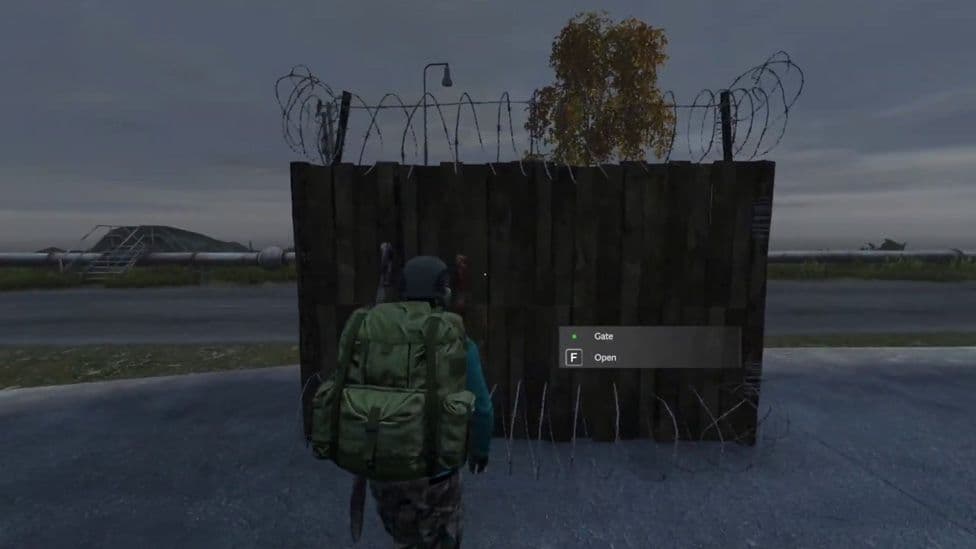
A gate is the only section of a perimeter that has to open onto walkable ground.
Metal changes the panels, not the skeleton. A Metal Fence wants 40 nails, 8 planks and 6 sheet metal, and the plank count drops because sheet metal replaces the planks in the panels rather than stacking on top of them: the 8 planks are the two frame sections, and everything above that is metal instead of wood. A Metal Gate is that same list plus the wire.
The Combination Lock you hang on the result is a genuinely good item and a genuinely narrow one. The cyan-cabled version has three dials and 1,000 possible codes; the red-cabled version has four and 10,000. It is irreparable, and it spawns rarely, in industrial and farm loot. What the Combination Lock buys you is that nobody strolls in. What it does not buy you is a single second against someone who brought damage, because Bohemia's own patch note says the lock drops when "important parts of the gate are destroyed" — the wording is that loose in the original, and it does not matter, because a raider is destroying those parts either way. There is no cutting action, no lockpick that fits it, no code-guessing minigame. Raiders never attack the Combination Lock. They attack the thing holding it, and the lock falls into the grass on its own.
The Cheapest Way Through Is Never the Gate
Base raiding became arithmetic on 30 June 2020, when update 1.08 made tents, watchtowers and fences destructible by explosions, gunfire and melee damage and gave every part a health pool. That system is still the one in force. WOBO's raiding tool, which extracts the values straight from the game's files, currently prices a single section like this:
| Target | Plastic Explosive | Mosin 9130 | M4-A1 | Pickaxe |
|---|---|---|---|---|
| Wooden panel + frame | 3 | 348 | 531 | 3,811 |
| Metal panel + frame | 3 | 410 | 626 | 4,491 |
| Wooden panel only | 2 | 199 | 304 | 2,178 |
| Metal panel only | 4 | 261 | 399 | 2,858 |
| Frame only | 3 | 149 | 228 | 1,634 |
A gate has no row of its own because it does not need one. It is a fence, so a wooden gate is the 348-round line and a metal gate is the 410-round line, lock or no lock.
Start with what a blast actually costs, because every other number is measured against it. Plastic Explosive is rated Unique — it spawns only in a handful of industrial zones, and on its own it does nothing at all, since it needs a Remote Detonation Unit to fire. Three of those is not a shopping list, it is an expedition. That is the real reason the rifle columns are worth reading rather than skipping.
The columns also prove how the damage model works, which is more convincing than being told. Add the panel row to the frame row and you get the combined row back: 199 plus 149 is exactly 348 for the Mosin, and 261 plus 149 is exactly 410 against metal. Bullets and swings kill the panel, then start over on the frame. Explosives do not — three blasts clear a full section whether it is wood or metal, because the blast reaches the frame through the panel.
Which produces the strangest number on the grid. Taking a metal panel off by itself costs 4 blasts, one more than levelling the entire metal section. If you are raiding with explosives there is never a reason to be surgical; the whole section is cheaper than half of it.
Sheet metal is worth more than builders usually think and less than the marketing suggests. Against explosives it buys two extra blasts on a bare panel and nothing on a complete section. Against everything else it buys about 18 percent: 410 rounds instead of 348, 4,491 pickaxe swings instead of 3,811. That is not a wall a rifle cannot solve. It is 62 more rounds.
The softest thing on any perimeter is a frame with nothing on it — 149 Mosin rounds against a finished section's 348. A half-built stretch is not a wall in progress. It is the cheapest door in the compound.
And melee is not a plan. The best raiding tools are the Pickaxe and the Firefighter Axe at 3,811 swings for a wooden section, with the Crowbar trailing at 6,449, and those swings are rationed by stamina rather than patience: a heavy attack costs 25 points from a ceiling of 100 that refills at 5 per second standing still. A raider who arrives with a hatchet and no explosives has not brought a tool. They have brought a hobby.
Place the Fence Kit Backwards and Strangers Get a Dismantle Prompt
Here is the mistake that costs more bases than any material choice. You always build a fence from the inside: the face you are looking at as you position the Fence Kit becomes the inner face, and the panels end up on the far side of the frame. Place the kit while standing outside your own perimeter and the entire wall goes up backwards, with the frame — and the material pile, and the barbed wire slots that 1.08 deliberately moved inside — presented to the street.
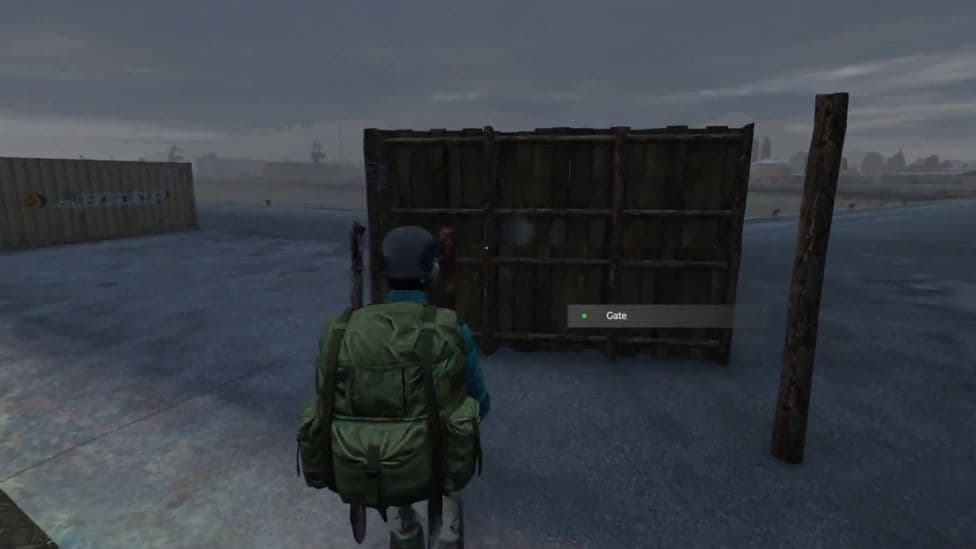
The frame side. If a raider can see this, the wall was built facing the wrong way.
That is worse than losing a cosmetic layer, because tools dismantle a fence from the inside only. Stand on the correct side with a hatchet in hand and the game offers Dismantle; stand on the wrong side and it offers Destroy, an action disabled on every relevant tool for balance reasons and left available only to modders. DayZ has no concept of who owns a wall — the prompt depends on nothing but which side of it you are standing on. So a backwards-built fence hands a passing stranger the Dismantle option: no explosives, no gunfire, nothing anyone will hear, and the dismantle returns materials scaled to the damaged state of the part. The base logs can be dismantled from either direction regardless, so the posts are never the piece quietly protecting you.
A gate adds one constraint on top of all that: it has to open onto ground a person can walk through. That fixes, permanently and visibly, the one section of your perimeter a raider knows is reachable on foot, and it is the section whose approach you have already cleared for your own convenience. Site it against terrain that gives an attacker nothing to stand on, or accept that you have chosen their firing position for them.
Your Loot Sits in the Same Cone of Fire as Your Wall
The 1.08 rewrite reached inside the walls too. Barrels, crates, chests and tents can all be destroyed by explosions, gunfire and melee, and ruined containers and tents drop their contents onto the ground. Shooting your tent apart does not burn your loot; it tips it onto the floor at the feet of whoever is holding the gun. Storage destruction is a raiding tool, not a raiding penalty.
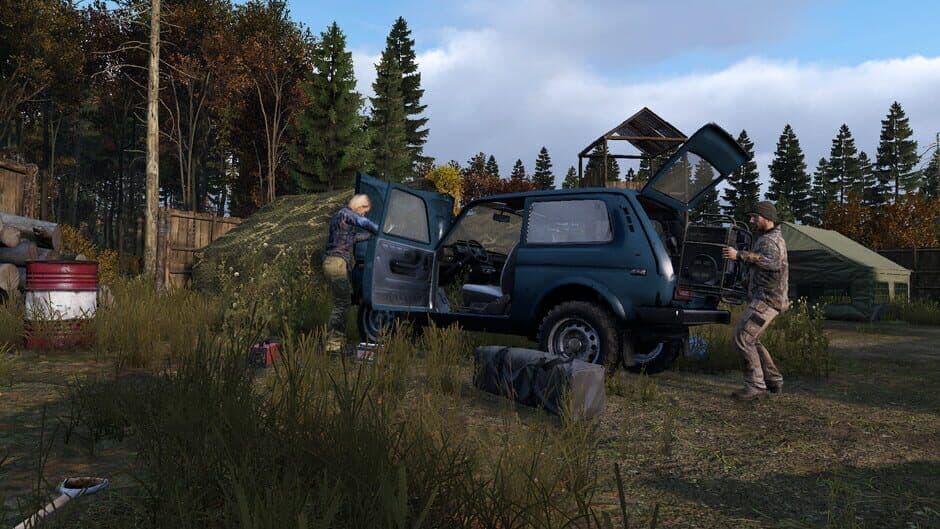
Containers parked against the wall line share its cone of fire.
The same rework improved the ballistic properties of metal walls specifically — Bohemia's phrasing was that they became "much better at protecting against projectiles passing through." Wooden panels got no such treatment. A tent shoved flush against a wooden wall is therefore sitting in the same cone of fire as the wall itself, and the 348 rounds someone spends breaching that section are landing on your kit at the same time. Set containers back from the wall line, and if you can afford sheet metal on only one stretch, spend it on the stretch your storage sits behind.
Depth matters more than thickness here. A raider who blows one section and finds an empty yard has spent three blasts to learn nothing, and now has to decide whether to spend three more with the noise already made.
A Half-Mast Flag Advertises That Nobody Is Home
The Flag Pole is the one structure that talks to people outside the wire. A raised flag refreshes the lifetime of everything within 60 metres every five days, and since fences, watchtowers and tents despawn after 45 days, a maintained flag can carry a camp to 90 days without anyone touching it.
The catch is that the flag lowers on its own across those same 45 days, and its height is readable at distance. A pole at half-mast tells anyone glassing your compound exactly how long it has been since a human was here — that the owners have stopped logging in, that the raid will be unopposed, and that the timer on the whole camp is already running. Re-hoisting is five actions.
Two Booleans Can Make Your Walls Invincible
None of the numbers above are guaranteed to be live on the server you are standing on. Update 1.08 also added two server parameters, disableBaseDamage and disableContainerDamage, and disableBaseDamage alone decides whether raiding exists on that server at all. Bohemia ships them in its own Central Economy files under GeneralData, both set to false; the file accepts the equivalent 0 and 1 that most host control panels display. Turn either on and damage and destruction stop applying to the relevant objects entirely — walls, or storage, or both. None of it does anything unless the server also sets enableCfgGameplayFile to 1, which is why two servers advertising the same map can play by completely different physics.
The consequences run both directions. Where disableBaseDamage is on, a four-dial lock stops being a speed bump and becomes the entire defence, because the wall behind it cannot be hurt at any price. On a modded server the opposite happens: code lock mods restore precisely the mechanic vanilla removed, letting a hacksaw cut a lock on a configurable timer measured in seconds.
Then there is the rules layer, which no config file expresses. DayZRP counts flag-lowering and prior communication as part of whether a raid was legitimate. DayzUnderground bans disproportionate and joint actions, and treats double-digit groups roaming or raiding as a rule break. StalkerZ requires faction approval, a minimum server population, and an interval between raids. On those servers the arithmetic is intact and irrelevant — you can breach the wall and still lose the character to an admin.
So before you carry three Plastic Explosive across half of Chernarus, work out which of the three layers you are actually up against. The wall in front of you is a number, a rule, or nothing at all, and only one of the three can be solved with explosives.