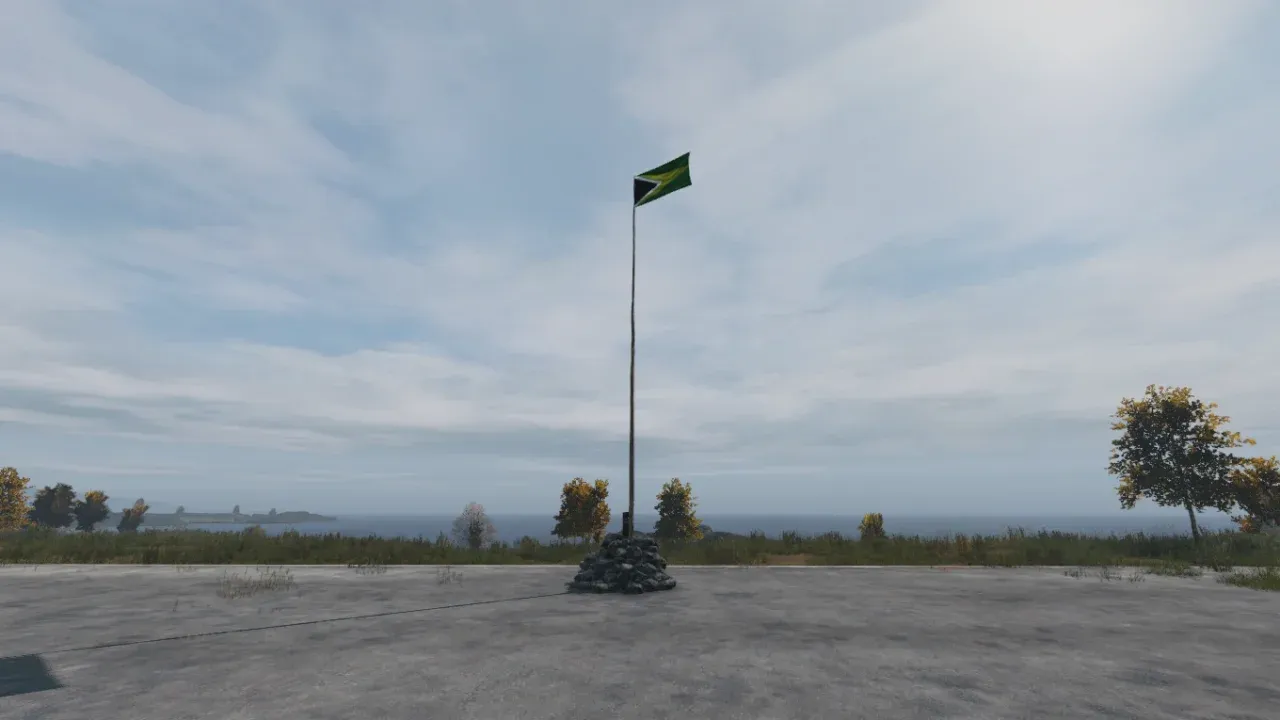
A flag pole does not stop your base despawning. It resets a timer — once every five days, on everything within 60 metres of it, and only on the objects whose own lifetime was long enough to be worth resetting. That is the whole mechanic. Almost everything else players believe about flag poles is downstream of a single number that is wrong.
The number is 90 days. Both DayZ wikis print it, community guides repeat it, and Bohemia's own shipped configuration contradicts it: FlagRefreshMaxDuration is 3,456,000 seconds — forty days — sitting beside a comment in the game's script source that reads "40 days (+ 5 days final refresh)". A fully raised flag refreshes for forty days and then stops. What you actually get for a wall or a crate is about eighty-five days from the last time you walked the mast to the top.
The gap between 85 and 90 matters less than what it was hiding. The object doing the protecting — the pole itself — ships with a seven-day lifetime, against the forty-five days of the walls it stands over. By a factor of six, it is the most fragile thing in its own territory. And because vanilla DayZ has no concept of ownership anywhere in this system, that mast is a control any stranger can operate bare-handed, eight days at a pull.
So this is what sixty metres buys: roughly eighty-five days of walk-away time for structures and storage, nothing at all for the rifle lying on the floor beside them, one very tall object the game will not let you hide, and a public status board that anyone can read — or quietly rewrite.
What the Pole Actually Does: One Lifetime Reset Every Five Days
Raise the flag and watch. Nothing happens. Nothing happens tomorrow either, or the day after that. For five full days the pole is inert — and then, in a single server tick, it does the only thing it was ever built to do, and goes back to sitting there.
That interval is not an estimate. Bohemia ships it as a plain number in the mission's db/globals.xml, the Central Economy config file that every DayZ server loads: FlagRefreshFrequency is set to 432,000 seconds, which is five days to the second. The value is byte-identical in the offline mission files for Chernarus, Livonia and Sakhal, so there is no per-map variation to hunt for. The flag pole's own update loop just accumulates elapsed time in a counter, and when that counter reaches the interval, it fires once and resets to zero.
What it fires is a single engine call, RadiusLifetimeReset, centred on the pole's own position and given a radius of 60 metres. To understand what that does, you need the one piece of DayZ plumbing most players never see. Every persistent object in the world — a fence panel, a tent, a barrel, a dropped rifle — carries a countdown called its lifetime, set per object class in the server's types.xml. The countdown runs whether you are online or not, and when it reaches zero the Central Economy deletes the object. Touching something resets its countdown. That is why, before the flag pole existed, keeping a base alive meant physically walking to every wall, every crate and every tent and interacting with each one before its own clock ran out.
That chore is precisely what Bohemia said it was retiring. Announcing the flag pole for the 1.09 experimental branch on 18 August 2020, the developers described the goal as a single central object that refreshes the lifetime values of everything within its radius — currently set, in their words, to 60 metres — so that "you will no longer need to run around all the objects and manually refresh them." Read the mechanic against the chore and the shape of it becomes obvious: the pole is not a new kind of protection. It is your old errand, run automatically, from one spot, once every five days.
Two things follow from that, and both matter more than they sound.
The first is what a reset actually restores. The engine call is documented as putting each entity's lifetime back to the default value held in the database — its own configured lifetime, the one it started with. It is not a bonus, not a bump, not an extension. A tick cannot make an object outlive the number its class was given, because the number the class was given is exactly what the tick writes back. The flag pole hands nothing out; it only refuses to let the clock finish.
The second is that protection here is granular, not continuous. There is no field around the pole, no state an object sits in. There is a counter, a threshold and a moment. In the five days between one tick and the next, a flagged base is in precisely the same condition as an unflagged one — every countdown inside those 60 metres is ticking down normally, and the pole is doing nothing about it.
So stop thinking in terms of protected and unprotected, and start thinking in terms of a clock with a five-day beat. Pace your compound from the pole rather than from your walls, because the pole's position is the centre the game measures from — 60 metres from the pole, and the far corner of a sprawling perimeter can quietly fall outside it. And treat the number stamped on GameConstants.REFRESHER_RADIUS = 60 in the game's script source as fixed furniture: it has read 60 since the feature shipped, and neither timer in globals.xml has moved since the 1.09 commit added them — the 1.08 files do not contain the variables at all.
Which leaves the awkward part. If every tick does nothing more than restore each object's own default lifetime, then the entire value of a flag pole is inherited from those defaults. The pole is only ever as useful as the numbers attached to the things standing near it — and not everything in your base has a number worth restoring.
It Only Saves Things That Already Live Longer Than Five Days
Every persistent object in DayZ answers one question about itself, and it answers it before your pole is ever built. The routine is called MaxLifetimeRefreshCalc, and the thing to notice is where it lives: on the entity, not on the flag. A fence panel runs it. A barrel runs it. A dropped rifle runs it. Each one reads its own configured lifetime out of its economy profile, reads the flag refresh frequency out of the server's Central Economy globals — falling back to the compiled five-day default if that value is missing — and compares the two numbers. If the refresh frequency is less than or equal to the object's own lifetime, the object marks itself refresher-viable. If it is not, the object is on its own, permanently, no matter what is standing ten metres away with a flag on top of it.
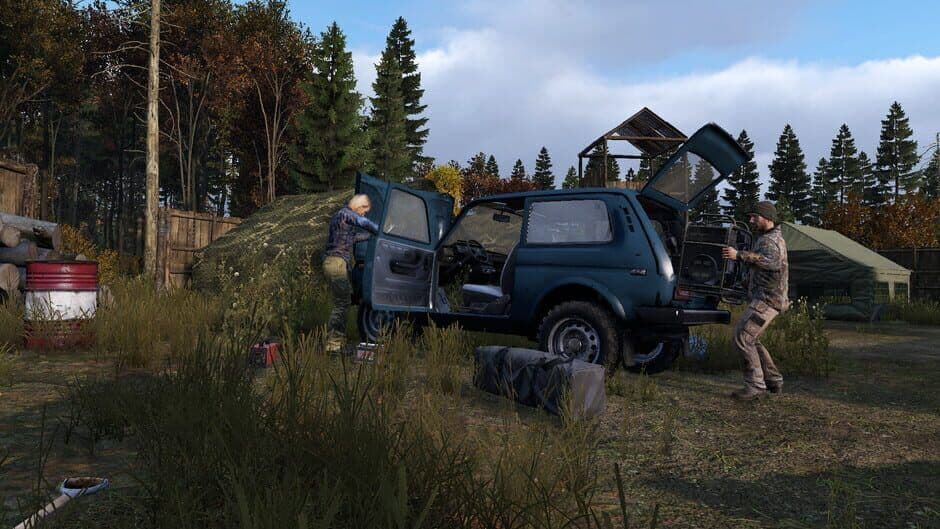
The fence, barrel, tent and watchtower all carry 45-day lifetimes. The bag on the grass does not.
There is no whitelist of protected classes anywhere in this system. There is one comparison, run per object, against a number the object was shipped with. That is the entire eligibility rule, and it explains something the "60-metre protection bubble" model cannot: why a tick can touch two objects sitting side by side and only one of them lives.
Because the reset itself is indiscriminate. When the five-day tick fires, the engine restores everything in range to its database default — the rifle included. The rifle genuinely is refreshed. It is refreshed to two hours. It then dies two hours later, with four days and twenty-two hours still to run before the next tick arrives to refresh it again. Nothing failed and nothing was skipped; the object simply has no way of reaching the next reset under its own power, so it never sees a second one. The flag is not choosing what to save. The arithmetic is.
Here is what that arithmetic produces on Bohemia's shipped types.xml, identical across Chernarus, Livonia and Sakhal:
| Object | Lifetime | Clears the five-day bar? |
|---|---|---|
| Fence (every built wall and gate), Watchtower | 3,888,000 s — 45 days | Yes |
| Sea Chest, Wooden Crate, Barrel | 3,888,000 s — 45 days | Yes |
| Large, Medium, Car and Party tents | 3,888,000 s — 45 days | Yes |
| Underground Stash | 1,209,600 s — 14 days | Yes |
| Shelters (fabric, leather, stick) | 604,800 s — 7 days | Yes, by two days |
| Hunting Bag on the ground | 28,800 s — 8 hours | No |
| Plate carrier, rope, nails, metal wire, tools, a wooden log, a loose flag | 14,400 s — 4 hours | No |
| M4-A1, AKM | 7,200 s — 2 hours | No |
Forty-five days is the number the flag pole conversation is really about, and it belongs to a short list: your walls, your gate, your watchtower, your tents, and the three containers worth building for — Sea Chest, wooden crate, barrel. Those are what a tick is restoring. Everything in the bottom half of that table is measured in hours, and the gap is not close. A rifle would need its lifetime multiplied by sixty to qualify.
Which is why the claim you will find in circulation — that a raised flag keeps all items fresh inside 60 metres, dropped backpacks full of supplies included — is wrong in the specific way that costs people gear. The version that gets it right adds a qualifier: items inside a storage container. Your loot survives a long absence because the container survives it, and cargo goes where its container goes. Take the same items out and set them on the floor of the same compound, well inside the same radius, under the same fully raised flag, and they are on an hours-long clock that no tick will arrive in time to interrupt.
The scale of the radius makes this sharper rather than softer. Sixty metres from the pole is a circle of roughly 11,300 square metres — about 1.1 hectares, comfortably larger than any base you can hand-build out of fence kits. In practice you will almost never be fighting the radius. Two barrels standing in your compound are inside it and are reset to 45 days on every tick. Tip those same two barrels out onto the dirt beside them — same spot, same distance, same flag — and their contents are four-hour items with no container carrying them, and the tick that would have mattered is up to five days away. The binding constraint is never how far the flag reaches. It is what inside that reach has a number worth restoring.
There is one documented effect that behaves differently, and it is worth knowing because it is the only place a flag's influence extends past 60 metres at all. A boat parked within 100 metres of an active flag takes 30 % of its normal engine decay — the code comment says decay is deactivated, but the code multiplies the damage by 0.3, and what runs is what runs. That is a decay-rate reduction on engine health, a different system from lifetime entirely, with its own range written specifically for boats. Decay is skipped altogether while any player is within 300 metres, and it is quadrupled if the boat is flipped.
So before you count on the pole for anything, sort your base into two piles: things with a lifetime worth resetting, and things without one. The first pile is structural and it is storage — walls, watchtower, tents, chests, crates, barrels. The second pile is everything you actually loot for. If it matters to you, it needs to be inside something in the first pile before you log out; a flag will not save a rifle propped against a wall or a backpack left on the floor, and it never could, because that decision was made by the item's own class value long before you raised a mast.
The flag, then, resets your 45-day structures every five days, indefinitely, for as long as it keeps ticking. That last clause is doing all the work — and it raises the only question that matters for a long absence: how many of those resets do you actually get?
The Ceiling Is 40 Days, Not 90 — and the Real Number Is About 85
Eight. That is the entire answer, and it deserves a moment, because the figure most players carry around implies something much closer to open-ended: raise the mast, wander off, come back whenever, the base is fine. The refresher is not open-ended. It is a budget, it is spent at a fixed rate, and it runs out.
The budget sits in the same file as the five-day interval, one line below it. FlagRefreshMaxDuration ships at 3,456,000 seconds. Divide by 86,400 and you get 40, with no remainder — forty days, exactly, and again byte-identical in the offline mission files for Chernarus, Livonia and Sakhal. That is how long a fully wound refresher runs before it stops, and at a five-day beat it buys you eight ticks: days 5, 10, 15, 20, 25, 30, 35 and 40.
It would be reasonable to assume a number living in a server config is just a default somebody happened not to change, and that Bohemia's real intent is elsewhere. It is not. The same forty days is compiled into the game itself. The script constant reads REFRESHER_MAX_DURATION_DEFAULT = 3600 * 24 * 40, and the flag's initialisation only overrides that compiled figure when the Central Economy globals supply a value above zero. Delete the line from globals.xml entirely and your server still runs a forty-day ceiling. The number is stated twice, in two independent places, and both say forty.
Which raises the obvious question of where the other number came from. Ninety days is in both DayZ wikis. It is in community server guides. It is in Steam threads. As a ceiling, it traces back to nothing Bohemia shipped — not the 1.09 announcement, not the Central Economy files for any of the three maps, not the script source, and not the commit history of either repository going back before the feature existed.
What Bohemia did write is a comment, sitting on the same line as that compiled constant: "40 days (+ 5 days final refresh)". Read that beside the wikis' own sentence — that fences, watchtowers and tents despawn in 45 days, "but when combined with a flagpole, could last up to 90 days" — and the arithmetic behind the community figure becomes visible. Forty-five days of flag coverage, plus a structure's own forty-five days, equals ninety. It is a tidy sum, and the forty-five inside it is not a wiki invention: 40 + 5 is Bohemia's own arithmetic, in Bohemia's own comment. Where the wikis go wrong is in what they do with the total — they print 90 as the ceiling, as a span the pole itself is capable of holding, when the pole's ceiling in the shipped config is forty and everything past it is a structure's own lifetime running out unassisted. Exactly one secondary source found anywhere gets this right: a third-party globals.xml reference that lists the default as 3,456,000 and glosses it, correctly, as forty days.
So the honest position is narrower than a debunk. Ninety is wrong as a ceiling: nothing in this system holds ninety days of refresher, and a pole somebody tells you is good for ninety days is not. As a total it is one reading of Bohemia's parenthesis — the reading in which that final refresh lands five days after the timer expires. This article reads it the other way, for a reason the tick table below makes concrete: the deactivation reset fires at day 40, in the same moment as the eighth tick, which puts a 45-day structure's last day at about 85 rather than 90. Plan against the 85. It is the conservative reading of the same comment, and it is the one you can watch happen.
You do not have to remember any of this in-game, though, because the pole displays its own remaining time. On every refresh tick the flag animates to 1 − remaining/max: a fully wound refresher puts the mast at the top, an empty one puts it at the bottom, and everything in between is a direct proportion. The mast is not decoration and it is not a rough indicator. It is the timer, drawn.
And because the animation only updates when a tick fires, it does not glide. Each tick spends 432,000 seconds out of 3,456,000 — exactly one eighth, 12.5 % — so the flag drops in eight discrete steps, holding perfectly still for five days between each one. Both wikis describe the mast as lowering "over 45 days", which is wrong twice: wrong duration, and wrong motion. Laid out tick by tick, the whole life of a refresher looks like this:
| Day | Refresher left | Mast | What happens |
|---|---|---|---|
| 0 | 40 days | top | Flag attached and raised five times |
| 5 | 35 days | 12.5 % down | Everything eligible in range reset to its own lifetime |
| 10 | 30 days | 25 % down | Same again |
| 15 | 25 days | 37.5 % down | Same again |
| 20 | 20 days | half mast | Same again |
| 25 | 15 days | 62.5 % down | Same again |
| 30 | 10 days | 75 % down | Same again |
| 35 | 5 days | 87.5 % down | Same again |
| 40 | 0 | bottom | Eighth reset; refresher deactivates and fires one final reset as it switches off |
That last row is where the real walk-away number comes from. Day 40 is the last thing the pole ever does for you: the timer reaches zero, the refresher marks itself inactive, and the state change itself triggers one more radius reset on the way out — which is where this article reads the developers' "(+ 5 days final refresh)" comment as landing. On that reading the eighth tick and the deactivation reset arrive in the same moment, so in practice it is one last restoration rather than two — and the five days in the parenthesis describe a courtesy already spent, not five more to come.
From that moment your structures are simply running on their own clocks, unassisted, with nothing left to interrupt them. A fence, a watchtower, a tent, a Sea Chest, a wooden crate and a barrel all carry 45 days. Forty days of refreshing plus forty-five days of unassisted lifetime is day 85.
Be clear about which of those three numbers is which. The 40 is exact and stated twice by Bohemia. The 45 is exact and comes straight from the shipped types.xml. The 85 is neither printed nor claimed anywhere in Bohemia's files — it is arithmetic over the two, and it holds as long as your last full raise really was full and the parting reset lands where the tick loop puts it.
Filling that timer, for the record, is done in five actions. Each raise adds FLAG_STEP_INCREMENT, 0.2 of the maximum — 691,200 seconds, or exactly eight days — and lifts the mast one fifth. Five of them takes an empty pole to a full forty days, which is the "fully raised in five actions" line the wikis report and the code confirms.
Notice the mismatch buried in those two figures. Decay moves the mast in eighths. You move it in fifths. The positions do not line up, so a partly decayed flag will rarely be sitting on an action boundary, and the function that adds time clamps at the forty-day maximum. Come back on day 5 with the mast one step down — 35 days banked — raise it once, and you have added eight days to a timer that can only hold five more. Three days go straight in the bin, and the mast is back at the top either way.
Which is the practical shape of the whole mechanic: the pole banks forty days and not one second more, no matter how often you visit. Weekly maintenance does not accumulate. There is no such thing as a well-tended flag pole with ninety days of refresher on it, and there never was. Plan absences against 85 days from a full raise — and if your absences are shorter than the 45 days an untouched structure already survives on its own, be honest that the pole is not the thing keeping your base alive.
Eighty-five days for the walls, then. But there is one object standing in that timeline that does not last anywhere near that long, and it is the one holding the flag.
The Pole Dies First: 7 Days Against Your Walls' 45
Open the same types.xml that gives a fence its 3,888,000 seconds, find the TerritoryFlag entry, and the number sitting in it is 604,800. Seven days. Byte for byte the same on Chernarus, Livonia and Sakhal, exactly as the 45 is. The object that exists to keep your base alive is configured to last one sixth as long as the cheapest wall panel it stands over.
Be clear about what kind of claim that is, because it is not one you will find printed anywhere. No wiki says the pole dies first; both of them say the opposite, listing the flag pole's lifespan as 49 days in their infoboxes, a figure that matches nothing in the shipped files. What you are reading is Bohemia's own two numbers set beside each other — 604,800 against 3,888,000 — and the ratio is doing the arguing. Nor is the short one an oversight somebody forgot to update. One line under the radius constant in the game's script source, next to the two timers, the developers wrote the pole's own lifetime out longhand as a comment: the lifetime of the refresher itself is in the database, 3600 * 24 * 7 = 604800. They knew. It has read 604,800 since the commit that shipped the object.
So why does a pole not simply vanish a week after you build it? Because seven days clears the five-day bar, the same way the shelters in that eligibility table did. The refresher's radius is centred on the pole, and the pole is an object in it, so every tick that resets your walls resets the pole along with them. It keeps itself alive for precisely as long as it is running. Which means the seven days that matter are not the first seven. They are the seven after the last reset — and you already know when that lands. Day 40, the timer hits zero, the refresher switches off and fires its parting reset. That reset is the last one the pole will ever receive, from itself, and from that moment it is an ordinary 604,800-second object counting down. Around day 47, the Central Economy deletes it.
Walk back into your own compound on day 60 and this is what that looks like. The fences are there. The gate is there. The Sea Chest is there, with weeks still on its clock and your gear still inside it. What is not there is the pole — no mast, no stone base, nothing but the patch of ground it stood on. The flag is not lying at the bottom waiting for you either; a loose flag carries a four-hour lifetime, so whatever became of it when its host was deleted, nothing has been sitting there since. The structure that was supposed to be protecting everything is the only thing in its own territory that failed to survive the trip.
And this is the part worth sitting with, because the loss is not the one it looks like. You did not lose gear on day 47. You lost the ability to do anything about the gear. A bottomed pole is still a pole: return on day 45 with a flag in your bag and five raise actions puts forty days back on the clock and the whole territory with it. Return on day 50 and there is nothing to hoist a flag on. The walls have not moved, the chest has not moved, and there is no route from where you are standing to another refresh that does not start with building a second flag pole from scratch. The window in which a late return still saves the base does not close on day 85 when the structures die. It closes on day 47, when the thing that could have saved them is deleted.
Nor can you get ahead of this by looking after the pole. The wikis put the finished structure at 60 kg and a 6×6 inventory footprint, and the code confirms it can be repaired to pristine — but repair and lifetime are separate systems that share nothing. Repairing damage restores an object's health. Lifetime is a countdown held by the Central Economy against the object's class, and no amount of hammering touches it. A pristine pole and a badly damaged one expire on exactly the same day.
Server admins have reached for that number too, though not quite as proof of anything. On a thread about poles vanishing after server restarts — where the causes actually identified were misconfigurations rather than Bohemia's default — one of the fixes posted is to open the TerritoryFlag entry and replace 604,800 with 3,888,000, the fence's own figure and a little over six times what ships. That is not the shipped seven days killing poles on its own. What it is is a record of which line an admin opens first when poles start disappearing, and of how much headroom they judge it needs.
So the pole is not a structure you build. It is a consumable you install, with a shelf life measured against the timer it hosts, and every base that outlives one is a base that pays for another. Which turns the obvious next question from a purchase into a subscription: what does putting one up actually cost?
The Cost Is Transport and One Irreplaceable Tool — and You Pay It Again
Read the recipe first, because it is the least interesting part of the answer. Ten wooden logs, thirty-two large stones, sixty nails, one metal wire, one rope, three sticks. Nothing on that list is a trophy item. You will not clear a military base for any of it. The bill is not written in rarity — it is written in kilograms, in inventory slots, and in one tool that nothing else in the game can stand in for.
Start with the kit, which is the cheapest step of the whole project and the one most often reported wrong. Bohemia's own crafting script takes exactly one Rope and three Wooden Sticks — sharpened sticks work just as well, and the recipe pulls three out of the stack rather than consuming the whole thing. That is it. A damaged rope still works; only a ruined one refuses. You will nonetheless find a widely circulated build guide listing the kit as three short sticks and a length of "metal rope", meaning metal wire. That part is an error: the Flag Pole Kit has never contained wire, and the recipe script, an independent wiki item page and the build guide of a vanilla community server all say rope. The same guide's "2× Rope" total, though, is not the same mistake — count the kit's rope and the Pole stage's rope and two is genuinely what the build consumes, unless you get the first one back. Which, as it happens, you can.
From the kit, the pole goes up in four gated steps:
| Stage | Materials | Tool |
|---|---|---|
| Base | 1 Wooden Log | Sledgehammer — nothing substitutes |
| Support | 32 Large Stones, 6 Wooden Logs | Shovel or Pickaxe |
| Pole | 3 Wooden Logs, 60 Nails, 1 Metal Wire, 1 Rope | Hammer or Hatchet |
| Flag | 1 Flag | none |
The order is not advice. The construction categories are gated in code as Base, then Support, then Pole, then Flag, and the flag slot on the mast will not accept a flag at all until the pole part exists — which is why a half-finished pole with a flag in your hands does nothing for you. Dismantling runs backwards through the same list, and each stage comes apart with the tool that built it.
Be clear about which parts of that table are which kind of fact. The four stages and their order are read straight out of the game's shipped scripts, as is the kit recipe. The material counts are not. Those live in config.cpp, a file Bohemia does not publish, so they come from two independent DayZ wikis and a community server's build guide that agree with each other word for word, with nothing found anywhere that contradicts them. Treat them as the agreed figures rather than as numbers lifted from Bohemia's own files.
Two of the three tools are forgiving. A Shovel and a Pickaxe do the same job on the Support stage, and a Hammer and a Hatchet do the same job on the Pole. The Sledgehammer has no partner. If you do not have one, you cannot lay the Base, and everything downstream of the Base is unreachable — which makes it the single item most likely to send a fully loaded builder walking back into town. Find it before you fell anything.
Then comes the part nobody budgets for. A wooden log weighs 20 kg and occupies a 3×11 footprint — thirty-three slots — and carries the Heavy flag. No backpack in the game has a grid that shape, so a log is carried in your hands, one at a time, and ten of them is 200 kg moved in ten separate trips. Stone is lighter per unit and worse in bulk: a large stone is 2 kg and nine slots, so thirty-two of them is 64 kg and 288 slots of volume against the thirty-five a Mountain Backpack offers. What that load does to your stamina ceiling and your sprint is a whole arithmetic of its own — slots per kilogram, worked out elsewhere on this site — and the point here is simply that the pole is not gathered, it is freighted. The site you pick decides the size of the job far more than the recipe does.
There is a deadline on all of it, too. Every one of those materials is a loose item with the short lifetime that came up earlier — logs, rope, nails and wire all sit in the hours, not the days. You cannot stage a neat pile of ten logs at the build site on Tuesday and come back for them on Thursday. Whatever you drop, you drop as part of a build you are finishing now.
Only two ingredients are genuinely a scavenging problem. Metal Wire is Rare, found in farm, work, forester and hunting loot, and one is all you need. Sixty Nails is Uncommon in the same civilian and industrial pool, but sixty is most of a full seventy-nail box, which is a lot of shelves — the faster route is to dismantle something that already contains them, since fences, watchtowers and wooden crates all give nails back. Rope you can simply make, from two stacks of six rags. And you only need the one, because the Base stage drops the Flag Pole Kit onto the ground as it completes: the wiki's tip, consistent with a kit whose disassembly hands back both the rope and the three sticks, is that you pull the rope back out of the discarded kit and spend it again on the Pole stage.
The flag itself is the other gate, and it is not where the wikis send you. Bohemia's loot tables tag every spawning flag variant for offices and schools on all three official maps — nominal two, minimum one per variant — and nowhere else. The wiki.gg flag page's "Hunting, Rare" is wrong; you want a town with a school or an administrative building, not a hunting stand. Which colours you find is a smaller question than it looks: more than thirty flag designs exist in the 1.29 script source, while about twenty actually spawn on any given official map, and the counts you see quoted differ mainly because they are counting different things. Any of them powers the pole identically. One warning attached to that: a flag can be cut into three armbands with almost any blade or saw, and the flag is destroyed doing it. Wear the armband and you have thrown away the thing that makes your pole a refresher.
So the sequence that saves you a wasted trip is: Sledgehammer and flag first, then the Shovel-or-Pickaxe and the Hammer-or-Hatchet, then the wire and the nails, and only then the logs and the stone — because the heavy freight is the part you do not want to do twice for a build you cannot finish. Pick the site before you start hauling, keep it within one carry of your trees, or bring the M3S, which has dedicated wooden-log slots for exactly this trip.
And budget the whole thing twice. That is not a figure of speech about damage or bad luck; it is the shape of the system you read in the last section. A pole that runs out of time is deleted, and a deleted pole is not repaired or restarted — it is rebuilt from the Base stage, with a fresh log, a fresh kit, another 200 kg of freight, another sixty nails, another flag, and the Sledgehammer you had better still own. The pole is a subscription paid in cargo runs.
Which raises the question that a subscription usually answers first, and this one does not. You have paid the bill, possibly more than once. What exactly does that purchase give you control over?
Anyone Can Lower Your Flag, and Every Pull Takes Eight Days
Nothing. Not "less than you would like" — nothing at all. Go through the flag pole's class looking for the field that records who built it, and there is no such field to find. Vanilla DayZ does not ship a territory permission system that happens to default to open. It has no concept of a territory owner anywhere in this code, and the pole is not an exception to that rule so much as the clearest demonstration of it.
You can see the absence most plainly in the two actions themselves. ActionRaiseFlag and ActionLowerFlag both declare their item condition as CCINone and their target condition as CCTCursor — which, translated out of engine terms, means: nothing needs to be in your hands, and you need to be looking at the pole. That is the entire gate. No tool. No key, because there is nothing to lock. No group check, no build-permission check, no comparison against whoever placed the kit. The only two conditions either action tests are that a flag is attached to the mast and that the mast is not already at the extreme you are trying to move it towards. Both are full-body standing interactions you hold down, so the sole thing a stranger spends is a few seconds of standing still in the open.
None of this was a discovery. When the pole arrived in the 1.09 experimental branch, players immediately reached for the comparison they had — the plot poles of the ARMA mod era, which genuinely claimed ground and locked outsiders out of building on it — and were corrected in the same threads. The DayZ pole, as one reply put it, is "ONLY for resetting the interaction timer on base objects in a radius." It marks nothing, reserves nothing and refuses nobody. Six years and twenty updates later that is still exactly what it does.
Which makes the lower action considerably more serious than it looks. It is tempting to read the mast as a switch — up is on, down is off, and putting it back up puts everything back. It is not a switch. FLAG_STEP_INCREMENT is 0.2, and a lower action subtracts that fraction of the maximum from the refresher timer, the precise mirror of the eight days a raise adds. Somebody pulling your mast down is not turning your protection off. They are spending it, out of the same forty-day budget you filled by hand, and each pull is a withdrawal of eight days that has to be re-earned with a flag, a trip and another action. Nor can you get ahead of them by topping up early: the forty-day ceiling is a hard cap, so there is no buffer to stockpile against tampering.
The one piece of the system that looks protective turns out to be the trap. The flag is slot-locked into the mast whenever the pole is not fully lowered — the game re-locks that attachment slot on every animation change, so you cannot walk up to a raised pole and pull the flag off it. What that actually guarantees is the timing: the moment the flag becomes takeable is the moment the refresher has already been drained to zero. And there is no gentler version of the same act, because detaching the flag does not pause anything. The detach handler forces the mast animation to fully lowered and sets the refresher to zero outright. Whatever time was left is not held in escrow for you; it is gone the instant the flag leaves the pole.
Put together, the whole griefing move costs a stranger nothing but a few minutes. They walk into your compound with empty hands and perform five lower actions on the mast. Eight days, sixteen, twenty-four, thirty-two, forty — the refresher is at zero and the slot has unlocked, so on the way out they pocket the flag as well. No wall was touched. No gate was breached, no lock was broken, no explosive was spent, and nothing in the base is missing or damaged. If you walk back in an hour later, the only difference between this compound and the one you left is the height of a piece of cloth. Everything inside it has quietly stopped being refreshed, and the countdowns you read about two sections ago have started running unassisted with nothing scheduled to interrupt them.
The trail it leaves is close to nothing, too. The pole does write to the admin log — TotemFlagChange — where the server keeps one, and only when a player action puts the mast at the very top or the very bottom. Intermediate raises and lowers write nothing whatsoever, and the eight discrete steps of ordinary decay write nothing either. So a stranger who pulls your flag down four times and wanders off leaves eight days on the clock, a mast standing at one fifth height, and not a single line anywhere. The complete five-pull job, the one that empties the timer and takes the flag, produces exactly one entry. That is the whole record of an act that has just cost you forty days of cover.
This is why community servers write flag rules at all: the code has no opinion, so the rulebook has to have one. Sunnyvale Servers, a modded community whose players already have code locks and a land claim kit, requires flags belonging to different groups to sit at least 160 metres apart so their territories cannot overlap — comfortably more than the 120 metres two 60-metre radii would need just to stop touching. It permits lowering a flag only from the base of the pole, closing off the ways players found to reach the mast from above it. And it forbids moving a base flag pole while you are actively being raided. Read those three together and you have a fair inventory of what vanilla permits by default: overlapping claims, lowering from anywhere you can reach, and relocating the pole mid-fight. None of it is a bug being patched. It is a house rule filling a space the game left empty.
So stop thinking of the flag as yours. It is a public control mounted on your property, operable by anyone who walks past, and the only thing standing between it and a stranger's hands is whether a stranger walks past. Check the mast height every time you come home rather than assuming it reads what you left it reading, because a base that has been drained looks precisely like a base that has not. Keep a spare flag in your storage, since the cheap version of this attack ends with yours in somebody's backpack. And do not expect the server to tell you what happened — for anything short of a full raise or a full drain, nothing was written down.
Which raises the question in reverse, and it is the one you should be asking on every base you walk past that is not your own: if any stranger can change what a flag says, how much can you trust what somebody else's is telling you?
Reading a Flag: What a Half-Mast Does and Does Not Tell You
The honest answer is sometimes — and nothing about the flag will tell you which time this is.
Start with what the mast is genuinely honest about, because it is honest — it is just answering a narrower question than the one you are asking. Mast height is a rendering of the refresher's remaining time and of nothing else. There is no activity sensor behind it, no last-login field, no occupancy state. It is one number drawn as a picture, and every conclusion a player draws from it is inference stacked on top of that number.
Applied to the three positions you will actually see from a treeline, the arithmetic reads like this. A flag at the top means somebody walked that mast up recently and the territory is sitting on close to its full forty days of cover — it does not mean anybody has logged in since. A flag at half mast means roughly twenty days of refresher left, which puts the forty-five-day structures under it about sixty-five days from disappearing: comfortably long enough that "abandoned" is a guess, not a reading. A flag on the ground means the refresher is empty, and the innocent version of that is nobody has raised the pole in at least forty days. Note the word innocent. The other version is that somebody drained it in five actions this morning while the owner was asleep, and from the outside those two states are the same picture.
That is the first way the signal leaks, and the second one runs the opposite direction. Remember what a lifetime reset is: the flag is an automated version of a chore you can still do by hand. Every time a player physically interacts with an object, that object's countdown goes back to its default — which is exactly what the tick does, just object by object instead of all at once. So a survivor who logs in most evenings, opens their own crates, moves a barrel, adds something to a tent, is refreshing those containers themselves on a schedule far tighter than five days. Their walls may be the only thing running on borrowed time, and even those get touched whenever somebody builds or repairs. A permanently bottomed flag on a base that somebody lives in is not a contradiction. It is what an active player who never bothered to find a flag looks like.
Put both leaks together and the mast fails in both directions at once. A raised flag can stand over a compound whose owner died on the coast five weeks ago and never came back. A bottomed flag can stand over a compound somebody slept in last night. And because the pole has no owner and needs no tool, the position you are reading is a position any passer-by could have set — including a passer-by who wanted the base to look neglected before they came back with friends.
There is a better tell, and it is the absence rather than the height. A pole standing bare with no flag on it, or no pole at all in the middle of intact walls, is a far tighter inference than any mast position. Both of those states have a floor under them. A flag does not come off a pole that has time left on it, so a bare mast means the refresher was already at zero when the flag was removed. And a pole with a dead refresher stops receiving the resets that were keeping it alive, which on the shipped values gives it seven days before the Central Economy deletes it. So intact forty-five-day walls with no pole between them is not ambiguous the way a half mast is: it says the refresher stopped at least a week ago, and probably a good deal longer. That base is on its own clock, and you are looking at the middle of a countdown rather than at somebody's laundry.
The strongest check of all, though, is one the game will just hand you, and most players never notice it. When you look at an object, the game asks whether that object sits within sixty metres of a live refresher — it keeps a list of the active ones and measures against your target's position — and if it does, the action prompt draws a small flag icon on it. That check does not care who you are. Walk up to somebody else's wall, look at their crate, put your crosshair on their watchtower, and the prompt tells you whether the territory around it is currently being refreshed. You never have to find the pole, and you never have to guess what a piece of cloth halfway up a mast is trying to say.
It has two blind spots worth knowing before you lean on it. Ruined objects never show the icon, whatever is standing next to them. Neither do objects whose own lifetime is under the five-day bar — the same eligibility rule from earlier in the article, showing up in the interface — so a dropped bag or a rifle on the floor will tell you nothing even inside a fully wound territory. Look at a wall, a gate, a tent, a crate, a barrel: the things that qualify. And it is worth knowing that this is a comparatively recent piece of reliability rather than day-one behaviour.
The people who have to adjudicate this for a living reached the same conclusion about the mast and stopped using it. Sunnyvale Servers, whose rulebook already dictates how far apart flags must sit and where you may stand to lower one — and whose mods hand its players the ownership vanilla withholds — does not define abandonment by flag height at all. A base counts as abandoned there when its owners have not connected to the server to defend it within seven days — a human-activity test, checked against the server's records rather than against a silhouette. The same rules add that a base must be locked to count as occupied at all. Both of those exist because the thing the game shows you is not the thing anybody actually wants to know.
So read the icon, not the flagpole. Before you decide a compound is dead, put your crosshair on one of its walls and check the prompt; that is a direct answer where the mast is a hint. Treat a missing flag or a missing pole as a real finding and a half mast as no finding at all. And apply the same scepticism to your own base: your mast is not a status board for your group, because it reports a timer rather than attendance, and anybody could have moved it since the last person looked.
Every reading in this section, though, quietly assumes the flag you are squinting at is running Bohemia's numbers — and that is an assumption two of the three numbers do not survive.
Which of These Numbers Your Server Is Allowed to Change
The two that do not survive are the two you would plan around: the five-day interval and the forty-day ceiling. The one that does is the sixty metres.
That split has nothing to do with importance and everything to do with where each number is stored. FlagRefreshFrequency and FlagRefreshMaxDuration are two lines of XML in db/globals.xml, a file inside the mission folder that every server operator owns outright. Nothing gates the edit — they are counts of seconds in a file the operator owns, and an operator with a text editor can make them say whatever they like. A server can refresh every hour. A server can set a ceiling of a year. And neither value is visible to a player connecting to it: nothing in the browser lists them, nothing in the game reports them, and a raised mast on a server refreshing hourly looks precisely like a raised mast on Chernarus official.
REFRESHER_RADIUS lives somewhere else entirely. It is a constant in the game's script source, sitting two lines below the compiled forty-day default, and it is compiled into the build rather than read out of a config at start-up. Changing it means shipping altered script — which means a mod, which means a PC community server and a mod list you download on the way in. Everywhere else, the number is sixty. That includes every official server, and it includes console entirely, because console builds cannot load mods at all. The sixty metres is the one figure in this article that travels without checking.
There is a nice piece of engineering attached to the editable half, and it is worth knowing because it explains why nobody notices when it happens. If an operator changes the ceiling on a server that already has flag poles standing on it, the game does not break them and does not zero them. When a saved pole loads, it checks whether the maximum has moved since it was stored and rescales its remaining time in proportion. A flag holding half its old budget comes back holding half the new one. Since the mast is drawn from that same proportion, the silhouette does not shift by a pixel — the flag reads exactly as it did yesterday and now means a different number of days. An operator can rewrite the meaning of every flag on the map without touching a single one of them.
Beyond editing the numbers, a server can replace the system outright. KarmaKrew runs a custom flagpole system with tiered poles: a level 1 pole stands two days before it despawns, while a level 3 pole with a flag on it has an infinite lifetime and simply does not let the base disappear. The same system blocks anyone outside the owning group from building inside a territory and enforces storage limits automatically. Read that against the last three sections and you can see what a mod is actually selling: the ownership vanilla does not have, bolted onto a refresher whose expiry has been switched off. It is one example among many, and the only reason to name it is to fix the boundary — once a territory mod is loaded, none of the vanilla arithmetic is safe to assume.
Servers also decide, separately from any of this, whether bases can be damaged in the first place. disableBaseDamage and disableContainerDamage are theirs to set, so on some servers walls and storage cannot be harmed at all. That is a different system from lifetime and it is not this article's subject, but it belongs on the list of things two servers advertising the same map can quietly disagree about.
Picture three of them, all running Chernarus, all sitting in the same browser list. The first has edited globals.xml down to an hourly refresh, so its flags effectively never lapse and a bottomed mast there means something closer to negligence than to arithmetic. The second runs tiered mod poles with infinite lifetimes, where the top tier removes the question altogether. The third has broken its own TerritoryFlag entry, and its poles vanish after restarts — a failure real admins have compared notes on, with one crew fixing it by raising the pole's lifetime to the fence's 45 days and another tracing it to a missing serverTimePersistent=1 in the server config. The server browser shows you a name, a map, a player count and a ping. It shows you none of that.
What is at least stable is the code underneath. The last change to the flag pole script that altered behaviour landed in the 1.27 window, in January 2025, when active refresher positions became tracked on the server rather than only on the client — that is what made the refresher icon and the boat decay reduction dependable rather than approximate. The 1.29 touch to the same file swapped GetGame() for g_Game in three places and changed nothing about how flags behave. So on current stable, the mechanic is the mechanic. What varies between servers is configuration, not version.
Which gives you a short and slightly annoying checklist. Treat every figure in this article as the official-server default rather than a property of the game: correct where nobody has edited anything, and unverifiable from inside the game where somebody has. Before you plan a month away from a base on a community server, read that community's own documentation or ask in its Discord what its refresh and ceiling are set to — that is the only place the answer is written down. On officials, PC and console alike, this is Central Economy and script behaviour and you get the numbers as shipped; a console player is on vanilla by default, since the platform has no mod support, unless a console community server has edited its own files.
Two numbers you have to ask about, one you never do. That is as much certainty as this system hands out, and it is enough to settle the only question left.
You Cannot Hide It: Deciding Whether 60 Metres Is Worth the Advertisement
There is one part of this decision the game has already made for you, and it is the part about where the pole is allowed to stand.
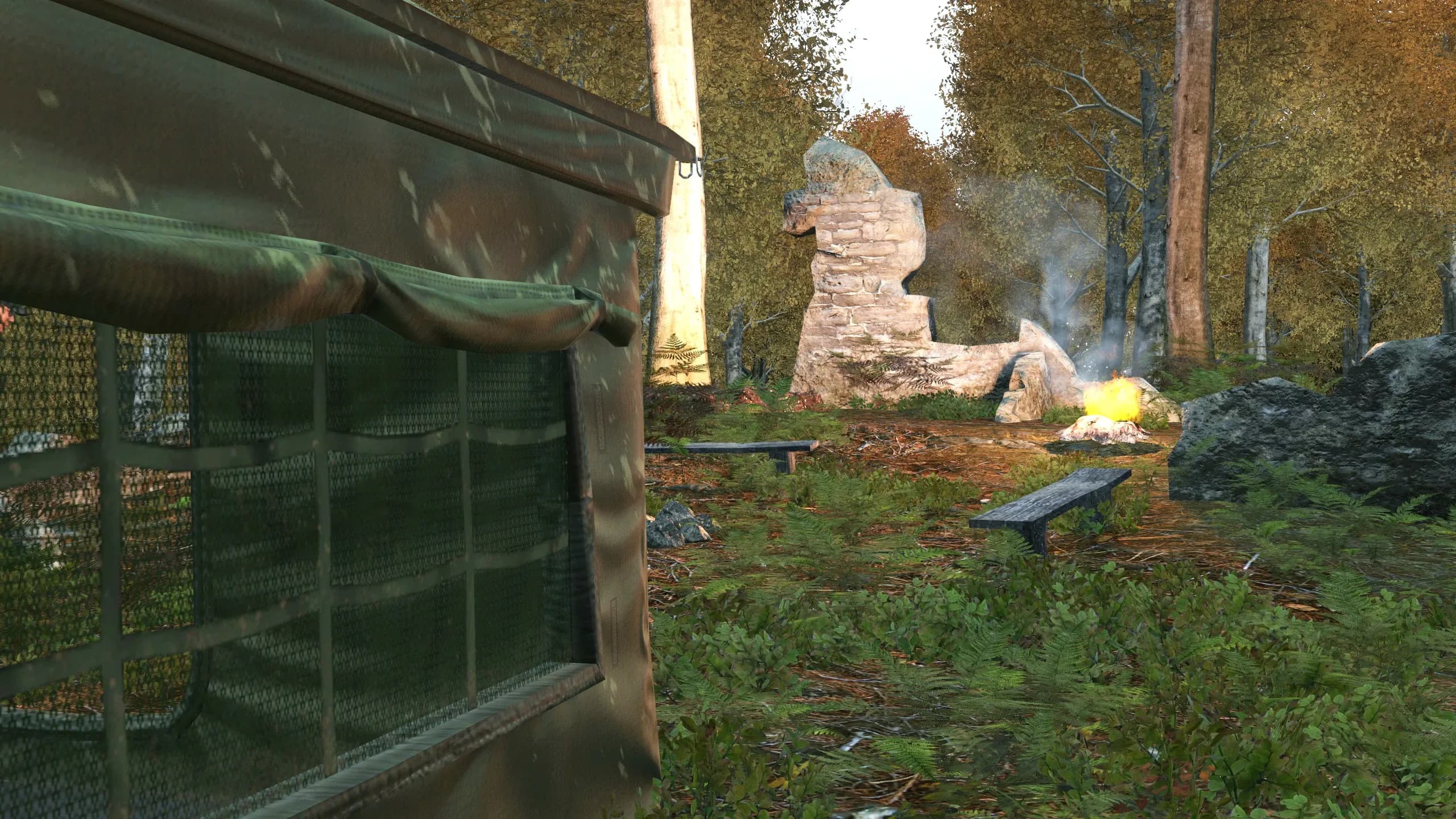
The kind of siting a flag pole rules out: it needs 11.3 metres of clear air above it.
Try to place a Flag Pole Kit and three rules go to work at once. You cannot turn it: PlacementCanBeRotated() returns false for this kit, so unlike almost everything else you deploy, the pole goes down facing whatever the game gives you. You cannot put it underground: TerritoryFlagKit sits on the deployment blacklist alongside the Fence Kit and the Watchtower Kit, so the bunker interiors on Livonia and Sakhal are closed to it outright. And before the game will let the kit go down at all, it fires a ray straight up from the placement point and refuses if anything solid is in the column.
The height of that column is the number to remember. Most deployables override the check with something modest — a Fence Kit asks for 2.54 metres of clear air, roughly its own height plus a little. The Flag Pole Kit asks for 11.3 metres, more than four times as much. That is not a clearance check on the kit sitting in front of you. It is a clearance check on the mast that will exist once you have finished, and it is the game telling you, at the moment of placement, exactly how visible the finished object is going to be.
Two honest caveats before you build a plan on it. The clearance test runs client-side only — it is the placing player's game that refuses, not the server. And it can be switched off at the server level entirely, via disableIsClippingRoofCheck in cfggameplay.json, which is one more of those quiet operator decisions from the previous section. So on a community server that has turned it off, poles under cover are possible. On officials, and on every server that has left the default alone, they are not.
Which settles the siting question in advance and not in your favour. No barn. No warehouse. Not under a road bridge, not beneath a low canopy of trees, not tucked into a bunker. The pole goes up in the open, on ground with eleven metres of nothing above it, and then it puts a piece of coloured cloth on the top of the mast where the whole point of the animation is that it can be read from a distance. This was the first thing players said about the feature when it appeared in the 1.09 experimental branch — one of them asking, before anybody had built one, whether the poles were "tall enough to attract a crowd of 'friendlies'" to an otherwise well-hidden base. It was never a question that thread could settle. The answer was in the placement code, and it has not moved since.
So the real price of the pole is not the haul. The haul is finite: you pay it, it is behind you, and if you are unlucky you pay it again. The advertisement is permanent, it renews every day you leave the base standing, and there is no version of the purchase that comes without it. What sixty metres of refreshing costs you is the option of not being found.
Set that against the alternative that has been sitting in the eligibility table since the start. An Underground Stash carries a fourteen-day lifetime. It needs no pole, casts no silhouette and puts nothing on the skyline, and because fourteen days comfortably clears the five-day viability bar, it is refreshed like anything else if it happens to lie inside a live territory — a buried stash out in the woods is a perfectly ordinary member of a flagged base, even though the flag itself can never go underground. Compare that with the Sea Chest above ground: forty-five days, refreshed by the flag, and sitting in the open where anybody who walks into the compound can see it and take it apart. The flag is what makes visible storage survive a long absence. It contributes nothing whatsoever to the argument that visible storage was a good idea.
Which turns the whole article into one question about you rather than about the pole: how long are you actually gone?
If you log in most weeks, you never needed a flag pole. An untouched forty-five-day structure outlasts a weekly player several times over, and every crate you open on a normal evening resets itself anyway. Building a mast to protect a base you visit every Tuesday buys you a landmark and nothing else.
If you disappear for a month or two at a time — a work stretch, a season on another game, a deployment — the refresher is doing real work for you, and this is the band it was designed for. Forty days of refreshing and roughly eighty-five days of total cover is a genuinely long leash, and the trade is worth taking. Plan the return around the mast, not around the walls: once the mast reaches the ground the pole has, on the shipped numbers, about seven days of its own life left, and after that there is nothing standing to hoist a flag on.
If you vanish for longer than that, the pole does not save you and never could. Eighty-five days is the ceiling on the whole system, and a player who is away for six months loses the compound with a flag on it exactly as surely as without one. That player should not be building. That player should be burying.
So make the call in that order, next time you are standing in a treeline deciding what to do with an afternoon. First: are your absences routinely longer than the forty-five days an untouched structure already survives on its own — judged by what your login history actually shows, not by what you intend? Second: is what you cannot afford to lose already sitting in visible containers above ground, where only the flag is renewing it? Third: can you reliably get back before the mast bottoms out?
Three yeses and the pole earns its place. Anything else and the better afternoon is a compact compound you can walk away from and a line of stashes nobody can see — as long as you do not mistake buried for permanent. A stash carries fourteen days of its own, so standing alone out in the woods it wants a visit inside a fortnight, while one dug in near a live pole rides the same five-day tick as your walls do. That second arrangement is the one that gets you both halves: a refresher renewing what is in the ground as well as what is on it, and the things you would most hate to lose sitting where no silhouette points at them. Dig those in tonight, before you decide anything at all about the mast.