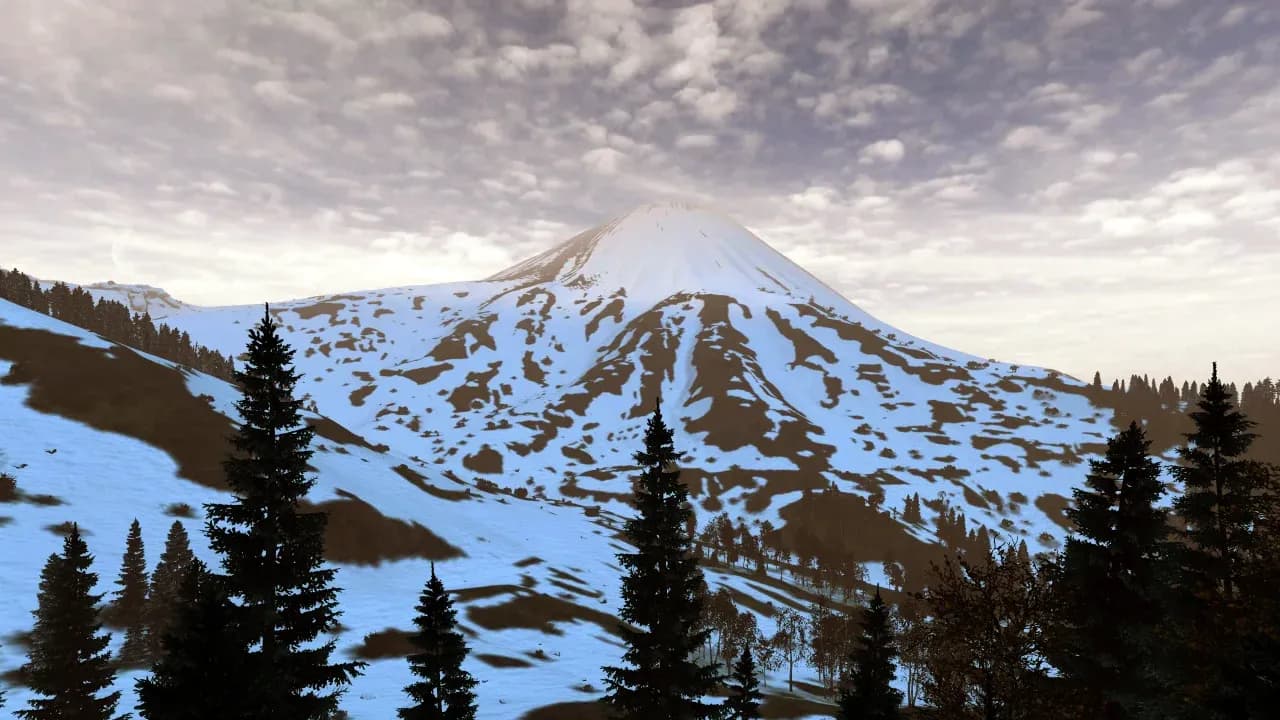
Every habit you built on Chernarus is a routing habit. The coast is poor, the interior is rich, so you walk north until the buildings start holding rifles instead of soda cans. Sakhal keeps that shape and deletes the reasoning behind it. On an archipelago of 105 km² — 83 km² of it actual land, the rest ice sheet — where the ambient temperature sits below freezing, the resources that decide whether your character sees the next hour are heat and clean water, and both of them are consumables you have to carry. Frostline is not Chernarus with a snow filter over it. It is a map where the loot run is a supply run, and the people who die on it are usually the ones who packed as though it wasn't.
The Coast Stops Being the Place You Leave
You still spawn on a shoreline, and since update 1.29 the game deliberately scatters those spawns further apart on repeated deaths, so you cannot count on rejoining a friend by dying near them. What changes is what you do next.
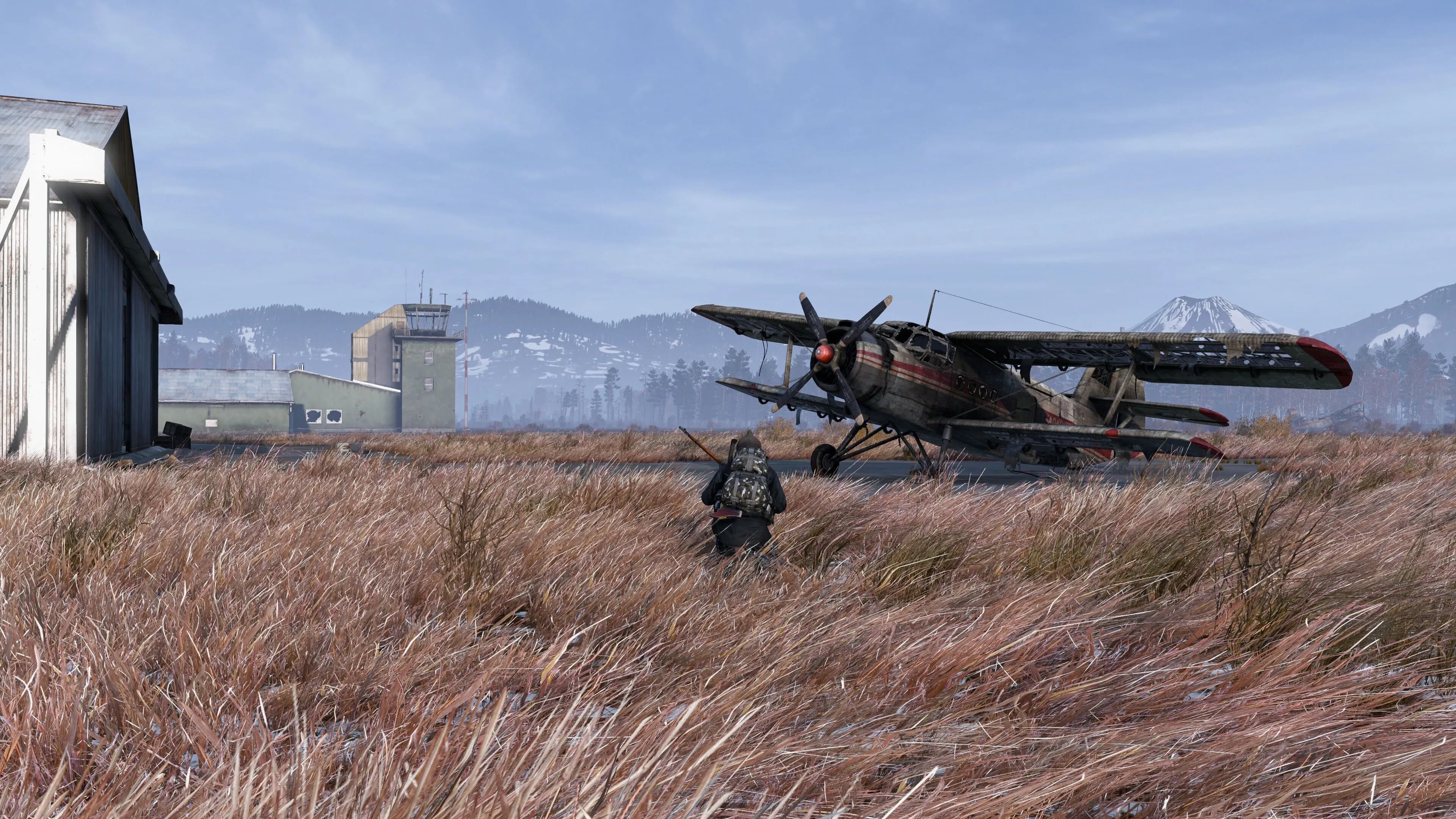
Nogovo Airfield is the map’s only airfield and, unusually for DayZ, an early-game destination.
Sakhal has no water pumps. It has water springs, and they are the only direct source of clean water on the map. They sit outside settlements rather than inside them, and they are concentrated on the main island's coastal ground rather than around the inland villages — which is the opposite of the Chernarus arrangement, where a well is a thing you pick up on the way to somewhere else. The hard version of the same fact is Burukan, the military peninsula in the south-west: there is no clean water anywhere on it. Not a spring, not a pump, nothing. The map's best military ground is also the only place on it where being thirsty has no local answer.
Food points the same way. Sakhal's inland lakes are frozen solid, and no tool in the vanilla game opens one — not a hammer, not a grenade, not even the Ice Axe, which mines boulders and has no interaction with ice at all. The ice-fishing clips you have seen come from community mods. Fishing itself is fine; it is just salt-water fishing now, Steelhead Trout and Pollock on a rod, shrimp in a Small Fish Trap. The trap is the one piece of gear that changes your day, because it works while you do something else: placed bare it catches on a 15% chance, baited with an earthworm on 85%, and it triggers 15 to 25 minutes after you drop it, provided you stay at least 25 metres away. It degrades a condition step each time, so a pristine trap is four fish and then rubbish. Note what those numbers ask of you — twenty-odd minutes loitering within sight of a shoreline you cannot leave. That is the most exposed thing a fresh spawn does on this map, and it is also the cheapest food on it.
The payoff for staying low is Nogovo Airfield, and it has no Chernarus equivalent. It is the map's only airfield, sitting on the south side of the main island between Nogovo and Dudino, and it holds medical supplies in its northern cluster and the bulk of the military loot in its southern one — a hospital run and a barracks run inside the same fence line. Forest closes in on both approaches, which is why it survives being obvious: you can arrive and leave without ever standing in the open, so long as you resist the smaller cluster east of the runway and the crossing it demands. Nobody gears up at the North-West Airfield as a freshie on Chernarus. On Sakhal you go to Nogovo Airfield early, because Nogovo Airfield is in the half of the map where the water is.
Heat Is Cargo
Frostline made temperature a property of items, not just of your character, and that one change is what turns cold from a weather effect into a logistics problem. Food left out cools through Hot, Warm, Chilly and Cold until it freezes, and frozen food sitting in your inventory pulls warmth out of you the whole time it is in there. Thawing is not a special mechanic — you warm it at a fireplace exactly the way you dry a jacket. Which means the trade runs both ways: a hot steak or a warm cooking pot carried against your body is portable heat, and a well-timed cook is worth as much to you as a coat.
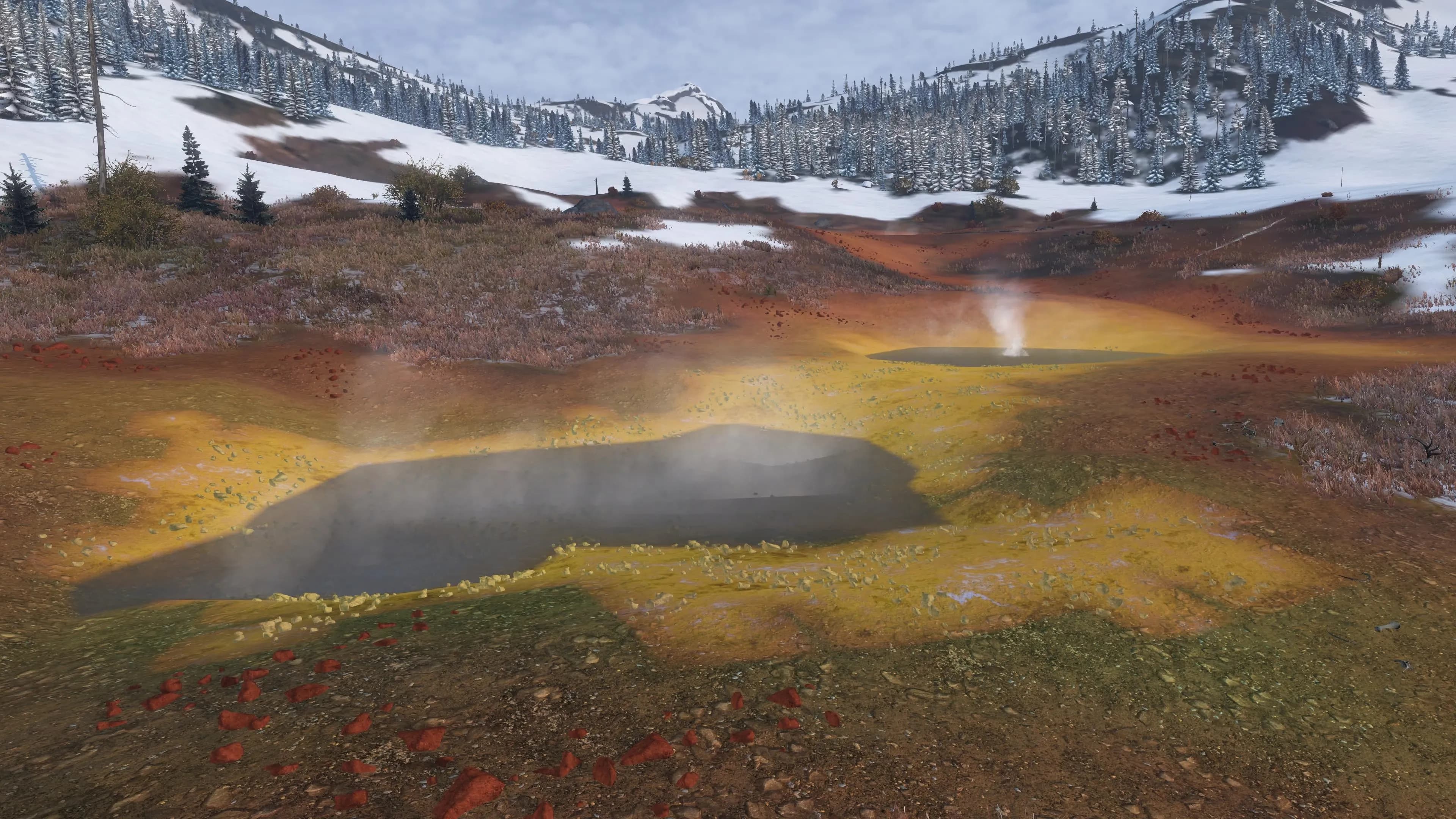
Hot springs put out fireplace-grade heat that never goes out — and erupt into geysers that kill anyone standing in the pool.
The coat still matters, and Frostline made insulation seasonal, so the Winter Hunter Gear insulates where the Summer Hunter Gear does not — the winter variants are not a cosmetic tier. Every soaking undoes that, and every drying costs a fire; update 1.29 removed the shortcut where a torch dried clothes faster than a fireplace, so wet clothes and frozen food now queue for the same flame. Firewood, matches and somewhere sheltered to burn them are the actual bottleneck on a long Sakhal route.
The map hands you free heat in exactly one place, and it is a trap dressed as a gift. Hot springs, in the drainage area of the volcano Odinokiy Vulkan, put out heat equivalent to a fireplace and never go out; stand next to one in good insulation and your temperature indicator climbs to its top state with nothing lit. Step into the pool and you warm much faster while taking burn damage to your health and your clothing, the same as standing in a fire. And the pools erupt: the centre starts bubbling and domes with steam, and the geyser that follows kills anyone standing in the water instantly. The volcano's crater offers the punishment without the payment — climbing down into it burns you the way a fireplace does, and it produces no warming effect at all, so there is no version of that trip that is worth taking.
So you plan a Sakhal route the way you would plan a hike with a fuel budget: fire to fire, spring to spring, with something cooked in your vest for the stretch between them.
Snow Is a Loan Against Your Thirst
Eating snow is the obvious answer to all of that, and it is why Heavy Metal Poisoning exists. You catch it from untreated snow or from drinking straight out of a hot spring, and its stages are unusually specific about what they take. Stage 1 drains 0.24 hydration per second — 14.4 a minute — and sets you shivering. Stage 2 pushes that to between 0.26 and 0.53 a second and adds slower stamina regeneration, intermittent deafness and random blurring. Stage 3 stops draining hydration and starts draining health at 0.003 to 0.045 per second, floats black clouds across your vision, and kills you between 40 minutes and nine hours later if you never treat it.
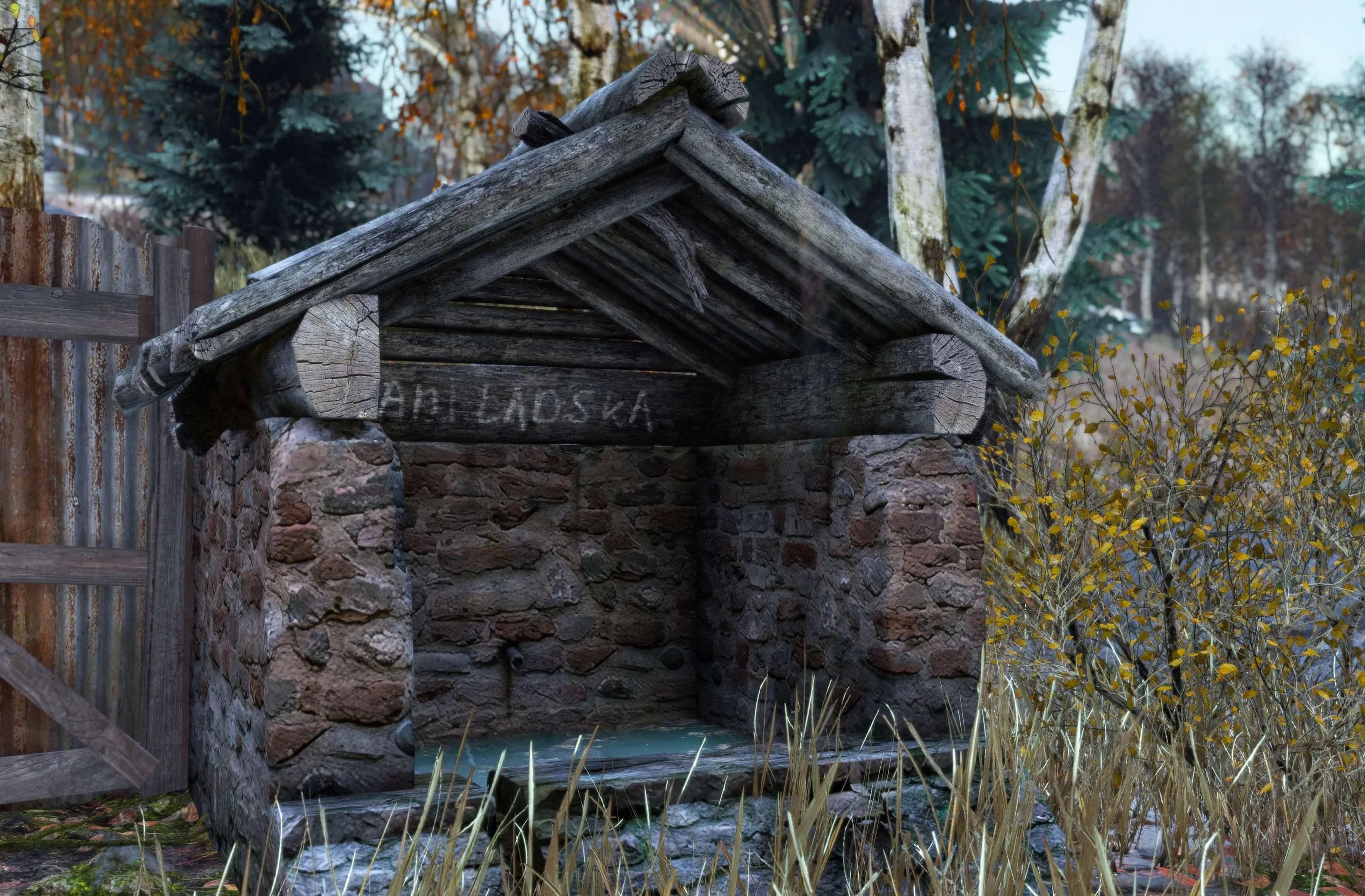
Water springs replace Chernarus wells on Sakhal — and sit outside settlements rather than in them.
The first two stages are the whole point. You ate snow because you were thirsty, and the illness bills you more thirst than the snow repaid. Snow buys you time at the edge of a bad situation; taken as a habit, it funds your own stage 3.
Treatment is stranger than the disease, and getting it wrong is easy because the intuitive move is the wrong one:
- Stage 1 or 2: take nothing. It clears by itself in about 40 minutes, or in six if your immunity is high.
- Chelating Tablets at stage 1 or 2: actively slow that recovery. You will be ill longer than if you had ignored it.
- Stage 3: Chelating Tablets are the only way down, and they only take you back to stage 2. Then stop.
- Multivitamin Pills: the way to raise immunity to the six-minute threshold — but the boost does nothing while contaminated water is still digesting, so take them after, not with.
Prevention is cheaper than every version of treating Heavy Metal Poisoning after the fact. Chelating Tablets used on a filled container strip the heavy metals before you drink, and a Filtering Bottle lets you drink contaminated water straight from it. Learn the bottle's limits before you trust your life to it: 0.65 litres in capacity, 10 of its 100 health points spent per litre drunk, which works out at about 15 refills before it ruins — filling and emptying cost nothing, only drinking does. It also cannot take anything over 80 °C, so a pot of boiled water poured into it destroys the thing that made the water safe. And know what does not work at all: boiling and Chlorine Tablets clear plenty of pathogens, but they leave heavy metals exactly where they were.
Burukan Rewards Supply, Not Aim
Burukan is Sakhal's military heartland and the clearest statement the map makes about what it wants from you. One landbridge connects it, ending in a military checkpoint that everyone arriving on foot has to pass — a chokepoint on a peninsula with wolf and bear spawns scattered across the whole of it and, since update 1.27 stripped its trees and vegetation, no cover to speak of. That change turned Burukan into long-range ground: you are visible from a long way off for most of the walk, and the players already there know it. Add the zero clean water and the trip stops being a raid and becomes an expedition you provision for.
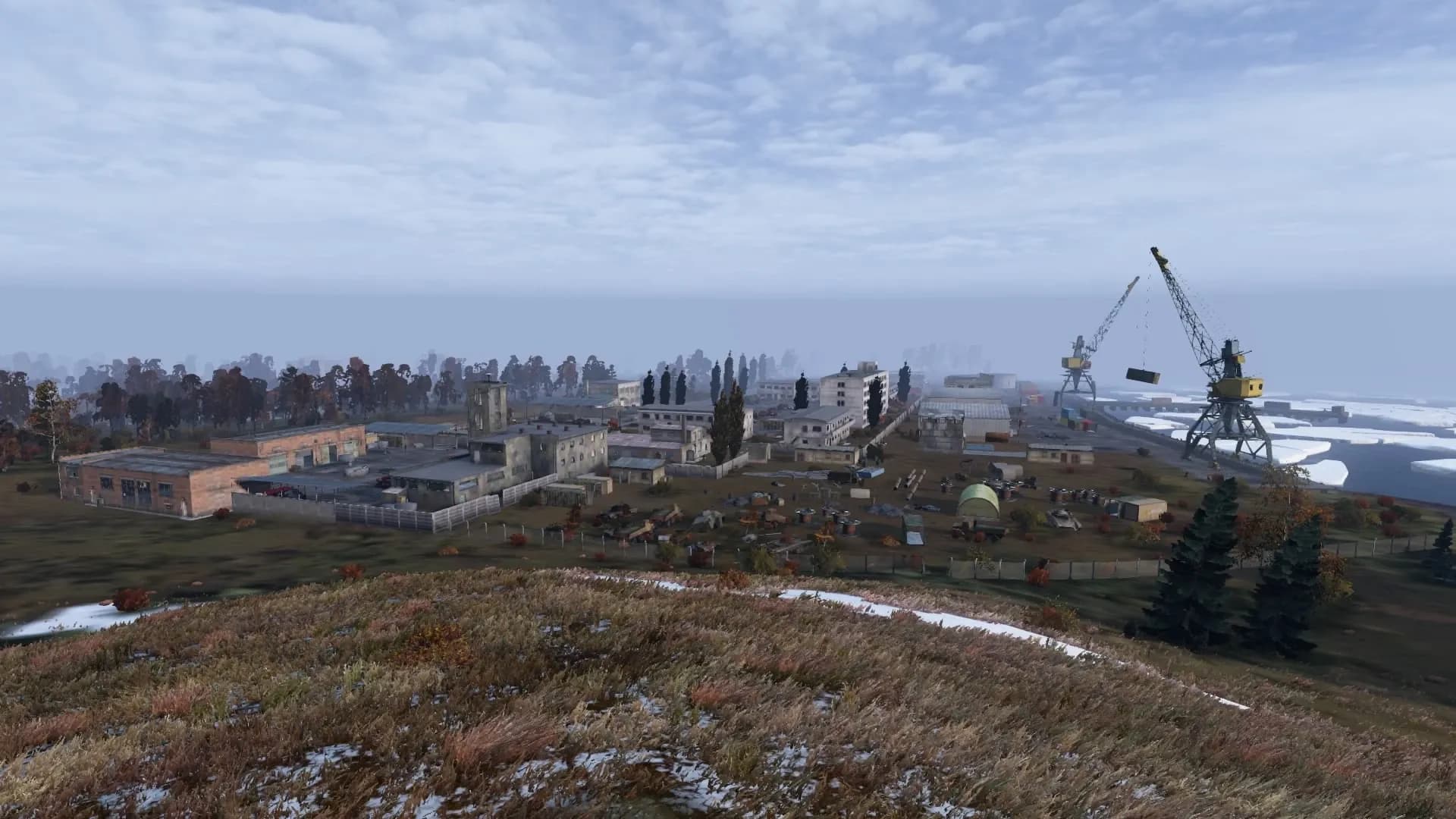
Cerny Mys holds the highest count of tank garages and barracks on Sakhal — and since update 1.28 it is loot tier 3 like the rest of Burukan.
What you are provisioning for has quietly changed value. Since update 1.28 the entire peninsula sits at loot tier 3, including Cerny Mys — the enormous military port at the south-eastern end with the highest count of tank garages and barracks on the map, which used to be tier 4. The top-end weapons moved to dynamic events instead. Beached Containers, washed up on the islands' shorelines, are under vanilla settings the only source of the M16-A2, M4-A1, AK-101 and the tactical helmet, and since 1.27 their doors carry colour-coded locks needing a matching container key — bring the wrong colour and the key destroys itself. The best gun on Sakhal is not guarded by better players. It is guarded by whether you brought the right key to a beach.
The Burukan Bunker takes that to its conclusion, and update 1.29 — the current build, released 8 April 2026 — added a new section to it. Its main room and four warhead storage rooms are electronically locked, and opening any of them means restoring power, which means gasoline and a Glow Plug. Gasoline is ordinary industrial loot. The Glow Plug is not: it does not spawn as regular loot under vanilla settings at all, and the only source is the Scientific Briefcase lying beside a Frozen Scientist, which spawns at randomised points within about a kilometre of Odinokiy Vulkan's crater and needs Scientific Briefcase Keys to open. Those keys cluster at the unnamed research outpost a kilometre south-east of the volcano. The briefcase earns the detour twice over: alongside the Glow Plug it carries two Filtering Bottles, Chelating Tablets, Tetracycline Pills, an Ice Axe, a GPS Receiver and a 9V Battery — the answer to your water problem and the key to the bunker, in the same box, on the far side of the map from the door it opens.
Bring a partner for the door itself. The power station sits about 500 metres east of the bunker entrance, at map coordinate 030 095, and its panel carries four switches, D1 to D4, one per storage room. Only one may be open at a time, and hitting a second before closing the first short-circuits the panel until it resets. Alone, that is four round trips of half a kilometre with the generator burning fuel you hauled across a peninsula with no water on it, and every one of those walks is taken in the open on ground with no trees left. Two players — one on the panel, one in the rooms — turn the same run into a single tank of gasoline and one exposure instead of eight.
Before you cross the Burukan checkpoint, count your litres, your matches and your fuel. The magazines were never the part that was going to run out.