A repaired vehicle is not ready for a long DayZ trip just because its engine starts. Fuel stations exist across Chernarus, Livonia, and Sakhal, but the useful question is whether the next pump is reachable, working, and safe enough to use. Your portable fuel plan matters just as much: a Jerrycan holds 20 L, while the vehicles in this guide range from a 38 L Sarka 120 to a 120 L M3S.
That makes gasoline a route-planning problem rather than a single-item checklist. This guide maps the main fuel anchors, separates containers that can actually carry gasoline, compares current vehicle tank capacities, and turns those numbers into reserve decisions without pretending they reveal a vehicle’s driving range. It ends with the pump-stop procedure that keeps a defective station, an exploding pump, or a watching survivor from ending the run.
Where to find fuel pumps across Chernarus, Livonia, and Sakhal
All three official maps have named fuel pumps, but their names are starting points for route planning rather than guarantees of a usable pump. Stations appear either as small sites with one pump and a building or as larger, roofed stations with several pumps. That makes them useful landmarks, but you still need to confirm where the station sits and whether it can support your trip.
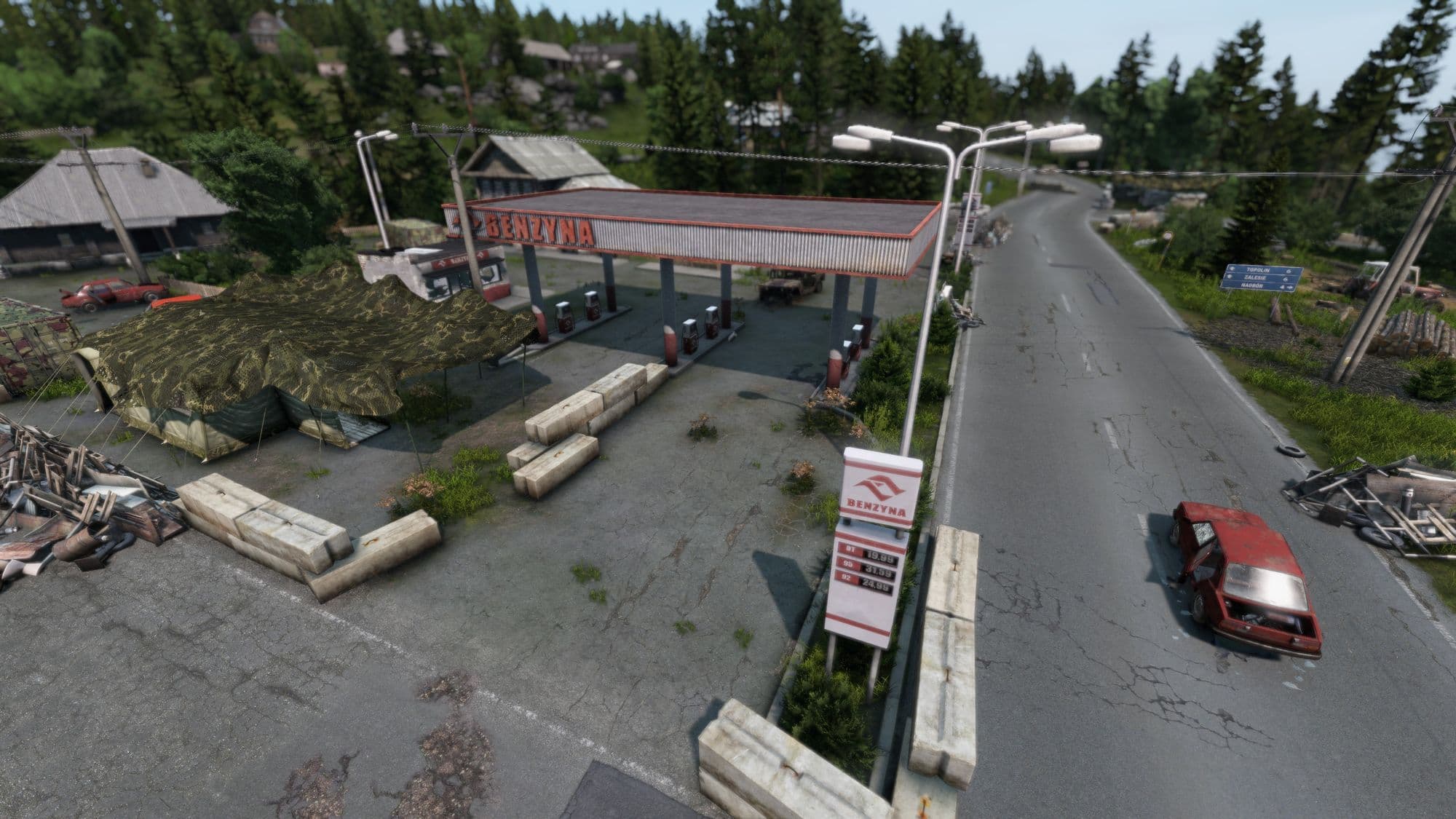
A named station becomes a route anchor only after its pump and approach are checked.
Chernarus
- Berezino
- Chernogorsk (two locations)
- West of Elektrozavodsk
- Grishino
- West of Kamensk at Tishina Dam
- North-West Airfield (two locations)
- East of Novaya Petrovka
- Pavlovo Military Base
- West of Pogorevka
- North of Polyana
- South of Pustoshka
- Severograd
- Solnechny
- South of Staroye
- Svetloyarsk
- Three Crosses
- Topolniki near Novaya Petrovka
- Vybor
- North Zelenogorsk
Livonia
- Brena
- Nadbór
- Polonina
- Sitnik
- Topolin
Sakhal
- Black Cape
- Nogovo
- Nogovo Airfield
- Petropavlovsk-Sakhalinsk (two locations)
- Rudnogorsk
- South of Shumnoye
- Severomorsk
Use an interactive map to turn those names into possible stops. A static list tells you that a station exists, while the map shows its position relative to roads, military areas, contaminated zones, and terrain. For example, you can mark several Chernarus candidates near the part of the map you intend to cross, then compare the same route-planning approach against the smaller Livonia or Sakhal anchor lists. The order is not universal: your vehicle’s location, spawn pattern, server population, and current world state all change which station is practical first.
Treat every name as a candidate until you verify two things:
- Its position fits the route without forcing an unnecessary detour.
- The pump is present and usable when you reach it.
A named list is not proof that every pump currently works, and it is not necessarily an exhaustive census of every unmarked military pump. Before committing to a long drive, mark multiple possible stations along the intended route and keep at least one alternative in mind. The map establishes where a stop might be; the world state determines whether it is actually worth stopping there.
Once the possible pumps are mapped, the next decision is choosing a container that can carry the gasoline.
Which containers can carry gasoline
Once you reach a pump, you are not limited to the item named “Gasoline Canister.” Pumps can fill Jerrycans, Plastic Bottles, Cooking Pots, and Canteens with gasoline. The liquid-system changes from the 1.06 era distinguish gasoline from water and diesel, so the useful fuel kit is broader than a single container type.
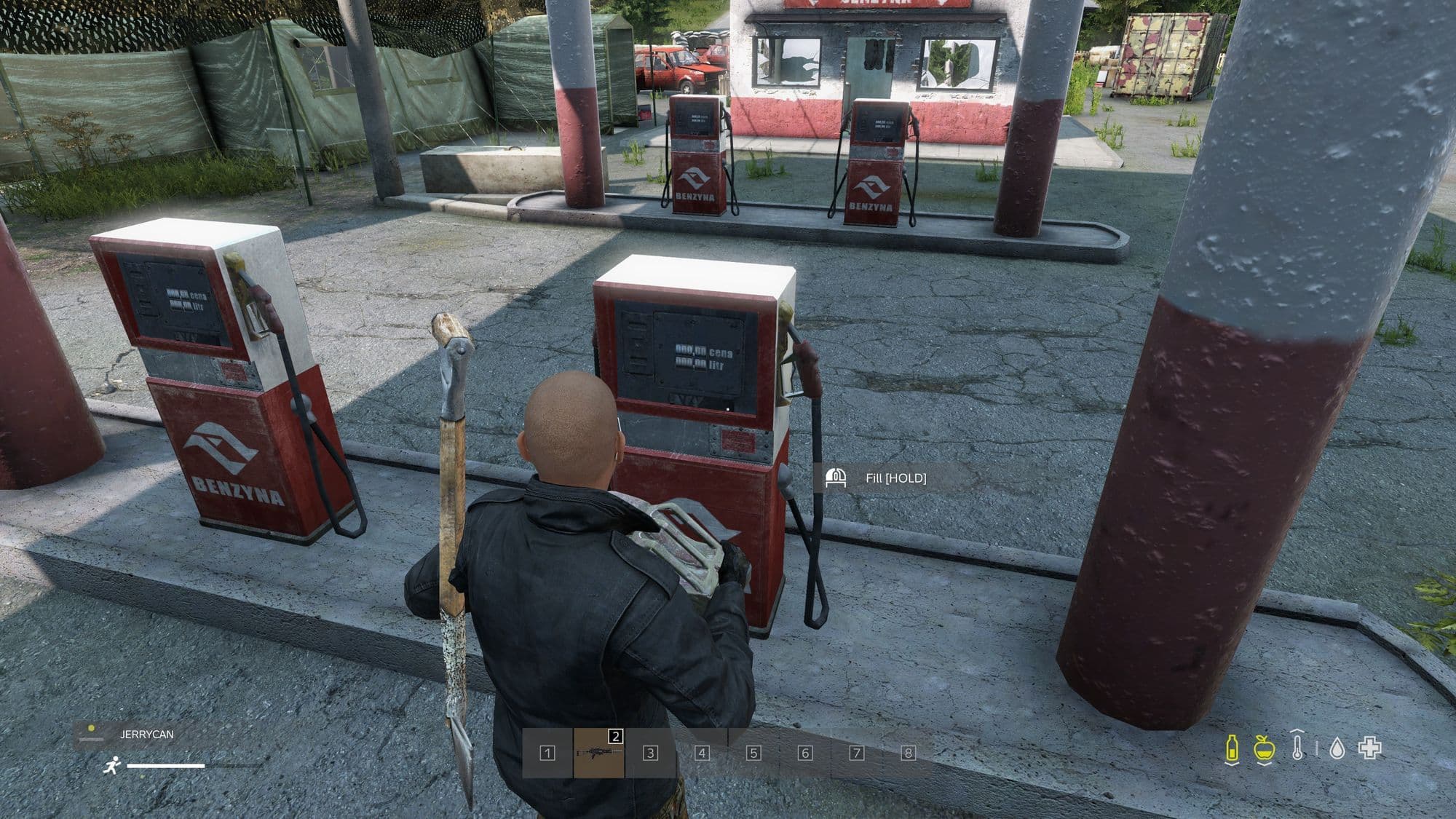
Fill the portable container first, then move away from the pump before fueling the vehicle.
The Jerrycan is the main reserve: its classname is CanisterGasoline, and it holds 20 L. A Plastic Bottle or Canteen holds 1 L, making either a much smaller backup. For example, one Jerrycan carries twenty times as much gasoline as one 1 L bottle or canteen, so the smaller containers are convenient emergency top-ups rather than replacements for a proper reserve.
| Container | Gasoline use | Practical role |
|---|---|---|
| Jerrycan | 20 L | Main portable reserve |
| Plastic Bottle | 1 L | Small backup reserve |
| Canteen | 1 L | Small backup reserve |
| Cooking Pot | Fillable with gasoline | Awkward emergency reserve |
| Filtering Bottle | Cannot store gasoline | Unsuitable for fuel |
Water state matters before you fill anything. Empty the water from a Plastic Bottle or Canteen first; a container holding water is not ready to accept gasoline. The same warning applies to a Jerrycan that you previously emptied and repurposed for water: check which liquid it contains before carrying it to a vehicle.
A Filtering Bottle cannot substitute for either a normal bottle or a canteen as a fuel container. Its filtering function is for treating drinking water, not for storing gasoline, and its similar shape does not make it compatible with the pump’s gasoline interaction. An Oil Barrel can store up to 200 L by liquid transfer, but do not assume it is always directly fillable from a pump. The same liquid containers can also fuel a Power Generator, but its 7,000 mL tank and roughly eight-hour runtime are separate from vehicle fuel consumption.
The practical loadout is simple: bring an empty compatible container, use bottles or canteens only after emptying their water, and verify the liquid inside any repurposed Jerrycan. With that portable fuel kit settled, the next question is how much gasoline your specific vehicle can consume before another stop.
How much fuel each DayZ vehicle holds
The container determines what you can carry, but the vehicle determines how much that reserve must support. The civilian cars cluster around smaller tanks, while the military M1025 and industrial M3S require a much larger fuel plan.
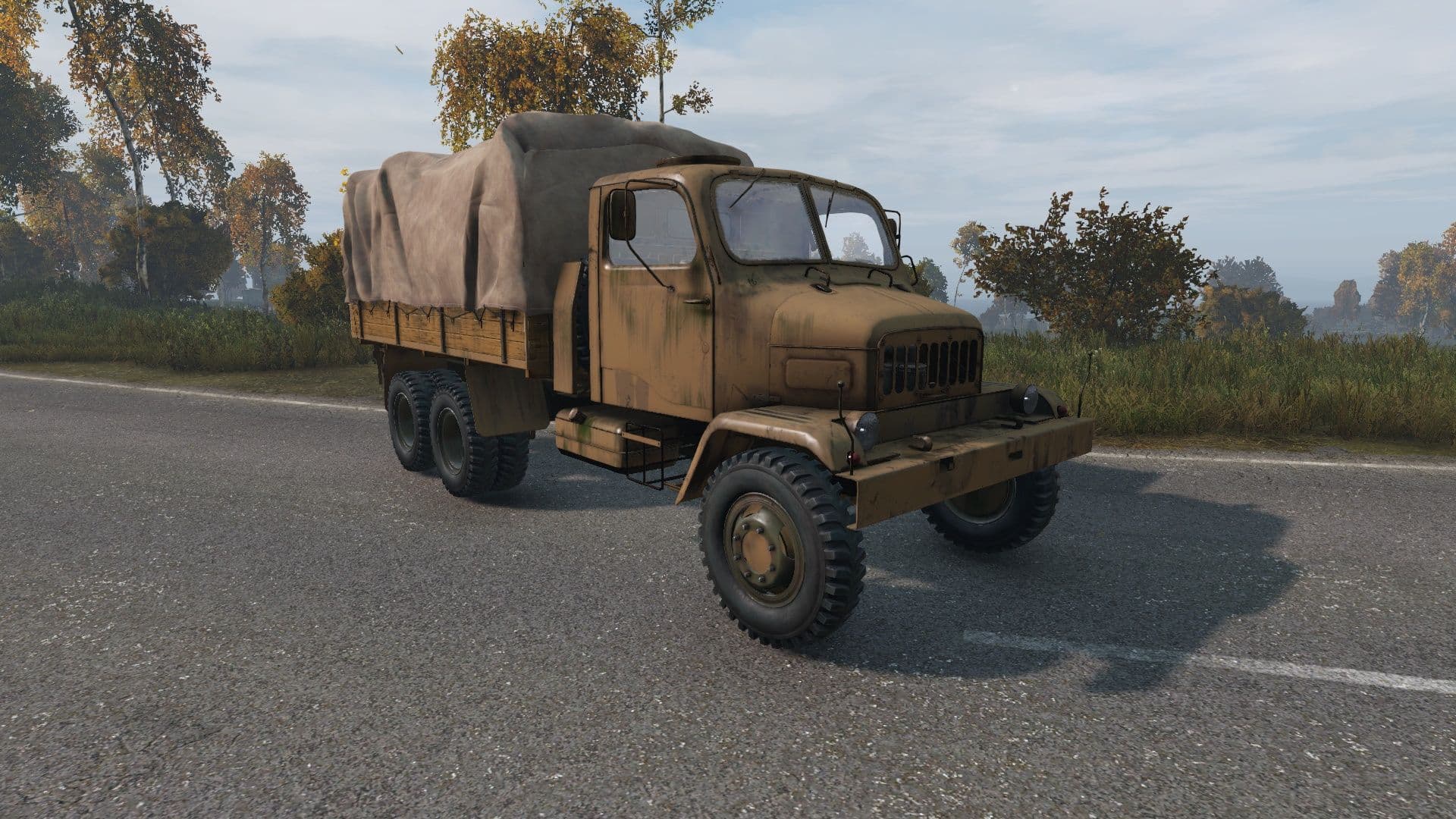
The M3S leads this comparison with a 120 L tank.
| Vehicle | Tank capacity | Repair-part distinction |
|---|---|---|
| Sarka 120 | 38 L | Standard car parts: Spark Plug and Car Radiator |
| Ada 4x4 | 42 L | Standard car parts: Spark Plug and Car Radiator |
| Gunter 2 | 42 L | Standard car parts: Spark Plug and Car Radiator |
| Olga 24 | 55 L | Standard car parts: Spark Plug and Car Radiator |
| M1025 | 115 L | Uses a Glow Plug instead of a normal Spark Plug |
| M3S | 120 L | Uses a Truck Battery; its listed parts do not include a normal Spark Plug or Car Radiator |
That spread is the planning difference: a 38 L Sarka 120 and a 120 L M3S need different portable-fuel plans.
That capacity difference matters alongside the repair-parts distinction. A standard civilian car uses four wheels, a Car Battery, a Spark Plug, a Car Radiator, and gasoline. The M1025 changes the ignition part to a Glow Plug, while the M3S uses a Truck Battery and follows a different listed operating-parts setup. Fuel planning therefore starts with identifying the vehicle, just as repair planning does.
These are current 1.29-era capacity values, so treat them as a version-specific reference rather than an unchangeable rule. Before deciding how many Jerrycans to stage, identify whether you are supporting a Sarka, Ada, Gunter, or Olga—or a much more fuel-hungry M1025 or M3S. A reserve plan that is sensible for a civilian car should not automatically be carried over to either large vehicle.
Tank capacity determines reserve demand, but it does not provide a distance estimate. To plan the trip, combine the vehicle’s capacity with reserve counts, map stops, pump condition, and current server conditions.
How many reserves to carry before a long trip
Treat the Jerrycan count as a ceiling for filling an empty tank, not as a distance estimate. With 20 L per Jerrycan, the arithmetic works out like this:
| Vehicle | Full-tank planning ceiling |
|---|---|
| Sarka 120 | 2 full Jerrycans |
| Ada 4x4 or Gunter 2 | 3 full Jerrycans |
| Olga 24 | 3 full Jerrycans |
| Empty M1025 or M3S | 6 full Jerrycans |
The smaller-car plan is therefore two or three full Jerrycans, while an empty M1025 or M3S may require the six-Jerrycan ceiling. These figures assume the vehicle starts empty and that the fuel transfers completely. Fuel already in the tank, imperfect transfers, or fuel consumed before the next stop all reduce the useful margin. Conversely, carrying six Jerrycans does not tell you how many kilometers or miles the vehicle can travel: tank capacity alone cannot establish driving range without a verified current fuel-consumption figure.
Use the interactive map to turn that ceiling into a route between possible station anchors. Chernarus has dense southern, eastern, and inland clusters, so one possible planning sequence is Chernogorsk → Elektrozavodsk → Staroye → Berezino → Zelenogorsk → Vybor → North-West Airfield → the Novaya Petrovka area. This is an example of linked checks, not a universal route; your vehicle’s starting point determines which anchor comes first and which becomes the fallback.
Use these as illustrative anchor sequences, not recommended routes. Choose the first anchor that best fits your current vehicle position and intended destination, then choose each next stop from the interactive map after checking route geometry and pump condition:
- Livonia: Brena → Sitnik → Topolin → Nadbór → Polonina
- Sakhal: Black Cape → Nogovo → Nogovo Airfield → Petropavlovsk-Sakhalinsk → Rudnogorsk → Shumnoye → Severomorsk
Keep an alternative anchor. The order is a planning reference, not a guarantee that any listed pump is available.
That reserve plan feeds directly into the pump-stop procedure: the next decision is how to make the stop without turning a fuel run into an avoidable death.
How to refuel without turning the pump into a death trap
A fuel pump is both a resource and a hazard. Pumps can explode and kill players when shot or otherwise damaged; Bohemia’s 1.05 notes even documented fixes to the explosion’s direction and smoke. Treat the pump as dangerous machinery, not harmless scenery.
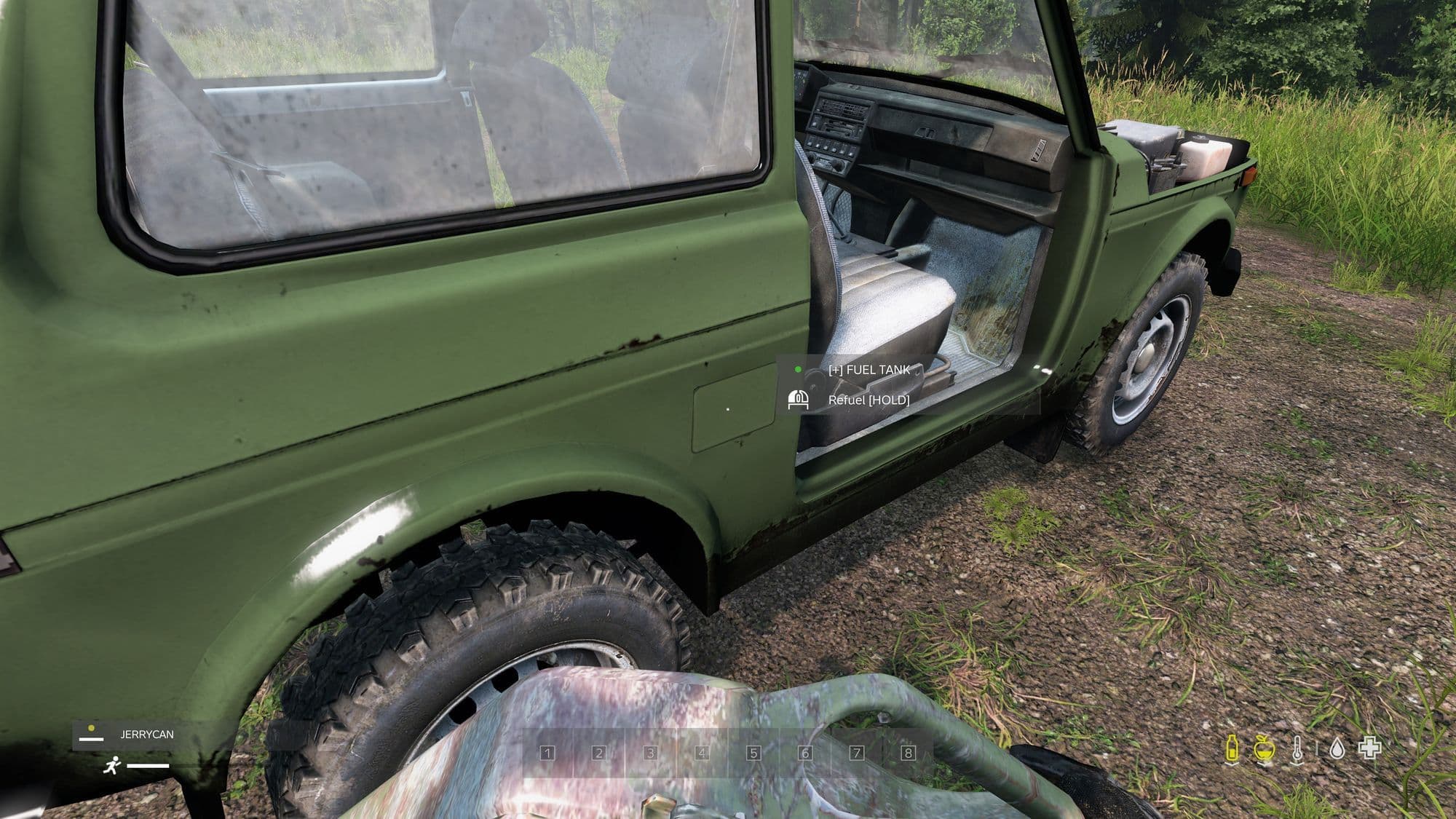
Refuel at the vehicle only after leaving the pump area and checking the surroundings.
Stop short and inspect it before committing to the refueling stop. A visibly damaged pump, such as one showing a protruding circuit board, may not dispense fuel. Test its usability before building the rest of your route around it. If it fails, leave and use a fallback station rather than standing beside it trying to force the interaction.
A safe pump-stop sequence is:
- Approach carefully and assume another player may be watching the station.
- Use a compatible empty container and fill it at an intact pump.
- Leave the pump and its immediate exposure point.
- From cover or a position with a clear escape route, check the surrounding area.
- Approach the vehicle’s fuel cap and hold the refuel interaction with the filled container.
Keeping the vehicle off during this process is sensible caution, but it is not a verified hard mechanic that should be presented as mandatory. The important separation is between filling the portable container at the pump and transferring that fuel at the vehicle. It reduces the time you spend beside an explosive pump and lets you check for an ambush before committing to the second interaction.
In update 1.25, the Livonia-branded (Enoch) pump type stopped dispensing, while military-style pumps could still work; Bohemia marked the issue resolved for an upcoming hotfix. That history explains conflicting reports, but it does not mean Livonia pumps are universally broken now. Check the pump you actually reach, account for server and version state, and keep distance from the station whenever possible.
Before driving, verify the map stop, compatible container, vehicle capacity, reserve count, pump condition, and escape position.