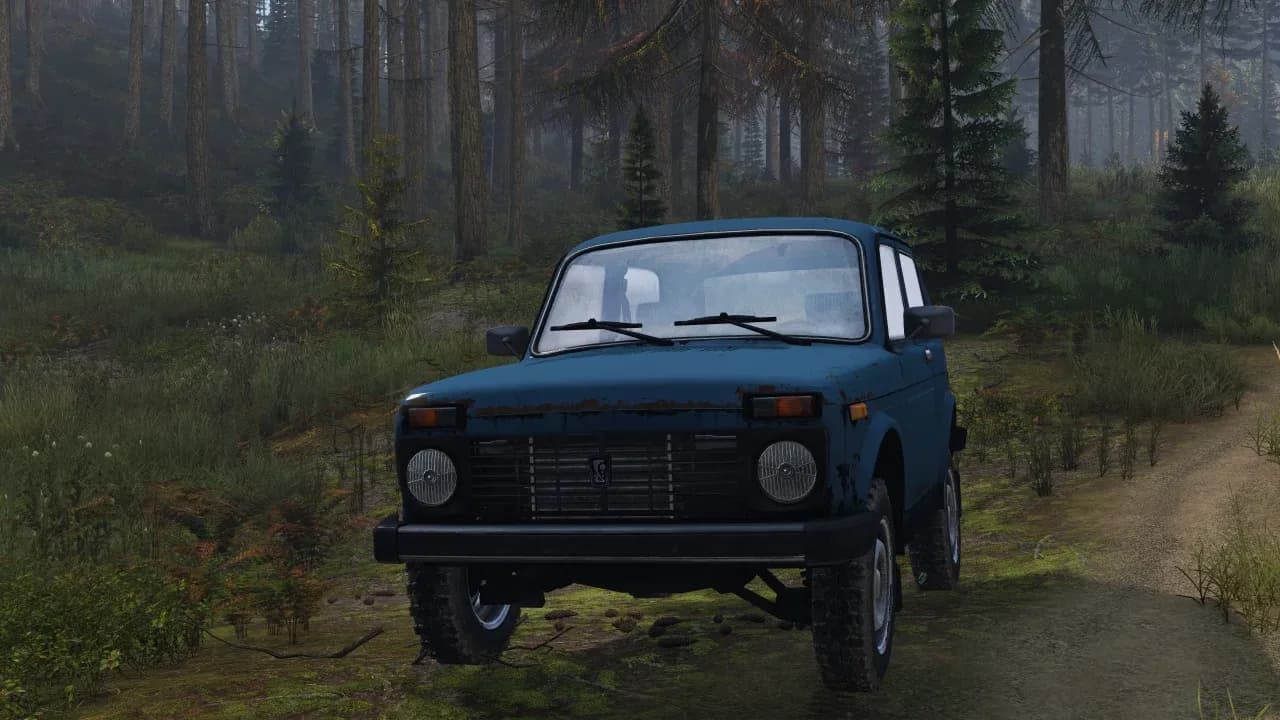
Ask anyone who has lost a car in Chernarus how it happened and you will rarely hear a story about gunfire. You will hear that it would not start, that the wheels were gone, or that it simply was not there after the restart. That is the honest shape of vehicle ownership in DayZ: your car is not competing against other players so much as against your own throttle discipline, the tools you did or did not bring, and the patch of ground you left it on. Two of the parts it needs cannot be repaired at all, one of those is destroyed by nothing but revving the engine, and every component bolted to the chassis comes off by hand unless you have specifically locked it. Get that right and a car outlives several of your characters. Get it wrong and you rebuild the same vehicle every week.
Most of the Car Is Optional
For the four ordinary cars — the Ada 4x4, Gunter 2, Olga 24 and Sarka 120 — the genuinely required set is four wheels, a Car Battery, a Spark Plug and a Car Radiator. Doors, hood, trunk lid and Headlight Bulbs are body parts, and the engine turns over without any of them. You will drive home in a roofless shell with no lights, but you will drive home. That distinction is worth holding onto when you are standing over a half-stripped wreck deciding whether to spend another hour searching.

Engine parts and body parts also come from different loot. Batteries, spark plugs and radiators are industrial: garages, warehouses, factories, sheds and barns. Wheels, doors, hoods and trunk lids come off the static car wrecks that sit at fixed positions around the map, which is why a broken-down car parked near a wreck of the same model is a far better prospect than one sitting on its own.
Two vehicles break the parts list, and knowing which one you are standing in front of changes what you go looking for. The M3S truck runs on a Truck Battery alone — no spark plug, no radiator, so two of the three scarce engine parts stop mattering. The M1025 is diesel, and takes a Glow Plug where every other vehicle takes a Spark Plug, which means the part you have been hoarding does not fit it.
The Spark Plug Dies From Your Right Foot
The Spark Plug cannot be repaired. There is no kit, no putty, no blowtorch pass that brings it back — damage to it is permanent, and a ruined one means the engine will not turn over at all. And the thing that damages it is not a bullet or a collision. It is redlining: holding the revs at the top of the gear.

Every land vehicle except the M1025 is a manual, shifted with Q and E by default on PC and with dedicated up and down shift inputs on console, and the tachometer sits in the dashboard cluster telling you exactly when you are cooking the plug. Unpaved slopes are where it happens, because the wheels break traction and the revs run away from you while the car barely climbs. Shift up, or ease off and take the hill slower.
The M3S does not even get the mercy of a replaceable part. It carries no spark plug at all, but redlining damages the truck internally, and that damage cannot be repaired afterwards. A truck driven hard uphill is a truck being permanently spent.
Until recently you could redline without touching the throttle: on unstable or low frame rates, the gear you selected could be skipped over unintentionally. Update 1.29 fixed that, which removes the last excuse — a plug that burns out now is a plug you drove out.
The Engine Forgives; the Radiator Does Not
Where the spark plug is binary, the radiator bleeds you slowly. It holds 5,850 ml of water, and you fill it by aiming at the top-right corner of the unit sitting behind the front grille. That is six litre containers — Plastic Bottles and Canteens both hold 1,000 ml — or three Cooking Pots at 2,000 ml each. Keep pouring until the engine stops smoking.
Two separate thresholds tell you when the car is hurting itself, and they are not the same measurement. The water level can fall to about a quarter of the tank, and the temperature needle can climb to about three quarters of the gauge, before the engine starts taking damage. Either one is a margin, not a plan. A radiator in Damaged or Badly Damaged condition leaks, so it burns through water far faster than a healthy one, and like the spark plug it cannot be repaired — only swapped for another.
The engine is the forgiving part of this system. A Blowtorch takes it all the way back to pristine, at a cost of 30% of the blowtorch's own condition, so a full torch is worth about three engine rebuilds. Epoxy Putty will not touch an engine; it handles doors, hoods and trunk lids only. The car does tell you when it is time, in the form of a check-engine light in the tachometer dial.
Which leaves the whole system as a short table, and it is the only part of this article worth memorising:
| Component | What to do when it is damaged |
|---|---|
| Engine | Blowtorch — restores it to pristine |
| Wheels | Tire Repair Kit — recovers to Worn at best |
| Battery | Electrical Repair Kit |
| Doors, hood, trunk, bumpers | Blowtorch or Epoxy Putty |
| Spark Plug | Replace it. No repair exists. |
| Car Radiator | Replace it. No repair exists. |
Bumpers earn their place on that list for a mechanical reason rather than a cosmetic one. They absorb impact damage onto themselves instead of passing it through to the engine or the frame. A car stripped of its bumpers is a car routing every kerb strike straight into the engine block.
Securing It Takes Three Tools, Not One
Every part on your car can be pulled off by hand by anyone who walks up to it. Locking is the answer, and it is where most people lose a vehicle they believed was safe, because locking is not one action. It is three tools covering three separate groups:

- Wrench — doors, trunk and hood
- Screwdriver — radiator, spark plug and battery
- Tire Iron — wheels
Bring only a wrench and you have carefully secured the bodywork of a car whose engine parts anyone can walk away with. Bring only a screwdriver and you come back to a vehicle sitting on its brake drums. The Tire Iron pulls double duty on a truck run, since it is also what splits an M3S Dual Wheel into two separate tires.
Wheels are the one part with a real repair path rather than a replacement one, and it is a partial path. A Tire Repair Kit brings a Damaged or Badly Damaged wheel back up to Worn and no further, and a full kit is good for four uses. A ruined wheel cannot be saved at all, and it is easy to spot from a distance: it renders as a bare rim with no tire on it.
Where You Park Is the Real Threat
Parking is not a detail in DayZ. It is how a fully working car gets destroyed with no other player involved. When the server restarts, vehicles are placed back into the world and can rotate slightly as they settle. If the car is touching anything while that happens, it gets shoved. Park it inside a building or hard against a wall and it can be re-inserted into solid geometry and destroyed outright — and once destroyed, it is cleaned up. Park it on a slope and it can simply roll away downhill without you.
So park it:
- On flat ground
- In the open, with nothing within a body panel's distance
- Never indoors
- Never on an incline
Concealment goes on top of those rules, not instead of them. A tree line off a dirt track beats a garage forecourt, because players travel roads and there is nothing out in the trees worth walking to.
The last layer is taking a piece of the car with you, and there is a correct piece to take. Pull the spark plug and pocket it — or bury it in a stash — and nobody who finds the vehicle can drive it away. Do not do this with the radiator: since patch 1.02 a radiator empties completely the moment it leaves the vehicle, so removing it costs you another 5,850 ml of water when you come back. The battery is safe to pull, because it keeps its charge off the car.
One more trap catches returning players: vehicles do not travel between servers. The car exists on the one server you built it on, and it is not waiting on the other server in the browser with a similar name.
Most Lost Cars Were Never Stolen
Vanilla DayZ has no action to right an overturned vehicle. This is not a problem you can solve by bringing the correct tool — it is a gap so well known that community mods exist purely to close it, FlipTransport among them, which adds the wrench action the base game does not have. On an official server your only in-game option is to nudge the car with a second running vehicle. If you do not have one, the car is gone.
The related trap is a vehicle missing wheels. Cars that are not sitting on a full set can behave violently, launching into the air and killing the people inside, and the wiki flags this as happening most often on console. If you find a stripped car, fit the wheels before you get in rather than after.
And if the vehicle is simply not where you left it, persistence is a likelier explanation than a thief. A car that has been destroyed, left unused for long enough, or pushed outside the playable limits of the terrain is removed and respawned elsewhere at random. How long "long enough" runs is a server setting rather than a fixed rule of the game — it is the lifetime value in the server's types.xml, and the longest any object can be given is 3,888,000 seconds, or 45 days. Which makes the cheapest maintenance in the game the one nobody counts as maintenance: drive the thing, on a schedule, before the server decides you have abandoned it.