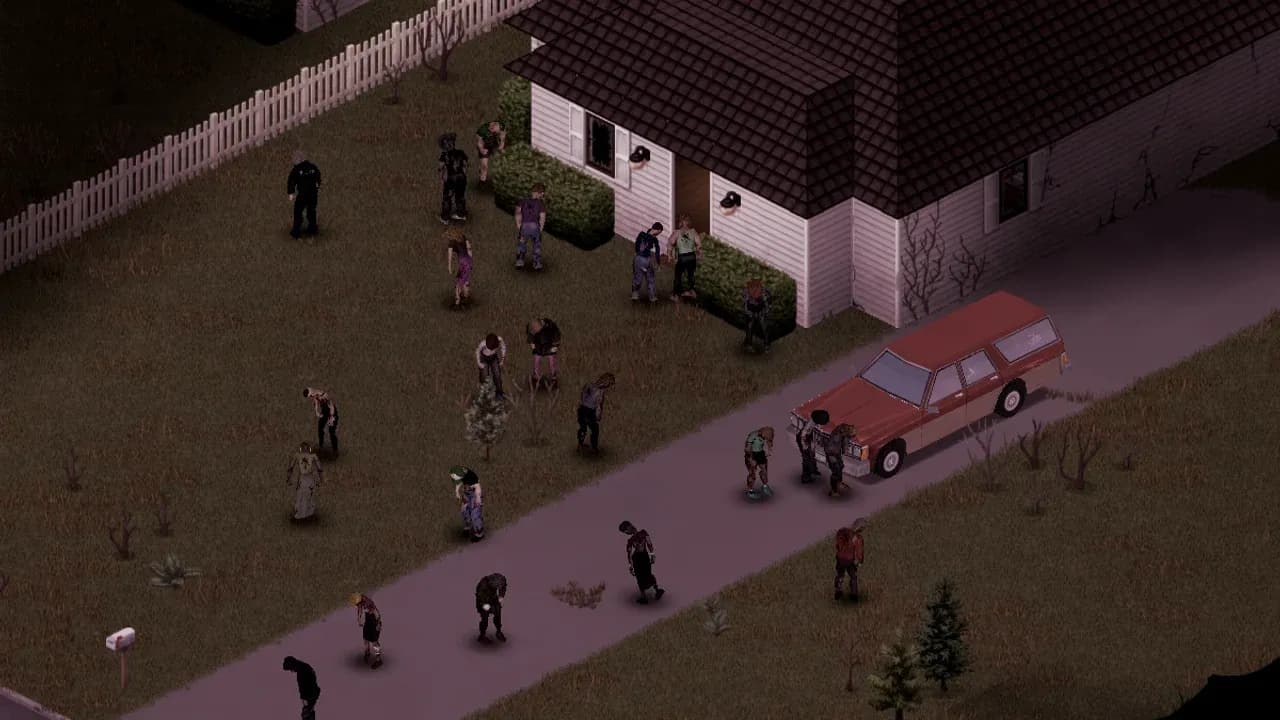
A horde is not a combat problem. Almost everything that decides whether you survive one is settled before you swing at anything: which noise in the neighbourhood is currently the loudest, which piece of fence they have to cross to reach you, and how much endurance is still in the bank when the twentieth one arrives. The weapon in your hands is the least important variable on that list, and Build 42's own preset files explain why.
The Game Only Lets You Fight One Zombie
Weapon Multi-Hit decides what kind of game you are playing, and the Build 42.20 preset files split cleanly on it: Apocalypse and Extinction ship MultiHitZombies = false, while Outbreak and Rising ship it true. The canon experience and the hardest experience are the two that refuse to let you cleave through a line.
That single setting gates stats the weapons already carry. A crowbar has MaxHitcount = 3 and a baseball bat MaxHitcount = 2; the shove has its own hit count of 3. With multi-hit off, every one of those numbers collapses to one. The crowbar's advertised ability to strike three targets in a swing is not a property of the crowbar. It is a property of the preset you loaded.
The code repeats the same lesson everywhere it hands you something for free. Both of the game's instant kills are gated on separation rather than on skill. The short-blade jaw stab wants a zombie isolated by at least a few feet before you commit, or you get flanked mid-animation. The spear's stationary insta-kill states its distance outright: the target must be 1.7 tiles or more from any other zombie. The spear's other insta-kill, the sprinting charge, can be performed into a group — and then leaves you standing inside one through a long recovery animation.
So the game pays you for spacing and charges you for crowds, and Weapon Multi-Hit is the only switch that changes that arithmetic. Damage per swing barely moves the outcome. How many zombies can reach you per second does, and that number is set by the ground you are standing on, not by what you are holding.
The Noise That Gathered Them Is Already Gone
Zombies walk toward the loudest thing they can hear and take the most direct route to it, with no regard for whether that route runs through your walls. Sound is scored as a plain number, so the fight is decided by comparison rather than by silence — and the comparison shifts in your favour faster than most players realise.

The two events that assemble a serious crowd are both temporary. A burglar alarm scores 600, the loudest thing in the game, and runs for about 20 in-game minutes, once per building. A helicopter scores 500 and, if it never spots you, searches the general area for up to an hour and leaves; if it does spot you, it parks overhead for 60 real seconds and then goes. By the time you are actually fighting the crowd those things summoned, the summons has stopped.
That is when the numbers become usable. A vehicle horn or car alarm is 150 and a running or idling vehicle is 55 to 220 depending on engine and muffler, against your own footprint of 14 sprinting, 7 walking and 3.5 sneaking. Once the alarm has decayed and the helicopter has gone, a car you left running two blocks from your killing ground is the loudest object in the neighbourhood, and it does not tell them where you are — unlike a shout, which scores 30 and comes from your exact tile. Keep the voice for peeling a straggler off the back of the group at close range.
Radius and volume are tracked separately, and the police lightbar siren is the instructive exception at radius 100 and volume 60: it carries a long way but pulls weakly, so a zombie will sometimes ignore it to chase a coughing survivor. Sirens move a crowd across a map. They do not hold one in place.
The last thing to price in is that the fight advertises itself. A zombie thumping on a door or window scores 20 — quieter than an unmuffled cough at 40, but continuous, and coming from exactly where you are. That is how a chokepoint that started with twelve zombies has twenty in it forty minutes later. Apocalypse runs Memory at Normal, so anything that loses you does eventually give up, and idle zombies re-form into groups of around twenty. You are buying a window, not changing the map.
The Fence Does the Killing, Not the Weapon
A zombie that crosses a small fence or an open window falls over on the other side. It hands you a prone target without a shove, which means without spending endurance.
A tall fence is the other half of the mechanism, because zombies cannot climb one at all. Faced with a tall fence they look for a nearby weakness first — a door, a window, a small fence — or simply walk around it. A boundary that is tall everywhere except at one low crossing is therefore not cover. It is a funnel, and it turns a crowd spread across a yard into a single file that arrives on its back.
Three costs come with that, and each of them kills people who thought the fence made them safe.
The lunge. The fence lunge (ZombiesFenceLunge) is on by default, so a zombie that has just come over can throw itself at your feet and put you on the ground, which in a crowd is usually fatal. The fix is not a magic standing distance — it is that the lunge can be cancelled. Hitting the zombie with a weapon, a shove or a stomp before it recovers prevents the attack outright, and so does simply being far enough back that it cannot reach. What gets people killed by a fence lunge is hovering at conversation range and watching. Higher fitness lowers your chance of being tripped when one does connect.
The fence itself. Zombies vaulting together damage the fence, and one under sustained simultaneous traffic will eventually come down; Apocalypse deliberately makes fences more vulnerable to zombie attack than the other presets do. There is no published thump count you can plan around, so treat the funnel as consumable and know where your second one is. A window is on a shorter and much more legible clock: an unbarricaded one can be smashed in as little as 20 in-game minutes. If you intend to cross a smashed window yourself, clear the broken glass out of the frame first or it will cut you on the way through.
What a doorway does not give you. A doorway is one tile wide, so the crowd behind it cannot spread around you, and that is worth a great deal. But a doorway produces no knockdown. It throttles how many zombies reach you; it does not manufacture prone bodies the way a fence or a window does. Fight in one when no low crossing is available, and budget for a longer fight — every kill there is one you pay for out of your own endurance.
Only the Stomp Kills
The shove deals no damage whatsoever. It knocks a zombie back and sometimes down, and that is its entire contribution. A zombie that cannot be put on the ground will never die to unarmed work, however long you keep pushing.

The stomp is where the killing happens, and it is fussier than it looks. The ground has three target points — legs, chest and head — and which one you hit is decided by where you are standing, not by where the animation appears to land. Stand over the chest and your foot may visibly strike the head; the game still scores it as a chest hit. So step up to the head end of the body before you stomp, and stay there. A zombie cannot be killed by stomping its legs at all — you can damage it there indefinitely and it will keep getting up.
Standing on a downed zombie stops it rising for as long as you remain there, with no time limit, and the same holds if another zombie is standing on it. That is what converts a body on the ground from a threat into a piece of furniture while you deal with the one behind it.
Two things degrade the shove exactly when you need it most. Knockdown chance and the damage you do to a prone zombie both scale with strength and are cut by fatigue, and panic reduces push knockdown chance and knockback on top of that. Pushing is also not free — bare hands carry an endurance modifier of 1.7. Spend shoves deliberately, on the zombie you have decided to kill next, rather than leaning on them.
Your Breath Runs Out Long Before Your Crowbar Does
Weapon durability is the constraint most plans are built around and it is almost never the one that bites. Average hits to breakage is simply maximum condition multiplied by the one-in-N chance of losing a point per hit, at level 0 in both maintenance and the weapon's own skill. A crowbar is 15 condition at 1-in-70, so about 1,050 hits — the most durable weapon in the game, though it cannot be repaired. A baseball bat is 15 at 1-in-20, about 300. A sledgehammer is 10 at 1-in-40, about 400. Even a hunting knife, 10 at 1-in-15, gives about 150, and both skills reduce those chances further as they level.

Endurance is on a far shorter fuse, and the thresholds arrive early:
- Out of Breath (25% spent): 50% less melee damage, 7% slower attacks, 19% slower movement.
- High Exertion (50%): 80% less damage, sprinting disabled.
- Excessive Exertion (75%): 90% less damage, running disabled.
- Exhausted (90%): 95% less damage, and you can no longer swing a sledgehammer at all.
Exertion also degrades the exit route, not just the fight: your chance of tripping when you run- or sprint-vault a low fence rises by 10% at Out of Breath and 40% at Exhausted, and your chance of climbing a tall one drops by up to 20%. The moodle that makes you want to leave is the same one that makes leaving go wrong.
Look at what this does to weapon choice. The sledgehammer hits for 2 to 3 damage with a knockback of 1, the best numbers on offer — and carries a 4× endurance modifier, which drives you toward the exact state in which it cannot be swung. A crowbar and a baseball bat carry no endurance penalty at all. In a long fight the boring weapon wins, because it is still doing full damage in the tenth minute.
Recovery is stingier than it looks. Endurance regenerates only while you are idle and taking no further penalties; walking or sneaking sharply reduces or nullifies it, and tiredness can halt it outright. Sitting down speeds it up. There is no version of "rest while backing away" that works.
Panic is the moodle players actually retreat from, and it is priced differently than they think. At Terrified it costs a flat 0.4 melee damage and 5.2% critical chance — and because it is flat, it is regressive. Against a sledgehammer's 2 to 3 damage that is a 13–20% loss; against a crowbar's 0.6 to 1.15 it removes between a third and two thirds of the swing. The light, low-fatigue weapons that win long fights are precisely the ones panic taxes hardest. Its other bill is vision: Terrified narrows the cone and darkens it, which is how zombies you never saw end up behind you.
The rule that falls out of all of this is to count crossings, not kills. Decide before you start how many zombies you can put through your funnel before Out of Breath, and leave at that number. What you come back to will not still be queued — idle zombies drift into groups of around twenty and you will have to rebuild the funnel — but rebuilding a funnel is a far cheaper job than the alternative. A horde you walked away from at 25% endurance is a horde you get to fight again. A horde you fought to Exhausted is the one standing over your corpse.