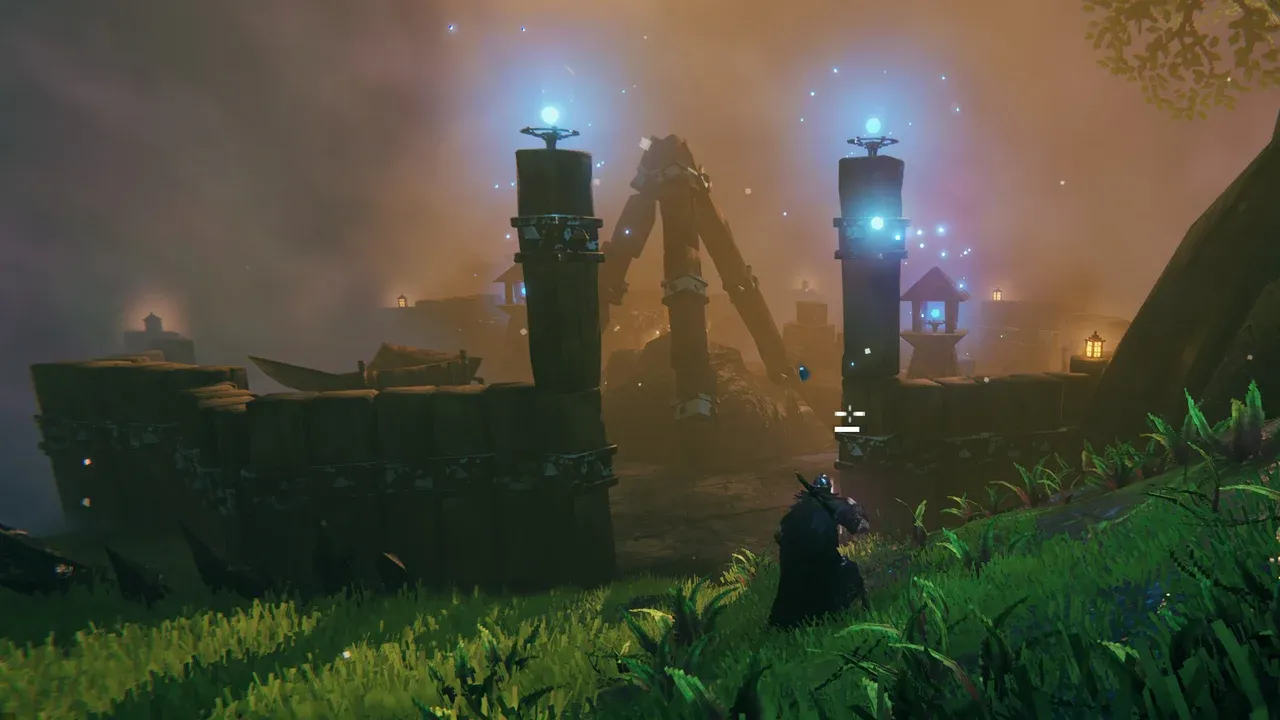
Valheim usually introduces an old culture through enemies or ruins. Draugr defend the remains of a people who challenged the gods. The Kingdom of the Emerald Flame survives as testimony, wreckage, and Fader. Then you find a lamp burning above a Dvergr door, walk inside without drawing a weapon, and meet residents who expect you to respect the place.
That encounter changes the role of the Mistlands. The Dvergr are not an untouched empire: Munin says their clans are cut off from Nidavellir, their oldest halls have fallen to other occupants, and relief will never come. Yet their living outposts still have specialized defenders, active excavation sites, protected stores, and a resource chain. The biome is not empty land waiting for you to conquer it. It already has property lines—and the item that opens your magic tier sits behind one.
Their Fall Stopped Short of Extinction
The runestone record is full of finished histories. One account remembers a proud people whose war with the Aesir and Vanir ended with cities razed, mines burned, and warriors returning as Draugr. The Ashlands stones let citizens narrate the Kingdom of the Emerald Flame's collapse, but its city is gone and its king has become Fader.
Dvergr history includes a collapse too. Munin describes their underground homes as relics of a gilded age whose treasures are now guarded by more sinister occupants. The active clans did not preserve that age whole; they lost halls, routes, and contact with their kin.
What remains is more than a monster faction camping in old masonry. Dvergr rogues and mages occupy towers, lighthouses, harbours, and excavation camps as workers and defenders. For this article, that is the useful threshold for a functioning society: living residents perform distinct roles, maintain defended work sites, and operate a resource process that continues in the present. The Dvergr meet it even after their larger world has broken apart.
Exile Made Work Their Continuity
A Mistlands runestone calls the Dvergr descendants of the great smiths of old, delvers who seek hidden treasure, mine Jotunn bones, and distill eitr. Munin supplies the cost: these are forlorn clans, long separated from their kin in Nidavellir, trapped at their outposts while expecting a reprieve that will not arrive.
Their survival is therefore not a military victory. It is the decision—or sentence—to keep practicing the same craft under worse conditions. Excavation sites are built around Giant remains. Component crates hold the Dvergr extractor required to tap Ancient Roots for sap. Soft tissue and sap feed refined eitr, which means the player's magic equipment depends on a crafting chain the Dvergr reached first.
A Dvergr mage can mention doing a little more mining before taking the haul back to Myrkheim. The game leaves Myrkheim unexplained, but the important part of the line is the next shipment. These workers still imagine a destination and a community beyond the dig in front of you. Their old halls have become history; their labor has not.
The Ward Turns an Outpost Into Territory
An inhabited excavation camp combines walls, stakes, lamps, stored materials, a component crate, and a Dvergr Ward around an active dig. Guard towers turn black marble into defensible vertical space. Harbours and lighthouses extend that footprint to the coast. These are battered structures in a hostile biome, but they still serve a network rather than merely commemorating one.

Dvergr are neutral toward you and hostile toward aggressive Mistlands creatures. An outpost can become a pocket of safety when Seekers or Gjall attack, but its defenders are protecting their ground, not joining your quest. You benefit because both sides have the same immediate enemy.
The Ward makes that limited coexistence legible. You may enter while the settlement remains neutral. Attack a Dvergr, another nearby Dvergr, or a structure protected by the Ward, and the nearby group becomes hostile. The runestone version is just as direct: left alone, the Dvergr pursue their plans and care little for other lives; rouse them, and they defend themselves.
Treat the settlement accordingly. Keep area attacks away from its walls and stores. If you draw a creature toward the defenders, remember that a stray hit on protected property can make the outpost part of the fight. A blue-lit tower can remain a useful waypoint in the fog, but neutrality is a boundary you maintain, not a reward you unlock.
The Extractor Makes Progress a Property Dispute
To build a sap extractor, you need a Dvergr extractor from a component crate inside an inhabited settlement. Sap then feeds the refined-eitr process that opens Mistlands magic equipment. Obtaining the component is mandatory for that progression; fighting its owners is not.

You have two dependable approaches:
- Break the crate yourself. The nearby Dvergr will turn hostile. You get the component directly, but lose the settlement as a neutral waypoint unless you are willing to fight its defenders.
- Make the damage environmental. Hostile creatures can break the crate without making the Dvergr blame you. A cart can also deal environmental damage to protected objects. Both methods can preserve neutrality, although a creature attack may wreck more of the site than you intended.
Ruined Dvergr locations can yield useful materials, but an intact component crate belongs to inhabited variants, so searching abandoned sites is not a reliable third route to the extractor.
The cart method is often treated as a clever trick, yet it exposes the same underlying design as a direct raid. You are bypassing a Ward because the game offers no trade dialogue for the component. Valheim could have placed the Dvergr extractor in an Infested Mine and made this a clean crafting step. Instead, it makes you cross a neutral society's property line—or manipulate what counts as crossing it.
If you want the Dvergr outpost to remain a safe stop, let external damage open the crate and keep your own attacks away from the Ward. If speed matters more than that relationship, take the component openly and be ready for the defenders who still claim it.