
Fenris armor is worse than Wolf armor. Thirty points of protection against sixty, at the same tier, in the same biome — there is no reading of the numbers where the wolf-hide set does not win a straight fight. It is still the set to build first, because the Mountains do not charge you in armor rating. They charge you in prerequisites, and the two sets have wildly different bills.
Fenris Is the Only Mountain Kit That Never Asks for Silver
Wolf armor is built at the Forge from 20 silver a piece — 60 across the drake helmet, the wolf hide chestpiece and the trousers — plus 12 wolf pelts, two drake trophies, a chain and four wolf fangs. The silver is the problem. You cannot even see a deposit without the Wishbone from Bonemass, and you cannot open one without an iron pickaxe, so the Swamp has to be finished and its boss killed before the Mountains start paying out.
The Fenris set skips that chain entirely. All three pieces are crafted at a level 2 Workbench, and a full set at quality 1 costs 60 Fenris hair, 12 wolf pelts, 20 leather scraps and a single cultist trophy. The pelt cost is identical to Wolf's. Leather scraps come off Meadows boars. The hair and the trophy come from one dungeon. Nothing on that list asks you to have beaten a boss you did not already beat to reach the biome.
| Fenris set (Q1) | Wolf set (Q1) | |
|---|---|---|
| Crafted at | Workbench, level 2 | Forge |
| Armor | 30 | 60 |
| Weight | 21 | 33 |
| Movement speed | +9% | −10% |
| Silver required | none | 60 |
The movement line is worth dwelling on, because Fenris is the only armor in Valheim that gives it. Each piece adds 3% and the set adds 9%; the wolf hide chest and trousers subtract 5% each. Swapping one for the other changes your walking speed by nearly a fifth in a biome made almost entirely of long climbs.
Your First Frost Cave Still Runs on Mead
There is a chicken-and-egg problem in the plan, and it is better to name it now than to find it halfway up a glacier. Fenris hair only exists inside Frost Caves, Frost Caves only exist in the Mountains, and the Mountains apply Freezing: no health regeneration at all, 60% less stamina regeneration, and a point of damage every second. You cannot craft your way out of that before the first trip, because the thing you would craft is in the cave.
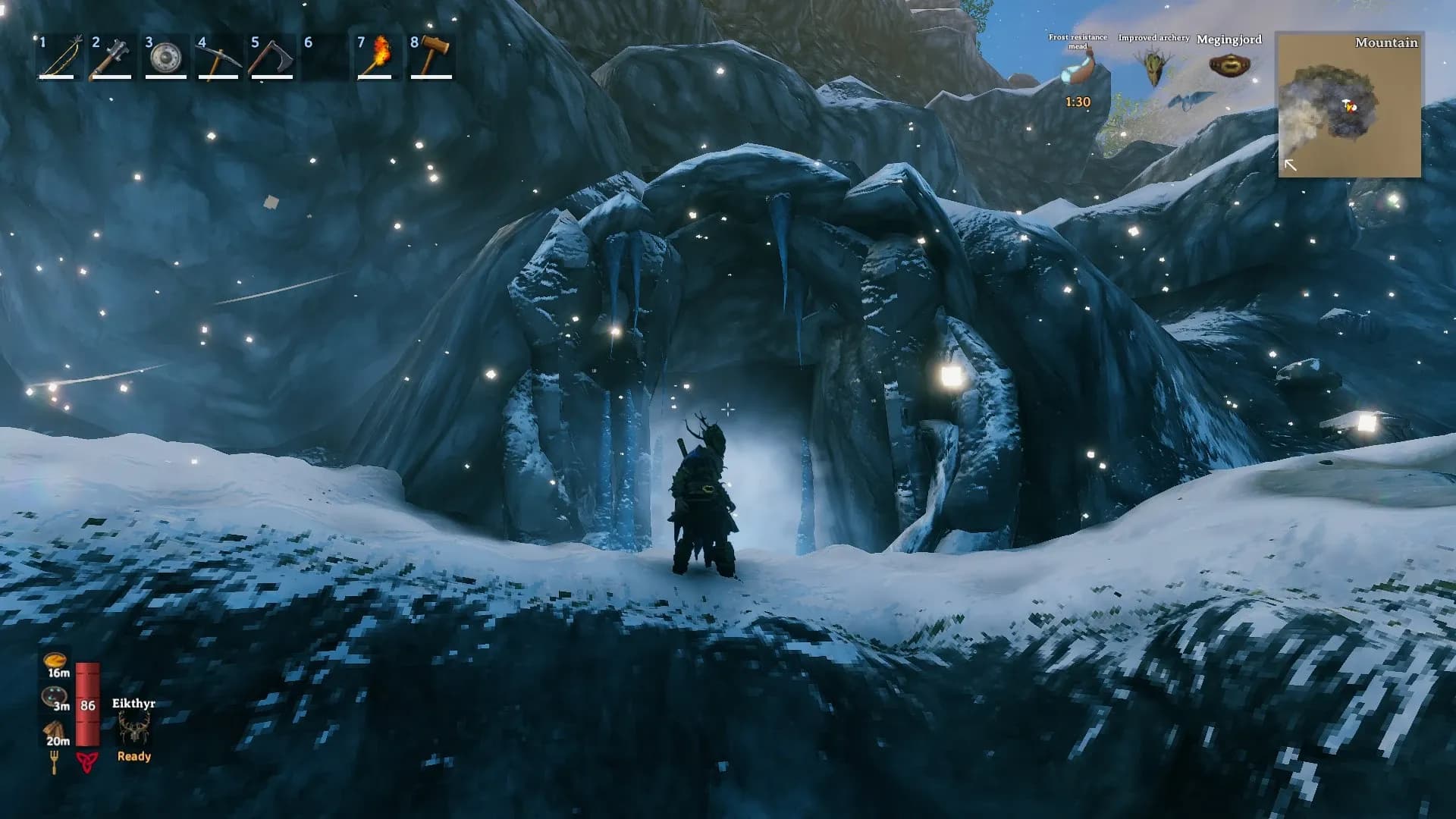
The frost resistance mead ticking down in the top corner is the clock your first Frost Cave run is racing.
So trip one runs on frost resistance mead. The base is brewed in a mead ketill from 10 honey, 5 thistle, 2 bloodbags and a greydwarf eye, ferments for two in-game days, and yields six meads lasting ten minutes each. Bloodbags come off Swamp leeches — which is worth being precise about, because it is the one prerequisite Fenris does not dodge. You need to have been to the Swamp. You do not need to have beaten Bonemass, and that is the whole difference: the mead needs a biome, the Wolf set needs a boss.
Ten minutes is the number that should shape the run. You are not exploring a cave so much as spending meads, and every one burned walking uphill is one you do not have for the walk back.
Where the caves are is the other half of the problem, and it depends on how old your world is. Frost Caves arrived in patch 0.207.2 on 1 March 2022, and Valheim will only place a point of interest in a zone that has not already been generated. A world you have been playing since before that patch has no Frost Caves anywhere you have already walked — when the update landed, the game had nowhere to put them. The fix is not a better search pattern, it is a boat. Sail past the edge of your explored map and find Mountains your save has never loaded.
Sixty Fenris Hair Means Stripping Lairs, Not Farming Kills
The most common way to waste a cave run is to treat Fenris hair as a drop and go hunting for it. It is not a drop. Ulvs give up wolf fangs and, one time in ten, a trophy. Cultists give red jute and, one time in ten, a cultist trophy. Neither is carrying any hair. The hair is scenery — matted tapestries hanging in the cultists' worked-stone lairs with knots of it tied underneath — so the run is a demolition job, not a body count. Push for the altar rooms, which stack several tapestries together with a guarded altar holding two or four more offerings of hair or claws, and clear each one out properly before moving on.
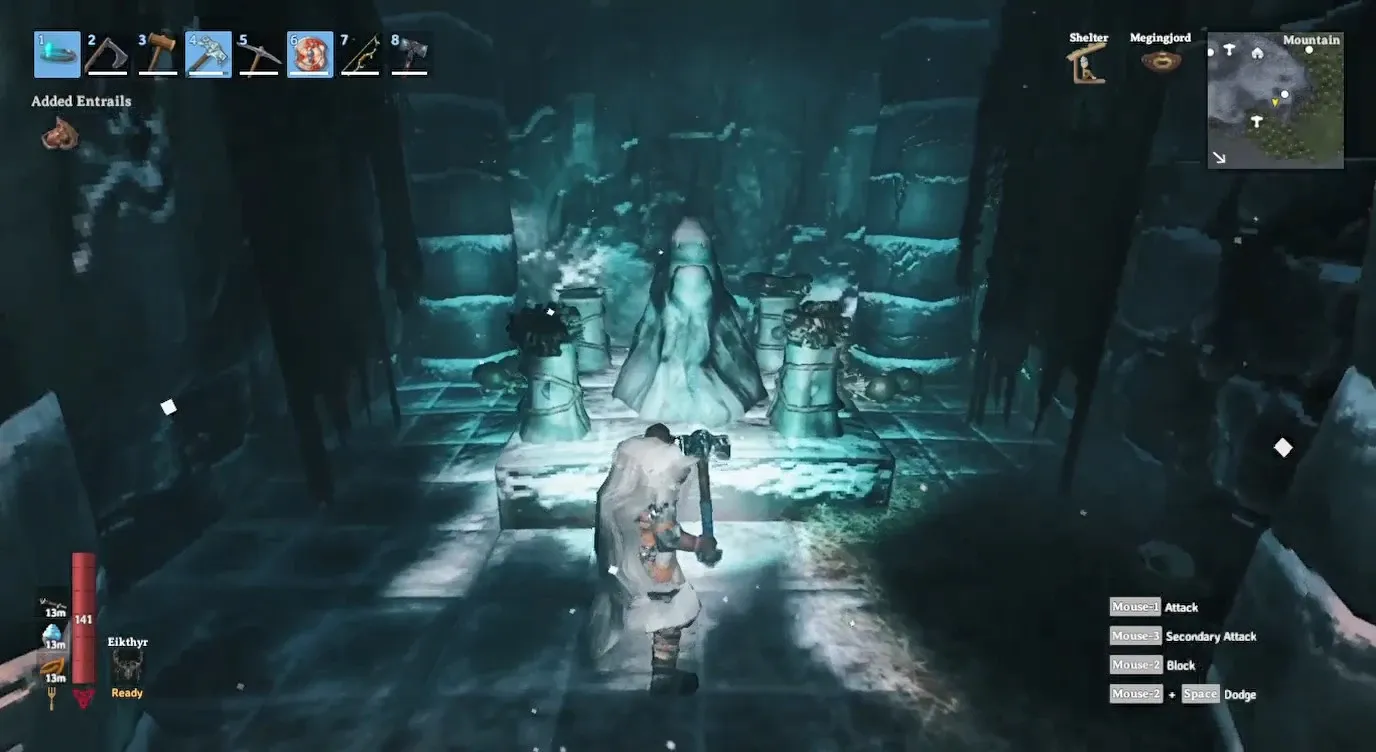
Altar rooms are where the hair is: tapestries on the walls and offerings on the altar itself.
The cultist trophy, not the hair, is the real bottleneck. You need exactly one, for the hood, and it drops one time in ten. Expect to come home with the coat and leggings covered and to go back in later for a hat.
Bring the right damage type. Cultists are immune to fire outright and Ulvs are very resistant to it, so every torch-and-flame trick you have leaned on since the Black Forest is dead weight down here. Both are weak to poison; ooze bombs are the answer. Know what a cultist does before it does it, too: 200 health, a fireclaw landing 35 slash and 40 fire, and a flame blast worth 50 fire that reaches four metres, cannot be blocked, and passes through walls. Ulvs are far flimsier at 50 health but bite for 80 slash, which is plenty in a corridor.
The cave itself is a hazard on its own terms. Walls of blue ice seal passages and break to any weapon, a pickaxe or your bare hands, but breaking one makes noise that carries. Icicles hang from the ceiling and fall with the same indifference as a felled tree, which is exactly why the Stagbreaker and the iron sledge — the two weapons whose whole appeal is hitting everything at once — are the worst things you can swing down here. The braziers in the cultists' rooms are the compensation: stand near one for comfort level 2 and a Rested bonus, so the run has somewhere to reset in the middle of it.
Howling Caverns Are the Other Hair Source, at a Price
Frost Caves are not the only place the material exists. Howling Caverns, the Mountain dungeon added with Hildir's Request, also hold Fenris hair and Fenris claws, and they solve the search problem outright — you get their location from Hildir's map table instead of sailing around hoping for an icicle-covered hole.
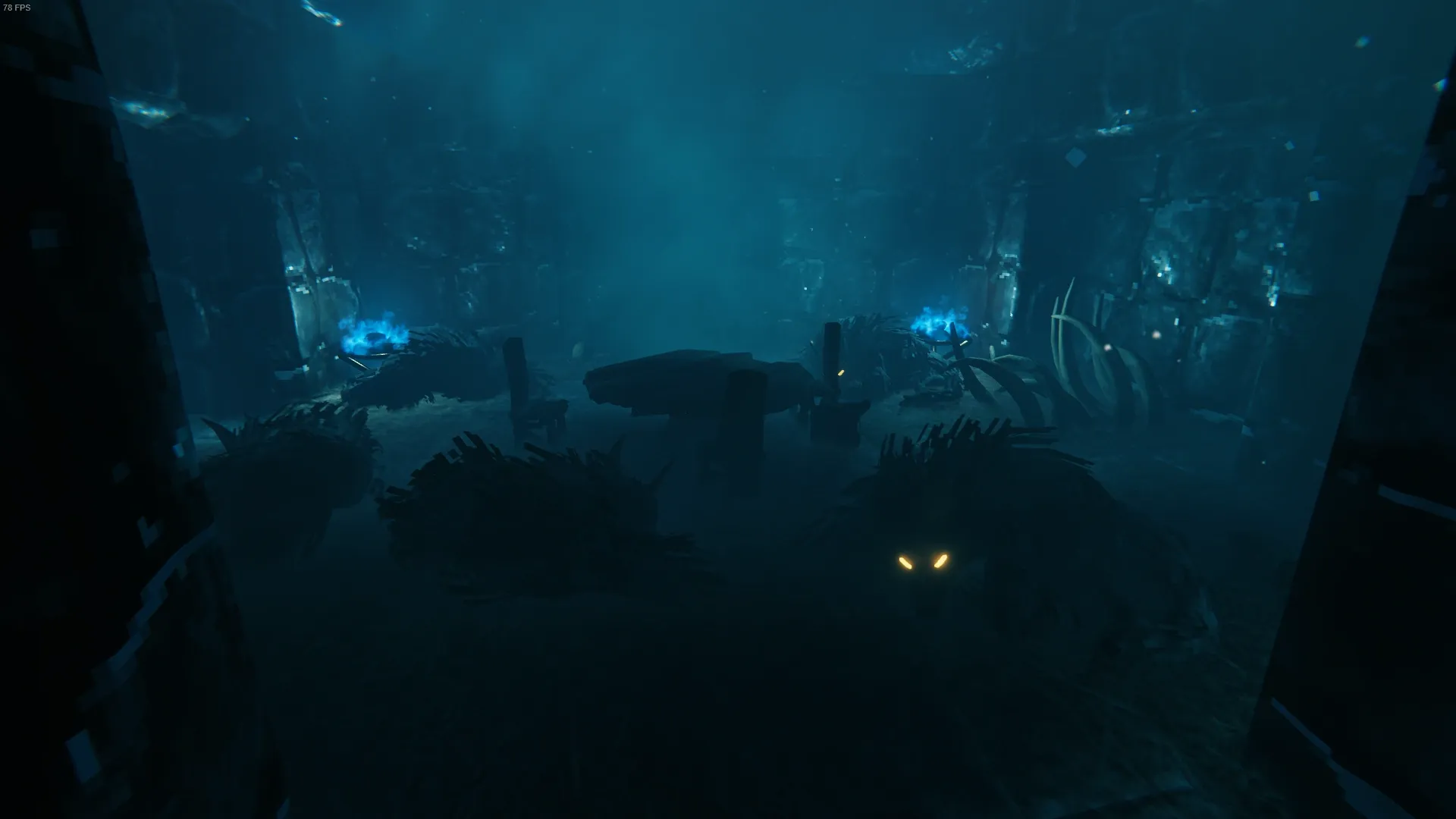
Howling Caverns pack Ulvs around Geirrhafa in numbers a Frost Cave never does.
What you pay for that convenience is Geirrhafa. The miniboss guarding the place has 3,700 health, packs the caverns with Ulvs and bats around him, and fights almost entirely in frost: an ice claw worth 60 slash and 70 frost, a 100-damage frost cone, and an ice nova that pulses 90 frost outward three times and can be neither blocked nor dodged. He is immune to frost himself and weak to fire, which neatly inverts the rule that keeps your torches useless everywhere else in these caves.
There is one quiet reward for showing up in the light set. The Fenris coat halves incoming frost damage, and Geirrhafa deals almost nothing else — so the piece you built to stop shivering is also the piece that blunts the hardest fight in the Mountain's dungeons. Save this trip for after your first Frost Cave, though. It is where you go when the nearby caves are stripped and you want claws in bulk, not where you start.
The Coat Frees Your Cape Slot and Your Honey Supply
Read the Fenris coat's frost resistance as a slot, not a stat. The things that stop Freezing outright are a short list — frost resistance mead, the Fenris coat, the wolf armor chest, the wolf fur cape, the lox cape, the feather cape — and none of them stack with each other. Wearing two is wearing one. So the coat is not stacking protection on top of what you had; it is taking over a job something else was doing and refunding you what that thing cost.
That refund is the practical case for the set. Your cape slot goes back to being a choice instead of a heating bill, and your honey stops disappearing into frost meads before every trip. Note where the alternative sits, too: the wolf fur cape, the cheap and obvious way to stay warm up there, still wants four silver of its own. Even the budget option is on the far side of the gate Fenris walks around.
One caveat catches people wearing the full set and confident they have solved the biome. Frost resistance holds off Freezing only while you are dry. Get Wet — rain, or a river you decided to cross — and the coat stops covering you for the two minutes the soaking lasts. Wet leaves you weak to frost damage on top of that, which the Mountains are well equipped to exploit.
The Blessing Turns Low Armor Into the Right Armor
Wearing all three pieces grants the Fenris blessing: +15 to the Fists skill, and fire resistance at half damage taken.
That fire resistance does more than 30 armor suggests, because of how Valheim stacks the two. Resistance halves the hit before armor is applied, and the reduction is at its strongest when your armor is at least half the raw incoming damage — at which point resistance stops halving the damage and starts quartering it. A cultist's fireclaw carries 40 fire, so the bar is 20, and the Fenris set's 30 clears it. Against the enemy standing between you and the rest of your armor set, the light set is working at full effectiveness.
The Fists half explains who this armor is for. The skill cuts attack stamina cost by up to a third and raises damage and knockback by up to 141% at level 100, and virtually nobody has any of it, because virtually nobody punches things in Valheim. Fifteen free levels on a skill sitting at zero is a genuine head start, and it applies to bare fists — the blessing costs you nothing extra to use.
The dedicated weapon is where the silver comes back. Flesh Rippers hit for 60 slash, climbing to 72, and their appeal is not the number: the primary is a two-hit combo that doubles up on the second swing, the secondary is a kick that staggers six times harder than a normal blow, and an unnoticed target takes sixfold damage. At 450 durability fully upgraded they outlast every other weapon in the game. But they are built at a level 3 Forge from 10 Fenris hair, 6 Fenris claws and 10 silver. The armor dodges the silver gate; the fists do not. Build Fenris first and you have the set and the Fenris blessing tonight — the Flesh Rippers are a later trip, funded by the silver you are now much faster at going to find.
Wolf Armor Still Wins the Fight You Came For
The moment you stop moving, the argument inverts. Moder does not let you disengage, a stone golem's swing does not care how quickly you arrived, and a drake pack catching you in the open will punish every point of armor you left at home. None of that is a problem +9% movement speed can solve, and Fenris gives up half your protection to provide it.
So run both and choose by verb. Fenris is what you wear to move through the Mountains — clearing caves, prospecting for the silver you do eventually want, crossing the biome on your way somewhere else. Wolf is what you change into when you have stopped travelling and started fighting. Build Fenris first not because it is the better armor, but because you can be wearing it tonight, while Wolf armor is still a boss fight and a mining expedition away.