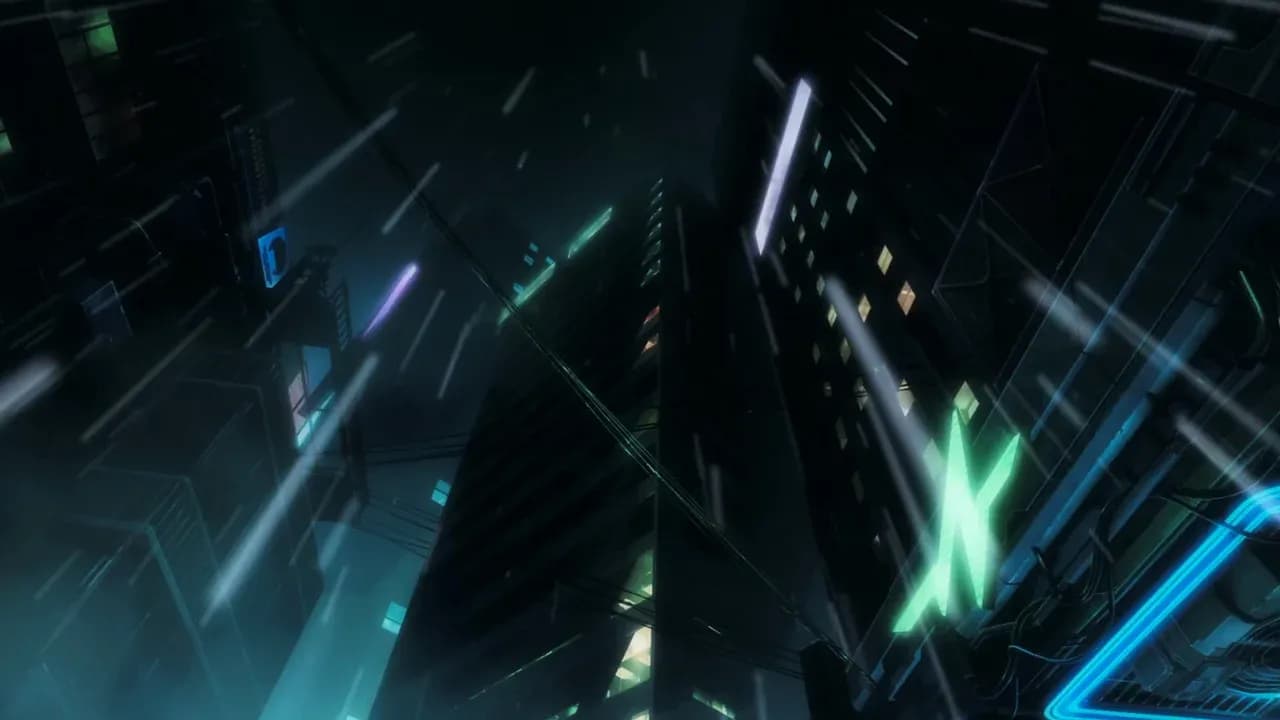
If you are waiting for Cyberpunk: Edgerunners 2, the useful question is not which anime is a substitute for David's story. The better way to use the wait is to follow the Studio Trigger and creator connections behind the Edgerunners visual language, while separating documented lineage from the visual parallels you can watch for.
This is a spoiler-light, non-ranked watchlist of exactly seven Trigger works. Kill la Kill and Promare show the clearest action lineage; the other five isolate different parts of the studio's toolkit, from compressed escalation and technology-driven spectacle to transformed identity and cyberpunk-adjacent urban violence. None is presented as a proven source for a specific Edgerunners scene. Think of the list as a set of visual lanes, so you can choose the kind of Trigger energy you want next.
The next Edgerunners is standalone, so this list follows Trigger DNA
The official project is Cyberpunk: Edgerunners 2: a new standalone story told across 10 episodes, coming exclusively to Netflix in Fall 2026. It is being presented with a fresh cast and a raw, gritty, brutal tone, not as a promise that David’s story continues. That makes the waiting period useful in a specific way: you can prepare for the next production’s creative language without treating it like a conventional sequel guide.
The current character snapshot is more precise than the shorthand that has circulated around the announcement:
- Weak is a washed-up cyberpunk legend forced to live without chrome, once known as “King.”
- D is a Snake Nation netrunner hunting the killer who wiped out his clan.
- Roman Carax is a young cinephile documenting real stories in a city that has abandoned film for braindance, rather than merely a video journalist following the crew.
- Talia was raised in corpo towers and hardened in Maelstrom’s grip.
Those details establish what this list is preparing you to watch for: a new Night City story about legacy, revenge, identity, and the pressure to turn brutal lives into something meaningful. They also set the evidence standard. Netflix described Trigger’s contribution to the original adaptation as its “signature, vibrant style,” while the official sequel materials emphasize rawness and brutality. That makes Trigger’s back catalogue a useful visual-energy primer for the wait.
The creator links make the organizing principle concrete. The original adaptation’s staff history connects Hiroyuki Imaishi with Kill la Kill and Promare, Yoh Yoshinari with BNA: Brand New Animal, Yoshiki Usa with SSSS.GRIDMAN and Promare, and Hiromi Wakabayashi with Kill la Kill. For Edgerunners 2, Kai Ikarashi brings a documented SSSS.Gridman connection, while lead character designer Kanno Ichigo is also linked to Promare. These are staff and studio continuities, not seven separate claims of direct influence, but they are stronger evidence than simply grouping together anime that happen to look intense.
Studio Trigger’s own catalog validates the complete seven-work set, while also making one important classification clear: Promare is a film. So this is an entertainment watchlist built from the studio’s actual body of work, distinct from a Cyberpunk 2077 mechanics guide, an adaptation-news recap, or an objectively ranked list. Each entry will stay spoiler-light, give only the premise needed to orient you, and identify the visual or creative lane worth watching rather than walking through episodes.
In practical terms, start with the kind of Trigger energy you want to study: kinetic exaggeration, saturated action, technology-driven staging, expressive character animation, or cyberpunk-adjacent urban violence. The list cannot prove that one of those older titles supplied a specific shot in the new series, and it does not need to. Its value is showing the recurring creative vocabulary behind the collaboration. That distinction leaves two clear action-lineage examples to start with.
Kill la Kill and Promare show Trigger’s action language at two scales
The clearest route from Trigger’s earlier work to Edgerunners runs through Hiroyuki Imaishi. He directed both the original adaptation and Kill la Kill, making the latter the clearest creator-continuity route in this list. Its setup is deliberately charged: Ryuko Matoi transfers to Honnouji Academy while pursuing the woman connected to her father’s death, only to enter an academy controlled through uniforms that grant special abilities.
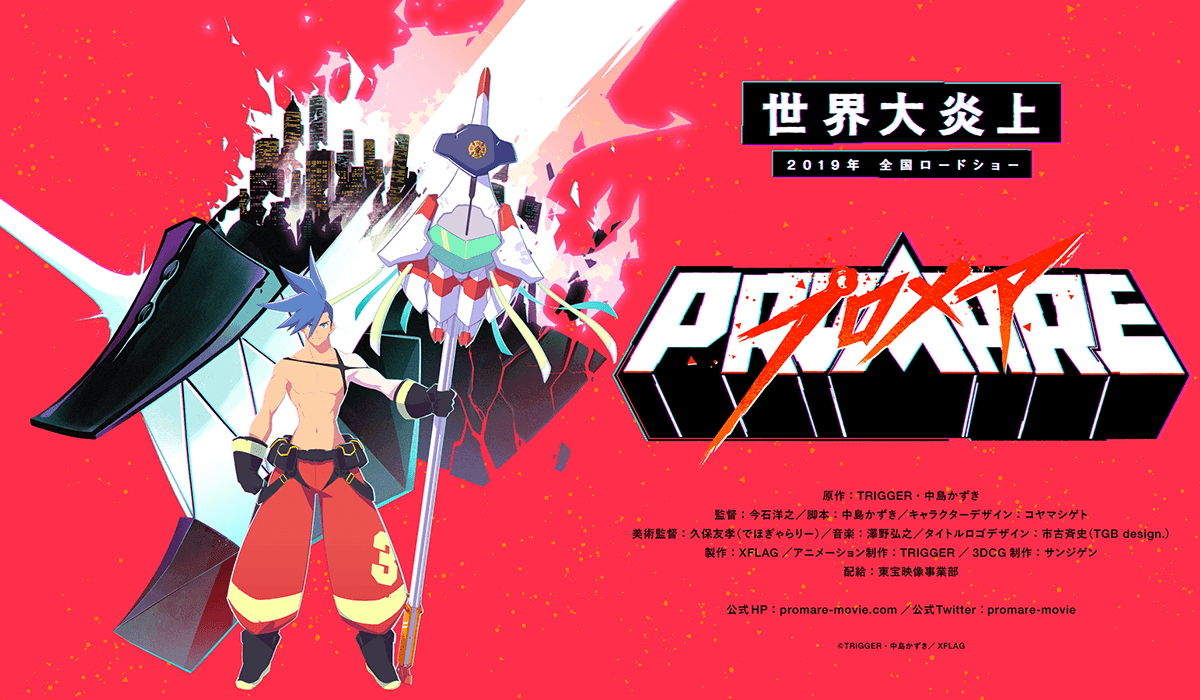
Promare’s saturated palette and 2D/3D spectacle make Trigger’s film-scale action visible.
That premise gives the action a visual system to watch. Power is not just a number attached to a fighter; it is expressed through clothing, silhouette, hierarchy, and sudden changes in movement. Pay attention to how a uniform can make a character instantly readable at speed, how poses stretch a confrontation beyond naturalistic motion, and how a personal grudge becomes a large, graphic clash. Those details give you a concrete way to watch Imaishi’s action vocabulary and Trigger’s broader style.
Promare takes related ingredients from a school-sized series to an original theatrical film. Imaishi directs again, with Kazuki Nakashima writing, Shigeto Koyama designing the characters, Hiroyuki Sawano composing, Trigger handling the animation, and Sanzigen providing the 3D CGI. That combination makes the film a useful place to watch spectacle expand beyond the school-sized conflict: track its color, music, character shapes, and CG-assisted staging at theatrical scale.
The relationship between the two works is documented beyond their shared director. A production interview identifies connections in their character design, soundtrack, and narrative tendencies, while also describing Promare’s brighter red, orange, and pink palette as a response to its heavy CG use and simplified design needs. The film deliberately blends traditional 2D animation with 3D CG rather than treating the techniques as separate visual worlds. Kanno Ichigo’s lead character-design credit on Edgerunners 2 adds another concrete link to Promare.
The useful comparison is therefore about scale and emphasis. Kill la Kill makes you track fast bodies and sharp silhouettes inside a conflict organized by uniforms and school authority. Promare asks you to track the same kind of graphic clarity while the frame expands into saturated color, music-led momentum, and theatrical 2D/3D spectacle. Watch movement first, then color, then silhouettes: the series shows how a character can dominate a chaotic exchange, while the film shows how that readability survives when the composition becomes bigger, brighter, and more CG-heavy.
Start with Kill la Kill if you want the most direct Imaishi-to-Edgerunners route and a series-length look at exaggerated action. Choose Promare if your priority is saturated color, music, theatrical scale, and the deliberate handoff between 2D animation and 3D CGI. Together, they make Trigger’s documented creative lineage visible. For a faster test of that visual language, start with a shorter sampler.
Space Patrol Luluco is the fast sampler for Trigger’s visual shorthand
After seeing Trigger’s action language expand from a series to a theatrical film, Space Patrol Luluco offers the quickest way to study that energy in compact form. Its starting point is ordinary: Luluco is a middle-schooler living in OGIKUBO, a space immigration zone where humans and aliens share the same community. Her routine changes when AΩ Nova arrives as a transfer student, turning a familiar school-day setup into an alien and genre-driven escalation.
That jump is the reason this work belongs on the list. Luluco’s everyday baseline gives the story something immediately legible, while Nova’s arrival opens the frame to a much stranger kind of adventure. Here, “visual shorthand” means watching how quickly a simple premise can communicate a new genre, a new scale of danger, and a bold design language without requiring a long runway.
Hiroyuki Imaishi’s direction gives the recommendation a concrete creator connection to the Trigger lineage already established by Kill la Kill and Promare. Here, that connection is most useful as a lesson in compression. Instead of beginning with a large world-building explanation, pay attention to the contrast between Luluco’s normal life in OGIKUBO and the disruption created by AΩ Nova. The change itself becomes the organizing device, letting the work move from the familiar to the fantastical with very little visual or narrative delay.
Pick Space Patrol Luluco when you want the fastest test of whether Trigger’s high-velocity style works for you. It is the focused short-form choice for rapid genre escalation and expressive design, without asking you to begin with a longer series or a film. Once that compressed rhythm clicks, Trigger’s technology, computers, kaiju, and team combat provide a broader lane.
SSSS.GRIDMAN and SSSS.DYNAZENON turn technology into team spectacle
For a technology-first route into Trigger’s visual language, SSSS.GRIDMAN starts with a strikingly modest doorway: amnesiac first-year student Yuta Hibiki meets Gridman through an old computer. The series revisits the Gridman concept through modern ideas such as the internet and computer viruses, then throws Yuta into a city under attack from kaiju. That contrast—ordinary hardware opening onto a public-scale threat—is the core of its appeal for Cyberpunk fans. Technology is not just decoration; it is the point where memory, identity, and urban danger connect.
Tetsu Amemiya directs SSSS.GRIDMAN, Trigger animates it, and the production uses 3D-CG alongside its hero and kaiju animation. When you watch it, pay attention to how the old computer and the city-wide attacks frame the action: the story moves from a personal encounter to spectacle that has to be read across streets, buildings, and a transforming defender. That makes GRIDMAN a natural choice here if you want computer-driven staging and a clear sense of how an urban environment can become part of a fight.
SSSS.DYNAZENON uses a different entry point. Yomogi meets the mysterious kaiju user Gauma and is pulled into battles involving the giant robot Dynazenon alongside a larger group. Amemiya again directs, with Trigger handling the animation. The result is a natural companion to GRIDMAN: where Yuta’s story begins with an old computer and a city under attack, Yomogi’s begins with an encounter that grows into coordinated kaiju battles and team dynamics.
That difference changes what you should watch for. GRIDMAN emphasizes the relationship between technology and an urban threat, making its computer-origin premise the cleanest match for readers interested in systems, interfaces, and city-scale danger. DYNAZENON puts more weight on how people with different circumstances function around giant machinery. Its spectacle is still large, but the group’s emotional grounding gives the battles a different texture from a purely mechanical showcase. Together, the two series cover both sides of the technology/mecha lane: the device that opens the threat and the team that has to carry it.
There is also a concrete sequel connection in the staff record. The official Cyberpunk: Edgerunners 2 announcement identifies Kai Ikarashi as director and associates him with SSSS.Gridman. That makes GRIDMAN a direct director bridge to the upcoming series in this pair. The credit ties Ikarashi to the Trigger production without making Edgerunners 2 a repeat of any particular Gridman scene.
Choose SSSS.GRIDMAN if you want computers, urban-threat staging, and the strongest sequel-director connection. Add SSSS.DYNAZENON if you want ensemble battles, giant machinery, and spectacle anchored by a more emotionally grounded group. The other side of that spectacle puts the pressure on bodies and identity.
BNA and Ninja Slayer add altered identity and near-future violence
After technology and machinery, BNA: Brand New Animal moves the focus onto the body itself. Humans and beastmen share a world shaped by the displacement of beastmen, and Michiru’s transformation into a tanuki beastman sends her to Animacity. There she meets Shirou, a wolf beastman, and has to navigate a community where physical difference is inseparable from identity and belonging. The premise makes transformation more than a combat upgrade: the changed body alters how Michiru is seen, where she can live, and what kind of person she is allowed to be.
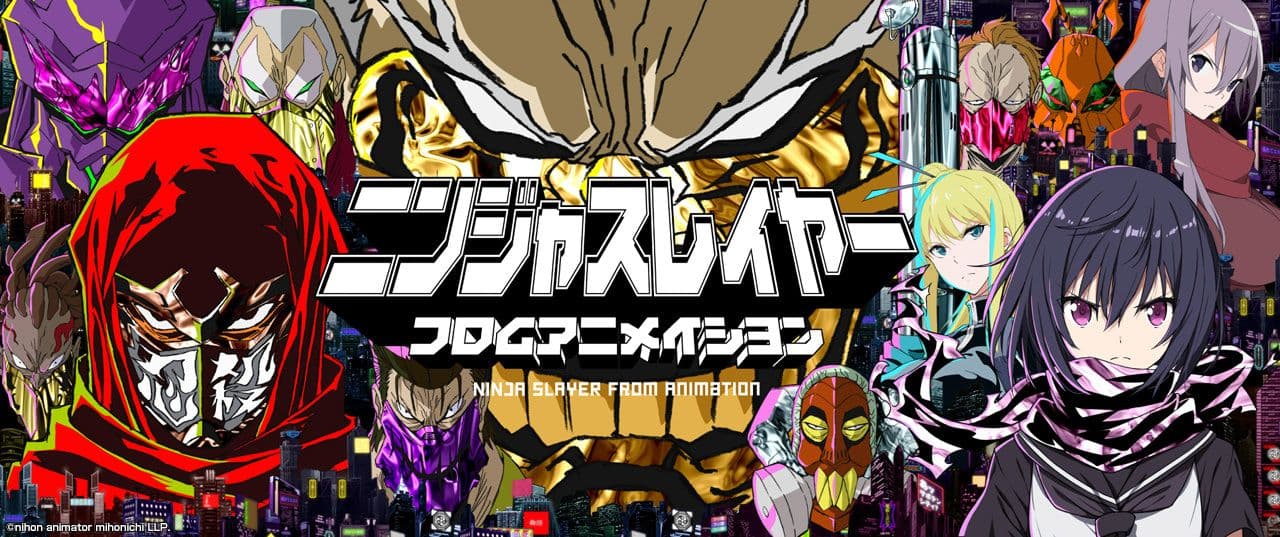
Ninja Slayer adds stylized urban violence and cyberpunk-adjacent revenge to the Trigger lineage.
That makes BNA a useful recommendation here for expressive character animation. Yoh Yoshinari directs the series, and Netflix identifies him as the original Cyberpunk: Edgerunners character designer. The credit establishes a concrete creator lineage between BNA and the Cyberpunk adaptation, especially for readers interested in how bodies, expressions, and transformations carry character information. The value is seeing a related staff member work through altered identity in a different setting.
Ninja Slayer from Animation takes a harsher route into the same broad territory. Fujikido becomes Ninja Slayer after his family is killed and a ninja soul possesses him, turning personal loss into an engine for revenge. The story unfolds in near-future Neo-Saitama, giving the list a cyberpunk-adjacent city and a strong emphasis on stylized urban violence. Trigger animates the series, with Tetsu Amemiya serving as series director, so its connection to the watchlist is both studio-based and grounded in a distinct visual approach to brutal action.
The comparison is useful because the two works treat altered identity in opposite directions. Michiru’s tanuki transformation leads her into Animacity and forces questions about belonging, community, and the gap between an inner self and an externally judged body. Fujikido’s possession fuses him with a ninja soul after a family murder, making the altered body inseparable from revenge and the violent city around him. Both offer a visual and thematic parallel to Edgerunners’ interest in bodies under pressure while remaining separate from the Cyberpunk universe.
Choose BNA if you want transformation, identity, and expressive character animation, with Yoshinari’s documented connection providing the clearest staff bridge. Choose Ninja Slayer from Animation if you want stylized urban violence and cyberpunk-adjacent revenge in a near-future city. Together, these two close the list’s thematic range; the table below lets you choose a starting lane without ranking the works.
Choose your first Trigger watch by the Edgerunners energy you want
There is no objectively best first pick here. Each title offers a different way into Trigger’s creative vocabulary, so choose the quality you want to spend time with rather than treating the list as a ranking:
| If you want... | Start with... | What to watch for |
|---|---|---|
| Direct creator continuity | Kill la Kill | Hiroyuki Imaishi’s exaggerated action, fast-readable silhouettes, and graphic clashes |
| Saturated, film-scale 2D/3D spectacle | Promare | Bright color, music-led momentum, theatrical scale, and the handoff between 2D animation and 3D CGI |
| Short-form visual shorthand | Space Patrol Luluco | Rapid escalation, expressive design, and how quickly a familiar setup becomes strange |
| A computer-driven urban threat | SSSS.GRIDMAN | Technology opening into city-scale danger and spectacle organized around an urban environment |
| Team mecha and kaiju spectacle | SSSS.DYNAZENON | Ensemble dynamics, giant machinery, and action grounded by the group’s emotional circumstances |
| Transformation and identity | BNA: Brand New Animal | Expressive character animation and the way an altered body changes belonging and self-image |
| Cyberpunk-adjacent revenge | Ninja Slayer from Animation | Stylized urban violence and a near-future city shaped by personal loss |
Pick one lane and watch that work spoiler-light before deciding whether to continue. Verify current regional streaming, rental, or purchase options independently; this list makes no availability promise.