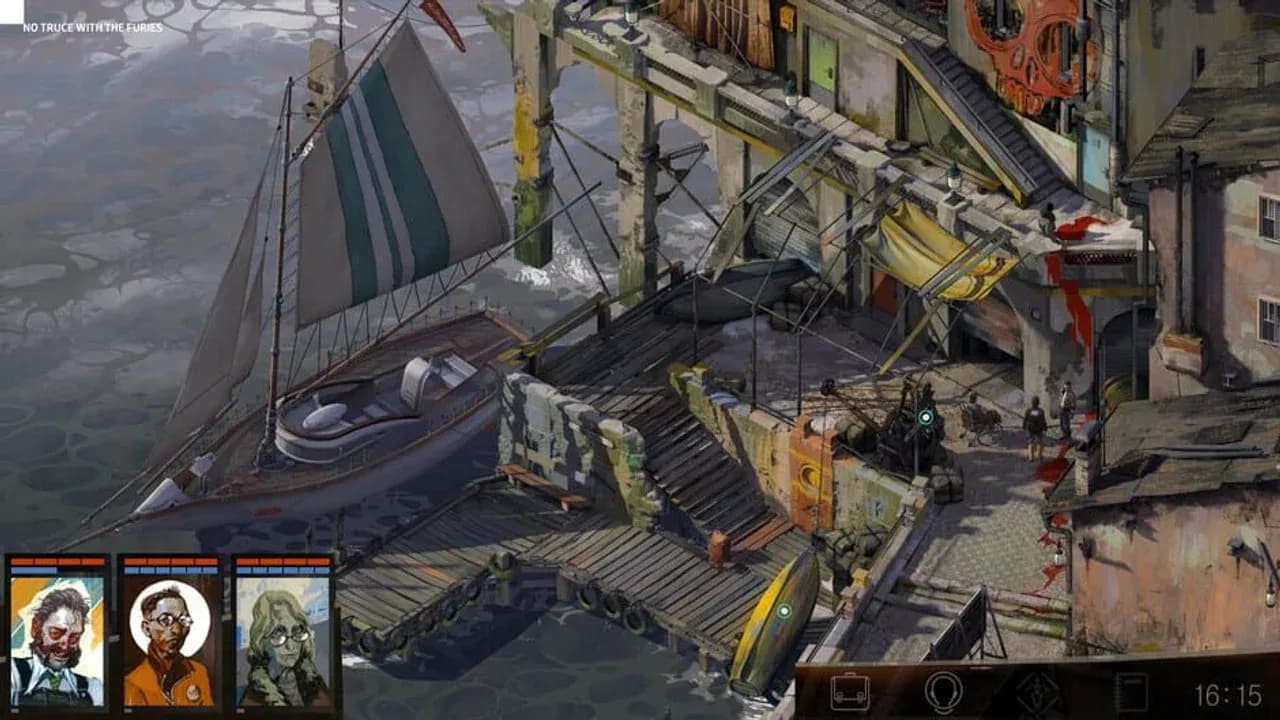
Disco Elysium’s Premise and First Impressions: An RPG Built Around Failure
Disco Elysium begins with a detective who has lost almost everything, including the basic facts of his own identity. That is not merely an amusing setup for a murder investigation; it is the game’s central challenge to the RPG genre, asking whether a protagonist can be defined by conversation, ideology, addiction, incompetence, and failure as meaningfully as by combat statistics or equipment.
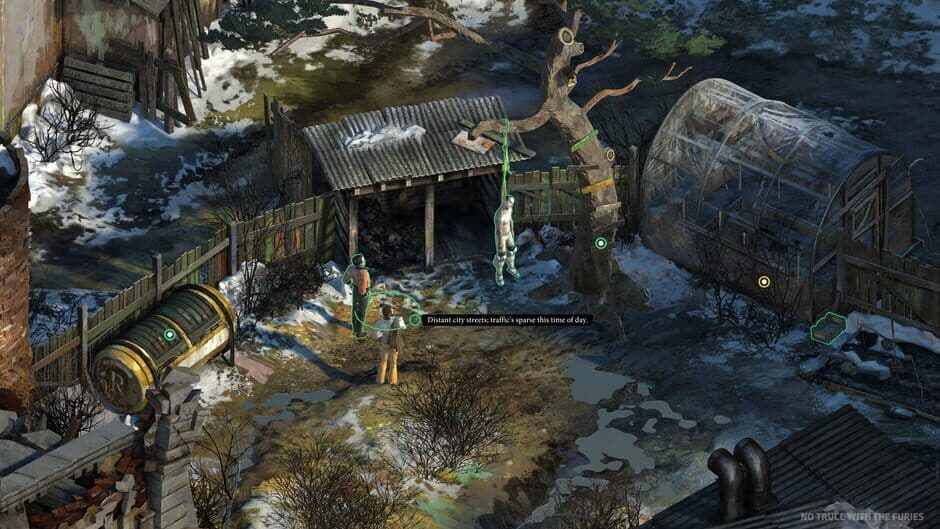
Players navigate a decaying world while piecing together their own shattered identity.
Structurally, Disco Elysium is an isometric, single-player role-playing game built around investigation, dialogue, exploration, and skill checks rather than conventional combat. Its hook is immediately stranger—and more promising—than the standard fantasy quest: a disgraced detective must investigate a murder in Martinaise, a politically fractured district shaped by class conflict, historical violence, and competing ideologies. The case gives the opening a clear objective, but the game quickly makes the detective himself the more compelling mystery. Every conversation can expose another piece of his past, while the district’s residents respond not just to what he discovers, but to the kind of person he chooses to become.
That freedom is strongest when the game treats role-playing as self-definition rather than simple problem-solving. You can steer the detective toward political conviction, reckless self-destruction, reluctant professionalism, or some unstable combination of all three; skills speak up as competing internal voices, while addictions, failed checks, and impulsive dialogue choices turn his personality into something you actively perform. The design does not ask you to create an ideal investigator. It asks whether you will accept an embarrassing answer, pursue a dangerous hunch, or let failure become part of the detective’s identity. This makes even poor decisions feel authored rather than accidental: the game’s most memorable version of the protagonist may be the one who repeatedly makes the wrong choice and finds new meaning in the consequences.
Disco Elysium is not asking whether you can solve the case. It is asking what kind of person is solving it—and whether that person deserves to be trusted.
The first hours are demanding by design, but the barrier is real. Martinaise’s political and philosophical context is rarely introduced through neat explanations, and the game’s dense terminology can make ordinary conversations feel like examinations in a subject you have not studied. The opening also moves slowly, prioritizing disorientation and character reconstruction over immediate momentum; before the investigation feels fully underway, you are spending considerable time learning how this broken detective thinks and how this unfamiliar world speaks. That approach creates powerful curiosity, but it can also make the game appear more interested in displaying its ideas than welcoming the player into them. Disco Elysium’s refusal to simplify its language is artistically defensible, yet its early opacity narrows the audience before its role-playing systems have had time to prove why the effort is worthwhile.
That tension defines the review ahead. Disco Elysium is too interactive to dismiss as an illustrated novel: choices alter the detective’s identity, failures redirect conversations, and exploration turns interpretation into action. Yet it is also closer to an interactive novel than most RPGs, because its major rewards are shifts in perspective, new lines of dialogue, and the pleasure of inhabiting an unusually precise voice rather than collecting better weapons. The result is a genuine hybrid—one where writing is not decoration placed around a game, but the primary material from which the game is built. Whether that makes Disco Elysium satisfying depends on how much patience you have for uncertainty, reading, and role-playing a person who may be far less competent than you are.
Disco Elysium Gameplay: Skill Checks Make Failure Part of the Design
Disco Elysium turns character statistics into a cast of unreliable witnesses living inside the detective’s head. Its greatest mechanical insight is that progression does not make you universally better; it makes you more specifically strange, giving failure, obsession, and bad judgment enough personality to become legitimate forms of play.
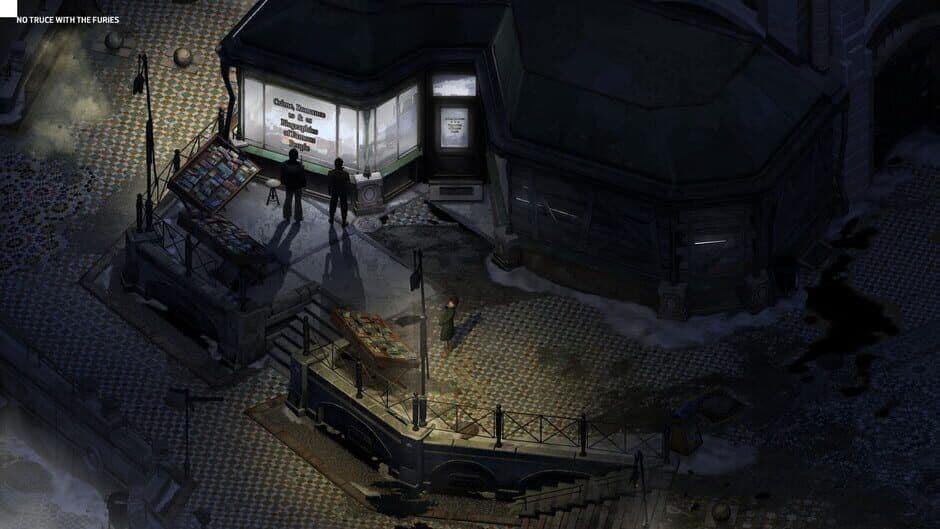
Dialogue encounters serve as the primary form of conflict resolution.
Twenty-Four Voices, Not Just Numbers
Character development is divided among 24 skills, arranged under Intellect, Psyche, Physique, and Motorics. Intellect contains abilities such as Logic, Rhetoric, Encyclopedia, and Conceptualization; Psyche governs Volition, Empathy, Authority, and Inland Empire; Physique covers everything from Endurance and Pain Threshold to Electrochemistry and Shivers; Motorics handles Perception, Interfacing, Savoir Faire, and Hand/Eye Coordination. This is a broader and more expressive system than the usual RPG spread of strength, dexterity, and charisma because each skill describes not only what the detective can do, but how he interprets the world.
The crucial distinction is that these skills speak. Inland Empire may turn an inanimate necktie into an object of profound significance, while Logic tries to impose order on a conversation and Half Light interprets hesitation as an imminent threat. A high skill does not simply unlock a larger number; it inserts a more forceful personality into the detective’s internal monologue. When Rhetoric dissects an argument, Empathy reads the emotional damage beneath it, and Authority demands submission, the character sheet becomes a dramatic ensemble rather than a menu of bonuses. This is where Disco Elysium earns its reputation: the detective’s build changes the narration itself, so raising a skill changes not only the odds of success but the questions you are capable of asking.
In most RPGs, statistics tell you what your character can do. In Disco Elysium, they argue about what your character should believe.
That design also explains why failure is so often more interesting than success. A failed check can produce humiliation, a new line of dialogue, an unexpected clue, or a complication that sends the investigation in a stranger direction instead of simply locking a door. Failing an interaction may reveal the detective’s lack of social competence; failing a physical or perceptual moment can turn an ordinary task into a memorable piece of absurdity. The important point is not that every failure advances the case efficiently—it does not—but that failure usually generates narrative material. Disco Elysium understands that an RPG built around a detective should not treat mistakes as dead ends when they can expose character.
The Roll Is Part of the Drama
The game’s dice checks make that philosophy visible. Active checks show the target number and the player’s current probability, then allow preparation through skill points, clothing, equipment, and situational modifiers; passive checks, by contrast, trigger automatically when a skill is high enough, quietly adding observations to a conversation or location. This creates a useful distinction between deliberate gambles and unconscious expertise. You can inspect the detective’s chances before committing to a difficult roll, change clothing to improve a specific attribute, pursue another lead for a modifier, or increase the relevant skill—but preparation rarely guarantees control. Even when the probability looks favorable, the result still belongs to the dice.
That transparency is both the system’s strength and its most persistent irritant. Visible odds make risk legible: when you attempt a difficult physical feat with poor Physique, you understand that the detective is being reckless rather than betrayed by an invisible formula. White checks can sometimes be retried after improving the relevant skill or finding a new modifier, while red checks are generally one-time decisions with more dramatic consequences. Yet the game’s most consequential conversations can hinge on a single roll, and players who want a specific story outcome may find themselves reloading until the desired result appears. Disco Elysium encourages you to accept failure, but its save structure still makes refusal easy—especially when a missed check feels less like an authored complication than an arbitrary interruption.
The tension is most obvious because the writing is often strong on both sides of a roll. Success can reveal useful information or open a new approach, but failure may produce the funniest response, the most revealing embarrassment, or a completely different emotional beat. Reloading therefore does more than remove difficulty; it can erase content. At the same time, the game cannot entirely control the player’s relationship with randomness: if a check appears to determine whether a crucial exchange proceeds, some players will reasonably protect the narrative they want rather than accept a result that feels mechanically imposed. The dice system works best when failure creates a branch; it works less well when the player experiences that branch as punishment for not bringing the correct build.
This is also where Disco Elysium’s lack of conventional combat becomes most consequential. There is no regular sequence of tactical battles to absorb failed attempts, test equipment, or provide a reliable action-game rhythm. Social pressure, deduction, self-control, and physical confrontation all use related dialogue-and-check structures, so a dangerous conversation can carry the same mechanical suspense as a fight. That unification is elegant: the detective can lose because he misreads a person, loses his nerve, or lets an internal impulse take over, and each form of defeat says something about him. But players expecting the usual RPG safety net of combat encounters, loot, and clearly measurable power growth will find that Disco Elysium replaces those rewards with changes in context, tone, and self-understanding.
Thoughts as Delayed Consequences
The Thought Cabinet extends this idea by turning ideas into a form of equipment. Thoughts can be internalized over time, temporarily occupying the detective’s attention and often imposing an inconvenience or penalty before completion; once processed, they grant longer-term bonuses, unlock new dialogue possibilities, or define the ideological direction of the character. The system makes introspection mechanically tangible. A thought is not a passive perk selected from a skill tree—it is an idea the detective has to live with while it changes him.
That delay matters. Internalizing a thought asks the player to accept short-term instability for a possible future advantage, which mirrors the game’s broader interest in transformation rather than optimization. A politically loaded idea can provide useful bonuses while also nudging the detective toward a particular worldview; a self-destructive or embarrassing fixation may produce comic complications before becoming unexpectedly valuable. The Thought Cabinet therefore sits between character development and ideological role-play: it rewards experimentation, but it also makes the detective’s beliefs feel like commitments with consequences. Its weakness is that some thoughts can resemble opaque build choices until their effects emerge, meaning players who want to shape a precise character may need to consult descriptions carefully or accept that their detective will be altered by ideas they only half understand.
The result is a gameplay loop that rarely asks, “How do I defeat this enemy?” Instead, it asks which part of the detective should take control, how much uncertainty you are willing to tolerate, and whether a disastrous outcome might be more valuable than a clean success. The 24-skill system, visible dice, internal voices, and Thought Cabinet all reinforce the same principle: Disco Elysium makes personality the battlefield. Its occasional reliance on reloadable randomness weakens that principle, but when the game lets a failed check create new meaning rather than block progress, it achieves something traditional combat systems rarely manage—the mechanics do not merely measure the protagonist’s identity; they produce it.
Investigation and Exploration in Disco Elysium: A Dense World With Uneven Momentum
Disco Elysium’s Martinaise is a crime scene that refuses to stay still. Its ruined tenements, industrial harbor, abandoned commercial district, and cold coastline do not merely surround the murder investigation; they explain it, revealing how political violence and economic abandonment have settled into the architecture. The district’s competing forces—the Dockworkers’ Union, Wild Pines, moralists, communists, and fascists—rarely arrive as cleanly labeled factions, because their histories surface through arguments, graffiti, uniforms, buildings, and the people forced to live with their consequences. This is worldbuilding by accumulation: a conversation at the Whirling-in-Rags may clarify a political conflict, while a walk toward the fishing village shows what that conflict looks like after it has exhausted everyone.
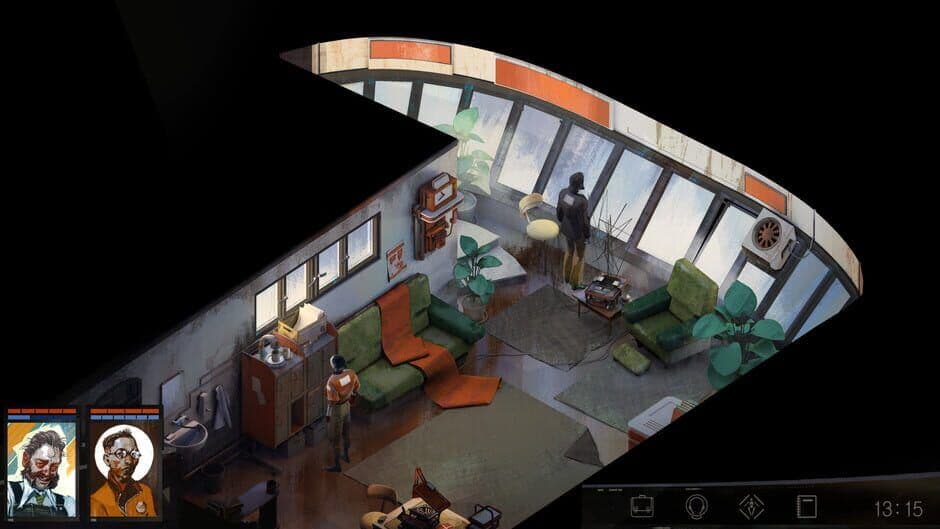
Engaging with the world's unique quest structure.
Martinaise is not a backdrop for the investigation. It is the evidence.
That density gives the murder case an unusual freedom of movement. You can interrogate residents, inspect the corpse, search containers, examine signs, follow rumors, or pursue an apparently irrelevant lead before returning to the main question of who died and why. The game rarely insists on one correct sequence, and that flexibility is more than a convenience: information acquired from one person can change the meaning of an earlier conversation, while a new skill response can turn a dead end into a viable lead. The harbor, for example, is not simply a destination in the case; it is a social system, and understanding the Union’s power requires speaking to several people rather than extracting a single exposition dump. Disco Elysium makes deduction feel less like assembling a fixed puzzle and more like building an interpretation from contradictory testimony.
The world’s objects support that approach, although not always with equal importance. Containers, doors, posters, shop signs, bodies, and scraps of urban debris can trigger passive skill commentary or open new lines of inquiry, making the act of looking itself a form of investigation. Examining the hanged man is mechanically significant, but the same design also gives narrative weight to less obvious discoveries: a piece of clothing, a sign connected to the district’s past, or an object that prompts the detective’s internal voices can reveal personality as readily as evidence. This is where the environmental interaction becomes more than point-and-click scavenging. Martinaise teaches the detective—and the player—how to read a place, even when the reward is a new perspective rather than a key item.
However, the game’s commitment to openness often comes at the expense of momentum. Leads can stall behind a locked route, a failed check, a conversation that must be revisited after gaining new information, or a condition that only becomes available later in the investigation. Moving between the Whirling-in-Rags, the harbor, the coast, and the commercial areas is usually purposeful, but repeated crossings can make the case feel administratively slow rather than intellectually difficult. The problem is not that Disco Elysium asks the player to wander; wandering is frequently the point. The problem is that the game sometimes offers no clear distinction between productive uncertainty and simple waiting, leaving the player to exhaust dialogue options and inspect familiar spaces again because the next meaningful step has not yet revealed itself.
This uneven pacing affects the side content most sharply. Optional cases and diversions often match the central investigation’s writing, particularly when they expose the district’s obsessions through comedy, superstition, or personal grief; the cryptozoological search, for instance, begins as an eccentric interruption but becomes a carefully judged test of belief, disappointment, and human connection. Political quests likewise turn ideology into something the detective performs rather than merely selects, though their value is primarily thematic and conversational rather than mechanical. Personal interactions and absurd errands can deliver some of the game’s funniest and most revealing moments, but they also compete with the murder case for attention without always changing its outcome or improving the detective in a conventional RPG sense. That contrast is deliberate: Disco Elysium treats optional content as a way to deepen the world and the protagonist, not as a second progression track, but players seeking tightly integrated side quests may find some diversions feel like brilliant digressions.
The investigation is therefore at its best when exploration produces interpretation. Martinaise’s locations, residents, and objects make the murder inseparable from the district’s political decay, while the nonlinear quest structure lets players discover that relationship in different orders and through different versions of the detective. Its weaker stretches are equally clear: backtracking, locked progress, and repeated conversations occasionally turn curiosity into procedural maintenance. Even so, the design’s central achievement survives those slow patches. Disco Elysium understands that solving a murder is not only about finding what happened; it is about learning what kind of place could allow it to happen, and what kind of detective is capable of seeing the answer.
Disco Elysium’s Story and Characters: Brilliant Writing With Deliberate Excess
Disco Elysium’s murder mystery is almost a decoy. The case matters, but the game’s real subject is what people do with history after history has already broken them—and whether jokes, ideology, or professional duty can keep that damage from becoming meaningless.
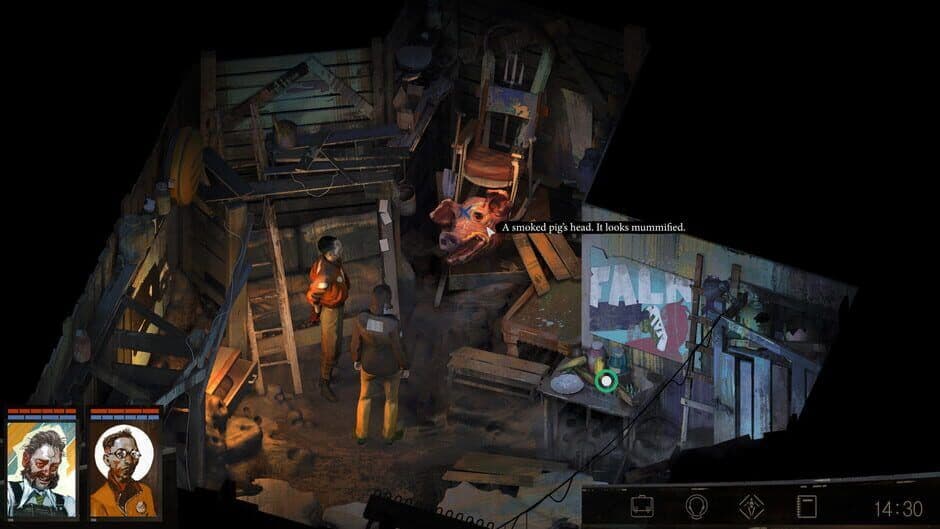
The central murder mystery drives the character-focused narrative.
A Mystery About More Than the Murder
The central investigation works because its clues are never merely pieces of a puzzle. The dead man, the ruined district, the labor dispute, the competing accounts from Martinaise’s residents, and the detective’s own fractured memory all point toward a crime shaped by forces larger than any individual suspect. Disco Elysium understands the appeal of a detective story—interrogations, contradictions, physical evidence, and the satisfaction of connecting details—but it refuses to pretend that solving the case will restore order. Every revelation clarifies one part of the crime while exposing another layer of political violence, class resentment, historical defeat, or personal grief.
That makes the suspect structure more interesting than a conventional whodunit, even when it becomes less tidy. People lie, evade, posture, and misremember for reasons that are social as much as criminal; the detective is not simply identifying a culprit but deciding whose version of reality deserves scrutiny. The investigation repeatedly shifts between the immediate facts of the murder and the history that made those facts possible. Its final explanation is thematically stronger than a clean twist because it connects private action to the long afterlife of war, ideology, and abandonment. As a pure mystery, the case occasionally loses momentum beneath its digressions. As a vehicle for examining how history survives inside ordinary people, it is remarkably sustained.
The ending earns its power by resisting the fantasy that a solved case produces a solved world. The detective can reach an answer, account for the crime, and still return to a district where poverty, political failure, and old resentments remain firmly in place. That refusal of tidy closure gives the conclusion an adult melancholy: justice is possible, but it is neither total nor transformative. Disco Elysium’s mystery ultimately asks not only who committed the crime, but what society has made such a crime imaginable—and why everyone involved has learned to live with the consequences.
Kim Kitsuragi and the Human Scale
The partnership with Kim Kitsuragi keeps this philosophical investigation from floating away into abstraction. Kim is methodical where the detective is impulsive, observant where the detective is distracted, and professionally restrained where the detective’s internal voices turn every conversation into a referendum on identity. His presence gives the player a procedural baseline: while the detective can chase a bizarre theory, insult a witness, or surrender to an ideological performance, Kim remembers that evidence still needs to be collected and people still need to be treated with some degree of respect.
Kim is not merely the sensible companion placed beside a comic protagonist. His reactions make the detective’s choices matter. A reckless outburst can produce embarrassment because Kim witnesses it; a moment of competence carries greater weight because Kim recognizes it; a cruel or self-destructive decision becomes more painful because it strains a working relationship rather than occurring in isolation. The game builds this trust through small professional exchanges and shared investigative pressure, not through sentimental declarations. Kim’s approval never turns him into a reward dispenser. It feels earned precisely because he remains capable of disappointment.
Kim is the person who keeps Disco Elysium’s tragedy from becoming an intellectual exercise. When the detective turns himself into a theory, Kim insists on seeing the person underneath.
That contrast also sharpens the protagonist’s characterization. The detective’s amnesia is not a blank slate in the conventional RPG sense; it is an opportunity to reveal his history through behavior. His addictions, humiliating impulses, political commitments, and attempts to reconstruct his past emerge through choices made in the present. You do not receive a complete biography and then select a personality from a menu. You perform that personality in front of Kim, suspects, bystanders, and the voices inside your own head. When the detective behaves with professionalism, the moment feels like an achievement because the game has shown how difficult basic stability can be for him.
This approach gives Disco Elysium’s character development unusual moral texture. Political beliefs are not detached alignment labels, and addiction is not a cosmetic quirk; both shape how the detective interprets people and how other characters respond to him. A player can make him compassionate, authoritarian, ideological, self-mocking, or spectacularly embarrassing, but none of these identities exists outside the consequences of daily conduct. The protagonist is defined less by what the player claims to believe than by what he does when confronted with humiliation, temptation, poverty, or another person’s pain.
Politics Written as Temptation, Not Alignment
The political writing is strongest when Disco Elysium treats ideology as an emotional need rather than a list of correct answers. Communism, liberalism, fascism, moralism, nationalism, and political apathy all appear as attempts to explain suffering and offer the detective a place within a larger story. The game’s political quests and dialogue options let the player pursue these positions, but they rarely make any ideology look entirely clean. Communism can carry genuine solidarity alongside historical failure; liberalism can promise moderation while preserving indifference; fascism offers the comfort of hierarchy and grievance; moralism presents stability as an excuse to avoid meaningful change.
That complexity matters because the game does not reduce politics to dialogue-tree bonuses. A political commitment changes the tone of the detective’s thoughts and the kinds of conversations he is prepared to have, but it does not magically solve the murder or transform him into a better person. The detective can adopt grand theories while remaining vain, addicted, frightened, or incompetent. This is the joke and the criticism at once: ideology can become another way to avoid personal responsibility, especially when the protagonist uses historical language to disguise his own failures.
Disco Elysium is particularly sharp about political apathy. The apparently sensible position—stay moderate, avoid extremes, preserve order—can look less like wisdom than surrender when placed beside Martinaise’s poverty and historical wounds. Yet the game also understands why exhausted people retreat from politics. Residents are not simply waiting for the detective to select the correct ideology and repair the district; many have seen grand promises fail before, and their skepticism is grounded in experience. The writing’s achievement lies in allowing political arguments to be funny, embarrassing, insightful, and self-serving in the same conversation. Its limitation is that the satire can occasionally feel more interested in exposing the absurdity of a worldview than in exploring what its adherents might build.
The Cost of Saying Everything
The dialogue is often extraordinary because it combines literary description, absurdist humor, social observation, and precise characterization without treating those qualities as separate modes. A conversation can begin with a mundane procedural question, veer into an argument about class or history, and end with an image so strange that it becomes unforgettable. The internal skills intensify this effect: a single exchange may contain Logic’s analysis, Empathy’s discomfort, Authority’s aggression, and Inland Empire’s surreal speculation, each voice revealing a different pressure inside the detective. The result is not simply witty writing. It is characterization delivered through rhythm, interruption, contradiction, and the precise comic timing of a mind failing to stay on task.
The humor gives the heavier material room to breathe. Disco Elysium can place absurd behavior beside poverty, addiction, grief, and political violence without pretending those subjects are equally funny. The detective’s embarrassment is often hilarious, but the game understands when embarrassment turns into self-loathing; a ridiculous conversation can suddenly reveal how badly someone wants to be heard. That tonal control is why the comedy rarely feels like an escape from the story. It is part of how the characters survive the story.
But the writing’s abundance is also where the seams show. Conversations are long, invented vocabulary arrives without much hand-holding, and the detective’s internal commentary can interrupt nearly every important interaction. Philosophical digressions sometimes illuminate a character or setting; other times they delay the next actionable clue while demanding that the player process another miniature essay. The experience can become especially exhausting when several skill voices pile onto the same conversation, repeating or reframing a point without materially changing the decision in front of you. Disco Elysium’s density creates its singular voice, but it also makes urgency fragile: a murder investigation can feel less like a race against time than a reading assignment that occasionally remembers it has a plot.
That criticism is not a complaint that the game contains too many ideas. The problem is uneven hierarchy. Its best digressions deepen the human story, while weaker ones make the writing feel pleased with its own cleverness. Players willing to read closely will find extraordinary detail in those passages; players looking for momentum may experience the same detail as narrative drag. Disco Elysium does not merely ask for patience—it asks the player to accept that the prose itself is often the destination.
When the Absurd Becomes Painful
The emotional payoff works because the game refuses to separate comedy from damage. The detective’s addictions and personal ruin are funny when his worst instincts produce an outrageous line or a humiliating performance, but they become painful when the consequences settle in and the joke reveals a person who has lost control of his own life. Poverty is treated with similar complexity. Martinaise’s residents are not symbols placed around the case; they are people negotiating debt, political disappointment, exhaustion, and the indignities of being ignored. Even the game’s strangest side stories can turn toward grief when the initial absurdity has lowered the player’s guard.
The detective’s recovery is therefore not a conventional redemption arc. Disco Elysium does not erase his past because the player chooses kinder dialogue, nor does it guarantee that political insight produces emotional maturity. What changes is the possibility of attention: he can begin to listen, recognize harm, accept help, and act with purpose despite the wreckage behind him. Kim’s partnership makes those changes visible, while the murder investigation gives them a practical test. The detective may remain ridiculous, but he is no longer only ridiculous; he can become someone capable of carrying responsibility without pretending to be healed.
This emotional range culminates in a conclusion that ties personal ruin to colonial history, political exhaustion, and the stubborn possibility of human connection. The themes are enormous, but the game usually grounds them in faces, voices, and awkward encounters rather than speeches alone. That grounding keeps Disco Elysium from becoming a purely ideological text. Even when its politics become discursive and its prose threatens to overwhelm the case, the strongest scenes return to a simple question: what does one damaged person owe another?
Disco Elysium’s greatest emotional trick is making laughter feel like evidence. The joke lands, and then the game shows you what the character was trying not to feel.
The story’s excess is inseparable from its achievement. Disco Elysium is too verbose, too politically argumentative, and occasionally too enamored with its own vocabulary to deliver a consistently brisk mystery. Yet the same excess allows its characters to exist in contradiction: funny and cruel, ideological and apathetic, damaged and capable of care. The murder case supplies structure, Kim supplies human balance, and the detective’s choices turn exposition into lived experience. By the time the investigation reaches its answer, the real revelation is not simply who is responsible—it is how much history, grief, and absurdity a person can carry before becoming something else.
Art, Voice Acting, and Music in Disco Elysium: A Unified Atmosphere
Disco Elysium looks like a memory that has been left out in the rain. Its painted environments, bruised colors, and grotesque flashes of surrealism create an identity so distinctive that technical roughness rarely erases it—but the contrast between visual sophistication and limited animation is impossible to miss.
A World Painted in Decay
The oil-painting-inspired backgrounds give Martinaise a visual language built from texture rather than polish. Walls appear weathered, streets look damp and neglected, and the district’s muted reds, browns, blues, and grays make political exhaustion feel embedded in the scenery. The effect is especially powerful around the Whirling-in-Rags and the harbor, where damaged buildings and industrial spaces make the murder investigation feel inseparable from the district’s economic collapse. These are not merely attractive backdrops; they turn environmental decay into a recurring visual argument about history refusing to disappear.
Character presentation works through a different kind of exaggeration. Expressive portraits capture suspicion, exhaustion, arrogance, or sudden vulnerability more efficiently than the limited in-world models can, while surreal imagery externalizes the detective’s fractured perspective. A face can become grotesque, monumental, or emotionally abstract when the scene shifts into memory, ideology, or internal monologue. That visual instability complements the role-playing systems discussed earlier: Disco Elysium does not show the detective as a fixed, neutral avatar because his appearance and surroundings are constantly filtered through unreliable perception.
Disco Elysium’s painted style does not make Martinaise beautiful. It makes the district look remembered, misremembered, and impossible to escape.
Lighting and weather deepen that impression. Cold outdoor spaces, dim interiors, industrial shadows, and the persistent sense of damp create an atmosphere of physical discomfort that mirrors the detective’s mental and personal collapse. Visual transitions into more abstract or dreamlike imagery are effective because they interrupt the otherwise grounded investigation at precisely the moments when reality becomes psychologically unstable. The presentation rarely separates political decay from personal ruin: the broken district and the broken detective appear to belong to the same damaged world.
This is where the game’s artistic direction exceeds its technical means. The backgrounds can communicate history through a single composition, while a character standing in front of them may move only minimally or repeat the same presentation across several conversations. The painted environments feel carefully authored; the animation often feels functional. That discrepancy does not destroy immersion, but it makes the player aware of the machinery beneath the writing, particularly during scenes whose emotional complexity deserves more physical expression than the game can provide.
Voice Gives the Text a Body
The Final Cut edition added full voice acting to the game’s dialogue and expanded the available political vision quests. The voice work changes the texture of Disco Elysium substantially because the original experience asked the player to construct much of its rhythm internally, reading each exchange at a personal pace. Spoken performances now give characters vocal identities and make long conversations easier to inhabit, especially when the detective’s internal skills interrupt one another like a quarrelsome cast sharing one mind. A dry delivery can sharpen a joke, while hesitation or weariness can make a seemingly procedural exchange reveal its emotional cost.
The strongest performances improve characterization without replacing the writing’s precision. Kim’s controlled professionalism gains extra weight when set against the detective’s erratic inner commentary, and the competing skill voices become easier to distinguish as personalities rather than paragraphs in a character sheet. Voice acting also helps the game’s more theatrical moments land: absurdity benefits from timing, while moments of discomfort become harder to skim past when the delivery forces the player to hear the pause or emphasis. This is a meaningful improvement in immersion, not simply an accessibility checkbox.
However, full narration changes the appeal of the text-first design as much as it enhances it. Reading Disco Elysium originally allowed the player to set the tempo of its digressions, speeding through familiar exchanges or lingering over a particularly sharp description. Spoken dialogue makes the experience more immediate, but it also makes the game’s verbosity more imposing; a long philosophical detour now occupies audible time rather than only visual attention. Players who value the intimacy of reading may find that voice acting narrows their imaginative role, while newcomers will likely appreciate the help it provides in navigating the game’s dense terminology and constantly shifting tones.
The result is best understood as an alternative emphasis rather than a simple replacement. The Final Cut makes Disco Elysium more welcoming and gives its characters a stronger presence, but the original text remains the foundation of its artistry. The performances succeed because the writing already understands how every line should sound, whether it is delivered by a companion, a stranger, or one of the detective’s intrusive mental faculties.
Music for a City That Cannot Heal
The soundtrack and ambient audio complete the atmosphere by keeping Martinaise uneasy even when nothing immediate is happening. Music supports investigation without turning every discovery into a conventional triumph; its melancholy suggests that knowledge may bring clarity without bringing comfort. Ambient sounds give the district a sense of exposure and isolation, making quiet stretches of exploration feel reflective rather than empty. The combination is particularly effective when the detective moves between social spaces and more desolate areas, because the audio shifts the emotional meaning of the same investigation from procedural curiosity to loneliness.
Sound design also protects the game from becoming visually static. When characters move only slightly and backgrounds carry most of the visual detail, environmental audio supplies motion and psychological pressure. It makes the harbor feel like a working, hostile space and gives interiors a distinct sense of shelter that is never quite secure. During reflective dialogue, the restrained presentation leaves room for the voice performances and internal monologues to dominate, allowing the player to focus on the detective’s interpretation rather than on spectacle.
The music is most valuable because it refuses easy emotional instructions. Disco Elysium can be funny, political, grotesque, and heartbreaking within a short span, yet the soundscape maintains a thread of melancholy beneath those tonal shifts. That continuity binds apparently unrelated scenes together: the comedy belongs to the same world as the grief, and the detective’s personal absurdity exists alongside Martinaise’s larger historical wounds. The soundtrack does not merely decorate the investigation; it gives the game’s contradictions a common emotional register.
The presentation is therefore artistically unified even when it is not technically seamless. Painted environments, expressive portraits, surreal imagery, voice performances, ambient sound, and music all reinforce the same themes of memory, collapse, and survival. Limited animation and repeated character staging reveal the game’s constraints, but the direction is strong enough that those constraints usually feel like visible seams in an ambitious work rather than evidence of an incoherent one. Disco Elysium’s atmosphere ultimately earns its place beside the writing: it does not soften the game’s density, but it gives that density a world, a voice, and a mood readers can feel.
Disco Elysium Performance and Usability: A Strong Final Cut With Rough Edges
Disco Elysium’s current Final Cut is far more dependable than its launch reputation suggests, but it still occasionally feels like a brilliant manuscript running on imperfect software. The update’s full voice acting, expanded political content, and years of patches make this the version to play, yet technical blemishes remain most noticeable when the game is already asking you to track dozens of conversations, clues, and conditional outcomes. A crash or dialogue hiccup is not merely an inconvenience here: it can interrupt a carefully built chain of reasoning and force you to reconstruct where the investigation was left. The good news is that these rough edges are exceptions to a generally functional experience, not the defining condition of playing Disco Elysium today.
A Better Final Cut, Not a Perfect One
The post-launch improvements matter because Disco Elysium’s structure magnifies even minor technical problems. The Final Cut’s full voice acting gives conversations a more consistent presentation, while its additional political vision quests add content rather than simply repackaging the original release. Patches have also moved the game away from the instability associated with its early versions, making crashes, freezes, missing lines, and progression interruptions less central to the experience than they once were. However, reports of occasional dialogue issues and technical hangs have not vanished entirely, and the risk is more frustrating in a game where a conversation can contain a clue, a skill response, and a quest trigger at the same time.
Platform expectations should remain modest. On PC, mouse control makes examining small objects and moving through menus more natural, while controller-based versions make the game comfortable from a sofa but expose more friction when selecting items or navigating crowded spaces. The underlying experience is the same across platforms, but input method changes how much effort routine interaction demands. Disco Elysium is not a performance showcase that needs high-end hardware; its technical concerns are primarily stability, interface behavior, and presentation consistency rather than graphical ambition. That distinction matters when judging the current version: this is a patched narrative RPG with occasional seams, not a broken game rescued only by nostalgia.
The Final Cut fixes the most visible wounds, but Disco Elysium still occasionally reminds you that its most intricate system is not the Thought Cabinet—it is the web of conditions holding every conversation together.
An Interface Built for Information
The interface succeeds because it understands that Disco Elysium is fundamentally a game about managing information. The journal separates active tasks from completed thoughts and investigation notes, giving the player a place to return when Martinaise’s competing leads begin to blur together. The map provides valuable orientation between major areas, while the character sheet makes the relationship between attributes, skills, clothing, equipment, and available points legible enough to support deliberate preparation. Most importantly, skill checks display their odds and modifiers before the player commits, turning a potentially opaque roll into an understandable decision rather than a hidden punishment.
The dialogue interface is similarly effective at presenting choice without pretending that every option is equally safe. Responses communicate tone—professional, cruel, evasive, ridiculous, or ideologically loaded—while internal skill interventions show how the detective’s mind is interpreting the exchange. The result is a useful compromise between clarity and uncertainty: you can usually see what kind of person a line will make you appear to be, but you cannot fully predict how another character will react. Inventory and clothing menus also support the game’s unusual progression by making equipment relevant to skill checks rather than reducing it to a conventional loot treadmill. Swapping an item before a difficult check feels like preparation for an interrogation, not a routine damage upgrade.
That readability is essential because Disco Elysium offers no traditional combat loop to organize the player’s attention. The journal, map, skills, Thoughts, and dialogue choices collectively replace the familiar structure of weapons, enemy markers, and battle objectives. When these tools work together, the game feels unusually transparent for such a dense RPG: the player may not know what a clue means, but they can usually identify where it came from and which system produced it. This is where Disco Elysium’s interface earns trust. It makes a complicated narrative machine inspectable without reducing its mysteries to checklist entries.
Where Routine Interaction Becomes Work
The weakness is not that Disco Elysium lacks information; it is that accessing some of that information can be needlessly fiddly. Small interactable objects can be easy to miss against the painted environments, and traversal routes are not always obvious when doors, stairways, and room entrances blend into the surrounding scenery. The player may understand that a location matters but still spend time searching for the precise point where the detective can interact with it. In an investigation built around noticing details, that distinction is significant: occasionally the challenge is not interpreting evidence but locating the game’s interaction prompt.
Movement between spaces can create similar friction. The map helps establish the district’s broad layout, but it does not eliminate the need to cross familiar routes, revisit rooms, or recheck conversations after obtaining a new lead. That repetition is partly intentional—investigation requires returning with better questions—but the interface does not always make the reason for a return clear. Inventory management is also functional rather than elegant, particularly when clothing changes become part of check preparation and the player is comparing several situational bonuses. None of these problems undermines the writing or investigation systems, but together they make Disco Elysium less immediately comfortable than its slow, thoughtful pace might suggest.
Some ambiguity, however, belongs to the design rather than the technology. The game deliberately withholds certainty about which lead matters, which voice deserves attention, and whether a political or personal choice will improve the detective’s life. A journal that refuses to turn every task into a precise waypoint preserves the pleasure of interpretation. The problem begins when deliberate uncertainty overlaps with unclear interaction design. Disco Elysium is strongest when the player is unsure what a clue means; it is weaker when the player is unsure whether a nearby object is usable at all.
Accessibility and the Cost of Reading
The Final Cut’s full voice acting is the most meaningful accessibility improvement because it gives the text a second route into the player’s attention. Long conversations remain readable through subtitles and written dialogue, but hearing the skills, Kim, and the detective’s many conversational partners makes character distinctions easier to follow and reduces the burden of silently parsing every exchange. Voice acting also clarifies tone in scenes where a line’s humor or discomfort depends on delivery. It does not solve the game’s central demand—Disco Elysium still requires sustained reading and concentration—but it makes that demand less visually exhausting.
The game remains less accommodating for players who struggle with dense text, small interface elements, or sustained visual tracking. Its presentation relies on muted colors, painterly backgrounds, and subtle environmental details, which create a powerful atmosphere but can make interactable objects and routes harder to distinguish. The game’s accessibility support is therefore strongest at the audio level and less convincing as a complete readability solution. Players who need larger text, stronger contrast, or more explicit navigation assistance may find that the game’s artistic identity and interface ambiguity work against them, particularly during long dialogue sequences or when searching a cluttered room.
This limitation has a clear impact on the experience. Disco Elysium’s most important discoveries are often delivered through a skill response, a line of dialogue, or a small environmental interaction rather than through a conspicuous objective marker. Missing one can mean losing not just flavor text but a useful lead or a new interpretation of the detective’s situation. The Final Cut makes the writing easier to hear, but it does not make the game’s information density easy to process. Accessibility here is a question of audience tolerance as much as settings: players comfortable with reading-heavy RPGs will find the presentation manageable, while others may need to rely more heavily on saving, revisiting the journal, and taking the investigation at a deliberately slow pace.
An Onboarding Process That Trusts Too Much
Disco Elysium’s opening teaches its systems through consequences rather than tutorials, and that approach is thematically appropriate but mechanically uneven. Early skill checks demonstrate that failure can create new dialogue instead of ending a quest, while the detective’s health and morale make reckless physical or psychological choices immediately dangerous. The Thought Cabinet introduces longer-term character modification by asking the player to internalize ideas over time, and political or personal choices reveal that dialogue can shape identity beyond the immediate conversation. These systems are not presented as isolated menus; they emerge from the detective’s first humiliations, impulses, and attempts to function.
The design intent is clear: the player should learn to inhabit an unstable person, not operate a perfectly explained machine. Yet the opening does not always explain the boundaries between these systems cleanly enough. A player can understand that health and morale are important without immediately grasping how easily a bad decision can threaten them, just as the benefits and costs of a Thought may remain unclear until it has already influenced the build. Political choices can initially resemble throwaway jokes before revealing themselves as commitments that shape later interactions. Disco Elysium teaches through discovery, but some discoveries feel like lessons the interface should have delivered earlier.
This creates a steep but defensible learning curve. Unlike a conventional RPG, the game does not begin by handing the player a reliable combat rotation, a clear equipment ladder, and a set of low-risk encounters for practice. It asks the player to learn what matters by failing, rereading, experimenting, and accepting that the detective’s mind will sometimes make decisions before the player fully understands them. That onboarding reinforces the game’s role-playing philosophy, but it also explains why newcomers can bounce off Disco Elysium before its systems become coherent. The game eventually teaches its logic; it simply expects patience before it offers comfort.
Disco Elysium’s technical and usability profile is therefore defined by a productive contradiction. The Final Cut is the strongest and most accessible version because patches, full voice acting, and expanded content address real weaknesses, while its interface gives unusually clear access to skills, checks, tasks, and character development. Yet small-object interaction, route-finding, dense reading, occasional technical faults, and an under-explained opening continue to create friction. Some uncertainty is the point; some inconvenience is not. Disco Elysium remains a remarkably coherent RPG because even its systems-heavy presentation serves the idea of inhabiting a damaged, distracted detective—but the game’s current version asks for patience not only with its protagonist, but with the software carrying him.
Is Disco Elysium Worth Playing? Value, Audience, and Genre Comparisons
Disco Elysium is worth playing for the same reason it may frustrate you: it treats conversation, failure, and self-interpretation as the reward loop rather than as preparation for something more familiar. A typical playthrough delivers a substantial murder investigation, a dense collection of optional cases, dozens of hours of dialogue, and a protagonist whose identity changes through decisions rather than a conventional hero’s journey. That is extraordinary value for readers who want an RPG to keep producing new ideas and character moments, but a poor proposition for anyone measuring value in combat encounters, loot drops, or visible power increases. The right question is not whether Disco Elysium contains enough content; it is whether its content is made of the things you actually want to do.
What You Get for Your Time
The campaign’s value comes from the quality and interconnection of its material. The central investigation provides the spine, but optional stories expand the world rather than merely filling space: political quests test how the detective performs ideology, personal errands expose his habits and delusions, and stranger diversions can shift from comedy into genuine emotional insight. A single conversation may reveal a clue, trigger several internal skill responses, alter Kim’s reaction, and open a new interpretation of the district, giving even apparently minor content more density than a typical side quest built around combat and rewards. Disco Elysium’s dialogue is not disposable text between objectives; it is the objective, the character development, and often the most meaningful consequence.
That makes the game’s asking price difficult to judge by conventional RPG standards. You are not paying for a long equipment treadmill or a huge catalog of enemy types; you are paying for a carefully authored web of perspectives, conditional scenes, failed outcomes, political commitments, and character-specific reactions. The investigation can slow when the next lead is obscured, and the writing occasionally spends too long proving that it has another clever angle on a subject it has already examined. Still, the amount of distinctive material delivered in one run is substantial because the game gives narrative weight to embarrassment, dead ends, and conversations that would be optional flavor in another RPG. For readers who value writing and role-playing consequences, Disco Elysium offers exceptional campaign value; for players seeking mechanical variety, its abundance can feel narrower than its length suggests.
Disco Elysium does not pad its campaign with more things to kill. It fills the time with more ways to understand why everyone is already wounded.
Replayability Without a Second Combat Build
Disco Elysium has real replay value, but it is not the kind that asks you to master a combat system or optimize a new class. Different investments among the 24 skills change which internal voices dominate, which passive observations appear, and which checks become available; a detective led by Logic and Rhetoric reads a room differently from one guided by Inland Empire, Electrochemistry, or Half Light. Failed checks also matter because they can produce unique humiliation, information, or complications rather than simply subtracting progress. A second playthrough is therefore not just the same investigation with a different numerical profile—it can reveal a different version of what the investigation means.
Political commitments and Thoughts deepen that variation. Pursuing communism, fascism, moralism, or liberalism changes the detective’s ideological self-presentation and unlocks different conversations, while the Thought Cabinet turns ideas into temporary burdens and long-term influences. These choices do not create entirely separate campaigns, and the murder’s broad structure remains recognizable, so players looking for radically divergent plots should moderate their expectations. The replayable material is concentrated in perspective, tone, checks, reactions, and side content rather than in a branching narrative that sends the player to wholly different worlds.
That distinction makes replayability a matter of temperament. If you enjoy comparing outcomes, role-playing a detective with a deliberately contradictory build, or revisiting a conversation to see how another skill changes its meaning, Disco Elysium can support multiple absorbing runs. If you prefer one definitive playthrough and feel little urge to reread dialogue, the second run may feel less like discovery and more like repetition, particularly because exploration still takes place across the same compact district. The game rewards reinterpretation more than completionism, and that is a narrower but more intellectually satisfying form of replayability.
The RPG Rewards It Refuses
The limitation is obvious: Disco Elysium offers almost none of the conventional feedback that defines a traditional computer RPG. There is no regular combat loop, no parade of weapons to compare, no tactical encounter structure, and no reliable stream of loot that makes the character visibly stronger after every quest. Clothing and equipment can alter skill checks, but swapping a jacket for a better modifier is preparation for a conversation, not the thrill of acquiring a dramatically superior artifact. Even progression through skills and Thoughts is restrained; a new point may unlock a perspective or improve a probability, but it rarely makes the detective feel universally more powerful.
That restraint is thematically coherent and mechanically divisive. Because the detective can fail socially, physically, psychologically, or intellectually, the game’s power curve is about becoming more specifically capable rather than simply stronger. Yet players accustomed to the satisfying cadence of defeating enemies, collecting rewards, and watching a build come together may find the progression too abstract. A successful interrogation, a newly understood political conflict, or a devastatingly funny failure can be memorable, but none provides the tactile satisfaction of a hard-won tactical victory. Disco Elysium replaces conventional rewards with context, self-knowledge, and altered dialogue; that is a bold exchange, not a universal improvement.
This is why the game should not be recommended as a combat-free substitute for a combat-heavy RPG unless the player genuinely wants a different kind of interaction. Its absence of combat is not an empty space waiting to be filled. The same systems govern arguments, deductions, physical risks, and emotional breakdowns, making the detective’s personality the central arena. But if a player needs tactical encounters to create rhythm, or equipment optimization to make progression feel concrete, Disco Elysium’s elegant minimalism will eventually feel like deprivation.
Who Should Play Disco Elysium?
The ideal audience is made up of readers who enjoy dialogue as gameplay rather than as an interruption between gameplay sequences. Disco Elysium suits players who want to interpret characters, follow political arguments, examine a damaged society, and make choices whose consequences are tonal or personal rather than immediately material. It is especially rewarding for anyone who has enjoyed reading-heavy RPGs but wished their character’s statistics could alter the narration itself. When Empathy, Rhetoric, or Inland Empire interrupts a conversation with a distinct interpretation, the player is not selecting a bonus from a menu; they are deciding which part of the detective’s mind deserves authority.
Exploration-minded players will also find strong reasons to persist. Martinaise’s locations, objects, residents, and competing histories continually reward attention, even when the reward is a new perspective rather than a quest marker or item. Players who enjoy role-playing through consequences may appreciate that the detective can be incompetent, cruel, ideological, self-destructive, or unexpectedly kind without the game forcing him toward a single idealized version. The design respects the possibility that a failed check or embarrassing decision can be more representative of a character than a successful one.
The fit is less obvious for players who need immediate momentum or clear mechanical mastery. Disco Elysium begins slowly, uses unfamiliar political and historical vocabulary, and frequently allows conversations to expand into philosophical digressions. Its bleakness is not decorative, either: addiction, depression, poverty, personal ruin, violence, colonial history, and political extremism are woven into the setting and the protagonist’s behavior. Readers who want levity without emotional discomfort, or who may find depictions of substance abuse and despair distressing, should approach with caution. The game can be compassionate, but it does not make suffering comfortable merely because it is sometimes funny.
Planescape: Torment and the Dialogue-Heavy Tradition
The closest historical comparison is Planescape: Torment, another dialogue-heavy RPG that treats identity, mortality, and philosophical argument as central content. Both games make the protagonist’s inner life more important than conventional heroism, and both understand that an RPG can ask what a person is rather than simply where that person should go next. The difference is in how they express player agency. Planescape: Torment often builds its philosophical force through authored exposition and a more traditional party-based RPG structure, while Disco Elysium turns skills into speaking characters and makes the detective’s interpretive habits part of the mechanical interface.
That distinction gives Disco Elysium a more immediate relationship between build and prose. In Planescape: Torment, dialogue choices and attributes shape the conversation, but Disco Elysium’s internal voices constantly dramatize the conflict between those attributes. The player hears Logic, Authority, Empathy, and Half Light disagreeing in real time, so character development becomes a debate rather than a statistic check hidden behind text. Planescape remains stronger for players who want a broader party dynamic and more recognizable computer-RPG scaffolding; Disco Elysium is more radical in making one damaged mind function as the entire party.
The comparison also clarifies the value of Disco Elysium’s investigation. Traditional computer RPGs often use dialogue to deliver lore before sending the player toward combat, traversal, or an objective. Here, questioning a witness, inspecting a room, surviving an awkward exchange, and deciding what the detective believes are the primary actions. The absence of combat is not merely a reduction in systems; it lets the game maintain thematic pressure across every encounter. Disco Elysium’s gamble succeeds because the writing and skill checks are varied enough to replace the tactical rhythm that combat would normally provide.
Baldur’s Gate 3 and the Modern Choice-Driven RPG
Baldur’s Gate 3 demonstrates how different a choice-driven RPG can be while still offering extraordinary player expression. Its branching decisions are expressed through cinematic performances, party relationships, environmental interaction, turn-based combat, class abilities, spells, equipment, and multiple solutions to physical problems. Disco Elysium has fewer systems in that conventional sense, but it applies far greater concentration to internal characterization. Baldur’s Gate 3 lets you define a character through what they do across a reactive world; Disco Elysium lets skills, ideologies, addictions, and mental impulses argue over what the character thinks before he acts.
The contrast is especially clear in failure. In Baldur’s Gate 3, a failed check may trigger a different encounter, tactical disadvantage, or quest outcome within a highly systemic environment; the surrounding world can often absorb that failure through combat and simulation. In Disco Elysium, failure is more intimate. Losing a roll can expose vanity, cowardice, delusion, or unexpected insight, and the consequence is usually delivered through language and altered self-perception rather than a new battlefield. Baldur’s Gate 3 offers broader systemic agency and more cinematic immediacy, while Disco Elysium offers a deeper examination of the voice making the choice.
Neither approach is automatically superior. Baldur’s Gate 3 is the better recommendation for players who want party dynamics, tactical combat, spectacular set pieces, and branching choices expressed through action. Disco Elysium is the stronger recommendation for players who want a role-playing system to interrogate their motives, beliefs, and habits at every turn. One asks how many ways a world can react to what you do; the other asks how many voices can explain why you did it.
The Verdict for Different Players
Disco Elysium remains one of the best values in RPGs for a specific audience, not because it satisfies every definition of role-playing but because it rejects several of them with unusual confidence. It gives a typical playthrough a rich investigation, substantial optional material, meaningful character development, and enough build-dependent variation to make alternative runs worthwhile. Its limitations are inseparable from that focus: combat, loot, equipment optimization, and a conventional power curve are not underdeveloped features waiting to be improved; they are features the game has chosen not to prioritize. That choice produces a singular experience, but it also makes the recommendation conditional.
Play Disco Elysium if you want to read closely, explore patiently, inhabit a flawed protagonist, and accept that the most valuable reward may be a line of dialogue that changes your understanding of a person. Approach it carefully if bleak themes involving addiction, depression, poverty, violence, and political extremism are likely to overwhelm the game’s humor and compassion. Skip it if your ideal RPG is built around frequent fights, loot escalation, tactical mastery, or cinematic spectacle, because Disco Elysium will not quietly become that game after the opening hours. Its value is immense when its priorities match yours—and almost irrelevant when they do not.
Final Verdict: Is Disco Elysium Still One of the Best Written RPGs?
Disco Elysium is not merely one of the best-written RPGs ever made; it is one of the rare RPGs where the writing and the mechanics are inseparable. Its prose would be impressive in a novel, but the game’s lasting significance comes from making failure, identity, and ideology playable. Logic, Empathy, Inland Empire, political commitments, addictions, failed checks, and embarrassing decisions all belong to the same system: they determine not only what the detective can do, but how he understands the world. That coherence is why Disco Elysium has endured beyond its novelty. It does not put a great story around an RPG; it turns the RPG itself into an argument about personality.
The Complete Package—and Its Demands
The role-playing design remains the game’s decisive achievement. A failed check can expose the detective’s cowardice, produce an absurd humiliation, or reveal information that a successful roll would never provide; a Thought can temporarily disrupt the character before reshaping his capabilities; a political quest can turn ideology into something he performs in front of Kim and Martinaise’s residents. These systems do not feel like disconnected features because they all ask the same question: what happens when a damaged person tries to interpret reality? Even the lack of conventional combat reinforces that focus. Arguments, deductions, physical risks, and emotional breakdowns are all treated as conflicts in the same psychological arena.
That is also why Disco Elysium’s reputation does not rest on dialogue quality alone. Its writing, painted environments, melancholy music, surreal imagery, and politically fractured setting pursue one distinctive adult tone: funny without being comforting, intellectual without being detached, and compassionate without excusing anyone. Martinaise’s ruined streets and harbor are not decorative scenery around a murder; they are the physical remains of political failure, just as the detective’s fractured mind is the personal remains of his own collapse. The result is an artistic unity rarely matched by mainstream RPGs. A conversation about ideology, a bleak walk through the district, and a skill voice arguing inside the detective’s head all feel like expressions of the same world.
Disco Elysium’s influence comes from proving that an RPG can make interpretation itself a form of action. You do not simply choose what the detective does; you decide which version of reality he is willing to inhabit.
The qualification is substantial. This is a demanding game, and its demands are not limited to reading a lot of text. You must tolerate uncertainty about which lead matters, slow stretches of backtracking, opaque systems, and conversations that sometimes care more about examining an idea than advancing the murder investigation. The opening’s unfamiliar political vocabulary can feel like homework before the game has earned your confidence, while later digressions occasionally repeat a point because the writing is more interested in discovering another angle than preserving momentum. The dice system adds another layer of friction: visible odds make risk understandable, but a crucial failed check can still tempt players to reload rather than accept a branch they did not want.
The Final Cut is the version prospective players should buy, but it does not eliminate every reservation. Full voice acting makes the dense dialogue easier to follow and gives the internal skills clearer personalities, while the expanded political content strengthens an already ambitious package. Patches have made crashes, freezes, missing lines, and progression interruptions less central than they were at launch, yet occasional technical hangs and dialogue problems still matter because a single conversation may contain a clue, a quest trigger, and several conditional responses. Navigation and interface friction remain more mundane but equally real: small interactable objects can disappear into the painterly scenery, routes are not always obvious, and returning across familiar spaces can make the investigation feel administratively slow. These are not reasons to reject the game, but they temper an otherwise enthusiastic recommendation.
Who Should Buy It?
For narrative-focused RPG players, the recommendation is emphatic. Buy Disco Elysium if you want character statistics to alter the narration, if you enjoy following contradictory leads, or if a failed roll that produces a new piece of characterization sounds more valuable than a successful roll that simply opens a door. Buy it if you are willing to read closely and let the detective become incompetent, cruel, ideological, ridiculous, compassionate, or all of those things in the same afternoon. The current Final Cut represents strong value because its investigation, optional stories, political quests, internal voices, and character consequences offer an unusually dense experience even when the conventional rewards are sparse. Its price is best understood as payment for a web of reactions and perspectives rather than for combat encounters or loot.
Action-focused players should be more cautious, and combat-driven players should probably pass. Disco Elysium does not conceal a tactical battle system behind its opening hours, nor does it eventually provide the familiar rhythm of fighting, collecting equipment, and steadily overpowering enemies. Clothing modifies skill checks, Thoughts reshape the detective’s abilities, and successful investigations provide meaningful satisfaction—but none replaces the tactile feedback of a strong combat loop. Players who need frequent action, clear objectives, cinematic momentum, or a visible power curve will likely experience the game’s deliberately limited gameplay as deprivation rather than elegance.
The buying boundary is therefore clear: choose Disco Elysium despite its demanding presentation if you want an RPG that treats reading, interpretation, and self-definition as gameplay. Skip it if those elements sound like obstacles standing between you and the “real” game, because here they are the real game. The technical imperfections and uneven pacing deserve honest acknowledgment, but they do not undermine the central achievement. They simply make the recommendation conditional on patience.
Final Verdict
Disco Elysium is still one of the best-written RPGs because its writing is not an isolated accomplishment. The prose gives the game its intelligence, but the skill system gives that intelligence structure; failures create character rather than merely withholding progress; ideology changes the detective’s voice rather than sitting in a menu; and exploration turns political history into something the player uncovers through action. Its dense exposition, uneven momentum, randomness, limited conventional gameplay, navigation friction, and occasional technical imperfections are genuine costs. None of them changes the fact that no other RPG makes the inner life of a flawed protagonist feel quite so mechanically alive.
Verdict: Essential for narrative-driven RPG players; an acquired taste for everyone else. Disco Elysium’s current Final Cut is worth buying if you can accept a slow, text-heavy, occasionally awkward experience in exchange for extraordinary writing, character freedom, and consequences that remain memorable long after the case is closed. It is not the most accessible RPG, the smoothest RPG, or the most mechanically varied RPG. It is something rarer: a role-playing game with the courage to make personality the primary system—and the craft to make that idea work.
Pros
- Exceptional writing that combines literary detail, absurdist humor, political analysis, and emotional precision.
- Characterization that emerges through skills, failures, ideology, addiction, and player choice.
- A deeply integrated role-playing system where statistics and psychology change the experience of dialogue.
- Martinaise’s dense worldbuilding, with its political history embedded in locations, residents, and investigations.
- Consequence-driven detective work that makes failure and interpretation meaningful.
- A unified visual, musical, and atmospheric identity.
- The Final Cut’s full voice acting and expanded content make the current edition the definitive version.
Cons
- Dense exposition and unfamiliar political terminology can make the opening feel opaque.
- Slow pacing, backtracking, and digressive conversations sometimes weaken investigative momentum.
- Limited conventional gameplay for players seeking combat, tactical encounters, loot, or a strong power curve.
- Randomized checks can encourage reloading when a failed outcome feels too consequential.
- Navigation and object interaction occasionally create friction in cluttered environments.
- Remaining technical imperfections, including occasional dialogue issues or hangs, interrupt an otherwise remarkable experience.