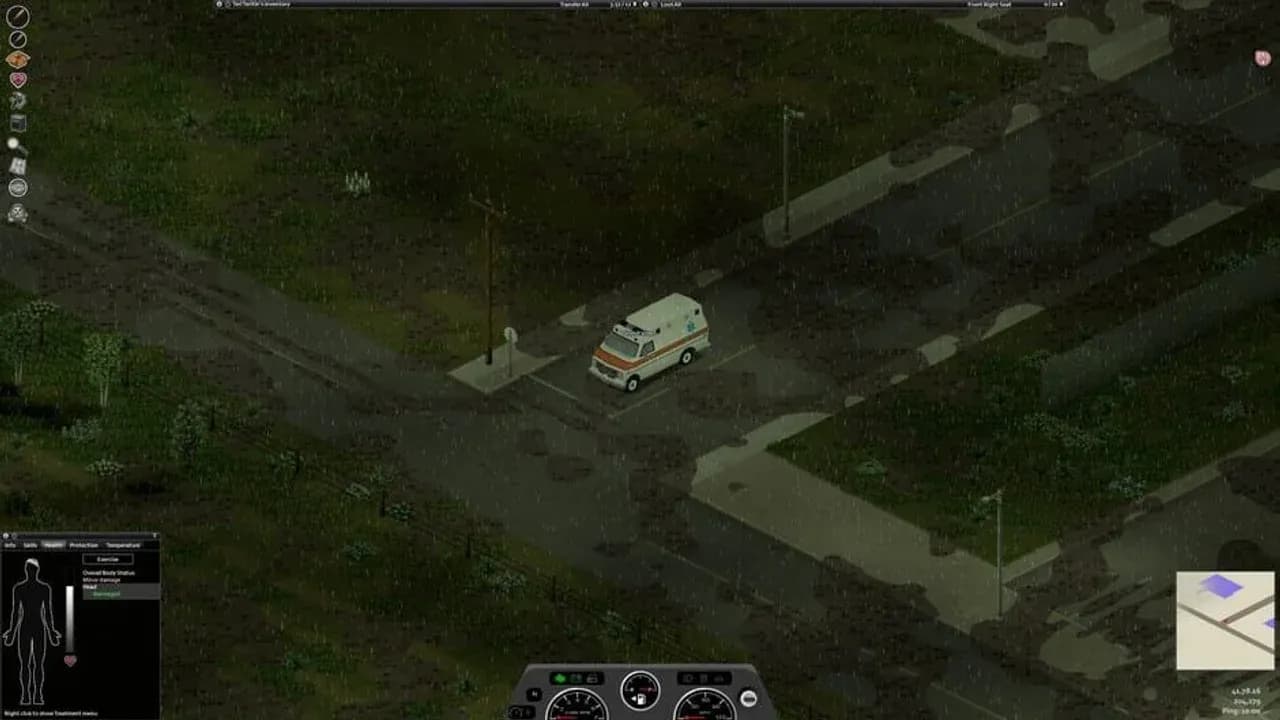
Thirst runs at 2.875% of the bar per in-game hour on Apocalypse settings, and a litre of water takes half the bar back. Sleep through eight of those hours and the rate drops to an eighth. Do the arithmetic on a normal day and your character drinks a litre.
One rain collector barrel holds six hundred of them.
So storage is not what rations you in Build 42. The step between the barrel and your mouth is. Every renewable source in Knox Country except a map well hands you tainted water, and the three ways to make it drinkable — a pot on a fire, a purification tablet, a plumbed tap — have ceilings that differ by orders of magnitude. Pick the purification method first and the rest of your water plan falls out of it: where you can afford to live, how much fuel you burn, and whether the water shutoff is an event or a footnote.
A Litre a Day Is All You Actually Drink
You do not need to sip at it either. The Thirsty moodle costs you nothing worth caring about until 25%, where you lose one point of carrying capacity and a third of your health regeneration. Past 70% it turns serious. Past 85% you lose 22% of your health every in-game hour until you drink or die.
The multiplier that catches people out is heat. Thirst feeds the body-fluid system that governs how much your character can sweat, so a dehydrated survivor cools worse, runs a hotter core, and gets thirstier for it — PZwiki calls it a fatal feedback loop, and in August, mid-fight, that is exactly how it behaves. Sprinting adds another fifth on top.
Set that litre against the numbers in the rest of this guide. A cooking pot of boiled water is a day and a half. A full pack of purification tablets is twenty days. Those are your real supply, and they are nowhere near six hundred litres.
The Shutoff Comes Without a Word, and the Pipes Stay Full
The power failure gets a courtesy call. The Automated Emergency Broadcast System announces it up to two days ahead, and it cannot land before day 14 on Apocalypse. Water gets neither protection. It fails on a random day from 0 to 30 — day zero is legal — and the AEBS never mentions it at all.
You find out in two ways, both late. Right-clicking a tap starts showing a finite number where there used to be an endless supply, and sinks and bathtubs make a different noise, air mixed into the water, when you turn them on. If you are waiting for the radio, you have already been rationing without knowing it.
Here is the part worth acting on: water sitting in pipes and basins when the mains die stays there, and it never spoils. Every sink, toilet and bathtub in your safehouse is a sealed container of clean water that costs nothing to keep. The pre-shutoff job, then, is mostly restraint — leave alone every fixture you do not have to drain, because each untouched basin is free clean water banked against a day you cannot predict.
The prize is the water dispenser. It holds 250 units, twenty-five water bottles' worth, and once emptied it can be refilled with clean water and kept as a permanent tank. At 30 encumbrance it needs no tools to pick up, so it is worth walking one home from the nearest office or warehouse. Two caveats: it will not collect rain, and it filters nothing. What you pour in is what you get out.
A Well Is a Place You Move To, Not a Thing You Build
A well is the only source in the game that hands you clean water for no work whatsoever. Right-click, fill, drink — no fire, no tablets, no fuel, no skull icon.

There is also no recipe for one. Build 42 has no carpentry entry to dig a well; wells are map objects sitting on rural and farm properties out past the towns, and the only way to own one is to live beside it. That makes "get a well" a base-location decision rather than a project, and a costly one. Committing to a well means committing to a farmhouse — away from the hardware store, the pharmacy, the mechanic's garage and the fuel pumps. You accept a permanent logistics tax on every other supply line in order to delete one chore.
Take it if you spawn near one and never think about water again. Otherwise, do not reorganise a campaign around hunting one down. Put collectors on the roof instead.
Only the Drinking Litre Has to Be Clean
The rain collector crate and the rain collector barrel are the two sizes, and neither is expensive.
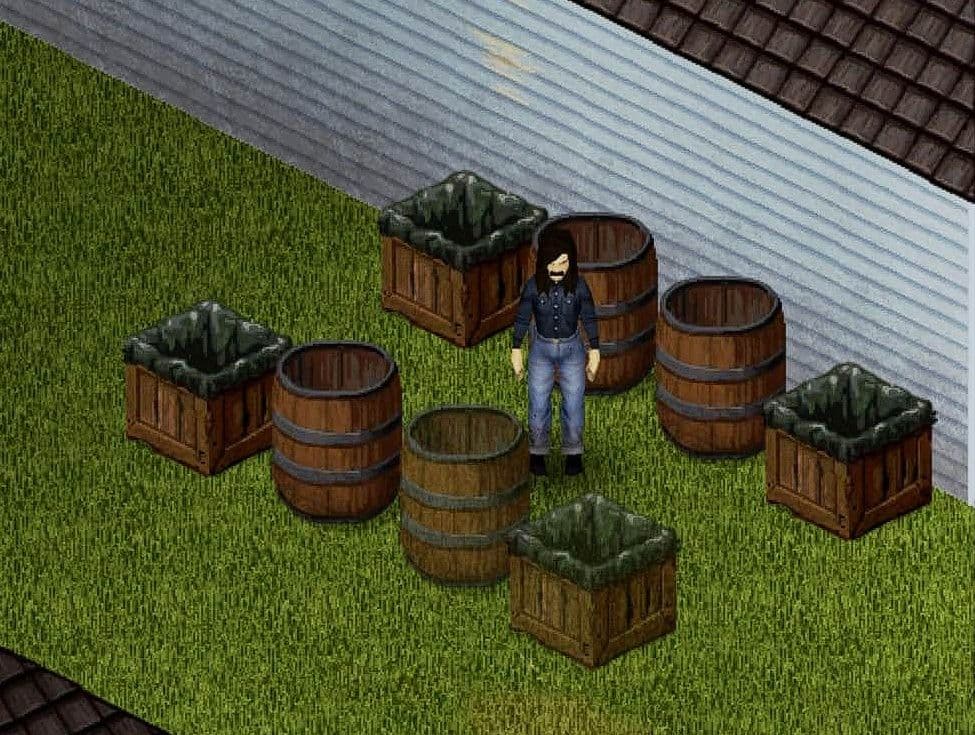
Crates and barrels both need a genuinely outdoor tile under open sky to collect anything.
| Collector | Carpentry | Capacity | Rain factor | Materials |
|---|---|---|---|---|
| Rain collector crate | 3 | 400 L | 0.4 | 4 planks, 4 nails, 4 garbage bags or 1 tarp |
| Rain collector barrel | 5 | 600 L | 0.25 | 6 planks, 5 nails, 4 garbage bags or 1 tarp |
The smaller one collects faster. Rain factor is the multiplier on intake, and the crate's 0.4 beats the barrel's 0.25, so in the same storm the crate takes on more water despite holding less. If you can only build one thing early, build the crate — it is also two carpentry levels cheaper. A rain collector barrel is a store, and its one advantage is a lid you can open and close from the right-click menu when you want to stop collecting.
Two placement rules kill more of these projects than materials ever do. The tile has to be genuinely outdoors under open sky, so an enclosed rooftop room or a solid overhang collects nothing at all. And most roofs in this game are not walkable — you will fall straight through unless you have laid a wood floor first. Check with the Walk To cursor before you commit: green means the tile holds you, red means it does not.
What collects is tainted, and this is where the guide's whole argument lands. Tainted water waters your crops, washes your clothes and washes you with no treatment whatsoever. Only what you drink and what you cook with has to be clean. Everything else your base needs water for can come off the roof untreated, forever — which is why the number you have to purify is one litre a day and not six hundred.
Boiling Is Free and Slow; Tablets Are Fast and Finite
Boiling costs nothing. Put tainted water in a metal container rated to boil — a cooking pot and a kettle both hold 1.5 litres — set it on a heat source, and wait for the skull to clear.
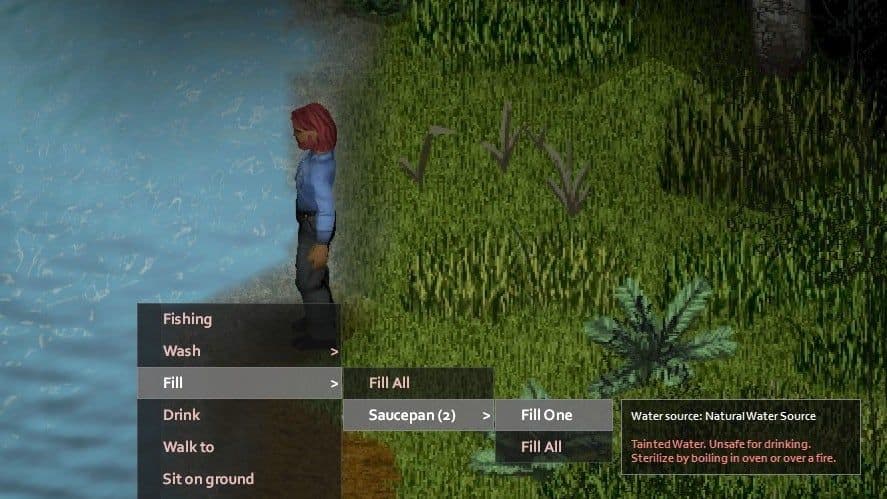
Every natural water source in Knox Country reports the same thing: unsafe for drinking until boiled.
The catch is which heat source. Ovens and microwaves run on mains electricity, and that dies between day 14 and day 30. A charcoal barbecue burns charcoal, wood, paper and cloth, can be picked up and run indoors, and does not spread fire when something burns on it. It is the one heat source that scales into a long game, so build the water plan on that rather than on the kitchen oven you are using in week one.
Water purification tablets suit the road better than the base. One unit treats one litre and a full pack holds twenty units — twenty litres, twenty days of drinking, or enough to cross the map without lighting a fire that something can hear. A ten-litre bucket costs ten of them, and clearing a 600-litre rain collector barrel would take thirty packs. Water purification tablets are loot only; there is no recipe for them. Keep them for travel and for the nights when a fire is a worse idea than thirst.
Bleach does not belong on this list. Build 42's fluid system classes it as a poison, not a disinfectant, and using it to "sanitise" a bottle kills you faster than the tainted water would have.
None of that is what usually gets people, though. Autopilot is. Once thirst passes 10%, your character drinks unprompted from any fluid container in the inventory holding at least 120 millilitres of water — and tainted water qualifies. That pot of lake water you filled for cooking and forgot about will go down mid-fight, without a confirmation prompt. Keep clean and tainted in separate containers, and never top a clean bottle up from a river.
Plumb One Sink and the Boil Goes Away
A pipe wrench, no skill requirement, no materials and about a minute of work removes boiling from your routine permanently.
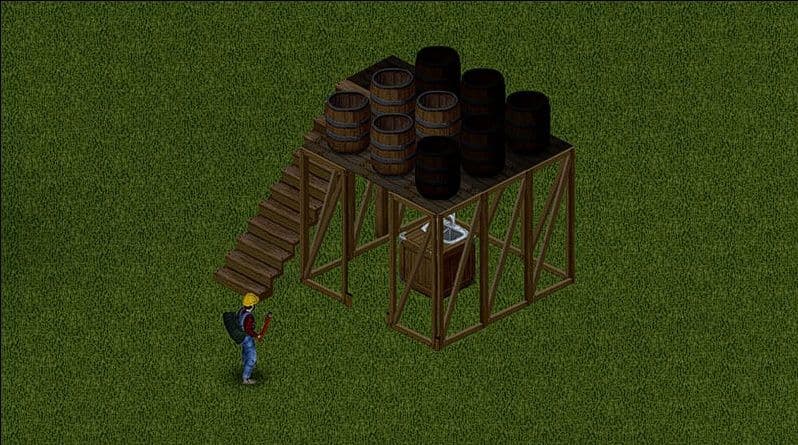
The reservoir has to sit one floor above the fixture and within a 3x3 of it.
The geometry is the fiddly part, so check all four conditions before you blame the game:
- The reservoir sits one floor above the fixture and within a 3×3 of it. Directly above is the layout to try first.
- The fixture registers as inside: four wall frames, or walls and doors, plus a roof.
- The pipe wrench is in your main inventory, not in a bag inside a bag or a car trunk.
- You right-click the fixture, not the barrel, and choose to plumb.
Everything after that is unusually generous. A plumbed sink works with no electricity whatsoever, so it survives the blackout your fridge does not. Once the connection exists you can add and remove barrels anywhere in that 3×3 zone without breaking it — only moving the fixture itself does that. And the walls do not have to stay: throw up temporary frames around a rooftop sink, plumb it, then disassemble them.
The reason to bother is that a plumbed sink gives you clean water. PZwiki says so on both the Plumbing page and the rain collector barrel page, and the long-running community plumbing guides agree. That is what makes the fixture worth more than the barrel feeding it: a plumbed sink converts an unlimited tainted water supply into an unlimited drinkable one, permanently, for the price of one tool. At least one Build 42.19 guide disagrees and holds that plumbing only routes water, leaving tainted water tainted at the tap.
Which is worth ten seconds of your own testing rather than anyone's word. Plumb the sink, fill one bottle from it, and look at the bottle. No skull and you have stopped boiling for good. A skull and you have still gained an indoor tap that runs without power — and the pot goes back on the barbecue.