Rust never tells you what happened to the island. It has no quests, no journals, no cutscene explaining the radiation — which is why the community's answers arrived as hour-long documentaries instead. Then, in May 2023, Facepunch buried a screen at the bottom of a new monument, and for the first time the game said something out loud about itself.
The screen is a laptop, cabled to a nuclear warhead, six levels underground. It reads REPOPULATION UNIT SURVIVAL TEST. Under that: the warhead is ARMED, the cycle is on STANDBY, and a four-field clock is running down. It is the most explicit piece of writing in the game, and it is genuinely load-bearing — Facepunch named the update after it and confirmed the reading again more than two years later.
Here is the part that reframes everything, and the reason this monument is worth reading carefully rather than dramatically. That clock is your server's wipe timer. It is computed from a handful of console variables, it defaults to the first Thursday of the month at 7pm London time, and an admin can move it by typing a number. Nothing detonates when it hits zero. The missile has never left its shaft.
So the silo does reveal something, and it is not what the theories need it to be. It names the cycle — an administered, repeating test with you as the subject — in the game's own words, on a surface you can stand in front of. It never names the cause. Every account of how the island fell is bridging that gap with material this monument does not contain, and once you can see the seam, you can check any claim about Rust's story against it yourself.
Getting In: One Red Keycard, Twenty Seconds, and No Way Back
Before you can read that screen, you have to reach it — and the way in and out is the first thing this monument tells you about itself.
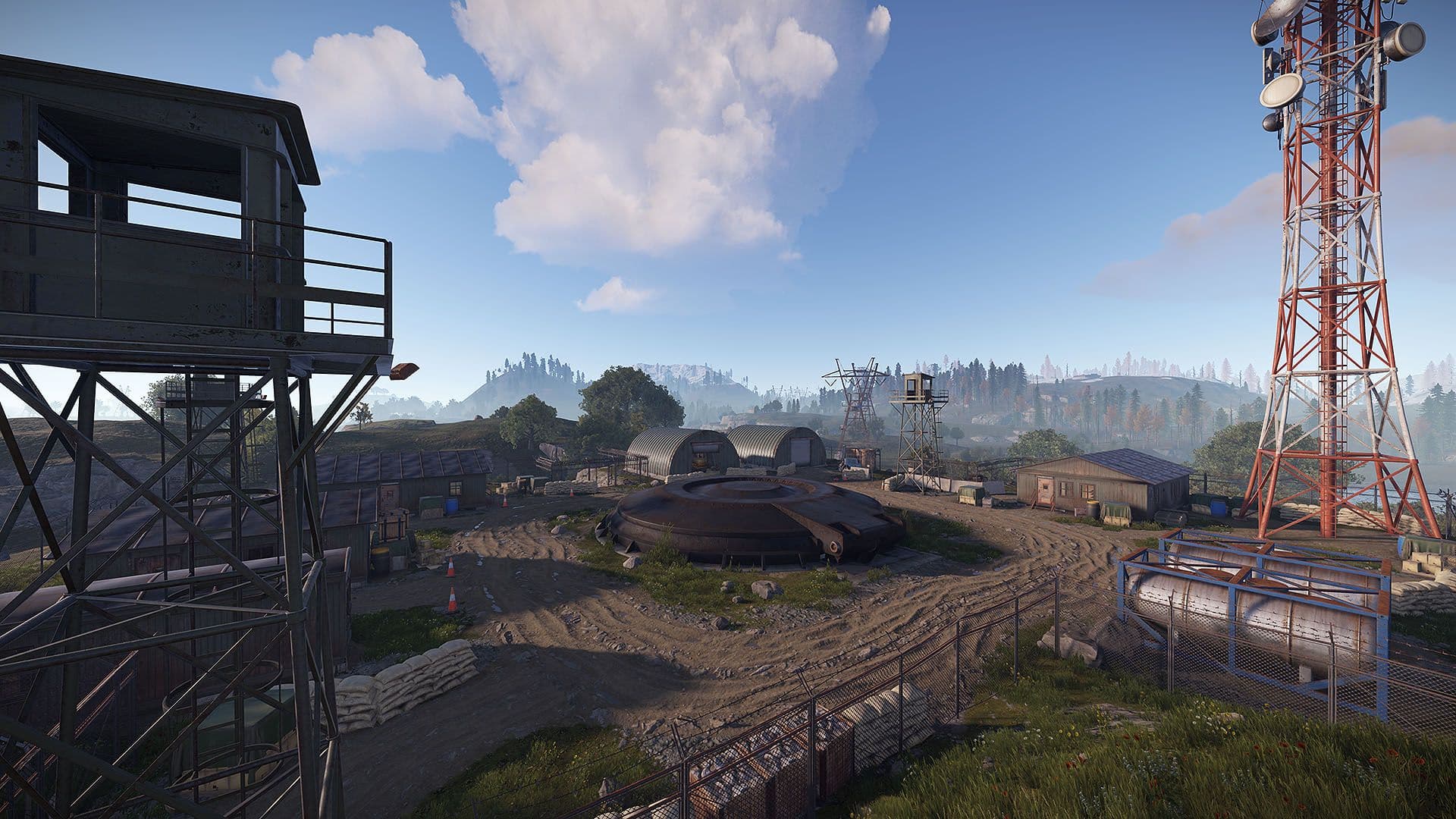
The hatch is the only way in and stays open for about twenty seconds. Touching the underside of the closing door kills you instantly.
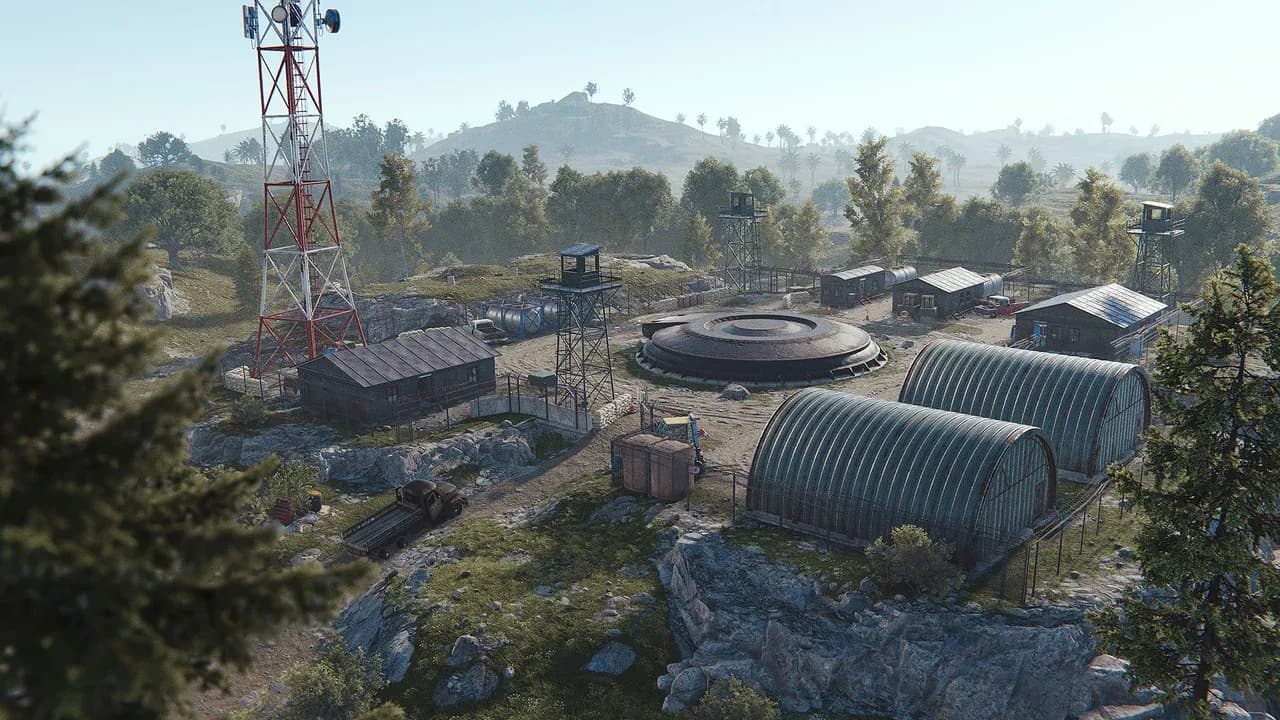
From the surface there is almost nothing to see. Facepunch's own pitch for the Nuclear Missile Silo — that is the studio's name for it; wikis and guides shorten it to "Missile Silo" — is a base that is "unremarkable from the outside," findable at distance mainly by a tall radio tower. Walk up and you get a small fenced compound: three watchtowers, a couple of corrugated hangars, site huts, a parked truck, propane cylinders on blue cradles, and a low black dome set in packed dirt with tyre tracks worn around it. It shipped on 4 May 2023, in an update whose patch notes list it as plainly as possible — "New monument: Missile silo," and, on the next line, "New event: Wipe day." It spawns in the temperate and desert biomes, so on a snow-heavy map you may not have one at all.
If you have been told the silo is part of Launch Site, it isn't. Launch Site's launch area holds "a static rocket that can not be interacted with," a rail-mounted crane on two lifts, and four spotlight towers — a finished, named facility whose centrepiece is scenery you can walk past forever. The Nuclear Missile Silo is a separate monument with no branding on the outside, and unlike that rocket, what it hides is still running.
Entry is one Red Keycard. The swiper sits in the small building to the left of the main entrance, watched by ordinary blue Scientists; you swipe, then press the button beside the lock. There is no green card, no blue card and no fuse, whatever a search result tells you — and this is exactly the fact most likely to be stale in whatever you read, because it was a blue-card monument from May 2023 until 2 October 2025. That same October pass is also the reason the run is worth making now: it added three more elite crates for four total, and put Advanced Blueprint Fragments here, which always spawn in pairs. If a guide still tells you to bring a blue card, everything else in it is from the same era. Dawdle at the panel and the puzzle resets thirty seconds after you step away from the keycard area, so swipe when you are actually ready to move.
Because the door does not wait. Pressing the button starts a very loud mechanical noise, the blast hatch creeps open, and it stays open for roughly twenty seconds before closing again. Touching the underside of the descending door is instant death — not a scripted animation you can clip through, but a hurt volume, one that Facepunch had to patch at the time so it would produce a proper death message. Sprint from the button and jump. Do not stop at the lip to re-check your kit; sort your loadout on the walk up, not on the rim of a closing lid.
And that jump is a commitment, because the silo is architecturally one-way. Facepunch's launch post put it gently — "while you're in you can't go back easily" — but in practice there is no back at all. The hatch is not an exit. The only way out is to complete the descent, work your way back up through the facility, reach the security checkpoint on the top underground level, and press a wall button that briefly opens a separate blue blast door built into the rockface outside the compound. There is no bailing halfway. Plan the run as a full traverse.
What you are committing to is six underground levels, signed in-game with negative numbers — LEVEL -2 stencilled on the stairwell walls, and a developer commit that reads "Replaced elevator sign on floor -2 with an exit sign." Guides renumber those levels 0 through 5, which is why two sources can describe the same room and disagree about which floor it's on. Radiation protection requirements are 10 in parts of the surface compound and 25 across every underground section, and 25 genuinely covers the traverse — it is the number the walkthroughs put in their recommended kit. Two other figures circulate for this monument and measure something else: a median radiation reading of 26 and a maximum of 81, taken inside the building rather than describing protection you are expected to wear. Twenty-five carries you through all six levels. There is exactly one spot where it stops being enough, and it is at the bottom.
Waiting inside are 23 NVGM Scientists, on top of the four standard ones patrolling the surface. They carry an LR-300 or a Spas-12, have 300 HP, and their night-vision goggles glow green in the dark, which is usually how you spot one before it spots you. Flashbangs are the counter — they cover their faces and retreat — and it is not a coincidence that flashbangs became effective against Scientists in the same May 2023 patch that added the monument. Bring more of them than feels reasonable. Nothing on site will resupply you either: no recycler, no repair bench, no research table, no vendors, no safe zone. Whatever you pick up, you carry out unprocessed.
Then there is the way out, which is the detail worth changing your habits over. That security checkpoint holds a computer terminal with five camera codes already programmed in: SILOTOWER, SILOEXIT1, SILOEXIT2, SILOSHIPPING and SILOMISSILE. Two of the five are pointed at the exit. Check them before you touch the button — the standard way to lose a silo run is to survive 23 guards and then step out of a door somebody has been sitting on for ten minutes. Per the community wiki, those same codes work from a computer station you build yourself anywhere on the map, which means the facility's own surveillance can be your scouting tool before you ever swipe the card. Read the list of codes while you are there, too: SILOSHIPPING names a function nothing else in the monument accounts for, and no source describes a shipping bay down there at all.
Put the whole route together and it reads less like a ruin you stumbled into and more like a procedure you were admitted to. You enter only when the facility lets you, through a hatch that kills you for mistiming a jump; you cannot leave the way you came; and you get out by walking the entire programme end to end and pressing a button in a security office, watched on the way by cameras that were already recording before you arrived. Reaching the evidence is itself the first piece of evidence.
Six negative-numbered levels down, past all 23 of them, you come out at the bottom of the facility in front of the thing the whole run is for — and the object Facepunch has described as ominous since 2023 turns out to be a laptop. So read it.
The Laptop Spells Out the Game's Own Name
It is a laptop. Not a wall-sized firing console, not a hardened military terminal — a laptop, sitting on a wooden crate at ankle height, with a cable running the short distance to the warhead beside it. Facepunch's own launch post describes exactly that and stops: "a nuclear warhead connected to a laptop displaying an ominous countdown." The word carrying the weight in that sentence is ominous, and for most players it has stayed the only word available, because the screen is small, the room is dark, and a monitor glowing red in the corner of a nuclear chamber looks like set dressing. It is not set dressing. It is the most explicit piece of writing Facepunch has ever put in Rust, and it is short enough to memorise.
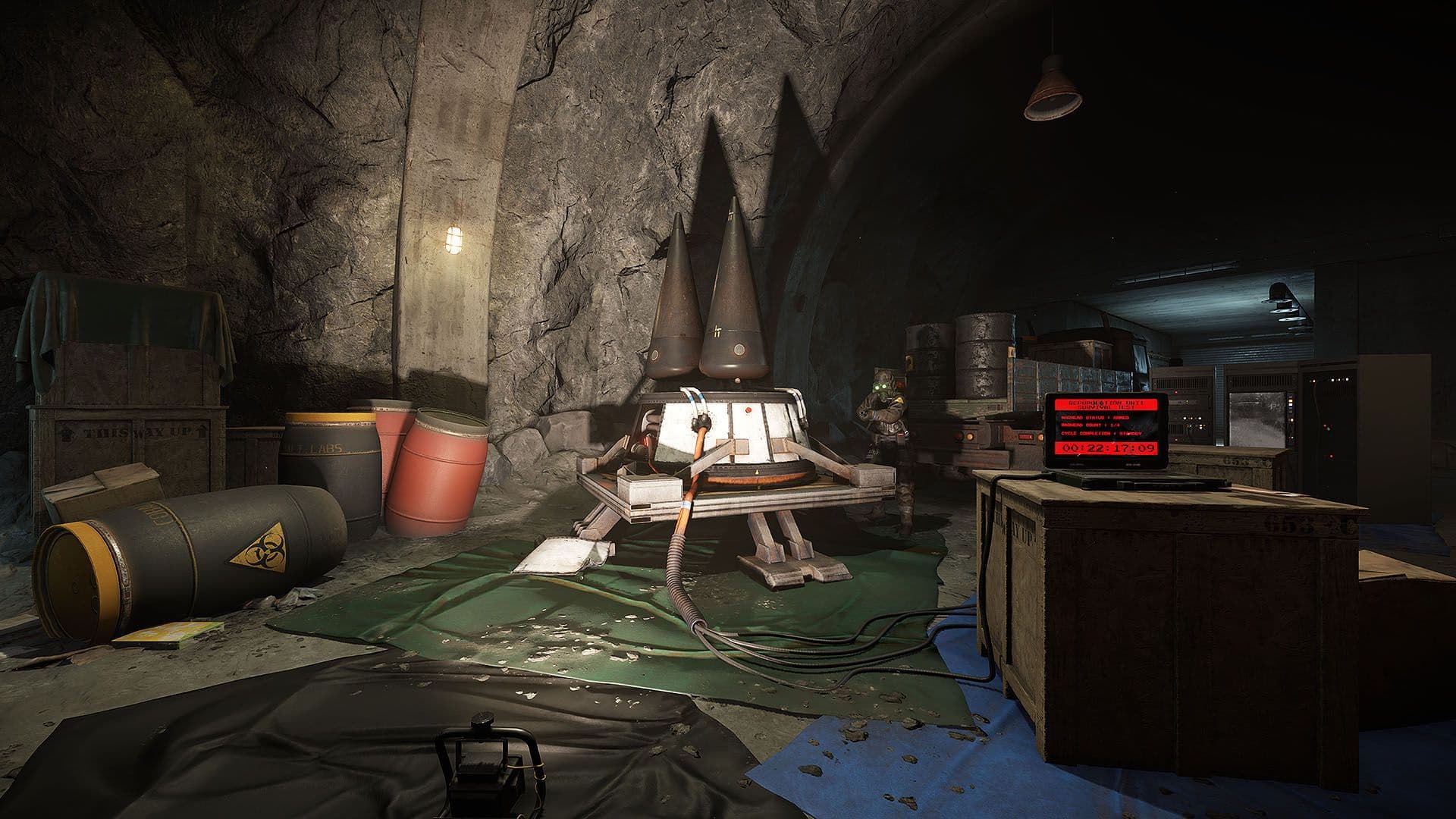
The screen, word for word: REPOPULATION UNIT SURVIVAL TEST, warhead status ARMED, a warhead count out of four, CYCLE COMPLETION on STANDBY, and a days:hours:minutes:seconds clock.
Word for word, red on black, the screen reads:
REPOPULATION UNIT SURVIVAL TEST— the header, running across the topWARHEAD STATUS : ARMEDWARHEAD COUNT— a count out of fourCYCLE COMPLETION : STANDBY- and beneath them, in much larger type, a four-field clock, reading
00:22:17:09in Facepunch's own published screenshot of the room
On the count line, the denominator is unambiguous: four. The numerator is a single digit that does not survive the resolution Facepunch published at — magnified, it resolves as either of two numbers, and picking one would be inventing a fact for the sake of a tidier sentence. So: a warhead count out of four, and the number in front of the slash is something you can go and read at your own render distance, which is more than any screenshot can offer you.
The clock is the other line worth reading precisely, because its shape tells you what kind of clock it is. Those are not hours, minutes, seconds and hundredths. The fields are days, hours, minutes and seconds, which is why the screenshot's 00:22:17:09 means just under twenty-three hours rather than just under a minute. Rust's own server console prints the same four-field shape when you query it — 34:21:03:06, thirty-four days out — and the official documentation writes its exhausted state as 00:00:00:00. A clock built to hold thirty-four days in its first field is not measuring a launch sequence. It is measuring something that runs for weeks.
So is any of this official, or is it a screen a fan magnified too hard? It is official twice over, and the second time is the one that settles it. The header is not a community transcription: Facepunch's own wiki names the label verbatim when it documents the system behind the laptop. And the backronym is the studio's, not the fandom's. The May 2023 update that shipped the monument was named R.U.S.T; its header read "Repopulation Unit Survival Test has begun, again?"; the wipe-event section closed by spelling it out with the initials bolded — Repopulation Unit Survival Test. That same header, incidentally, lists "lore" among the update's shipped features, alongside the monument and the SMG buffs, which is about as close as this studio comes to announcing that the story is now a thing you can look at.
The question mark was the loose thread. "Again?" is a wink; a wink can be walked back. It stayed loose for twenty-nine months, until 2 October 2025, when Facepunch published a devblog largely concerned with blueprint fragments, elite crate counts and the silo's promotion to a red-card monument. At the end of the Missile Silo section, under all the loot arithmetic, sat one standalone line: "Did you know? Rust = Repopulation Unit Survival Test." No question mark this time, no hedge, no "we'll let you decide." The joke about the game's name, buried in a patch note about crate placement, is the studio confirming in plain text that the thing on the laptop is the thing the game is called.
That gives you something rare in a game with no journals and no dialogue: four lines of first-party text you can hold every claim about Rust's story up against. Quote them exactly rather than from memory — REPOPULATION UNIT SURVIVAL TEST, ARMED, a count out of four, CYCLE COMPLETION : STANDBY — because the paraphrases are where the drift starts, and because a claim that cannot survive contact with those four lines is not being supported by this monument no matter how confidently it is delivered. This is the only place in the game where Rust names its own premise on a surface you can walk up to.
Three of those four lines are labels. The fourth is running, and the wipe has just been given a name to run under — CYCLE COMPLETION, sitting at STANDBY. What that clock counts is not a secret; this article gave it away in its third paragraph, because it is the thesis. What it has not given you yet is who documents that, and where the number on the screen actually comes from.
The Countdown Is Your Server's Wipe Clock, Not a Doomsday Timer
Facepunch documents this exact laptop. Not in a lore post and not in a fan transcription — on a page called Server Wipe Timer, in the official Rust wiki, written for the people who run servers. It identifies the laptop by the header you just read off the screen and settles the question in one clause: this timer "is counting down until the next server wipe." Nobody had to infer it — and the fact that the answer lives in server documentation is the first clue to what kind of object the clock really is.
Which means the number on the screen is not authored. It is computed, on your server, from settings that exist in a console. The starting point is the wipe tag the server advertises — monthly, biweekly or weekly — and from there three variables shape the result: wipetimer.wipeTimezone sets the reference clock, wipetimer.wipeDayofWeek takes a value from 0 to 6, and wipetimer.wipeHourofDay takes 0 to 23 and will accept decimals, so 14.5 means half past two in the afternoon. Left at their defaults — day 4, hour 19 — a monthly server lands on the first Thursday of the month at 19:00 London time. A weekly server does the same thing every Thursday. A biweekly server takes the first and third Thursday, and when the calendar hands it a three-week gap, it splits the difference 2+1 rather than letting the schedule drift.
Sit with that for a second, because it is the sharpest thing this monument has to offer. The ominous countdown at the bottom of a nuclear facility, the one wired to an armed warhead behind twenty-three guards, is wipetimer.wipeDayofWeek 4 and wipetimer.wipeHourofDay 19. Type 0 instead of 4 and the end of the world happens on Sundays. Type 14.5 and it happens after lunch. The clock is not a prophecy the server is watching; it is a preference the server was configured with, and it has a default the way anything else in a config file has a default.
There are two escape hatches for schedules those three variables cannot express. wipetimer.wipeUnixTimestampOverride pins the clock to one exact moment, and wipetimer.wipecronoverride accepts a cron expression for repeating patterns — which is how the short-cycle servers work, since anything faster than weekly has no tag of its own and has to be described one of those two ways. Both come with the same limit, and the limit is telling: if you hand the server a timestamp that has already passed, it ignores the override entirely. Give this clock a doomsday that already happened and nothing happens. It does not fire, it does not zero out, it just declines the value and carries on with the schedule it had. That is the behaviour of a scheduling utility, and the code backs it up — the implementation ships as WipeTimer.cs inside the dedicated server's assembly.
Keeping it honest matters for one reason beyond the display, and the wiki says so plainly: the same value "will also decide when server should start running endgame events, so it's important to keep this timer accurate with your server's wipe schedule." So the laptop is not purely decorative telemetry. It is the schedule the final stretch of the cycle runs on, and what the game does in that stretch is worth looking at on its own.
What it does not do is detonate. The finding here is an absence: across Facepunch's launch devblog, the official wiki page for the system, the developer commits on the monument's own branch, the community wiki, and the two most detailed player walkthroughs, no source documents a launch, an explosion, a cinematic, or any player interaction with the warhead or the missile when the clock runs out. Six independent places where a firing sequence would have to be described, and none of them describes one. The clock empties, the server wipes, the map regenerates, and the count starts again.
So where did the detonation come from? Partly from the object itself, which is doing a lot of work — but traceably, from the coverage. Facepunch's launch post, on 4 May 2023, said "an ominous countdown." PCGamesN's write-up the next day told its readers players would find "a laptop displaying a countdown to nuclear detonation." One of those describes a mood; the other quietly adds an event that no source has since documented. That is one documented instance of the upgrade — from ominous to nuclear detonation — and it belongs to the writer, not to the game.
Read the clock as a schedule and it becomes genuinely useful. It is the most reliable answer in the game to how long your base has left, and it tells you when the last stretch of the cycle begins rather than leaving you to guess. Just do not calibrate it against the default: on a modded or custom-cycle server the number is whatever the admin configured, and the first Thursday at seven means nothing there. And when a video tells you the timer is counting to a detonation, you now know precisely what to ask — which source documents the thing that fires, and where.
A scheduling utility, then — with a genuinely strange object standing next to it. If nothing goes off, the armed device in the cavern is not a prop for a countdown. So what is it, physically, and where in the facility is it actually sitting?
The Warhead Sits in a Rock Cavern, Not in the Missile
Not in the missile. That is the first thing to get straight about the bottom level, and it is the detail most likely to survive contact with whatever you have been told: the ICBM and the warhead are in two different rooms, and the room the warhead is in was dug out of the rock.
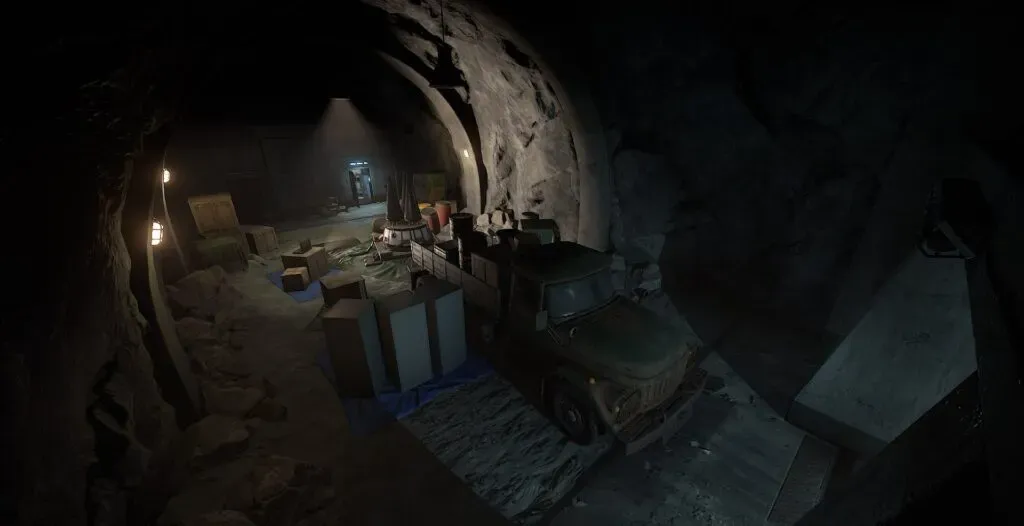
Rough stone braced with concrete ribs — an excavated chamber, not a launch bay. The truck, the tarps and the crates are observation; "work in progress" is a reading.
You pass the missile on the way down, so you can check it yourself. It stands vertical in its shaft — a large riveted cylinder, gantry mesh platforms spiralling up around it, hard green-grey light — with its service and umbilical arms still clamped against the skin. Two of the jumps on the middle levels cross that shaft, and the base of the missile is its own room at the bottom of the route, with no loot in it and nothing to do but look up. Nothing about it reads as spent or stripped. It reads as installed and attended.
The warhead is elsewhere, and the walls are the tell. There is no concrete launch bay around it and no rail, no trolley, no hoist over a hatch. It is a cavern: rough stone braced with concrete arch ribs, which the developers had to build a custom material for — a Facepunch commit on the monument's own branch reads "Created a new non-biome tinted material for the rocks inside the warhead room," because raw rock that changes colour with the biome above it looked wrong. Guides call the space the Cavern, or by the signage, the Hard Hat Area.
Here is what is actually in it, and this list is observation — objects in a published Facepunch screenshot of the room, corroborated by the only room-by-room walkthrough that covers the level. A low square metal cradle on four legs. On the cradle, two dark conical re-entry vehicles standing side by side, each carrying small yellow stencil marks and a circular inspection plate, with a red indicator sitting on the top plate. White cables banded in blue, and a heavy orange umbilical, running off the cradle and out across the floor to the laptop. Tarpaulins — green, blue and black — spread flat over the stone. Stencilled wooden crates, one of which the laptop sits on. Drums: a red one, one whose label is half-covered, and a black-and-gold one marked with a biohazard trefoil, which is worth a second look, because biohazard is not the radiation trefoil and this is the one room in the monument where radiation is measurably the problem. A hanging work lamp. Three diesel barrels. A military pickup backed in beside the assembly with an elite crate in its bed. A lit doorway leading back into the concrete part of the facility. And an NVGM Scientist standing guard over all of it.
Now the part that is not observation. Read that arrangement — excavated chamber, hard-hat signage, tarps laid out like work surfaces, a truck reversed in, cables run to a laptop — and it looks like something being worked on rather than something ready to fly. That is a reading. The game does not say it anywhere; no devblog, wiki page or commit describes what the crew in this room was doing, and a chamber full of tarps and drums would look much the same if the answer were storage, or disassembly, or staging for a trip up the shaft. Call it what it is: a plausible inference from staging, held loosely.
And there is a hard limit right next to it. Whether the ICBM's nose section carries a warhead is a question none of the sources checked here answers — not the launch post, not the wiki, not the commits, not any guide. The cavern is not evidence that the missile is empty, and it is not evidence that it is loaded. It is evidence about the cavern. If you have heard either version stated confidently, that confidence came from somewhere other than the game.
The count is unsettled in a smaller way. Facepunch's copy says warhead, singular. The launch-day write-up that still circulates said warheads, plural. The screen cabled to the cradle shows a count out of four. What you can see on the cradle is two cones, side by side, and "two visible" is the version of that sentence that does not require you to pick a side.
Practically, this room has one rule that overrides the loot: do not stand next to it. Radiation ticks accumulate, in the walkthrough's own emphasis, very fast here — even at maximum protection — and the 25 rad protection that carried you comfortably through six levels is not a comfortable number a metre from the cradle. Take the elite crate out of the truck bed from the far side of the room, keep the assembly at your back rather than at your shoulder, and if you want a good look at the cones or the stencils, take the screenshot and read it upstairs. That last habit generalises. When you tell somebody what is down here, give them the objects first and your reading second, in that order and labelled — the tarpaulins, the truck and the two cones are things anyone can go and verify, and the story you build on top of them is yours to defend.
Two strange facts now sit in the same rock chamber: a device the screen calls armed, in a room that looks mid-job, wired to a clock that only resets a server. So does anything at all happen when that clock actually reaches zero?
The Last 24 Hours: Two Events, and One of Them Does Nothing
Rust's endgame events are the closest thing the game has to a finale, and they are not what the countdown is building toward. They do not fire at zero, and they do not happen to the silo at all.
The escalation starts a full day early, documented on the same official page that told you what the clock counts. On the last day of every wipe cycle — 24 hours out, kicking in within an hour of that mark — the server starts its two endgame events. There are exactly two. Not two categories, not two phases. Two.
The first is called F-15E "Strike Eagle" Inbound. Jets begin, in the wiki's own phrasing, observing the island, and you hear them: the aggressive sound of a fighter going past overhead, on a map that has spent the last month sounding like wind and gunfire. It is a genuinely good piece of atmosphere, and the same page tells you exactly how much it is worth in a fight, in one flat sentence: "This event has no direct impact on game play." There is no strafing run, no spotting mechanic, no consequence for being caught in the open under one. An admin can fire the whole thing off any afternoon with spawn f15e, which is a reasonable summary of its weight. Half of the game's endgame escalation is sound design.
The second one is the one that changes your week. Under Road Bradleys, the island's Scientist population increases, and Bradley APCs start roaming random roads, "attacking anything they spot." The number is not thematic, it is arithmetic: WorldSize / 1000 * 2. Run it on your server and you get the count — a 3,000 map gets six, a 4,500 gets nine — and the community wiki adds the detail that makes it land, which is that the Bradley leaves Launch Site. The tank you normally have to go and pick a fight with comes to you instead. Manually spawned with spawnroadbradley, one takes the road you are looking at and traverses it back and forth, which is a fair picture of what the last day looks like: the road network becomes patrolled ground.
Put the two together and the shape of Rust's finale is clear, and slightly deflating. The dramatic half — the aircraft, the thing you notice first — is explicitly inert. The lethal half is a vehicle that already exists at another monument, redeployed onto roads. As the cycle winds down the island does not launch anything at you or at itself; it puts more staff on the ground and starts flying over you to look.
Which brings up the part of this that has been outstanding since launch. In the same Wipe Event section that introduced those two events in May 2023, Facepunch wrote one more sentence: "Future wipe events will include infantry patrols, bombing runs and more." Rustafied, covering the update the day it landed, reported that the developers had hinted at a future "big bang" event tied to the mechanic "but provide no specifics." Corrosion Hour's room-by-room walkthrough — the most thorough one there is, and one still being revised as recently as November 2025 — describes the silo as "the first of its kind, offering players the possibility of future content relating to player choice and the fate of the island they're playing on," and in that same November 2025 revision still notes that the functionality is "not yet cemented."
As of now, no source documents any of it as shipped. The official wiki page still lists two endgame events. Facepunch's 2026 roadmap — four quarters plus a long stretch-goal list, covering everything from modular boats to procedural caves — contains no missile silo entry, no nuke event, no infantry patrol and no bombing run. That roadmap opens by telling you it "isn't a promise carved in stone, it's a direction of travel," which cuts both ways: absence from it is not a cancellation, and the studio has clearly not stopped building. But three years and one full roadmap after the promise, the wiki still documents two events and the most careful guide on the internet still says the functionality is not cemented. Anyone waiting for the silo's second act is still waiting, and has been since the monument shipped.
So plan the last 24 hours around Bradleys, not around a finale. The jets tell you what day it is and nothing else; treat the flyby as a calendar notification. The APCs are the actual change, and the change is to how you move — roads that were routine for four weeks now have a scaling number of vehicles on them that shoot anything they see, and there are more Scientists across the island generally. Route around the roads or carry the answer to a Bradley, and either way get the loot moved before the window opens rather than during it. One caveat that matters more than it sounds: the whole window is a setting. eventschedulewipeoffset.event_hours_before_wipe moves it, and setting it to 0 switches the events off entirely, so on a modded server the last day may look exactly like every day before it. Check before you build your plan around a fireworks show that the admin turned off.
Nothing detonates, nothing launches, and the larger escalation announced in 2023 has not been documented as arriving. That kills the obvious question — when does it go off — and replaces it with a better one. If this facility is not building toward an ending, what is it doing? And who, exactly, is still down there doing it?
The Silo Reads as Staffed, Not Abandoned
Somebody made the beds.
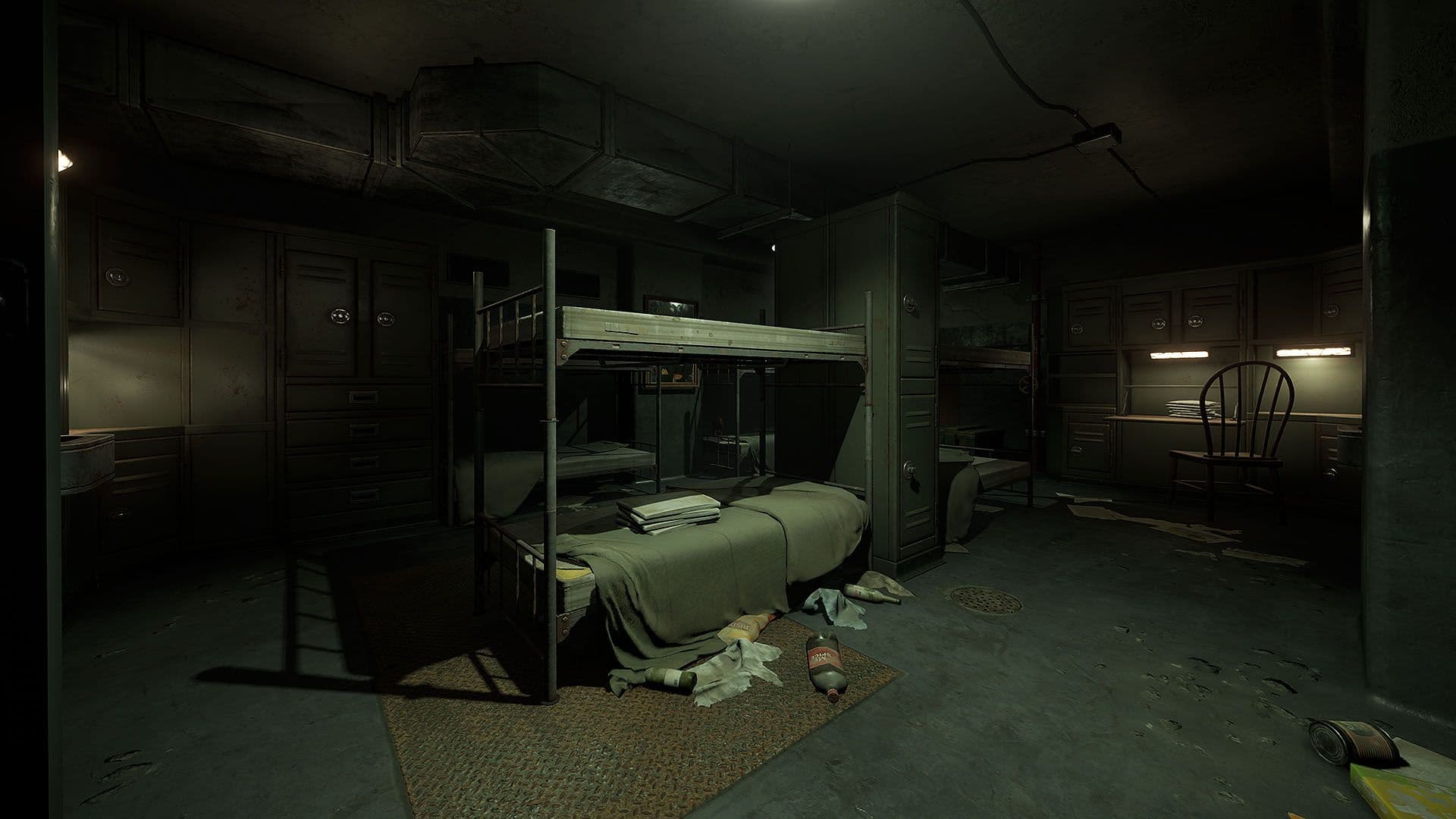
Somebody made the beds. The linen is folded on the mattress and the lockers are shut — a shift's quarters, not a ruin.
That is the detail that reorganises the building once you notice it. Level 3 is the living quarters, and it is the quietest floor in the monument — the walkthroughs put at most two NVGM Scientists across the whole level, which, after the eleven waiting on Level 2, feels like an oversight until you see what is down there. Metal bunk beds with the blankets pulled up. A stack of folded linen sitting on one of the mattresses, the way linen sits when it has been carried out of a cupboard and not yet put on anything. A wall of lockers and drawer units, closed. A framed picture hung on the wall, a woven rug on the floor, a wooden chair pulled up to a counter, tin cans, a floor drain, a bottle knocked over. Guides have nicknamed one of the two rooms the Pookie Bear room, which tells you roughly how it lands on people who have cleared it forty times.
The rest of the facility is stocked to match. There are nine toilets in this monument and they work — sit down on one and it restores comfort, and on a route with no bail-out and nothing on site to resupply you, a stop that heals you back to full is worth planning around rather than walking past. There is a pantry. Two of the doors are signed Employees-Only: the pantry, and the admin office that happens to be the single worst gauntlet in the building. The signage generally is written for a workforce rather than for you — RESTRICTED AREA / DO NOT ENTER on the elevator lobby wall, RESTROOMS → near the way out, a green-cross FIRST AID panel, a DANGER: Flammable Materials label. There is a sofa. And mounted on the wall a few steps from the exit door, there is a public telephone.
None of that is the furniture of a disaster site. Neither is the machinery around it: launch-control consoles with their seats bolted to floor rails, banks of dials and coloured indicator lamps, reel-to-reel cabinets, CRT terminals in red-and-white housings, a red typewriter, blue filing cabinets, papers spread across the floors of every office. The concrete is cracked, the plaster is chipped, and drains sit in the middle of the floors. But no official screenshot of the interior and no room-by-room walkthrough of it shows a body. The only corpse any source records is on the surface — a dead scientist visible through a window in the small building where you swipe the keycard, which is to say the only casualty documented anywhere on site is the one at the door, on the way in.
So who is still working here? Facepunch answered that in the launch post and most people read straight past it, because the sentence is about combat. The silo's guards are described as "a new dangerous type of Scientist who will shoot anyone trying to interfere with their experiments." Not the facility's experiments, not experiments — their experiments. That is a possessive doing a lot of quiet work, and the studio's other choice of words in the same post points the same direction: the wipe is not called an ending or a reset event, it is "the cycle reset." Then there is what the developers did to those guards afterwards. A commit on the monument's own branch records that NVGM Scientists roam anchored to a home point, and that they can use healing items. They have posts, and they treat their own wounds. Whatever else they are, they are not scenery decaying in place — they are personnel.
The walls make the same argument in a smaller voice. In the open-plan office on Level 2, above the cubicles and the typewriter, hangs a framed poster reading THE FUTURE IS OUT THERE over a rocket. That one is legible and unambiguous, and it is corporate-optimistic in the exact register of a poster nobody has taken down. Two other frames are more interesting and much less certain. In the computer room, a poster shows three test tubes in a rack — a seed, a sprouting bud, and a fully open flower, a growth sequence running left to right — above a wordmark band that a monitor cuts off after COB…. By the exit checkpoint, a framed portrait carries a header band that reads as COBALT. Both are small, dark and partly occluded, and the honest word for either is appears. Cobalt is certainly real and certainly current — Launch Site is officially the Cobalt Space Center, and Facepunch's own 2026 roadmap lists a Cobalt guard tower and a Cobalt Hovercraft among its stretch goals — which is exactly what makes the guess plausible and exactly why it is a guess. The corporate case for who owns this island is built at Launch Site, and it is a different article's argument. Nothing here needs it.
Take one habit out of this floor: treat signage and furniture as evidence of function, and treat what you cannot read as unread. A door marked Employees-Only tells you the building sorted people into two categories. Nine working toilets and a pantry tell you it fed and housed a shift. A telephone by the exit tells you somebody expected to make a call on the way out. Those are readable, checkable, and they do not require anyone's theory to mean something. The two wordmarks are a lead, not a finding, and you lose nothing by saying so — if the frames turn out to say COBALT, the argument on this floor does not get stronger, and if they say something else entirely, it does not get weaker.
Put every piece of it together — the made beds, the shift rotation implied by the bunks, the guards with home points and medical supplies, "their experiments," "the cycle reset" — and what the silo supports is that something is being administered here, on a schedule, and that it did not stop. That is one large claim, it is the game's own framing rather than anyone's reconstruction, and it is genuinely more than any other monument in Rust gives you. It is also where the evidence ends. No surface in this building names a war, a date, a disaster or an operator. Nothing states what the experiments are or who is running them. The silo will tell you the programme is live and refuse to tell you whose it is.
So the rest of the story — the part everyone actually repeats, the part about how the island fell — came from somewhere. It is worth knowing where.
The Collapse Theories Have Named Authors — Who Call Them Speculation
It came from people with YouTube channels, and that is not the insult it sounds like.
Rust's collapse story usually gets described the way folklore does — something the community collectively worked out, passed hand to hand until it hardened into background knowledge that everybody has and nobody sourced. It isn't folklore. It has authors, upload dates and view counts. The foundational text is Shadowfrax's NEW The Rust back-story 2019 EDITION, published 4 May 2019, sitting at 535,102 views — an order of magnitude more reach than anything that followed. The most recent large one is STELIC's The Hidden Backstory of Rust, 24 May 2026, 49,248 views, which credits Shadowfrax as an inspiration in its own description. Between them sit VirtuallyCracked's The COMPLETE Rust Lore Story, 22 August 2025, and COBALT LAB's What are they? Cobalt's experiment in Rust, 7 July 2024. Four names, four dates. Nearly everything you have heard about how the island fell traces to one of those or to somebody repeating one of those.
Start with the dates, because one of them does a great deal of work by itself. Shadowfrax's documentary predates the Nuclear Missile Silo by four years to the day — 4 May 2019 against 4 May 2023. Whatever that video concluded, it concluded without a laptop, without the header you read three sections ago, and without an armed device in a rock cavern, because none of it existed yet. That cuts in both directions and both directions matter: the theory was not built on silo evidence, and the silo cannot be produced as confirmation of the theory. When a comment tells you the monument "proves what Shadowfrax worked out years ago," the arithmetic should slow you down before the argument does.
Then read what the authors say about their own work, which is the single most useful thing in this whole section. Shadowfrax puts it in the video description, unprompted: "I don't know what the back-story really is, this is all at best speculation and the true story is firmly in the hands of the developers to reveal to us when they're ready." STELIC, seven years later: "While the offical backstory is not certain, this is my best speculation." His chapter for the reconstruction itself is titled "Rust Backstory (My Version)." These are not people caught overreaching. They labelled the goods accurately and shipped them anyway, which is what good speculation looks like. What happens downstream — in comments, in clips, in the confident summary somebody gives you in voice chat — is that the label falls off.
So take the four big claims and ask, one at a time, what this monument actually hands each of them.
That Cobalt ran the island, and the collapse followed its programme. This is the load-bearing claim across the whole lore canon; STELIC's chapter list does not hedge it at all, titling the section "Cobalt (Main Evidence)." What the silo supplies is thin. Two framed wall items that appear to carry the wordmark — hedged in the last section and still hedged here — which is decoration hanging in a room, not a deed. What the silo does not supply is everything you would actually want: no signage naming an operator, no branded keycard, no terminal readout, no document, nothing on the hatch, nothing on the laptop. The corporate case for Cobalt is a real argument and it is genuinely made elsewhere, at Launch Site, on Launch Site's evidence. It is simply not made down here.
That the nakeds are not ordinary survivors — clones, prisoners, test subjects re-instantiated each cycle. STELIC's chapter asks it directly: "Who are Nakeds? (Are we playing as prisoners?)" VirtuallyCracked promises "the chilling truth behind immortality on Rust Island." COBALT LAB frames it as genetic research. Of the four, this is the one the silo feeds best, and it is worth saying so plainly rather than grudgingly: the words REPOPULATION UNIT are printed on a screen in the game, and Facepunch's own sentence gives the guards possession of their experiments. That is a genuine piece of first-party material pointing in the theory's direction, and it is the closest Rust has ever come to endorsing anything in this column. It is also a phrase and a possessive. No surface in the monument says what a repopulation unit is, where one comes from, or whether you are one. Suggestive is not the same as stated, and the gap between them is where the rest of that theory lives.
That the wipe is, in-fiction, a deliberate nuclear reset — the "monthly nukes" VirtuallyCracked's description advertises alongside "the true story behind the wipe cycle." This is the most interesting fit of the four, because the silo very nearly delivers. ARMED and STANDBY sit on the same small screen as the wipe clock. Armed. Standby. Cycle. If you were assembling this theory from scratch you could not ask for better vocabulary, and you would not have had to invent a word of it. Then the one thing the theory needs — something that goes off — is the one thing no source documents, as established earlier. A device that is armed and has never fired is exactly the evidence this claim requires and exactly the evidence it never gets.
And that the programmes have names. VirtuallyCracked's description lays them out as settled history: "The Cobalt Corporation: Origins of Project Nova and the Regeneration Program." COBALT LAB lists "genetic research, Project Nova" the same way. Both read like established nouns, the kind you can look up. So look one up — this is the cheapest test in the article. No Facepunch source checked here — devblogs, official wiki, roadmap — uses "Project Nova" or "the Regeneration Program" as lore. The only documented Facepunch use of the phrase at all is Community Update 226, where "Project Nova made an amazing Mars map. Complete with lack of oxygen, bio domes, and breathing tanks." Project Nova is a community custom-map team with a website and servers. No Cobalt, no silo, no island, no collapse. That absence is not proof the studio has never typed the words somewhere across a decade of posts, and it should not be sold as one — it is the state of the evidence after going and looking. Which is enough for the only conclusion that matters: the documentaries using it as the name of a Cobalt programme are not quoting the game, because there is nothing there to quote.
One more failure mode is worth separating from all of that, because it looks similar and isn't. Two well-ranked guide pages for this monument do not survive a check against the primary sources. One tells you to bring green, blue and red keycards plus a fuse, and promises a recycler on site. The other counts twelve heavy scientists and ten separate radiation zones, describes a surface launch pad, and gives the silo an "MLRS chamber" — the MLRS is a static launcher at the Abandoned Military Base, a different monument in the desert entirely. None of that is a theory about the island's collapse. It is a description of a building nobody visited. The documentaries at least tell you they are reasoning; these pages are not reasoning at all. Both will cost you a wasted run, but only one of the two is honest about what it is, and it is not the one that looks like a guide.
So: attribute before you repeat. Three questions, and they take about a minute — who said it first, when, and how did they frame it. If the answer is a named creator with an upload date and a line in the description conceding it is speculation, you now know precisely what you are holding and can pass it on with the label still attached. And keep the four-year gap in view. The foundational documentary was published in 2019, before this monument existed, by someone who wrote in plain text that the real story is still the developers' to tell — which is a more accurate summary of Rust's lore in 2026 than most of what has been built on top of it.
Which means you have now watched a rule get applied eight or nine times without anyone naming it. It is worth naming, because it is small enough to carry, and because there are still two questions this article could not close.
Sort the Next Clue Yourself: Stated, Inferred, or Invented
Stated, inferred, or invented. Three buckets, one question each, and you can run the whole thing standing in the room.
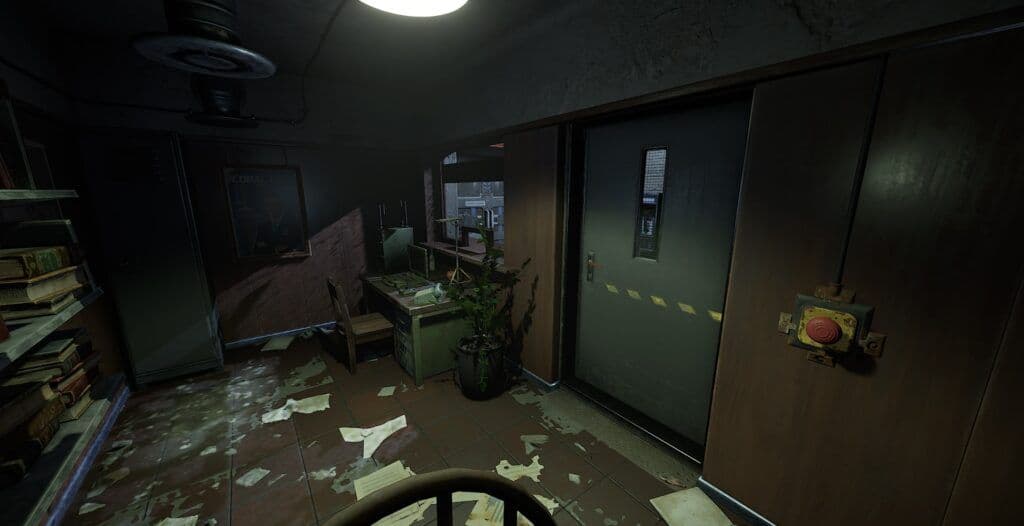
The exit checkpoint — the red button, and on the left wall the framed portrait whose header band appears to read COBALT. Go and decide for yourself.
Stated means the game prints it on a surface you can walk up to, or Facepunch documents it somewhere with their name on it — a devblog, the official wiki, a console variable you can type and watch behave. Inferred means the objects are real and the meaning is yours: you are reading an arrangement the game laid out and never explained. Invented means the name or the mechanism exists only in somebody's account of the game — not on a wall, not in a patch note, not in a config file. The buckets are not a ranking. Inference is how anyone reads environmental storytelling at all, and this article has done it out loud twice. The rule only asks you to know which one you are holding before you hand it to somebody else.
Run it on three things you met on the way down here. CYCLE COMPLETION : STANDBY — stated, and about as cheaply as a thing can be: it is printed on the laptop, and the header sitting above it was confirmed as the game's own name in an official devblog. You do not have to trust anyone about it, including this article. The warhead as a job in progress — inferred. The tarpaulins are real, the truck backed in beside the cradle is real, the cables running out across the stone are real, and "somebody is working on this" is a conclusion laid on top of them by a reader — this article included, which is why it said so at the time. And "the Regeneration Program" — invented. Ask the question the bucket asks: which surface is it printed on, which devblog documents it? The last section went and asked both, and came back with nothing. That is not a claim about the island. It is a claim about a video.
Then add the check nobody makes, which is the date. Stated facts about this monument have an expiry, because the monument keeps being edited. Entry was a Blue Keycard from launch until 2 October 2025 and has been Red ever since — so a guide can be accurate, careful, well sourced and still send you to a door with the wrong card in your hand. The launch-day write-up that still circulates was flagged work in progress by its own author on 4 May 2023, in the post itself. The most thorough walkthrough anyone has written still carries the line "Things in this guide are subject to change" through a revision made in November 2025. Even the official wipe-timer page tells you: its header reads "Updated: A Long Time Ago." None of those sources is hiding anything. They all say plainly what they are; the information just detaches from the disclaimer somewhere between the page and the person repeating it. So before who said it and how they framed it, ask when — and treat this monument's keycard, loot and puzzle as the parts most likely to have moved since.
The interesting part is what this article could not settle, because two of those things are not hard problems. They are just problems that require somebody to be standing there, and no screenshot is ever going to solve them. On your next run, at the bottom level, do three things:
- Read the numerator on
WARHEAD COUNT. The denominator is not in question. The digit in front of the slash does not survive the resolution Facepunch published at, which is why this article would not name it — but you will be looking at the screen on your own monitor, at your own render distance, with the freedom to walk a step closer. Whatever it says, you will know it first-hand, which is more than anyone writing about it from a screenshot can say. - Decide the wordmark for yourself. There are two frames worth a few seconds: the portrait by the security checkpoint on the way out, and the poster in the computer room. Both were described here with the word appears, deliberately, and both are close enough to your face in-game to resolve or to disappoint. Either answer is a real answer, and nothing in this article moves either way.
- Compare the clock to your server. Look at what the laptop is showing, then look at the wipe schedule your server advertises in its name or its description. If they agree, you are on the default. If they disagree, you have just watched the doomsday device take its orders from an admin, and you will never read that screen the same way again.
Do those three and you will have done something the whole lore canon mostly has not, which is check. Take a Red Keycard, 25 radiation protection, more flashbangs than feels reasonable, and a working knowledge of where the exit button is. The screen is six levels down and it is still counting.