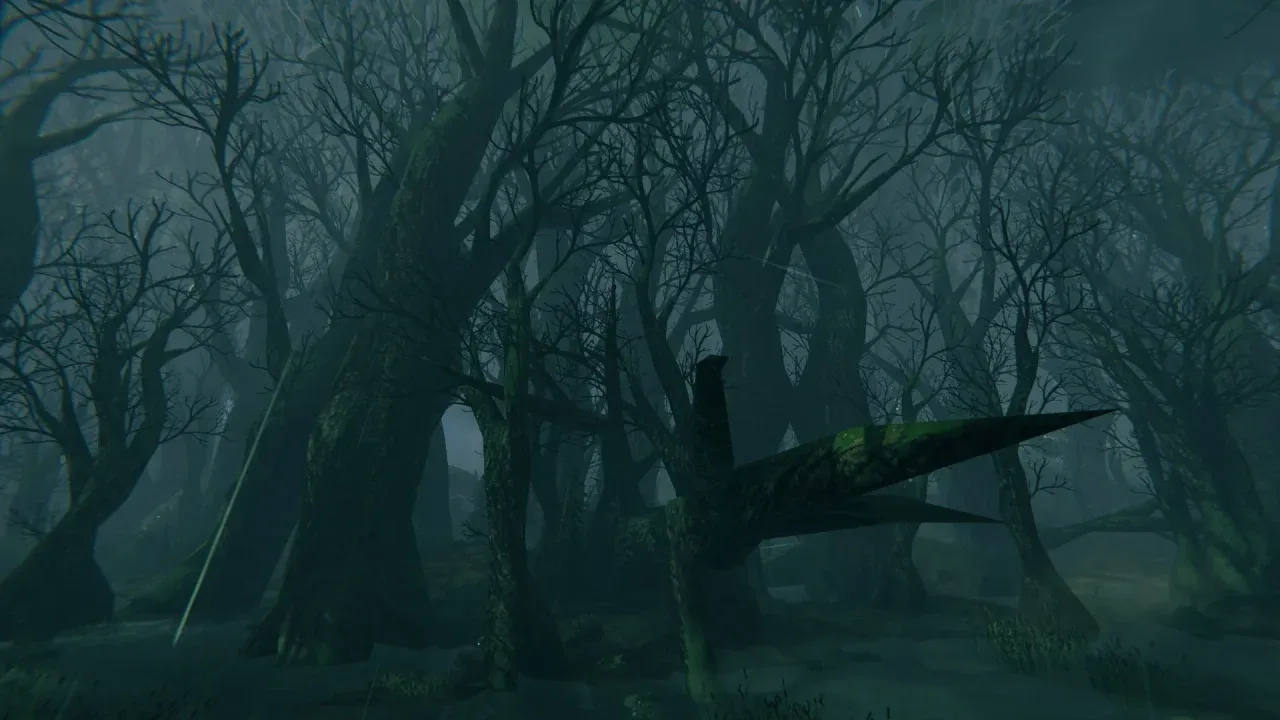
The Swamp is where Valheim stops hinting and starts testifying. The runestones here are longer than anywhere else in the game, they describe an actual war, and they tell you outright what the Draugr used to be before they started swinging axes at you. It is easy to read all of that as one story — a proud civilisation, a divine punishment, an undead hangover that you wade through on your way to iron.
Put the stones side by side and that story comes apart. Three Swamp stones explain the Draugr in three ways that cannot all be true, and one of them is not describing a single kingdom at all. What makes that more than a writing quirk is that the biome is built to match: five families of ruin that never touch each other, each with its own kind of dead standing over it. You can tell the layers apart by which corpse the game assigns to them — and once you can, you find that exactly one of those layers is still turning up in biomes hundreds of metres away.
The Draugr Get Three Origins, and They Contradict
The longest Swamp stone is the only text in Valheim that narrates a war between the gods and a mortal civilisation. A proud people built towers that reached the clouds, mined deep for metals, and eventually challenged the Aesir and the Vanir. The gods came in person: Odin levelled the cities, Loki burned the mines, Thor brought down the towers, Freya salted the fields. The warriors from that last battle will not accept the result, so they keep coming back in "ancient armour", rusting. The stone closes as an order rather than an elegy — break them, bury them, make them understand they are dead.
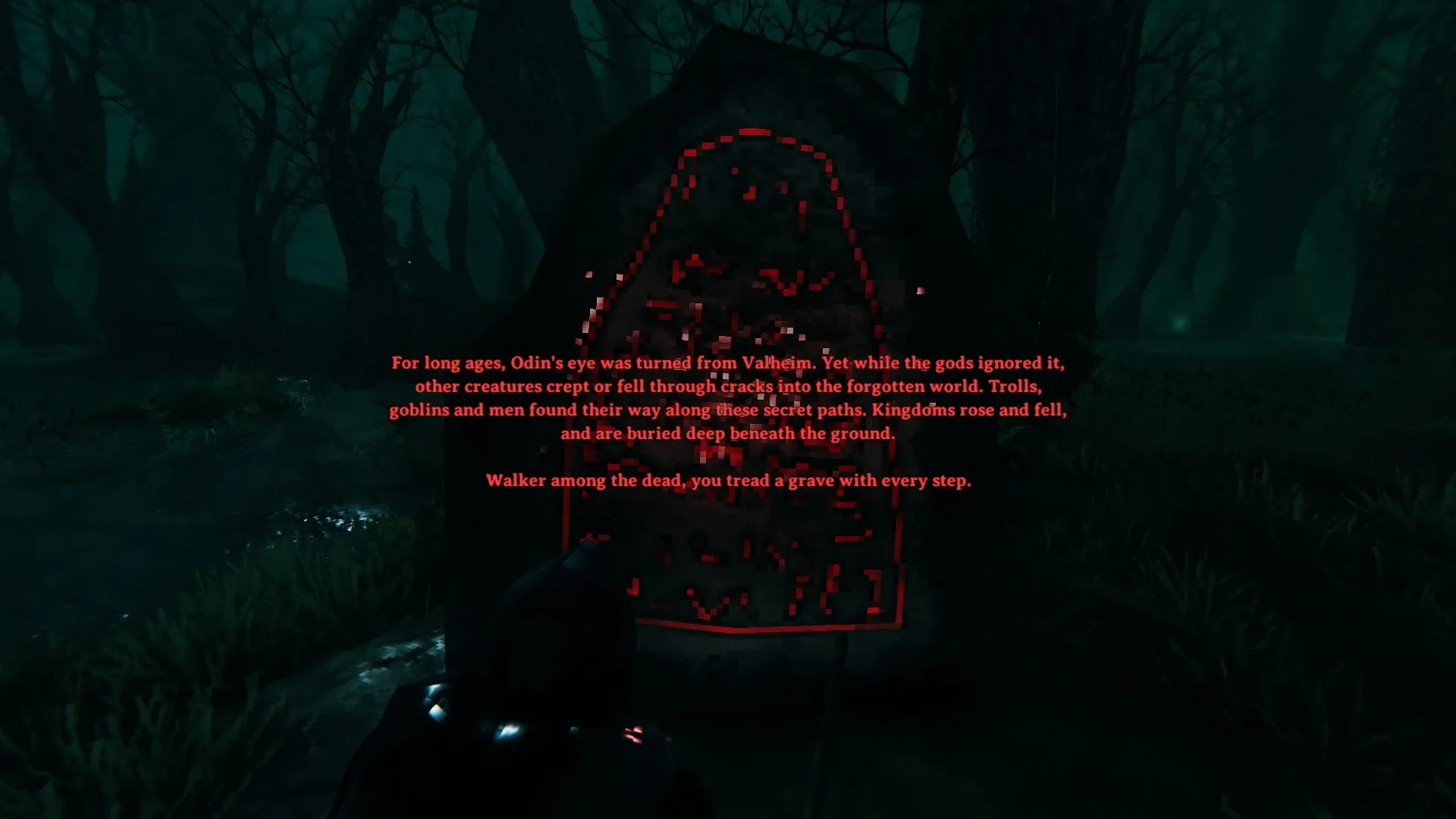
The stone that breaks the single-kingdom reading: kingdoms, plural, buried deep beneath the ground
A second stone hands you the same enemy with none of that attached. It says the Draugr walked these lands centuries ago much as you walk them now, that they are caught between living and dead in a shadow of a world they still half-remember, and that destroying them is a mercy. No war, no gods, no hubris. Just people who used to live here, and an apology for what you are about to do.
The third stone kills the singular reading outright, because it is openly about a different era. For a long stretch, Odin's eye was turned away from Valheim, and while nobody was watching, things crept or fell through cracks into it — trolls, goblins and men. Kingdoms, plural, rose and fell and ended up underground. Its last line is the biome's real thesis: you tread a grave with every step.
You cannot reconcile those three by reading harder, and the game never asks you to. What separates them is whether anyone divine was paying attention. One kingdom died because Odin looked directly at it. Others died because he did not. The Swamp is where both outcomes ended up in the same mud.
Nothing in the Swamp Is Built Like Anything Else in It
Walk a large Swamp and you will pass five kinds of ruin, and no two of them share a construction method:
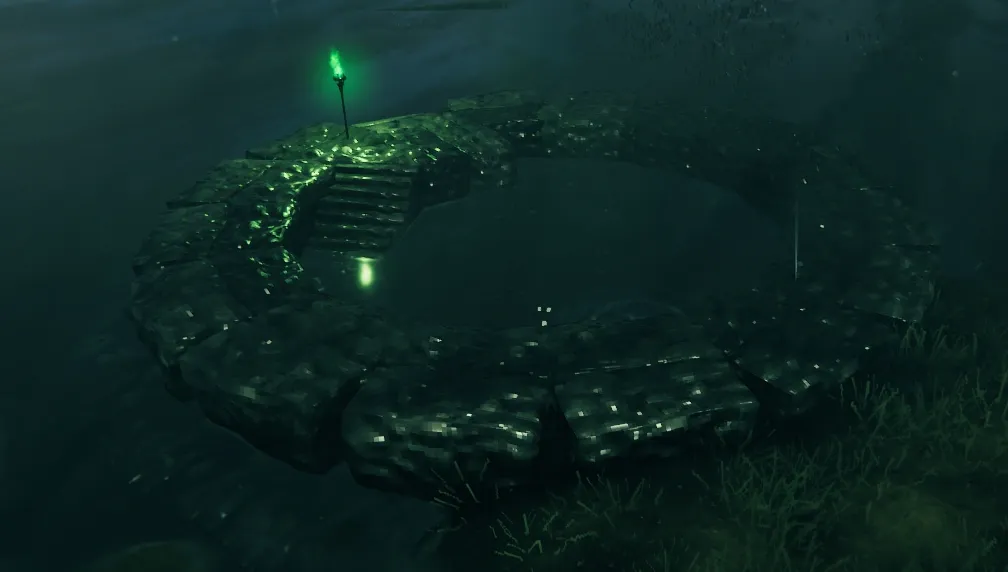
The Inverted Tower is the only Swamp ruin with a twin in another biome
- Swamp Runestone Towers — dressed stone, built up to tower height, snapped off partway.
- Abandoned Huts — timber stilt houses, five variants, sagging into standing water.
- Inverted Towers, also called Wells — a ring of stonework with a staircase running down below the waterline.
- Swamp Graves — six standing stones in a circle, with two more at the centre.
- Sunken Crypts — the locked dungeon, cut stone, rooms and corridors under the surface.
The point is not that these are different buildings. It is that the game never lets them meet. No hut leans against a tower. No grave circle sits in a crypt courtyard. Each one generates as its own isolated site with its own guard, and Valheim keeps them apart in the files as well — SwampRuin1, SwampHut1, SwampWell1, Grave1, SunkenCrypt4 are five unrelated prefab families rather than variants of one settlement.
Their condition sorts them further. The towers are broken, the huts are half-sunk, the crypt corridors have caved in and plugged themselves with mud. The grave circle is the exception: its stones are indestructible, and they give maximum structural support to anything you build on them. Every other ruin in the biome is a building that failed. The stone ring is in precisely the state its builders left it, and it is the only Swamp ruin the game guarantees you cannot change.
The Crypts Are Mines, and the Ore Is the Population
Sunken Crypts stay locked until The Elder gives up the Swamp Key, which is never consumed. Inside, the corridors are blocked by Muddy scrap piles, and the pickaxe work is the whole point of the trip.

Look closely at what a pile actually contains. A crypt pile has 30 minable segments, and each segment can yield Scrap iron at 14.29%, Leather scraps at 2.86% or Withered bones at 2.86% — about 4.3 iron, 0.86 leather and 0.86 bone from a full pile. It is the only metal deposit in Valheim that does not guarantee a drop when you break it.
Metal, hide and bone, from one node, with the metal common and the other two rare. That is a body: the armour, the kit and the person who was inside them, compressed into rubble. Scrap iron's item description is a single line about something old and rusty that can be smelted and used again. The long runestone said this people delved deep for precious metals and that Loki burned their mines. You climb down into a collapsed stone corridor and pull metal out of the wreckage, and your entire iron tier — the sledge, the buckler, the mace you are going to swing at Bonemass — is built from their gear.
The piles buried out in the open swamp behave differently. They run 20 segments, drop Scrap iron at 29.7% per segment for roughly 6 per pile, and yield bone at 0.3% — effectively never. Underground, in the halls, you find the dead. Out in the open ground, you mostly just find the metal. Valheim reuses the same trick once more much later, when the Mistlands' Ancient armor and Ancient sword nodes — giant helmets and blades left lying in the moss — break down into the same Scrap iron off a corpse of an entirely different size.
Every Ruin Comes With Its Own Kind of Dead
Valheim never leaves a Swamp ruin unattended, and it does not use the same guard twice. Which corpse stands over a ruin is the closest thing the biome has to a label.
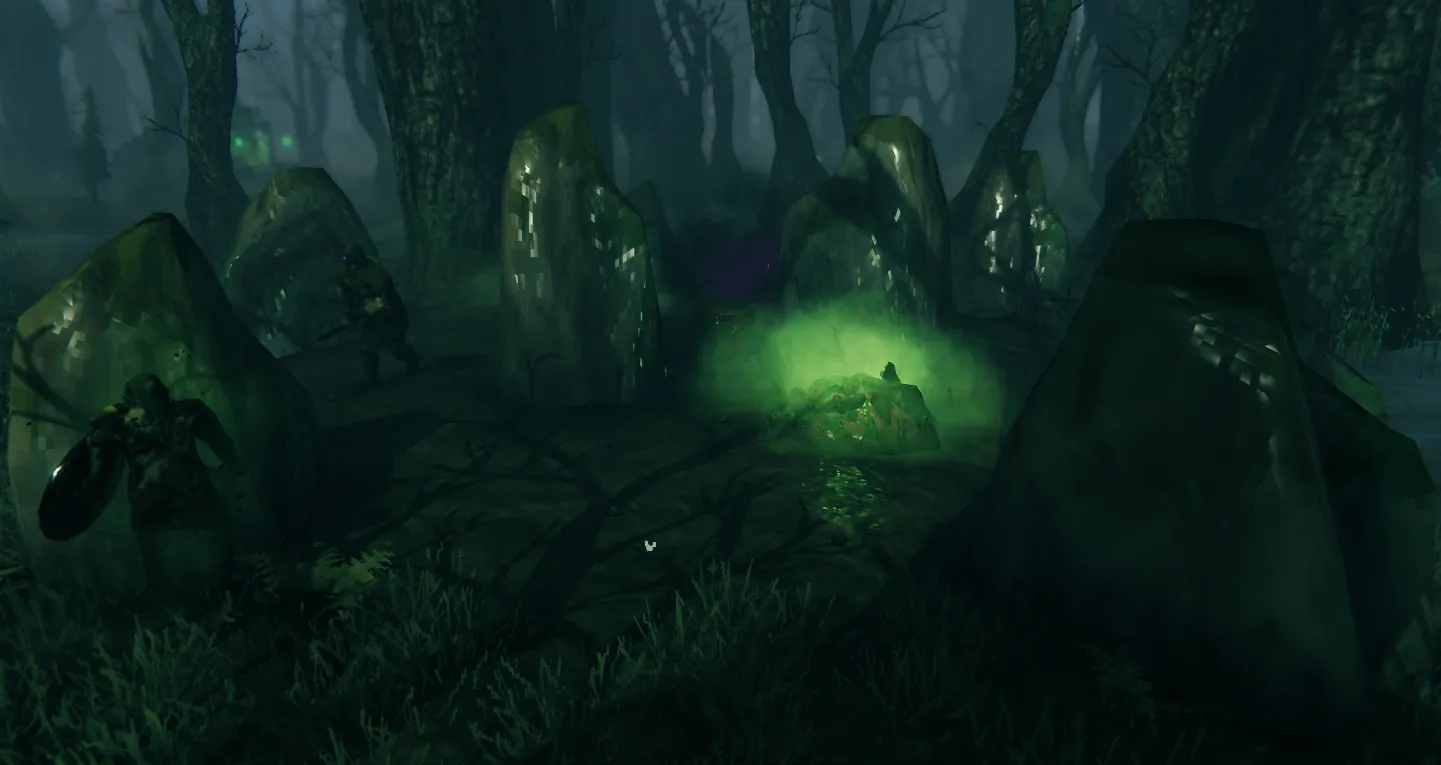
The Swamp Grave is the only site in the biome that fields both spawners at once
Two spawners do the work. A Body pile produces Draugr — 43% melee, 43% ranged, 14% elite on each spawn — waking when a player comes within 20 metres and pushing out another body every six seconds until two are standing nearby. An Evil bone pile does the same job with Skeletons, at 80% melee and 20% ranged. Which spawner a site gets is fixed by type. The percentages attached to each site below are a different thing entirely — per-structure generation chances that decide whether a guard is placed there at all, not per-spawn rolls.
- Swamp Runestone Towers get a Body pile, a 32.1% chance of a Draugr elite standing guard and two more Draugr at 50% each.
- Inverted Towers contain no loot at all in the Swamp. What they contain is up to two Draugr elite, at 32.1% each, surfacing out of the flooded stairwell.
- Swamp Graves are the only Swamp site that fields both spawners: two Body piles and an Evil bone pile, around a chest at the centre of the ring.
- Abandoned Huts get Wraiths. A hut that rolls its 10% chest spawns one once, even in daylight.
Cross that against the stones and it starts to sort. The stone towers pull the elite — the ones the long runestone described as still wearing ancient armour, which is the only Swamp dead the text explicitly accounts for. The grave circle is the one place that also produces bare skeletons, with no runestone claiming them at all. And the poorest structures in the biome are haunted by the least distinguished dead in the game, on their own separate authority: the Wraith's runestone says a Wraith is the soul of a warrior who died with no great deeds to their name, too thin and airy to sink into the earth, so it drifts upward and catches in the branches instead. Three architectures, three grades of corpse, and three unrelated explanations.
The towers get one more thing nothing else in the biome gets. Two crows circle a Swamp Runestone Tower permanently, on every tower, in every world. Of the five ruin types, the one the runestone says the gods personally came down to destroy is the only one Valheim keeps something watching.
Bonemass Is What the Ground Turned Into
Bonemass costs ten Withered bones, offered at what the game calls the Boiling death altar. Those bones come out of the Muddy scrap piles in the crypts. You dig ten of the buried dead out of a collapsed hall, carry them to a giant half-sunk stone skull with green liquid pooled in its jaw, and the altar tells you to cook their remains.

The stones have been building to this the whole time. One warns about a thing below the surface the writer refuses to name, a bitter mass of bone. Another is three lines about bone speaking to bone under the murk, remembering flesh. A third supplies the mechanism outright: the corpses of Odin's enemies fed lesser creatures, which fattened on the old magic still clinging to them, while the spirits soaked into the soil or went looking for new bodies.
Note what that mechanism does and does not cover. It names Odin's enemies — the war kingdom, one layer of the five. It says nothing about the peoples who died while he was not watching, and nothing about the huts. Whether Bonemass is the whole graveyard congealed or only the punished part of it, the game never says. What it does do is make you fetch the offering from the crypts specifically, so the bones you feed him are the ones sealed behind The Elder's key rather than the ones lying under the open bog.
Bonemass is not a monster that happens to live in a swamp. He is what the contents of that swamp become given enough centuries, and the ritual makes you assemble the quorum yourself out of mining leftovers. Five of his altars exist in a world, spaced 3,000 metres apart and never closer than 2,000 metres from the centre — and the Vegvisirs that reveal them are carved inside the crypts and the tower ruins. The buried layers point you at what they turned into.
The Draugr Are the One Layer That Didn't Stay Buried
The Wraiths never leave. Every entry in their spawn table is a Swamp entry — night spawns, the huts, and the chill event after Bonemass dies — and they exist nowhere else in Valheim. Whatever the hut people were, they are still lying in their own bog.
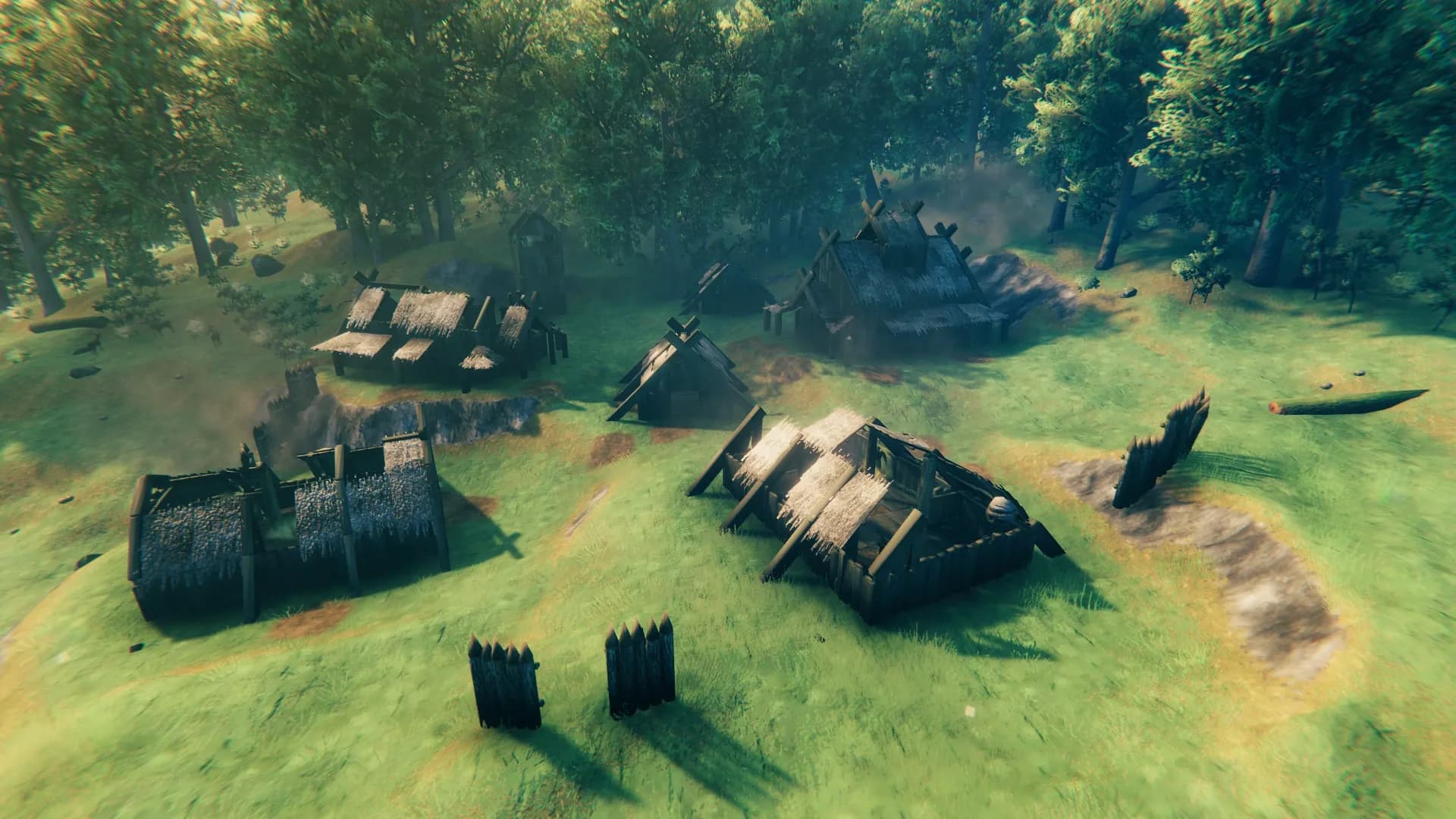
Draugr architecture with the roof still on, in the Meadows rather than the Swamp
The Draugr are the opposite. Body piles appear in the Swamp, in the crypts, and in Mountain ruins, and the Inverted Tower has a sibling up there too: MountainWell1 is the same circular shaft, unflooded, unguarded, with a 75% chance of a chest at the bottom. The Swamp's version drowned; the Mountain's did not. Mountain Towers are stone ruins with a one-in-three chance of three Draugr standing outside them, hundreds of metres above the nearest bog.
Then there is the version nobody thinks to look for. Draugr Villages generate in the Meadows, more than 2,000 metres from the world centre — wooden great halls, long houses, towers and partial log walls, with intact and ruined variants of the same buildings standing in the same settlement. The Draugr there are shut inside the houses and only come out if you open the doors. A great hall can hold six chairs, a Raven throne on a coin flip, six stones arranged where a hearth would go, and up to three chests under the floorboards beneath the body pile.
That is the layer worth chasing, and it is not in the Swamp at all. If you want to see Draugr architecture with the roof still on, do not dig — sail. Take a bow, get above the roofline of a Draugr Village on a far Meadows continent, and read the hall before you break a single body pile, because it is the only place in Valheim where the dead still have their furniture.