
How to Unlock and Dispatch Spies in Total War: Three Kingdoms
Your journey to unite China in War of the Three Kingdoms isn't just fought with armies—it's won in the shadows. Before you can incite civil wars or poison enemy supplies, you need to know how to plant your first agent. This opening section of our guide will walk you through the exact requirements and initial steps to start your espionage campaign.
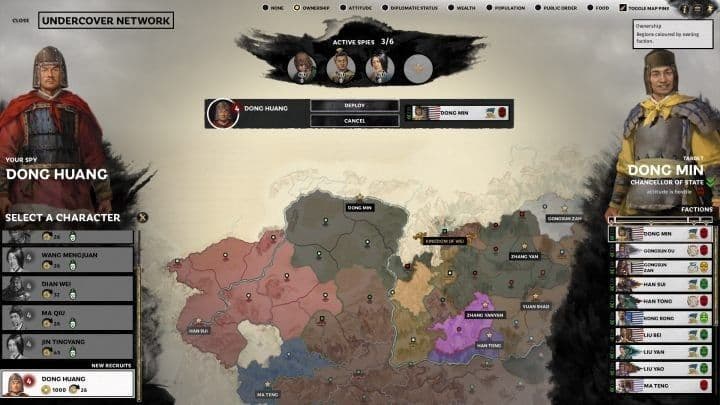
The espionage interface allows you to manage your network of active spies.
The Foundation of Espionage
Unlike previous Total War games, there are no dedicated spy units in Total War: Three Kingdoms. Instead, you'll recruit agents from your own pool of characters, which means you can't start spying right away. You need to meet two key prerequisites to unlock the system.
First, you must achieve the faction rank of Second Marquis. This is a campaign milestone tied to your overall Prestige. You'll unlock your very first spy slot automatically upon reaching this rank. Further slots can be unlocked as you advance to higher faction ranks, like Duke or King.
Second, you can increase your available spy positions by researching specific Reforms. Head to your Reform Tree and look for nodes that explicitly mention increasing your spy capacity. Investing in these reforms early can give you a significant covert advantage, allowing you to run multiple operations simultaneously.
Finding Your First Agent
With a spy slot available, you need to find a willing character. Not every general or administrator wants to live a double life. To identify a potential spy, open your Character List or inspect any character's information panel. Look for a small eye symbol next to their title rank. This icon indicates they are suited and willing to undertake undercover work.
Higher-level, more experienced characters are more attractive to enemy factions and will be recruited faster. Sending a legendary general as your spy is a high-risk, high-reward play.
Sending Them Into the Shadows
Once you have a candidate and an available slot, it's time to make your move. Open the Undercover Network panel from the top of your main campaign screen. Here, you can manage all your covert operations.
To dispatch a new spy, select your willing character and then left-click on your target faction. This action formally releases them from your service (at least publicly) and sends them into the global recruitment pool. They will now appear as a free agent, hoping to be hired by the faction you marked. This process can take several turns, and there's always a chance the target faction simply won't recruit them—so choose your target and your agent wisely.
With your spy dispatched, the real game begins. In the next section, we'll break down how they build trust and gather intelligence once they're inside the enemy court.
Understanding Undercover Network and Cover Mechanics
Your spy is embedded and the target faction is none the wiser. Now comes the real work: managing your covert operations with the two currencies that govern espionage in Total War: Three Kingdoms. Think of Undercover Network Points as your faction's global espionage budget, and Cover Points as your individual spy's personal safety net.

The espionage interface detailing spy upkeep and cover costs.
Let's break down how these critical resources work so you can plan your shadow war effectively.
Your Global Spy Budget: Undercover Network Points
Once a spy is successfully recruited by an enemy, they begin building a network of contacts, informants, and covert assets. This collective effort is represented by your faction's Undercover Network Points, a shared pool used to fund all your spies' advanced actions.
Every spy action has a cost in Undercover Network Points, with more impactful operations (like inciting a rebellion or assassinating a leader) demanding a higher investment. This creates a key strategic choice: do you spend your limited points on a single high-stakes operation, or spread them out for broader, subtler disruption across multiple fronts? This global pool means your espionage efforts are interconnected—a major operation for one spy drains the budget for all others.
Your Spy's Personal Safety Net: Cover Points
While your network points fund the mission, Cover Points determine its safety. As your spy spends time within the enemy faction, they naturally build trust with those around them, accumulating personal Cover Points. The higher their cover, the lower the risk of being caught.
Each spy action also costs a certain amount of Cover Points to execute. More dangerous actions drain this personal reserve faster. Crucially, you should always hover over an action in the Action Menu to see the success chance versus your current Cover points. A low cover pool means a high risk of revelation.
Patience is a virtue in espionage. Let a new spy build up a healthy reserve of Cover Points before attempting risky actions. A well-established spy is far more likely to pull off a high-impact sabotage without blowing their cover.
The Payoff and The Peril
When your spy is first recruited, you get an immediate intelligence windfall: Visibility Gain over the target faction's employed characters, their commanderies, and their armies. This line of sight is invaluable for planning your next move, whether it's a military campaign or another covert op.
But there's always a Risk of Revelation. If a spy's cover is blown during an action, the enemy warlord gets to decide their fate—execution, release, or turning them into a double agent. A revealed spy can never work for you again.
Mastering the balance between spending your global Undercover Network Points and managing each spy's individual Cover Points is the key to becoming a puppet master in Total War: Three Kingdoms. With this understanding, you're ready to move from simple observation to orchestrating chaos from within.
Best Strategies for Infiltrating the Enemy Court and Military
Getting your spy hired is just the beginning. In War of the Three Kingdoms, the real power comes from maneuvering them into the enemy's highest echelons—their court, their commanderies, and their armies. This is where you shift from gathering intelligence to actively dismantling a rival from within.
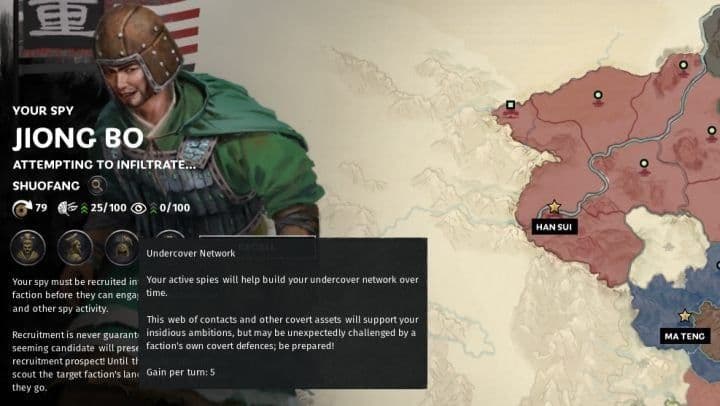
Recruiting spies and infiltrating enemy networks is key to gaining high-impact positions.
Your first and most critical strategic choice is whom to send. The AI judges candidates by their resume. To maximize your chances of a swift and high-ranking infiltration, follow this core principle:
Strategy: Recruitment Optimization (Campaign Map, send high-level/experienced characters to increase AI recruitment chance)
Don't waste your spy slot on a fresh recruit. The target faction is far more likely to hire—and subsequently promote—a character of higher level and with valuable experience. Look for seasoned generals or skilled administrators in your roster who show the eye symbol. Sending this premium asset dramatically increases the odds they’ll be snapped up quickly and placed into a position of real influence.
Think long-term with your spy placements. Send your best agents to factions you don’t plan to attack for the next 20-30 turns. This gives them the time needed to build Cover, climb the ranks, and become truly devastating.
Once your spy is successfully hired, they’ll start in the Court Noble tier. This grants immediate access to foundational actions like boosting your shared Undercover Network, influencing trade, or stealing from the faction treasury. Use these to build your resources and subtly weaken the enemy while your spy works on their promotion.
The two most impactful promotions are to Administrator or General. You can’t force these—you must wait for the AI to appoint your spy, which is why sending an attractive candidate is so vital.
Action: Administrator Role (Target Commandery, unlocked when AI appoints spy to govern a settlement)
If your spy is made the governor of a city, a powerful new menu unlocks. From here, they can sabotage the local garrison, tank public order to incite rebellions, or—in a grand finale—publicly defect, handing the entire commandery over to you without a fight. Placing a spy as an Administrator in a key economic or border province is a game-changer.
Action: General Role (Target Army, unlocked when AI appoints spy to lead a military retinue)
If your spy is appointed to lead an army, you gain the ability to sabotage. You can poison supplies for other armies, reduce their campaign movement range, or, at the peak of their treachery, incite a military revolt. This last action turns the spy’s entire army over to your control on the campaign map, instantly crippling your enemy’s front line.
Remember, a single spy can hold multiple roles—like being both an Administrator and a General—granting access to both sets of devastating actions simultaneously. With careful planning and the right agent, you can have an enemy's most prosperous city and their strongest army ready to turncoat at your command. Let the subversion begin.
How to Execute High-Impact Sabotage and Poison Supplies
Once your spy has successfully infiltrated the enemy's inner circle, the real fun begins. In War of the Three Kingdoms, you don't always need a massive army to bring a rival to their knees; sometimes, a well-placed vial of poison or a whispered rumor is more devastating than a thousand catapults.

Cunning strategies allow you to topple dynasties from within.
Crippling the Enemy Military
If your spy is appointed as a general in one of the target faction's armies, they gain access to high-stakes General Role actions that can gut an invasion before it even reaches your borders.
When an enemy stack is proving too tough to crack in a fair fight, use Poison Supplies. This is a [Left Click] action to reduce enemy replenishment and military supplies, effectively starving the troops and ensuring they can’t recover health after a skirmish. If you want to end the threat permanently, you can trigger a Military Revolt. This is a [Left Click] action to defect with the entire army to player faction, turning your rival's best soldiers into your own frontline defenders while their other generals are sent packing back to their court.
Timing is everything. Use Poison Supplies a few turns before your main army engages to ensure the enemy is at their weakest when the real battle starts.
Destabilizing Settlements from Within
When your spy is appointed as an Administrator of a commandery, they can dismantle a city's defenses from the inside. This is the ultimate way to prepare for a siege in Total War: Three Kingdoms without losing half your infantry to wall towers.
- Sabotage Garrison: This is an Administrator Role > Target Settlement, [Left Click] action to weaken walls and defenders. It makes the upcoming assault significantly easier by lowering the health of the garrisoned units and crumbling the settlement's physical fortifications.
- Incite Rebellion: If you’d rather let the locals do the dirty work, use this Administrator Role > Target Settlement, [Left Click] action to lower public order and spawn rebels. This creates a massive distraction for the enemy warlord, forcing them to pull frontline troops back to deal with internal uprisings.
⚠️ Watch out: Highly difficult actions cost more points and increase the risk of your spy being caught. Always check your success chance before pulling the trigger on a revolt.
With these sabotage techniques in your repertoire, you can hollow out an empire from the inside, leaving nothing but a shell for your armies to occupy. You've transitioned from a simple observer to a true architect of chaos—now go make them regret ever hiring your "loyal" general.
How to Incite Civil War and Assassinate Leaders in Total War: Three Kingdoms
You’ve spent dozens of turns building trust and climbing the political ladder, and now it’s time for the ultimate payoff. In War of the Three Kingdoms, the most devastating blow isn't delivered by a catapult or a cavalry charge, but by a single well-placed word in the enemy’s inner circle.

The campaign map is where players coordinate their global spy networks.
The Power of Family Subterfuge
To truly dismantle a rival from within, your spy needs to move beyond the rank of a mere courtier. The most lethal options are found in Family Subterfuge, a tier of actions within the Target Faction Family that is unlocked by marrying into the family or being adopted as heir. Once your agent is recognized as a legitimate member of the ruling house, the faction's fate is effectively in your hands.
Higher-level characters have a much better chance of being adopted or married into the family. If you have a legendary character willing to spy, they are your best bet for reaching this "inner sanctum" quickly.
Assassination and Successions
If a rival warlord is proving too competent or has a terrifying set of personal traits, you can simply remove them from the equation. Use the Assassinate Faction Leader action from your spy's Family Role and [Left Click] to kill the current ruler and force succession. This doesn't just eliminate a powerful general; it forces the enemy faction to deal with the immediate instability of a new leader, often leading to a massive drop in satisfaction across their entire court.
Inciting Chaos and Defection
If you prefer to watch the entire empire crumble at once, you can choose to Incite Civil War. By using this Family/Heir Role action, you can [Left Click] to split the faction into warring sub-factions. This turns their own armies against each other, forcing them to fight a bloody internal struggle while you move in to pick up the pieces.
However, you don't always need to destroy a faction to win—sometimes you just want their land. If your spy has been appointed to govern a region, they can perform a Public Defection. From their Administrator Role, you can [Left Click] to hand over the entire commandery to the player's faction. This is the ultimate "gotcha" moment, as you instantly gain a fully developed city and all its surrounding resources without losing a single soldier in a siege.
⚠️ Watch out: These high-level actions cost a massive amount of Undercover Network Points and Cover Points. If you fail, your spy will likely be executed, and you’ll lose your most valuable asset in that region.
With these tools at your disposal, you aren't just playing a strategy game—you're rewriting history from the shadows. Whether you choose to inherit an empire through blood or tear it apart with a civil war, the throne is yours for the taking. Let's go.
Counter-Espionage and Protecting Your Faction from Spies
The web of spies isn't a one-way street. As you've been infiltrating enemy courts in War of the Three Kingdoms, rival warlords have been doing the same to you. This next part can feel overwhelming—don't panic. Protecting your faction isn't about finding a magic "spy detector," but about building layered defenses that make your empire a fortress of paranoia where enemy agents struggle to operate.

Settlement buildings can sometimes provide bonuses to spy detection.
Your first and most straightforward line of defense is construction. In any commandery capital building chain, you can construct the Drum and Bell Tower. This isn't just for show; it actively increases the Cover points and Undercover Network points cost for any enemy spy action targeting that specific region. Think of it as raising the local "price" of sabotage, making it more expensive and risky for infiltrators to act against you there.
Prioritize building Drum and Bell Towers in your richest, most vital commanderies, especially those bordering hostile factions. It’s a cost-effective way to protect your economic and military heartlands.
Your court is your command center, and placing the right people in power is crucial for counter-espionage. This is where Ministerial Counterintelligence comes into play. Open your Court Panel and scrutinize the traits of your characters. Those with 'Counterintelligence' traits are your secret weapons. Assign them to the powerful ministerial roles of Prime Minister or Faction Heir. Their inherent skills will apply a faction-wide increase to the point costs for enemy spy actions, making every single operation against your entire faction more difficult to pull off.
Here’s the trick most guides miss: the game’s relationship systems are your best early-game defense. This is the Family Trust strategy. In your Court Panel, favor your family members—spouses, children, siblings—for key positions like Administrator or army General. While not foolproof, family relations have a higher base level of loyalty. Playing as a faction like Sun Jian, who starts with a strong, close-knit family, naturally lends itself to a more spy-resistant playstyle because you have more reliable characters to fill critical posts.
Despite your best efforts, a spy might get caught. When this happens, you’ll face the Revealed Spy dilemma in an Event Pop-up. This is your moment of judgment. You can choose to Execute them (permanently removing the threat), Release them back to their original faction (a diplomatic gesture), or cunningly turn them into a Double Agent. This last option sends them back to their master, but they now work for you again, potentially feeding you false information or continuing their operations under your control.
Trust me, you'll want to save here. With these layered defenses—hardened buildings, vigilant ministers, trusted family, and ruthless choices—you transform from a vulnerable target into a paranoid fortress. You’ll never be completely immune, but you can make the cost of espionage so high that your enemies will think twice before targeting your kingdom.
Cao Cao's Unique Espionage: Credibility and Proxy Wars
While other factions in War of the Three Kingdoms must rely on the standard spy system, Cao Cao plays a different game entirely. As the "Hero of Chaos," his path to power is paved not just by armies, but by cunning diplomatic manipulation that lets him control the board without ever moving a piece. This is where his unique resource, Credibility, becomes your most potent weapon.

Interacting with other warlords to influence their opinion through Credibility.
Think of Credibility as Cao Cao's political capital. It accrues each turn, and you spend it from the Diplomacy Screen to orchestrate events across China. Your first major tool unlocks at 25 Credibility: the Manipulate Relations action. This lets you target two other factions—you can either improve their relationship to forge an alliance, or, more often, worsen it to sow distrust and push them toward conflict. It’s the perfect way to isolate a target or distract a powerful neighbor.
Use Manipulate Relations early and often. Turning two rivals against each other buys you precious turns to consolidate your own power in Chen commandery without their interference.
Your masterstroke, however, requires 75 Credibility: triggering a Proxy War. This action on the Diplomacy Screen forces two rival factions to declare war on each other immediately. The beauty is the cost—or lack thereof. They bleed each other dry, weakening both for your eventual conquest, while you suffer no diplomatic penalty for starting the fight. In Cao Cao’s crowded starting position, surrounded by threats like Yuan Shao and Liu Bei, a well-timed Proxy War can neutralize your two biggest problems at once.
Managing your early economy is just as crucial as managing your neighbors. In Cao Cao's Court, don’t overlook Lady Bian, his wife. Assign her to a commandery to significantly boost peasantry income, providing a vital financial foundation while you navigate the opening turns and the pivotal Faction Dilemma concerning your father’s death.
With Credibility funding your schemes and Lady Bian securing your treasury, you’re embodying Cao Cao’s true strength: winning wars before the first sword is drawn. Master these tools, and you won't just conquer China—you'll orchestrate its downfall from the shadows.