
Night City is built to make dependence feel like weakness. You need chrome to compete, money to stay mobile, and a fixer to turn danger into work. Viktor Vector and Misty Olszewski are the rare people V can need without being reduced to a customer. Viktor reads the body; Misty reads the fear around it. Their shared space in Watson is important because it gives V two kinds of help that Night City cannot easily price.
The First Visit Is a Shared Threshold
Viktor's clinic is behind Misty's Esoterica in Little China. That route matters. V enters a bright, public shop, passes through the back, and descends into a private medical room. The game's opening ripperdoc visit moves V from conversation to vulnerability in a few steps, with Misty and Viktor occupying opposite sides of the same threshold.

Viktor works on his cyberware in his clinic.
In "The Ripperdoc," Jackie brings V to Viktor when their cyberware starts malfunctioning. Viktor installs the upgrades V needs and explains the work with the confidence of someone who knows the difference between a modification and a cure. The official game booklet calls him a mentor and describes his clinic as a refuge; the scene earns that description by letting V surrender control without surrendering dignity.
Misty makes the clinic more than a convenient location. She owns the shop in front, works as Vik's unofficial assistant, and is Jackie's girlfriend, but the important detail is her tone. She does not interrogate V's ambition or sell a version of the future. She makes room for a person who has just walked in carrying a problem no weapon can solve.
Viktor's Credit Shows What He Refuses to Monetize
Viktor's clearest act of friendship is a debt. He installs expensive cyberware for V before V can pay, then leaves the decision to settle the account in V's hands. "Paid in Full" turns that kindness into a small but telling mechanic: paying Viktor back restores access to his ripperdoc services, while delaying the payment has no dramatic punishment beyond finding another clinic.
The design says two things at once. Viktor's work is still a business—V cannot use the full service forever without settling the bill—but Viktor does not use the debt as leverage. He trusts that V will return when able, and the game lets the player decide whether that trust deserves an answer.
That is why Viktor's role is more specific than “the nice ripperdoc.” He is the person who treats V's body as something worth preserving before it becomes a build, a relic, or a corporate asset. When V returns after a job, the useful action is still changing cyberware. The emotional action is being recognized by the same person who helped before V had money, status, or a reason to call themselves a legend.
Tarot Gives Misty a Different Kind of Authority
Misty cannot diagnose the Relic, but she can give V a way to speak about what the Relic is doing to their life. Her Tarot readings are not a second technology system. They are a ritual that turns an approaching ending into something V can look at.
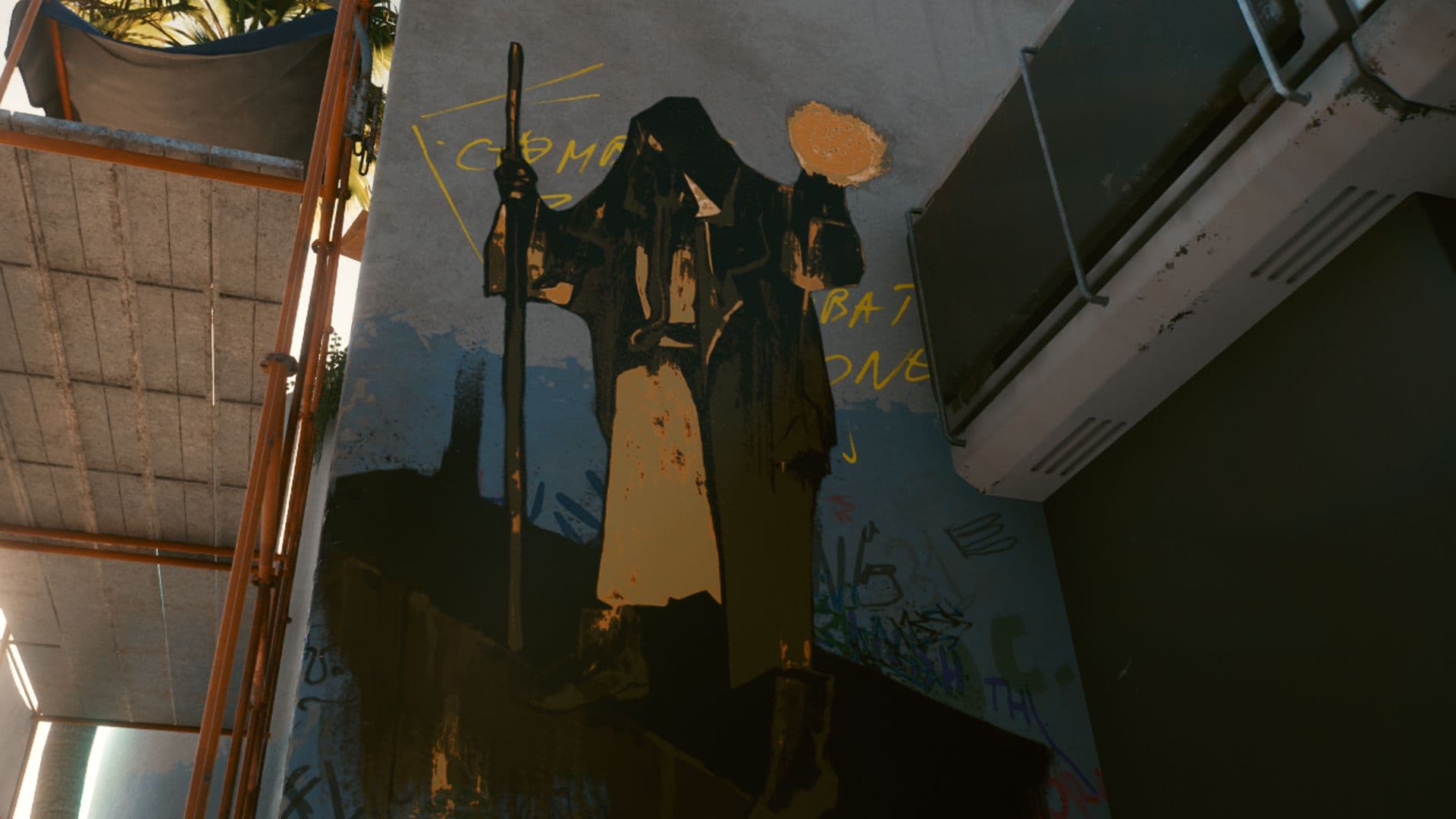
A Tarot mural from the hunt that sends V back to Misty.
"The Fool on the Hill" makes the player carry that ritual through Night City. V scans Tarot graffiti and returns to Misty for an interpretation, so the reward for exploration is not only a collectible or a completion mark. It is a conversation that asks what the symbols mean for a person who has stopped believing the future is negotiable.
Phantom Liberty's "Tomorrow Never Knows" repeats the structure in Dogtown. V photographs four new Tarot murals, then brings the cards to Misty so she can explain them. The job is mechanically simple, but its narrative function is precise: Misty does not claim to control the signs. She helps V live with a message that cannot be fixed by better equipment.
This is why her role complements Viktor's rather than opposing it. Viktor cuts through the body to find a repair. Misty sits with the uncertainty that remains after repair is no longer enough. Both are diagnosing V, but only one of them accepts that the diagnosis may not lead to a cure.
The Ending Tests Whether Care Can Survive Change
The pair's bond becomes clearest when V's life stops being only V's story. If V sends Jackie's body to his family, "Heroes" puts Misty outside Jackie's garage and brings Viktor to the ofrenda. They are not there to deliver a reward for the correct choice. They are there because grief has made the relationship visible.
Misty's Esoterica later becomes the threshold for the final decision. On the rooftop above the shop, V chooses what to do with the time and body left to them. Misty walks V there, and the ending messages from both characters extend the same relationship beyond the scene. Viktor asks V to come back for a checkup. Misty remains one of the people who speaks to V as a person rather than a result.
Phantom Liberty's Tower ending gives that care its necessary limit. After V's two-year coma, Viktor is working under Zetatech and Misty's old shop has disappeared into the city's redevelopment. Their refuge was never a fortress. It was a temporary arrangement between people who kept choosing to treat one another as human in a place that rewards the opposite choice.
That is the real reason Viktor and Misty stay with V. One protects the body from becoming equipment; the other protects the future from becoming only a deadline. Their care cannot stop Night City from changing, but it gives V a relationship that remains personal even when everything else becomes a contract.