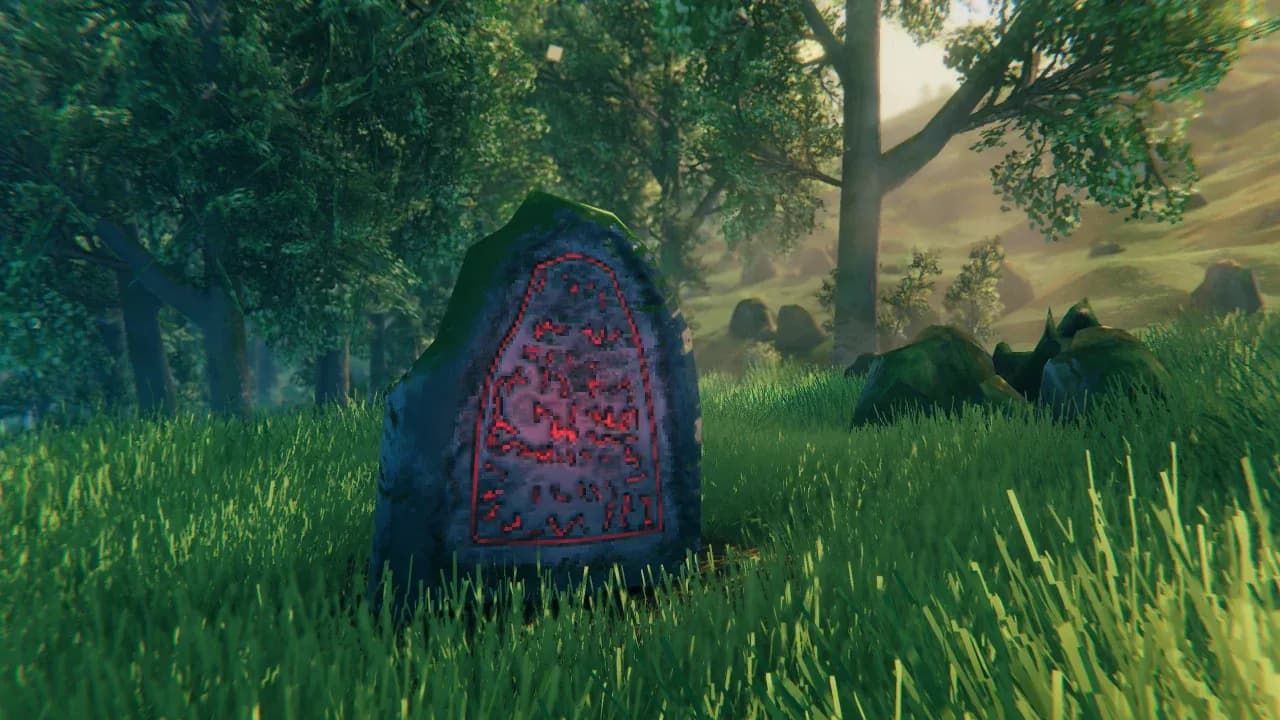
The phrase "First Men" occurs once in Valheim's writing and nowhere in Valheim's world. It sits on a long Surtling runestone that the current game does not place — the community wiki indexes the words on three pages total, and one of those is a note explaining that the text belongs to older builds. Search the stones you can actually walk up to and the name is simply absent.
What is there instead is five distinct dead peoples with five different fates, and a corpus written in two voices that disagree about all of them. One voice was present. The other explains.
The One Stone That Names Them Is Not in the Game
The long Surtling runestone is the only text in Valheim that uses the words "First Men." It explains the surtlings as fragments of the fire demon Surtr, shattered when the First Men killed him — "giant warriors of whom you are but a dwindling echo" — and it closes by saying the demon still seeks revenge on their children.

Read those two clauses again, because nothing else in the game makes either claim. The First Men were giants. And you, the Viking a Valkyrie dropped on this beach, are one of their descendants. That single stone is the entire textual basis for treating the First Men as your ancestors rather than as a turn of phrase.
Its status is worth stating precisely, because it is the whole foundation. The Valheim wiki's runestone list marks this text unused. The same wiki's Surtling page says that in earlier versions of the game, players could stumble upon it in the Swamp. Those two entries disagree about whether it was ever placed; they agree completely that it is not placed now. What spawns in the Swamp today is three sentences of tactics — surtlings are embers of an old fire, they gather in numbers, their lights carry, keep to high ground. The genealogy is not in the biome. It is only in the files.
So the most-cited fact about Valheim's deep past — that the player is a diminished descendant of a race of giant warriors — rests on a stone the game will not show you.
Five Dead Peoples, and Odin Was Only Watching for One of Them
The fastest way to tell Valheim's vanished civilizations apart is to ask a single question of each stone: where was Odin?

For exactly one of them, he was present and personally involved. A Swamp stone describes a race of "proud and noble people" who built towers to the clouds, mined deep, and then made war on the Aesir and the Vanir. The retaliation is itemised god by god — Odin levelled the cities, Loki burned the mines, Thor pulled down the towers, Freya salted the fields — and their warriors come back as Draugr.
The Fuling get a similar treatment on the Plains, but they are not the same people and the stone is careful about it. Their towers and cities rivalled "those of men," which only means anything if human cities were already the benchmark. Odin cracked their armour like snail shells and tore Yagluth in half.
The other three fell while nobody was looking, and their stones say so outright. One Plains stone puts ancient tribes in halls beneath the ground before the Allfather ever turned his eye toward the place. A Swamp stone works the same blind spot from the other side: while the gods ignored Valheim, trolls, goblins and men slipped through cracks into a forgotten world, and kingdoms rose and fell there unobserved. And the Ashlands holds the Kingdom of the Emerald Flame, which collapsed inside the lifetimes of the people who carved its stones, with no god involved at any point.
That is the line that will not blur. Two of these civilizations were destroyed by a pantheon that arrived in person. Three of them existed because the pantheon was elsewhere. You cannot merge a people Odin annihilated with a people whose entire history depended on Odin not knowing they were there.
Two more groups are often swept into the same pile and belong outside it, because they are not ruins. The Jotunn are named on a Mistlands stone as Odin's most ancient kin, and their bones are the raw material the Dvergr mine for eitr. The Dvergr are the descendants of the old smiths, and they are the counterexample to everything above: a Valheim civilization that never ended. They are still working, still armed, and still uninterested in you.
Nobody Signed the Stones That Explain Everything
Split the corpus by whether a carver is speaking, and the contradictions stop being lore holes.

Some stones have a person in them. Ulf builds a house badly and writes down what he learned about roofs and doors. Astrid records the spot where Odin's words reached her, frozen into pebbles by the cold, thawing in her hands one word at a time. Harald counts what the Forsaken took off him — an eye to Eikthyr, a shield hand to the Elder, a leg to Moder — and asks where he will wake next. Gudrun writes that she is no man's wife and no father's daughter, and that only her name is left to her.
These carvers are consistently modest about the past. The Black Forest settler who found the buried halls says only that those carried here by the Valkyrie "are not the first men in this land" — lowercase, a comparison rather than a name — and ends on a question about whether the same fate is waiting. Another Black Forest stone counts eight creatures banished by Odin in the first days of his kingship, then caps its own claim on the spot: the carver has seen two of them, knows little of the rest, and will add to the stone when they have seen more. Valheim currently has seven Forsaken. Whether the eighth is a boss still to come or a number the carver got wrong, the stone declines to say, and so should you.
The stones that explain things have no person in them at all. No carver, third person, no hedging, and total certainty about events nothing living witnessed. That is where Valheim's tidy cosmology comes from — and it is where the contradictions come from too. Two Swamp stones give the Draugr two incompatible origins: one makes them the last soldiers of that war against the gods, still unable to stop fighting, while the other says they merely walked these lands centuries ago, are caught in a shadow of the world they knew, and deserve pity. A third stone out in the Plains hands the walking dead to the pre-Odin tribes instead.
Three stones, one phenomenon, three different peoples. As a single history that is a mess. As two sources it is coherent: the people who were here tell you what they saw and mark where their knowledge stops, and an unsigned voice with a stake in the outcome tells you what it all meant. Deciding which of those to believe is the actual lore question in this game.
The Fuling Are the Only Fallen Empire You Can Still Fight
Every other dead civilization in Valheim is scenery. You loot the tribes' halls, break their Draugr, sail past the drowned towers. The Fuling are the exception, and the Plains stone is explicit about why.

Odin tore down their cities and split Yagluth's body, throwing the remains into Valheim to bleed out and crumble. That should have been the end of it. The stone says otherwise: the Fuling still rule the plains, their shamans draw on Yagluth for their crooked magic, and he is growing again in strength as his people spread across the world.
This is why the Plains reads so differently from the Swamp. A Sunken Crypt is an archaeological site. A Fuling village has residents, watchtowers and a war economy. Carry that into the fight and it changes what you are doing: you are not clearing a ruin, you are hitting a state that is rebuilding, and Yagluth is the reason it can.
In the Ashlands, the Dead Write Their Own Stones
Then the Ashlands does the thing the rest of the game never does. A run of stones there is written in the first person plural by citizens of the Kingdom of the Emerald Flame, and they narrate their own collapse in order.

Their king was a drake, and under him they had strength and security. Scouts in the far north found a boy sitting naked and asleep in deep snow, wrapped him in furs, and carried him home. The court named him the Winter Child and read him as a good omen.
The king took to sitting coiled around the sleeping child, face close, straining after whatever the boy murmured. Nobody heard what passed between them, but everyone saw what it did to him: justice curdled into wrath, caution into fear, punishments escalating in a spiral. While he was away visiting the wizard king of the Fulings, his own thegns rose and burned the palace with the Winter Child inside. The shriek out of that fire lasted nine days.
The king came home to the ashes of his hall and razed the rest of the city with his breath, then took the war to everyone. Brothers fought brothers. Only the charred ruins are left.
Three things separate this sequence from everything else in the game. It is dated by events rather than by "long ages ago." It names no god as an agent — one of these stones says flatly that the gods abandoned this world, and that prayers to the king had turned to ash in their mouths. And it identifies its own monster: a later stone says the creature stalking the ruined city was once a noble beast and a wise king, and the boss you summon at the Emerald Flame is Fader. The thing you fight in the Ashlands is the king these people served.
It is also the only line anywhere in Valheim that puts two of its dead civilizations in the same room. The Emerald Flame kingdom and the Fuling empire had diplomacy; their kings visited. Whatever else the deep past was, it was populated enough to have foreign policy.
And the same biome carries both voices at once, which is the clearest statement Valheim makes about its own storytelling. Beside the survivors' history stand the settler stones: Ulf, who reports that most things are on fire and the fishing is not good, and Astrid of the Long Arm, who says the raven gave her back a memory and that she will die as many times as she needs to die to see her son again. Neither of them explains a thing. Between the people who lived a history and the people still living through one, no unsigned narrator is required — and every time Valheim reaches for one, what you are reading is not the past. It is somebody's account of it.